
Requesting court record removal from search results involves identifying the indexed content, evaluating the applicable legal and technical removal pathways, submitting the appropriate requests, and monitoring search visibility after review. The process differs according to the source of the information, the legal status of the record, and the search engine’s content policies.
Reputation management strategies differ based on the origin of publicly accessible information and the level of control available over search results. Online reputation control methods are evaluated through their influence on reputation signals, entity credibility, search ranking influence, and the long-term composition of search engine results pages (SERPs).
How Does Court Record Removal From Search Results Differ From Content Suppression?
Court record removal from search results focuses on reducing or eliminating the visibility of a specific indexed webpage, whereas content suppression aims to decrease the prominence of unfavourable results by increasing the visibility of positive or neutral content. These approaches operate through different mechanisms and produce distinct outcomes within search ecosystems.
Court record removal is a reputation management method that targets the indexed relationship between a search query and a webpage. It operates by requesting de-indexing, legal review, or source-level removal where eligibility exists. Search engines evaluate such requests against privacy principles, public interest considerations, and the continuing relevance of the information. If approved, the page becomes less visible or disappears from relevant search queries, although the original document remains available if it still exists on the publisher’s website.
Content suppression is a reputation management strategy that operates by strengthening alternative content capable of competing for search visibility. Search engines interpret improved authority, relevance, and user engagement as positive ranking signals, allowing higher-quality pages to occupy more prominent positions. The original court record remains indexed, but its influence decreases because competing pages receive stronger search ranking influence. This method changes SERP composition without removing the original source.
Comparing both approaches demonstrates fundamental differences in effectiveness and sustainability. Removal strategies directly reduce visibility where eligibility requirements are satisfied, producing measurable changes in indexed search results. Content suppression delivers broader reputation benefits by improving sentiment distribution across search results, although it requires continuous publication, optimisation, and authority development. Removal depends primarily on legal and policy criteria, whereas suppression depends on organic search performance and content quality.
Which Factors Determine Whether Court Records Can Be Removed From Search Results?
Eligibility for court record removal depends on the legal status of the information, its ongoing public interest, the authority of the publishing source, and search engine privacy policies. These factors determine whether removal requests satisfy established review standards.
The legal status of a court record is a primary evaluation criterion. Records relating to spent convictions, quashed decisions, administrative errors, or outdated proceedings receive different consideration from records involving continuing legal relevance. Search engines analyse whether displaying the information continues to serve the public interest or whether privacy rights carry greater weight. This evaluation forms part of the broader assessment of entity credibility and information relevance.
The publishing source also influences removal mechanisms. Official government databases, court websites, legal archives, and independent news publishers maintain different editorial responsibilities and retention policies. Source-level deletion removes the original content entirely, while search engine de-indexing limits visibility without affecting publication. Understanding this distinction allows reputation management evaluations to separate content removal from search result removal.
Search engines measure additional reputation signals before determining visibility. These include content freshness, query relevance, authority, user expectations, and legal compliance. Information that remains accurate and newsworthy continues to satisfy strong ranking signals despite reputational concerns. Information that has become outdated or disproportionate receives different evaluation because search quality increasingly reflects current relevance rather than historical permanence.
Comparing these factors demonstrates that eligibility relies upon objective evaluation rather than personal preference. Legal standing establishes the foundation for review, publication source determines available removal pathways, and search engine policies define how visibility changes within the SERP. Each factor contributes independently to the final outcome.
Dive Deeper With Our Expert Guides:
How Arrest Record Removal in the UK Uses Privacy Law and GDPR Provisions
What Evidence Supports a Spent Conviction Removal Request Sent to Google
How Do Search Engines Evaluate Court Record Removal Requests?
Search engines evaluate court record removal requests by balancing privacy interests, public access to information, legal obligations, and search quality standards. The evaluation process focuses on maintaining accurate search results while protecting legitimate personal rights.
Search engines interpret reputation signals using entity-based indexing systems rather than isolated keywords alone. A person’s name, associated legal information, authoritative references, and contextual relationships form an entity profile that influences search visibility. Court records become one component within this broader information network. Removal requests therefore affect entity associations rather than only individual URLs.
Privacy evaluation operates through structured policy frameworks. Search engines analyse whether the indexed content remains relevant to current public interest, whether the information is accurate, and whether continued indexing creates disproportionate reputational consequences. The evaluation measures information quality alongside legal obligations instead of relying upon subjective reputational concerns. This systematic assessment maintains consistency across similar requests.
Search quality algorithms continue evaluating remaining reputation signals after any approved removal. Other authoritative webpages, news coverage, legal commentary, and publicly accessible documents continue contributing to entity credibility and sentiment distribution. Removing one indexed result therefore changes SERP composition without automatically transforming the complete search landscape. Reputation management strategies require evaluation across the entire search ecosystem rather than focusing on a single webpage.
Comparing search engine evaluation with publisher-level removal illustrates different operational mechanisms. Search engines adjust search visibility through de-indexing or restricted display, while publishers retain editorial authority over original content. Source-level deletion produces broader visibility changes because the indexed document no longer exists. Search engine removal modifies discoverability without altering publication history.
What Is the Difference Between Source-Level Removal and Search Engine De-Indexing?
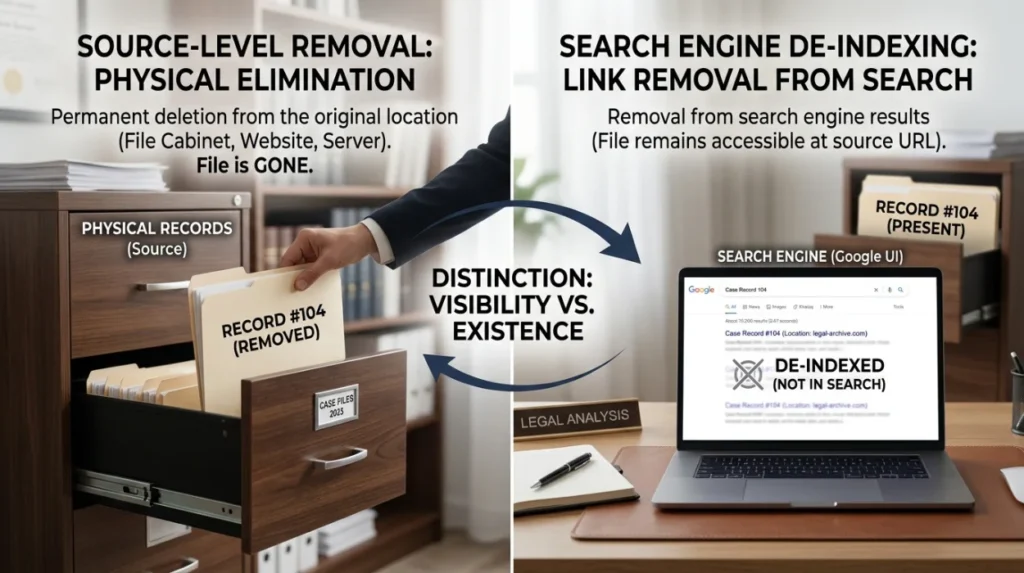
Source-level removal permanently eliminates the original published content, whereas search engine de-indexing removes or limits its appearance within search results while leaving the original webpage accessible through direct access methods. These methods operate independently and produce different effects on digital reputation.
Source-level removal is a content management process controlled by the website owner or publisher. It operates by deleting webpages, updating archives, correcting records, or restricting public access according to applicable legal or editorial requirements. Once removed from the source, search engines eventually recognise the absence of the content through crawling and indexing updates. This creates lasting changes in search visibility because the underlying webpage no longer contributes reputation signals.
Search engine de-indexing operates within the search platform rather than the publishing environment. Approved requests modify how specific URLs appear for relevant searches without changing the publisher’s records. Users accessing the webpage through direct links, archived references, or internal website navigation continue reaching the content if it remains online. Reputation management therefore addresses discoverability instead of publication.
Comparing these approaches demonstrates different strengths and limitations. Source-level removal produces stronger long-term effects because it removes the original information from the web ecosystem. De-indexing delivers faster changes to search visibility where policy requirements are satisfied, although the underlying content continues existing. Strategic evaluation therefore depends upon legal eligibility, publisher cooperation, and the desired impact on search ranking influence, entity credibility, and overall sentiment distribution.
Which Reputation Management Approach Provides More Sustainable Long Term Results?
Long-term reputation management is achieved through integrated strategies that combine lawful content removal, search visibility optimisation, and continuous digital footprint management. Sustainable outcomes depend on maintaining balanced reputation signals rather than relying on a single intervention.
Reactive reputation management focuses on addressing an existing issue after negative information appears in search results. It operates by responding to harmful content through removal requests, legal review, clarification content, or reputation recovery measures. Reactive approaches deliver immediate visibility improvements when clear eligibility criteria exist, although they remain dependent on external review processes and search engine policies.
Organic reputation management strengthens an entity’s digital presence before reputational issues become dominant. It operates by publishing authoritative content, improving structured entity associations, maintaining accurate online profiles, and encouraging balanced sentiment distribution across search ecosystems. Search engines interpret consistent authority and topical relevance as positive reputation signals, allowing trustworthy content to occupy stronger ranking positions over time.
Comparing reactive and organic approaches highlights differences in sustainability. Reactive methods resolve immediate visibility concerns but remain limited to individual pieces of content. Organic reputation management influences the broader entity profile, creating stronger search ranking influence across multiple queries. Combining both approaches establishes a balanced reputation framework because removal reduces existing exposure while ongoing optimisation strengthens future search visibility.
How Does Digital Footprint Optimisation Influence Court Record Visibility?
Digital footprint optimization improves search result composition by increasing the authority, relevance, and visibility of accurate digital assets associated with an individual or organisation. It operates by strengthening the overall entity profile rather than directly altering court records.
A digital footprint consists of every indexed webpage, profile, publication, directory listing, and publicly accessible reference connected to an entity. Search engines evaluate these assets collectively when determining relevance for branded and identity-based searches. Strong authority across trusted sources increases positive reputation signals and reduces reliance on isolated historical references.
Digital footprint optimization operates by improving information consistency, structured data, content quality, and entity relationships. Search engines analyse these elements to understand credibility and contextual relevance. As authoritative assets gain stronger ranking influence, the overall SERP composition becomes more balanced, allowing factual and current information to appear alongside or above historical records where algorithmically justified.
Comparing digital footprint optimization with direct removal strategies demonstrates different operational objectives. Removal focuses on reducing visibility of specific content, while optimisation strengthens the surrounding information ecosystem. Optimisation scales effectively because each authoritative asset contributes additional reputation signals that reinforce entity credibility across multiple search queries. This broader influence supports long-term search stability without depending solely on individual removal decisions.
How Can Court Record Removal Requests Be Evaluated Before Submission?
Effective evaluation begins with identifying the publication source, assessing legal eligibility, reviewing search engine policies, and analysing the potential impact on search visibility. Structured assessment improves the efficiency of reputation management while reducing unnecessary requests.
The evaluation process includes the following stages:
- Identify the original publishing source to determine whether removal, correction, or de-indexing represents the appropriate mechanism.
- Review the legal status of the court record, including whether it remains publicly relevant, has become outdated, or qualifies for privacy-based consideration.
- Compare publisher policies with search engine removal guidelines to identify the most appropriate submission pathway.
- Assess existing reputation signals and SERP composition to determine whether removal alone addresses the visibility issue or whether broader reputation management measures remain necessary.
- Monitor search indexing after submission to evaluate changes in ranking influence, entity credibility, and sentiment distribution.
Each stage operates independently while contributing to a comprehensive reputation management assessment. Source analysis determines available options, legal review establishes eligibility, and search evaluation measures expected outcomes. This structured framework enables objective decision-making based on measurable criteria rather than assumptions.
Comparing structured evaluation with isolated removal requests demonstrates greater efficiency and lower risk exposure. A complete assessment considers the entire search ecosystem, allowing reputation management strategies to address underlying visibility patterns instead of focusing exclusively on a single indexed page. This analytical approach supports sustainable search result improvements while maintaining accurate representation within search engines.
Requesting court record removal from search results involves evaluating legal eligibility, publication sources, search engine policies, and the broader reputation ecosystem rather than relying on a single removal method. Each approach operates through a different mechanism, producing distinct effects on search visibility, entity credibility, and sentiment distribution.
Content removal, search engine de-indexing, content suppression, and digital footprint optimization each contribute differently to reputation management. Removal strategies directly reduce the visibility of eligible information, while optimisation strengthens authoritative reputation signals across the wider search landscape. Comparing these methods demonstrates that long-term reputation management depends on balancing immediate visibility changes with sustained improvements in search ranking influence and digital authority.
Understanding how search engines interpret reputation signals, evaluate entity relationships, and measure content relevance provides a clearer basis for selecting an appropriate strategy. Evaluating legal status, publication control, scalability, sustainability, and search ecosystem impact allows informed decisions when addressing court records in search results.
Within broader discussions of legal eligibility and search visibility, topics relating to Remove Outdated Court Records From Search Results provide a practical extension for readers examining implementation-focused guidance.
Can court records be removed from Google search results?
Court records can be removed from Google search results if they meet specific legal or privacy criteria and comply with the search engine’s removal policies. Search result removal differs from deleting the original court record, which depends on the publishing source.
What is the difference between removing a court record and de-indexing it?
Removing a court record deletes the content from the original website, while de-indexing prevents the page from appearing in search engine results for relevant queries. De-indexing improves search visibility without altering the original publication.
How long does the court record removal process take?
The timeframe depends on the complexity of the request, the publisher’s response, and the search engine’s review process. Some requests are reviewed within weeks, while others require additional legal or administrative assessment.
Does removing a court record from search results erase the legal record?
No, removing a court record from search results does not erase the official legal record. It only affects how the information appears in search engines, while the original record remains subject to the publisher’s or court’s retention policies.
Why is it important to evaluate eligibility before requesting court record removal?
Evaluating eligibility helps determine whether a court record satisfies legal and search engine requirements for removal or de-indexing. As part of its informational resources, Clear Your Name explains that understanding these criteria supports a more accurate and efficient reputation management process.