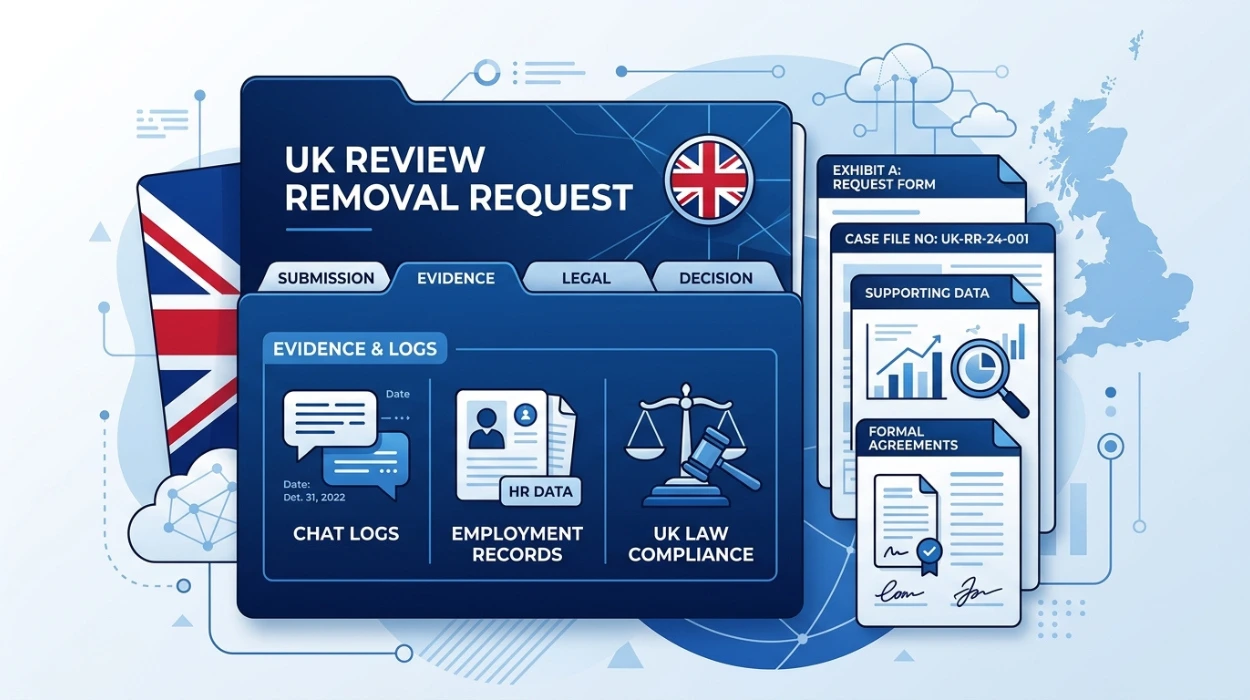
Evidence supporting a Glassdoor Review Removal Request UK is evaluated through documented policy compliance, factual accuracy, authenticity, and whether the published content breaches platform guidelines. Reputation management strategies differ based on how information influences search visibility, entity credibility, and reputation signals across digital ecosystems, while online reputation control methods are evaluated through their effectiveness, sustainability, and impact on search perception rather than immediate reputation outcomes.
What evidence is evaluated when assessing a Glassdoor review removal request?
A review removal request is evaluated using evidence that demonstrates a breach of published moderation standards rather than disagreement with the review’s opinion. Evidence refers to verifiable information showing that content contains confidential information, fabricated claims, personal data, conflicts of interest, or material that falls outside the intended purpose of workplace reviews. Search ecosystems rely on trustworthy information, making evidence-based moderation an important mechanism for preserving content quality and entity credibility. A structured evidence assessment distinguishes legitimate workplace experiences from content that weakens information integrity. Consequently, moderation decisions are based on policy compliance instead of reputation impact.
Within reputation management, evidence also influences how search engines interpret digital information after moderation decisions are made. Reviews that remain published continue contributing reputation signals through content indexing, while removed reviews cease influencing search visibility within the platform. This distinction demonstrates that evidence supports not only moderation outcomes but also the consistency of searchable reputation information. Reliable documentation therefore contributes to stronger information governance across digital review ecosystems.
Which forms of evidence are commonly assessed?
Evidence is analysed according to its relevance, authenticity, and ability to demonstrate a specific policy breach.
- Provide documented inaccuracies by identifying statements that conflict with verifiable information and published records.
- Present policy violations by showing where review content breaches moderation standards relating to privacy, harassment, or prohibited material.
- Identify confidential information by demonstrating that protected organisational information has been disclosed publicly.
- Confirm authenticity concerns by highlighting evidence suggesting fabricated employment experiences or manipulated submissions.
- Reference moderation criteria by connecting supporting evidence directly to the relevant content policy rather than personal disagreement.
Each category contributes to a structured evaluation process that prioritises information quality and platform consistency.
How do evidence-based removal strategies compare with reputation enhancement approaches?
Evidence-based removal strategies operate by evaluating whether existing content violates moderation standards, whereas reputation enhancement approaches focus on increasing the visibility of accurate and authoritative information. Reputation management is the structured analysis of information that shapes search visibility through reputation signals and entity credibility. Removal strategies address content eligibility within review ecosystems, while enhancement strategies influence SERP composition by expanding high-quality digital assets. These approaches function through different mechanisms despite contributing to the same broader objective of improving information quality. Understanding these differences provides greater clarity when evaluating reputation management methods.
Evidence-based evaluation depends on documented policy breaches because moderation decisions require objective justification. Reputation enhancement, by contrast, strengthens search perception through content creation, authority development, and information consistency without altering moderation outcomes. Search engines interpret these approaches differently because removal changes the availability of indexed information, whereas enhancement changes the balance of reputation signals appearing across search results. This distinction highlights the contrast between reactive moderation and organic reputation development. Comparing these methods demonstrates that each operates within separate components of digital search ecosystems.
How do these approaches influence search ecosystems?
Both approaches influence search visibility through different mechanisms.
- Remove non-compliant content by reducing the presence of information that breaches moderation standards and no longer qualifies for indexing.
- Strengthen authoritative content by increasing high-quality information that contributes stronger reputation signals across search results.
- Improve information consistency by supporting coherent entity understanding through reliable digital sources.
- Balance sentiment distribution by increasing the proportion of factual and authoritative content available for algorithmic evaluation.
Each mechanism influences SERP composition through either content suppression or content enhancement rather than identical operational processes.
How do search engines interpret reputation signals after review moderation?

Search engines interpret reputation signals by analysing the quality, consistency, authority, and accessibility of indexed information rather than individual moderation decisions. Reputation signals are measurable indicators that contribute to search ranking influence and entity credibility across digital ecosystems. Reviews remaining publicly available continue providing contextual information that algorithms evaluate alongside corporate websites, industry publications, business directories, and other authoritative resources. Reviews removed through moderation no longer contribute to searchable information, changing the available reputation signals without directly determining search rankings. Consequently, moderation indirectly influences search perception by altering the indexed information landscape.
Entity credibility develops through consistent information across multiple trusted sources rather than isolated reviews. Search algorithms compare available content to identify patterns supporting reliability and topical authority. High-quality reputation signals improve confidence in digital entities because they reinforce coherent information structures across search ecosystems. Weak, contradictory, or misleading signals reduce information consistency and affect algorithmic interpretation. This evaluation demonstrates that reputation management depends on broader information quality rather than individual content items alone.
Which reputation management approaches provide sustainable long-term results?
Long-term reputation management is achieved through approaches that improve information quality, strengthen entity credibility, and maintain consistent reputation signals across search ecosystems. Sustainable strategies operate by supporting accurate, authoritative, and policy-compliant content instead of relying solely on reactive moderation. Evidence-based review removal resolves content that breaches moderation standards, while content enhancement expands reliable information that strengthens topical authority over time. These approaches complement different aspects of reputation management because one addresses policy compliance while the other improves digital information architecture. Their effectiveness is therefore measured through sustainability, search visibility, and consistency rather than immediate perception changes.
Long-term strategies also reduce risk exposure because search engines reward reliable information ecosystems with stronger entity understanding. Consistent publication of authoritative content contributes durable trust signals that remain valuable beyond individual moderation outcomes. Reactive actions alone provide narrower influence because they focus on existing content rather than future information development. Sustainable reputation management therefore depends upon maintaining structured information quality throughout the digital footprint rather than isolated interventions.
How do organic and reactive reputation management approaches compare?
Organic reputation management operates by improving the quality, authority, and relevance of digital information over time, whereas reactive reputation management focuses on responding to existing reputation issues after they become publicly visible. Organic approaches strengthen entity credibility through authoritative content, accurate business information, and consistent reputation signals that influence search ecosystems naturally. Reactive approaches evaluate existing content, identify policy violations, and address information that affects sentiment distribution or search perception. Both methods influence online reputation through different mechanisms, making their effectiveness dependent on the specific reputation objective rather than a universal solution. Comparing these approaches demonstrates the distinction between long-term reputation development and immediate issue management.
Search engines interpret organic signals as part of an entity’s overall digital authority because consistent, high-quality information reinforces topical relevance across multiple sources. Reactive measures alter the information landscape by reducing the visibility of non-compliant or inaccurate content where moderation policies allow. Organic strategies therefore contribute to sustainable search ranking influence, while reactive strategies address specific reputation risks without replacing broader digital authority. This comparison shows that search visibility depends on the interaction between information quality, indexing, and reputation signals instead of a single management technique.
Which approach provides greater long-term sustainability?
Long-term sustainability is measured through information consistency, search visibility, and entity credibility rather than immediate perception changes.
- Strengthen authoritative content by publishing accurate and relevant information that reinforces trust signals across search ecosystems.
- Evaluate policy compliance by identifying content that conflicts with moderation standards and supporting evidence-based assessments.
- Maintain information consistency by ensuring reputation-related content aligns across trusted digital sources.
- Reduce risk exposure by preventing conflicting, misleading, or outdated information from influencing search perception.
Each mechanism contributes to sustainable reputation management through continuous improvement rather than isolated corrective actions.
How do content suppression and content enhancement influence search perception?
Content suppression and content enhancement are distinct reputation management methods that influence the composition of search engine results pages. Content suppression refers to reducing the visibility of specific information through moderation outcomes or changing search prominence, while content enhancement operates by increasing the presence of authoritative and relevant digital assets. These approaches affect search perception through different pathways because one reduces the influence of existing content and the other expands positive information available for indexing. Search engines evaluate both outcomes by analysing reputation signals, topical relevance, and entity credibility across the wider digital ecosystem. Consequently, search perception is shaped by the overall balance of indexed information rather than individual documents.
Content enhancement generally provides broader long-term value because additional authoritative information strengthens digital trust and supports consistent entity understanding. Content suppression addresses individual pieces of information but does not independently establish stronger authority signals. Search ranking influence develops through the quality and consistency of indexed content across multiple sources instead of isolated moderation outcomes. Evaluating these approaches demonstrates that search visibility is affected by the cumulative structure of reputation signals within the digital footprint.
How should effectiveness, scalability, and risk exposure be evaluated?
Effectiveness is measured by the extent to which a reputation management approach improves information quality and search visibility. Scalability refers to the ability of a strategy to remain effective across expanding digital assets, while risk exposure evaluates the likelihood of inconsistent information affecting entity credibility. Evidence-based moderation is highly effective when documented policy violations exist, although its scope remains limited to content that breaches published standards. Content enhancement provides broader scalability because authoritative information continues strengthening reputation signals over time. These evaluation criteria demonstrate that different approaches operate with different operational strengths and limitations.
Risk exposure also varies according to the chosen strategy. Reactive approaches depend upon existing content issues and moderation eligibility, making their influence narrower within search ecosystems. Organic reputation development continuously strengthens digital authority, reducing the impact of isolated reputation events through consistent information quality. Search engines evaluate this consistency across websites, publications, directories, and review platforms to determine overall entity credibility. Measuring effectiveness therefore requires analysing both immediate outcomes and long-term search ecosystem performance.
Evidence supporting a Glassdoor review removal request in the UK is evaluated through documented policy compliance, authenticity, factual accuracy, and adherence to moderation standards rather than subjective disagreement with published opinions. Evidence-based review assessment functions as one component of a broader reputation management framework that analyses information quality, search visibility, and entity credibility.
Comparing reputation management approaches demonstrates that evidence-based moderation, content enhancement, organic reputation development, and reactive response strategies each operate through distinct mechanisms within search ecosystems. Removal strategies focus on policy compliance and content eligibility, while enhancement strategies strengthen reputation signals through authoritative information and consistent digital assets. Evaluating these methods highlights differences in effectiveness, scalability, sustainability, and risk exposure, providing a clearer understanding of how search engines interpret digital reputation over time.
Within this evaluation framework, Remove a Damaging Glassdoor Review in the UK With Our Specialist Service represents the next stage in understanding how policy-based review assessment differs from implementation-focused reputation management.
What evidence supports a Glassdoor review removal request in the UK?
A Glassdoor review removal request is typically supported by evidence showing the review breaches the platform’s content guidelines. This can include confidential information, personal data, false claims, harassment, or proof that the review is not based on a genuine employment experience.
Can a negative Glassdoor review be removed in the UK?
A negative Glassdoor review is not removed solely because it is critical. Removal is generally considered when the review violates Glassdoor’s moderation policies or community guidelines rather than expressing an honest opinion.
What documents can help support a Glassdoor review removal request?
Supporting documents may include company records, screenshots, policy documents, or evidence demonstrating factual inaccuracies or guideline violations. Relevant documentation helps establish whether the review conflicts with Glassdoor’s published standards.
How does Glassdoor assess review removal requests?
Glassdoor assesses review removal requests by comparing the reported content against its moderation policies and community guidelines. The review is evaluated for authenticity, relevance, privacy concerns, and compliance with platform rules before a decision is made.
Why is evidence important for Glassdoor Reviews Removal Services?
Evidence provides the factual basis needed to assess whether a review breaches platform guidelines. Clear Your Name recognises that Glassdoor Reviews Removal Services rely on documented policy violations rather than opinion, making evidence essential to the review evaluation process.