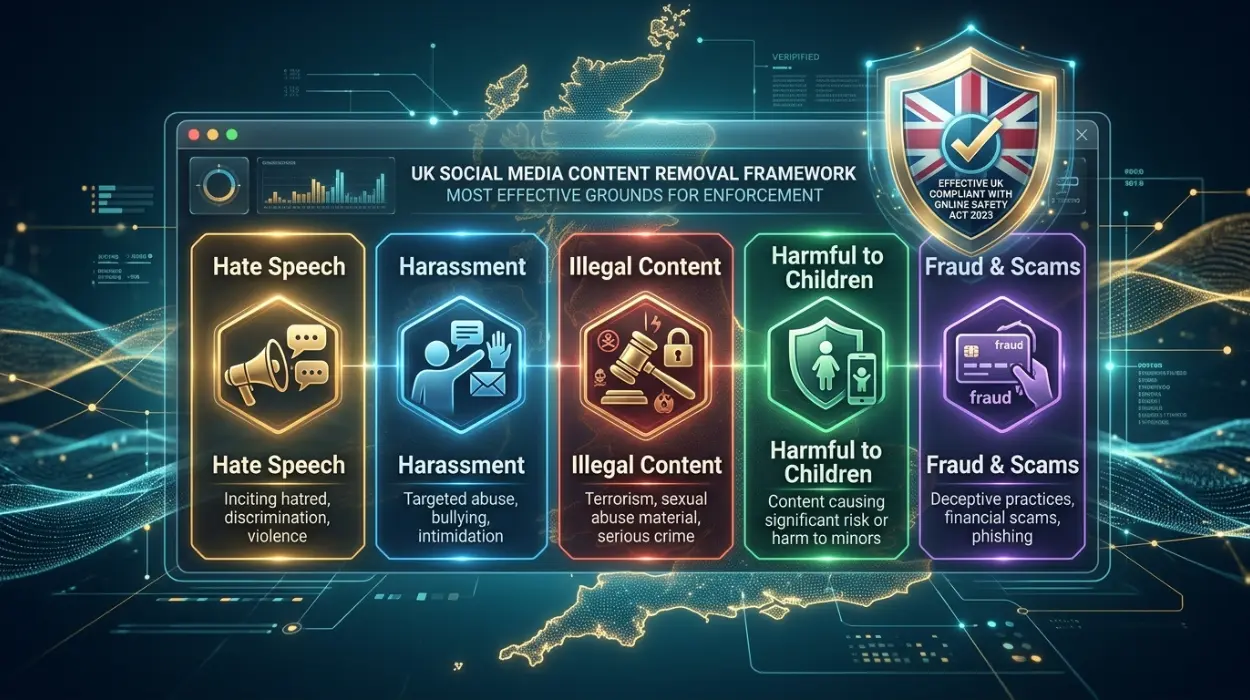
The most effective grounds for social media content removal in the UK are privacy violations, defamation, copyright infringement, impersonation, harassment, and breaches of platform community standards. The effectiveness of each ground depends on the evidence available, the platform’s moderation framework, and the relationship between the content and applicable legal or policy requirements.
Reputation management strategies differ based on the type of harmful information, the source of publication, and the level of search visibility associated with the content. Online reputation control methods are evaluated through their influence on reputation signals, entity credibility, search ranking influence, and long-term changes to digital perception.
Which legal grounds are the strongest for social media content removal in the UK?
Privacy violations and intellectual property infringements generally provide the strongest basis for content removal because they rely on clearly defined legal frameworks and platform reporting mechanisms. Social media platforms maintain dedicated procedures for handling reports involving personal information, copyrighted material, and impersonation.
Privacy infringement is the unauthorised disclosure of personal information or imagery that interferes with an individual’s reasonable expectation of privacy. This ground operates by demonstrating that the content exposes sensitive information without lawful justification. Platforms often respond quickly to privacy complaints because retaining such content increases legal and regulatory risk.
Copyright infringement refers to the unauthorised use or distribution of protected works. It operates by allowing rights holders to identify specific material that violates ownership rights. Copyright complaints frequently produce predictable moderation outcomes because platforms maintain established notice-and-takedown systems.
Defamation is also a recognised ground, but its effectiveness depends on proving that the information is false and harmful to reputation. Unlike copyright claims, defamation assessments often require contextual analysis and therefore involve more complex review processes.
How effective are community guideline violations compared with legal claims?
Community guideline violations often produce faster moderation outcomes than legal claims because platforms enforce their internal standards independently of court processes. The effectiveness of these violations depends on whether the reported content clearly breaches published rules.
How do platform policy breaches operate?
Platform policy breaches operate by comparing content against categories such as harassment, hate speech, impersonation, misinformation, and abusive conduct. Automated moderation systems and human reviewers evaluate whether the content falls within prohibited behaviours.
Community standard violations provide a practical route for removing harmful content because the threshold for action is frequently lower than the threshold required for legal proceedings. However, these removals depend entirely on platform interpretation and can vary between services.
How do legal claims differ?
Legal claims rely on statutory rights and recognised legal principles. They require evidence that demonstrates infringement, unlawful conduct, or reputational harm. While they often involve greater procedural complexity, legal grounds generally create stronger obligations for platforms to review and respond to complaints.
From a reputation management perspective, community guideline violations provide speed, whereas legal claims provide authority and greater long-term reliability.
Which content removal grounds have the greatest impact on online reputation?
Defamatory content, impersonation, and privacy breaches have the greatest impact on online reputation because they directly influence entity perception and sentiment distribution. Search engines and social platforms interpret highly visible negative information as part of an entity’s digital footprint.
Defamatory statements alter public interpretation by associating entities with inaccurate or misleading information. Impersonation damages credibility by creating confusion about identity and authenticity. Privacy breaches expose personal information that can affect trust signals and increase reputational vulnerability.
The removal of these categories changes the information environment surrounding an entity. Reduced visibility of harmful material influences search ranking composition and alters the balance of reputation signals available to users and search engines.
How does defamation compare with privacy infringement as a removal ground?
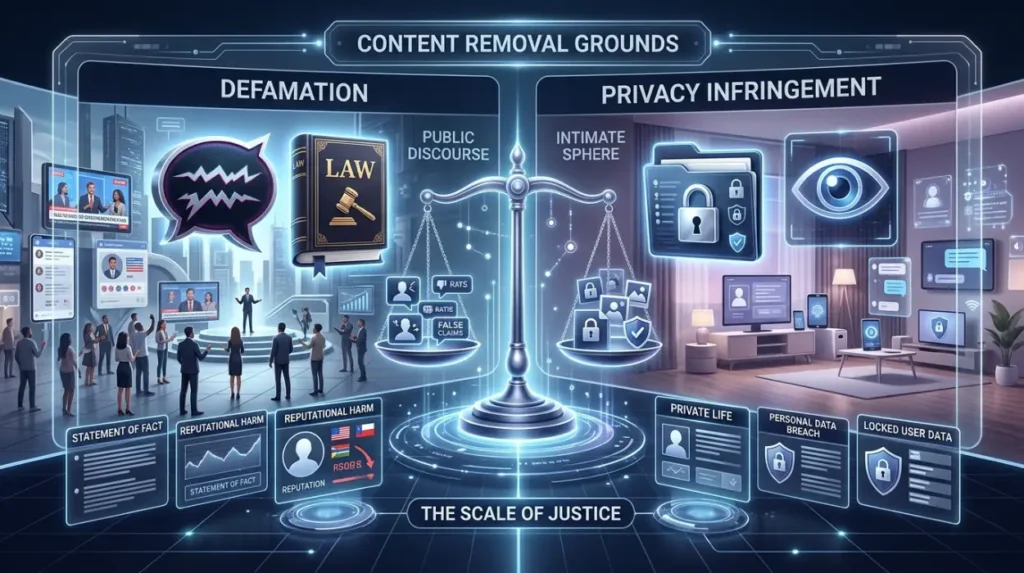
Defamation and privacy infringement address different forms of reputational harm. Defamation focuses on false information that damages reputation, whereas privacy infringement concerns the unauthorised disclosure of personal information.
Defamation operates through the correction or removal of inaccurate statements that negatively influence perception. The assessment process requires examination of truth, context, and reputational damage. This complexity often makes defamation claims slower to resolve.
Privacy infringement operates by establishing that the information was disclosed without a legitimate basis. The evaluation process is generally more straightforward because it focuses on the nature of the information and the absence of consent.
From an effectiveness perspective, privacy claims frequently produce faster moderation outcomes, while defamation claims address broader reputational damage and the correction of inaccurate narratives.
Are copyright complaints more effective than reputation-based complaints?
Copyright complaints are generally more predictable because they rely on identifiable ownership rights and formal takedown procedures. Reputation-based complaints often require contextual evaluation and interpretation of harm.
Copyright removal operates by identifying specific content that infringes protected works. Platforms maintain dedicated systems for processing these claims because intellectual property rights are clearly defined and internationally recognised.
Reputation-based complaints involve greater complexity because harmful content can remain lawful and still influence public perception. The distinction demonstrates the difference between rights-based enforcement and reputation management objectives.
The comparative analysis shows that copyright complaints offer procedural efficiency, while reputation-based complaints focus on reducing negative sentiment and improving entity credibility.
How do different removal grounds influence search visibility?
Different removal grounds influence search visibility by changing the availability of content that contributes to search indexing and reputation signals. Search engines evaluate information based on accessibility, authority, and user engagement.
Removing defamatory or misleading content reduces the visibility of negative references and alters sentiment distribution. The reduction of harmful information changes how entities are represented within search ecosystems.
Removing privacy-related content limits the accessibility of personal information and reduces the risk of harmful associations. Copyright removals eliminate unauthorised material that may compete with legitimate information sources.
These outcomes demonstrate that content removal is closely connected to search ranking influence and the management of digital footprints.
Which approach offers the most sustainable reputation outcomes?
The most sustainable reputation outcomes emerge from combining reactive content removal with broader reputation management strategies that influence the composition of online information. Content removal addresses immediate risks, while long-term reputation management focuses on the overall balance of search results and credibility signals.
Content suppression vs content enhancement represents two distinct approaches. Content suppression reduces the prominence of harmful information, while content enhancement increases the visibility of positive and authoritative material.
Search engines evaluate entities through cumulative signals rather than isolated content pieces. Therefore, sustainable reputation outcomes depend on both reducing harmful content and maintaining a balanced information ecosystem.
Within this evaluation framework, organisations and individuals frequently examine approaches such as Remove Harmful Social Media Content in the UK With Our Expert Takedown Team when considering direct interventions designed to reduce harmful online material.
The most effective grounds for social media content removal in the UK depend on the nature of the content and the mechanisms available for challenging it. Privacy violations and copyright infringement generally provide predictable outcomes, while defamation and community guideline breaches require more contextual assessment.
Different removal grounds influence reputation signals, entity credibility, and search visibility in distinct ways. Evaluating these approaches requires consideration of effectiveness, procedural complexity, sustainability, and their impact on long-term digital perception.
What are the most effective grounds for social media content removal in the UK?
The strongest grounds for social media content removal in the UK are privacy violations, copyright infringement, impersonation, defamation, and breaches of platform community standards. These categories are commonly recognised by social media platforms and often have established reporting procedures.
Can defamatory posts be removed from social media in the UK?
Defamatory posts can be removed if the content contains false statements that damage a person’s or organisation’s reputation. Platforms may review the claim against their policies, while legal considerations can also influence the removal process.
Is copyright infringement a strong reason to request social media content removal?
Copyright infringement is one of the most effective grounds because social media platforms have dedicated notice-and-takedown systems for intellectual property disputes. Rights holders can report unauthorised use of protected content and request its removal.
How do privacy breaches affect social media content removal requests?
Privacy breaches involving personal information, private images, or sensitive data often receive priority review because they can create legal and reputational risks. Removing this content can reduce harmful exposure and limit negative reputation signals.
What role do Social Media Content Removal Services play in reputation management?
Social Media Content Removal Services focus on identifying the most appropriate grounds for requesting the removal of harmful or unlawful content. Their role within reputation management is to evaluate content issues and understand how online information influences search visibility and digital perception, including approaches discussed by Clear Your Name.