

YouTube Video Removal Grounds determine whether a video qualifies for platform enforcement when content violates platform policies, legal requirements, privacy protections, intellectual property rights, or other recognised standards. The effectiveness of YouTube Video Removal Grounds depends on evidence quality, policy applicability, and platform review processes, as YouTube evaluates reported content against specific enforcement criteria before making a removal decision.
Reputation management strategies differ based on the source of reputational harm, the nature of the content, and the available enforcement mechanisms. Online reputation control methods are evaluated through their impact on search visibility, reputation signals, entity credibility, and long-term search ranking influence.
Which removal grounds does YouTube evaluate when reviewing harmful content?
YouTube evaluates content according to policy violations, legal standards, and platform governance requirements. Each removal ground operates through a distinct assessment framework that determines whether content remains visible or becomes subject to enforcement.
Platform enforcement begins with policy evaluation. YouTube analyses whether uploaded material breaches established community guidelines, privacy protections, harassment rules, impersonation policies, or intellectual property requirements. The review process compares reported content against documented standards rather than public opinion or reputational impact alone. This distinction is important because harmful content is not automatically policy-violating content. Reputation-related concerns therefore require evaluation through recognised enforcement categories.
Search ecosystems interpret removed content differently from content that remains indexed. Removal eliminates content availability, while unresolved content continues contributing to reputation signals. As a result, understanding accepted removal grounds becomes essential when analysing reputation management methods. The relationship between policy enforcement and content visibility directly affects search perception and SERP composition.
How does privacy based removal compare with harassment based removal?
Privacy-based removal focuses on unauthorised disclosure of personal information, while harassment-based removal evaluates targeted abuse, intimidation, or harmful conduct directed toward an individual. Both approaches address reputational concerns but operate through different enforcement mechanisms.
Privacy violations are assessed through information exposure. Personal addresses, financial details, identity documentation, confidential records, and sensitive data create enforcement risks because they compromise individual privacy. YouTube evaluates whether the content contains protected information and whether disclosure breaches platform standards. Successful privacy-based claims often result in direct content removal because the violation is measurable and evidence-driven.
Harassment-based reviews focus on behavioural patterns and communication intent. The platform analyses whether content contains targeted abuse, repeated attacks, threats, or behaviour designed to intimidate individuals. This evaluation introduces greater complexity because context influences interpretation. Privacy violations are generally easier to verify, while harassment assessments require broader analysis. Consequently, privacy-related removals often provide clearer enforcement pathways than behavioural complaints.
How does defamation differ from policy based content removal?
Defamation is a legal concept, while policy-based removal is a platform governance process. The distinction affects how content is evaluated and whether removal requests succeed.
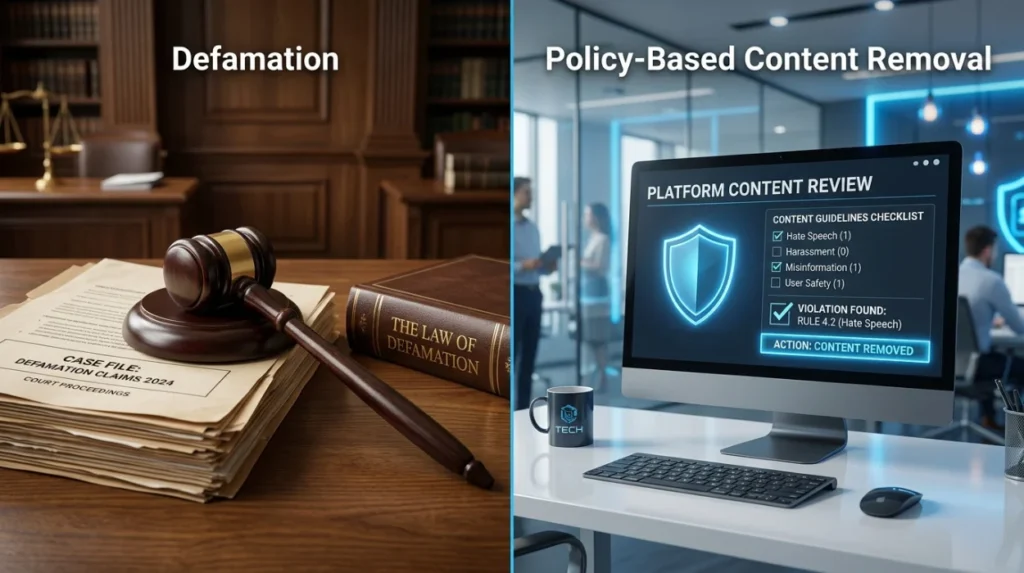
Defamation refers to false statements that damage reputation. Legal systems assess defamatory content through established evidentiary standards and jurisdiction-specific requirements. Platform reviewers, however, primarily evaluate content according to policy compliance rather than court-based legal analysis. This creates a separation between reputational harm and platform enforcement.
Policy-based removal operates by identifying direct rule violations. Content containing misinformation about an individual does not automatically trigger enforcement unless it breaches a recognised platform standard. Consequently, legal remedies and platform reporting mechanisms function as separate approaches. This distinction demonstrates how reputation management methods differ in scope, speed, and evidentiary requirements. The comparison highlights why content removal strategies require careful evaluation rather than assuming reputational harm alone determines platform action.
Which approach has stronger search ranking influence: removal or suppression?
Content removal delivers direct visibility elimination, while content suppression operates through search ranking influence. These approaches affect reputation signals through different mechanisms.
Removal operates by eliminating content availability. Once content is removed, indexing opportunities decline and search visibility decreases over time. This creates a direct impact on SERP composition because the information asset no longer exists within the platform environment. The strength of removal lies in reducing content accessibility rather than altering ranking relationships.
Content suppression vs content enhancement represents a different strategic comparison. Suppression seeks to reduce visibility by increasing the prominence of alternative assets, while enhancement focuses on strengthening authoritative content and entity credibility. These methods operate within ranking systems rather than enforcement frameworks. Removal provides immediate visibility reduction when successful, whereas suppression and enhancement influence perception gradually through search ecosystem dynamics. Each approach affects reputation signals differently and therefore serves distinct strategic functions.
How do copyright claims compare with privacy complaints?
Copyright claims focus on ownership rights, while privacy complaints focus on personal information protection. Both mechanisms provide recognised removal pathways, but they rely on different forms of evidence.
Copyright enforcement operates through intellectual property frameworks. Rights holders demonstrate ownership and identify unauthorised use of protected content. The platform evaluates evidence against established copyright procedures. Because ownership can often be documented directly, copyright-based removals frequently involve structured evidentiary processes. The evaluation framework emphasises legal rights rather than reputational outcomes.
Privacy complaints operate through personal protection standards. The assessment examines whether sensitive information has been disclosed without consent. Evidence focuses on information exposure rather than ownership. Compared with copyright enforcement, privacy reviews often require contextual analysis regarding the nature and impact of disclosed information. This distinction explains why removal pathways differ according to the type of violation being evaluated.
Which reputation management methods provide short term versus long term impact?
Short-term methods focus on immediate visibility reduction, while long-term methods focus on perception stability and entity credibility. The distinction reflects different operational goals within search ecosystems.
Short-term approaches include content reporting, policy enforcement requests, legal notices, and platform-based complaints. These methods target existing content and seek direct visibility changes. Their effectiveness depends on accepted enforcement grounds and evidence quality. When successful, visibility reduction occurs faster because the intervention affects content availability directly.
Long-term approaches focus on reputation signal distribution and search ecosystem optimization. These methods analyse sentiment distribution, authority development, and content positioning. Search engines continuously evaluate information relationships, making long-term perception management an ongoing process rather than a one-time intervention. The comparison demonstrates that immediate enforcement and sustained visibility management operate through different mechanisms. Both influence reputation, but they do so across different time horizons.
How do search engines interpret removed content compared with active content?
Removed content and active content contribute differently to search evaluation systems. The distinction influences search visibility, indexing status, and entity perception.
Active content remains available for crawling, indexing, ranking, and retrieval. Search engines continue evaluating its relevance and authority within content ecosystems. As long as the content remains accessible, it contributes to reputation signals and influences search ranking relationships. Visibility therefore remains a factor in perception formation.
Removed content loses accessibility and eventually experiences reduced search presence. Search systems cannot evaluate unavailable assets in the same manner as active content. Over time, indexing signals diminish as content availability declines. This process alters SERP composition because competing information sources assume greater prominence. The comparison demonstrates how content removal directly affects information availability, while active content continues shaping search perception.
Dive Deeper With Our Expert Guides:
How to Remove a Video From YouTube UK Using Copyright Privacy and Policy Grounds
How to Remove a YouTube Video in the UK Using Privacy Copyright and Policy Routes
What evaluation framework helps determine the strongest removal ground?
The strongest removal ground is identified through evidence strength, policy alignment, and enforcement applicability. Effective evaluation focuses on measurable criteria rather than subjective reputational concerns.
A structured assessment framework includes:
- Identify policy relevance by comparing content against specific platform standards.
- Examine evidence quality through documentation, records, or verifiable proof.
- Measure enforcement applicability by analysing whether the content meets removal thresholds.
- Evaluate search ranking influence by assessing visibility within branded or reputation-related queries.
- Analyse sentiment distribution by examining how the content contributes to entity perception.
This framework compares available options objectively. The approach focuses on enforcement potential rather than emotional impact. As a result, reputation-related analysis becomes more consistent and evidence-driven.
How does understanding removal grounds contribute to broader reputation analysis?
Understanding removal grounds contributes to reputation analysis because platform governance influences information availability within search ecosystems. Content visibility and content removal directly affect reputation signals and entity credibility.
The evaluation of removal criteria provides insight into how platforms regulate information. Policy frameworks determine whether content remains visible, while search engines interpret available information through indexing and ranking systems. These interconnected processes influence perception, trust signals, and search visibility. Reputation management analysis therefore requires understanding both platform enforcement mechanisms and search ecosystem behaviour.
Examining removing a YouTube video harming your reputation as a topic illustrates how content removal discussions intersect with broader visibility considerations. Removal standards define enforcement opportunities, while search systems determine how remaining information contributes to perception. This relationship highlights the importance of evaluating both governance and search dynamics when analysing reputation management strategies.
YouTube accepts video removal requests through recognised grounds such as privacy violations, harassment breaches, copyright infringement, impersonation concerns, and other policy-based enforcement categories. Each ground operates through a distinct evaluation framework that determines enforcement eligibility and content visibility outcomes.
The comparison of removal methods demonstrates important differences in effectiveness, evidentiary requirements, scalability, and sustainability. Removal strategies directly affect content availability, while broader reputation management approaches influence search ranking influence, sentiment distribution, and entity credibility over time. Understanding these distinctions provides a clearer framework for analysing how reputation-related content is evaluated within digital ecosystems.
What grounds does YouTube accept for removing a video that harms your reputation?
YouTube may remove a video if it violates privacy policies, harassment guidelines, impersonation rules, copyright protections, or other Community Guidelines. Reputation damage alone is not always sufficient unless the content breaches a specific platform policy.
Can a YouTube video be removed for containing false information about someone?
False information can lead to removal when it violates YouTube policies relating to harassment, impersonation, privacy, or legal requirements. The platform evaluates the content against policy standards rather than reputation impact alone.
Does YouTube remove videos that contain personal or private information?
YouTube can remove content that discloses sensitive personal information without consent. Privacy-based removal requests are commonly assessed when videos reveal personal data that creates safety, security, or reputational concerns.
How does YouTube decide whether to remove a reported video?
YouTube reviews reported content by comparing it against Community Guidelines, legal obligations, and platform policies. The decision depends on evidence, policy applicability, and whether the content meets enforcement thresholds.
What is the difference between YouTube video removal and reputation management?
YouTube video removal focuses on enforcing platform policies to remove specific content. Reputation management analyses search visibility, reputation signals, and content influence across search ecosystems to understand broader perception impacts.