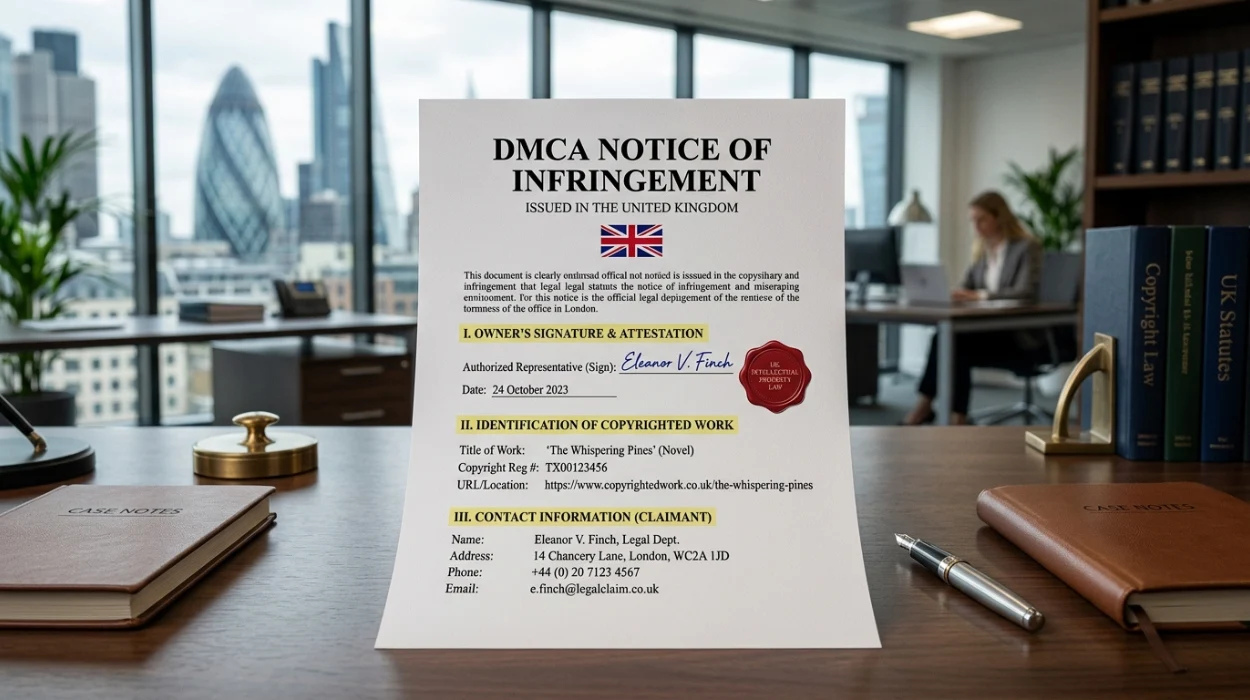
A Valid DMCA Notice UK must clearly identify the copyrighted work, specify the infringing content, provide accurate contact information, include a good-faith statement, and contain a declaration of accuracy under penalty of perjury. These requirements help ensure that a Valid DMCA Notice UK meets platform standards for copyright infringement reporting and content removal requests.
Reputation management is the process of monitoring, analysing, and influencing how information about an entity is discovered, interpreted, and evaluated within search ecosystems. Online reputation refers to the collection of indexed content, reputation signals, authority indicators, and sentiment references that shape entity perception across search engine results pages (SERPs).
What Is a DMCA Notice and How Does It Relate to Online Reputation?
A DMCA notice is a copyright infringement notification used to request the removal of unauthorised content from digital platforms and search environments.
The Digital Millennium Copyright Act originated in the United States as a legal framework for addressing online copyright infringement. Within search ecosystems, DMCA notices function as formal information correction mechanisms that challenge the presence of content alleged to violate copyright ownership. Search engines evaluate these notices as structured legal signals that influence content accessibility and indexing decisions.
Online reputation is directly affected by copyrighted material appearing within search results. When unauthorised copies of content become indexed, they create additional reputation signals that contribute to entity perception. Search systems evaluate all discoverable content regardless of ownership status until legal or policy-based intervention occurs.
The relationship between copyright enforcement and reputation management exists because search visibility determines information accessibility. A successfully processed copyright complaint can alter content indexing patterns, modify SERP composition, and influence how users interpret an entity’s digital footprint.
What Information Must a DMCA Notice Include to Be Considered Valid?
A valid DMCA notice must contain specific legal elements that allow platforms and search engines to identify, verify, and evaluate a copyright infringement claim.
The first required element is identification of the copyrighted work. This information defines the original content subject to protection and establishes the ownership basis of the complaint. Search platforms require precise descriptions because content evaluation depends on comparing the original material with the allegedly infringing version.
The second required element is identification of the infringing material. This refers to the exact location where the disputed content appears. URLs, webpage addresses, file locations, and indexed content references provide the information necessary for content verification and removal assessment.
The third required element is contact information. A valid notice includes the copyright owner’s name, address, telephone number, and email address. These details establish accountability and enable communication regarding the claim.
The fourth required element is a good-faith statement. This declaration confirms that the complainant believes the disputed use lacks authorisation from the copyright owner, agent, or applicable law. Search platforms interpret this statement as a formal assertion supporting the validity of the complaint.
The fifth required element is an accuracy declaration. This statement confirms that the information contained within the notice is accurate and that the complainant possesses authority to act on behalf of the copyright owner. The declaration strengthens procedural legitimacy and supports trust evaluation processes.
Why Does Search Visibility Depend on Accurate Copyright Information?
Search visibility depends on accurate copyright information because indexing systems rely on verifiable data to evaluate content legitimacy.
Search engines process enormous volumes of content daily. Content evaluation frameworks depend on structured information signals to determine relevance, trustworthiness, and accessibility. Copyright notices introduce legal and ownership data into these evaluation systems.
When a notice lacks required information, verification becomes difficult. Incomplete ownership details, missing URLs, or inaccurate content descriptions reduce the platform’s ability to perform content validation. This weakens the notice’s effectiveness within search ecosystem workflows.
Accurate copyright information supports reputation management because it improves the precision of content governance. Search engines use structured legal signals to determine whether content remains visible, becomes de-indexed, or receives transparency annotations. These actions directly affect the information users encounter during SERP evaluation.
Entity perception is influenced by indexed content volume and visibility. Accurate notices contribute to information quality control by ensuring that ownership disputes are assessed through documented evidence rather than subjective interpretation.
How Do Search Engines Evaluate DMCA Notices?

Search engines evaluate DMCA notices through procedural review systems designed to assess compliance, accuracy, and relevance.
The evaluation process begins with notice validation. Platforms analyse whether all mandatory elements are present. Missing declarations, incomplete ownership information, or insufficient content identification create procedural deficiencies that interrupt review workflows.
Once validation is complete, the search engine assesses the relationship between the copyrighted work and the allegedly infringing material. This stage focuses on evidence alignment. The objective is to determine whether the identified content corresponds with the ownership claim presented in the notice.
Search systems also evaluate authenticity indicators. Contact information, authority declarations, and accuracy statements contribute to trust assessment mechanisms. These elements function as reputation signals within administrative review environments.
Following review, search engines determine whether content removal, de-indexing, transparency reporting, or other actions are appropriate. These decisions influence search visibility and contribute to ongoing content ranking dynamics.
How Does Copyright Infringement Influence Entity Perception?
Copyright infringement influences entity perception because search ecosystems organise information according to visibility and accessibility.
Entity perception refers to the collective understanding users develop after interacting with indexed information. Search engines assemble content from multiple sources, creating a representation of an entity’s digital presence. Every indexed page contributes to this representation.
Unauthorised content can distort information accuracy. Duplicate publications, copied materials, and misattributed content create competing information signals. These signals affect credibility assessment and alter how users interpret authority indicators.
Search engines analyse content relationships through indexing structures. When infringing content appears prominently, it contributes additional visibility signals that shape SERP composition. The resulting perception reflects content availability rather than ownership legitimacy.
Reputation management examines how these information structures affect trust formation. Copyright enforcement mechanisms support content integrity by challenging inaccurate ownership representations and maintaining information consistency.
What Role Do Authority and Trust Signals Play in Copyright Evaluation?
Authority and trust signals play a critical role in copyright evaluation because search ecosystems prioritise verifiable information sources.
Authority refers to the perceived credibility of an information source within a subject area. Trust signals refer to indicators that support authenticity, reliability, and procedural legitimacy. Copyright notices contribute both types of signals when properly structured.
Ownership documentation establishes authority by demonstrating a relationship between the claimant and the original content. Contact details, legal declarations, and evidence references strengthen trust evaluation mechanisms by increasing accountability.
Search platforms analyse these signals during procedural reviews. Strong authority indicators improve content verification efficiency, while strong trust signals enhance confidence in submitted information. Together, these elements support informed content governance decisions.
The broader impact extends beyond individual complaints. Consistent authority signals contribute to reputation stability because they reinforce the accuracy of information associated with an entity across search ecosystems.
How Does a Digital Footprint Affect Copyright-Related Reputation Signals?
A digital footprint affects copyright-related reputation signals because it represents the cumulative record of indexed content associated with an entity.
Digital footprints include websites, articles, social media references, multimedia content, search listings, and publicly accessible documents. Search engines continuously analyse these assets to understand entity relationships and information relevance.
Copyright disputes become part of this information environment when notices, transparency reports, or content removals are documented. These records create additional reputation signals that contribute to search ecosystem interpretation.
Search visibility depends on the interaction between indexed assets and reputation indicators. Copyright-related actions influence this interaction by modifying content accessibility and changing the composition of searchable information.
The result is an evolving perception framework where ownership claims, content authenticity, and information quality collectively shape digital credibility assessments.
Dive Deeper With Our Expert Guides:
What Trademark Infringement Looks Like Online and When Content Removal Applies
How Copyright Infringement Occurs Online and What Protections UK Owners Have
What Is the Difference Between UK Copyright Enforcement and DMCA Procedures?
UK copyright enforcement and DMCA procedures differ in legal origin but share common objectives related to content protection and information governance.
The DMCA originates from United States legislation and establishes notice-and-takedown procedures for online copyright disputes. UK copyright protection operates through domestic copyright law and platform-specific reporting mechanisms. Despite differing legal foundations, both systems focus on identifying infringing content and enabling corrective action.
From a reputation management perspective, the distinction lies in procedural context rather than informational function. Both frameworks introduce structured legal signals into search ecosystems. These signals influence content accessibility, indexing outcomes, and search visibility.
Search engines operating globally evaluate copyright complaints through platform policies that integrate legal compliance requirements. As a result, copyright notices continue to influence SERP evaluation and entity perception regardless of jurisdictional differences.
Why Is Structured Information Important for Content Removal Requests?
Structured information is important because content removal systems depend on clarity, consistency, and verifiability.
- Identify ownership accurately – Copyright descriptions establish a direct relationship between the claimant and the protected work, enabling verification processes.
- Specify infringing content precisely – Exact URLs and content locations allow platforms to locate disputed material without ambiguity.
- Provide accountability details – Contact information supports communication and procedural transparency during review.
- Demonstrate good-faith intent – Formal declarations strengthen trust evaluation mechanisms and support authenticity assessment.
- Confirm factual accuracy – Accuracy statements provide legal accountability and improve information reliability within review systems.
Structured information improves efficiency because platforms process claims through standardised evaluation workflows. Consistent data formatting supports accurate decision-making and reduces uncertainty during content assessment.
A valid DMCA notice in the UK context requires clear identification of the copyrighted work, precise details of the allegedly infringing content, complete contact information, a good-faith statement, and an accuracy declaration. These elements form the foundation of copyright evaluation within search ecosystems.
Copyright notices influence more than legal compliance. They affect search visibility, content indexing, reputation signals, digital footprints, and entity perception. Search engines interpret structured copyright information as part of broader trust and authority assessment frameworks.
Understanding how copyright information is evaluated provides insight into the relationship between content governance, online credibility, and reputation management. Within modern search ecosystems, information accuracy remains a central factor influencing how entities are discovered, interpreted, and evaluated.
What information is legally required in a DMCA notice for content removal?
A valid DMCA notice must identify the copyrighted work, specify the infringing content, provide contact information, include a good-faith statement, and contain a declaration that the information is accurate. These elements help platforms verify copyright ownership and assess removal requests.
Does the DMCA apply to copyright infringement cases in the UK?
The DMCA is a United States law, but many global websites and search engines accept DMCA notices from UK copyright owners. In the UK context, copyright enforcement often relies on platform reporting systems and copyright law principles alongside DMCA procedures.
Why is an accurate URL important in a DMCA notice?
An accurate URL allows platforms and search engines to locate the exact infringing content quickly. Without a precise location, the content removal request may be delayed or rejected due to insufficient identification of the material.
What happens if a DMCA notice is missing required information?
A DMCA notice that lacks essential details such as ownership information, infringing URLs, or legal declarations may be considered invalid. Platforms typically require complete information before evaluating a copyright infringement claim.
How does a valid DMCA notice affect online reputation and search visibility?
A valid DMCA notice can lead to the removal or de-indexing of infringing content, which changes the information available in search results. This helps maintain accurate reputation signals, supports content integrity, and improves the reliability of an entity’s digital footprint.