
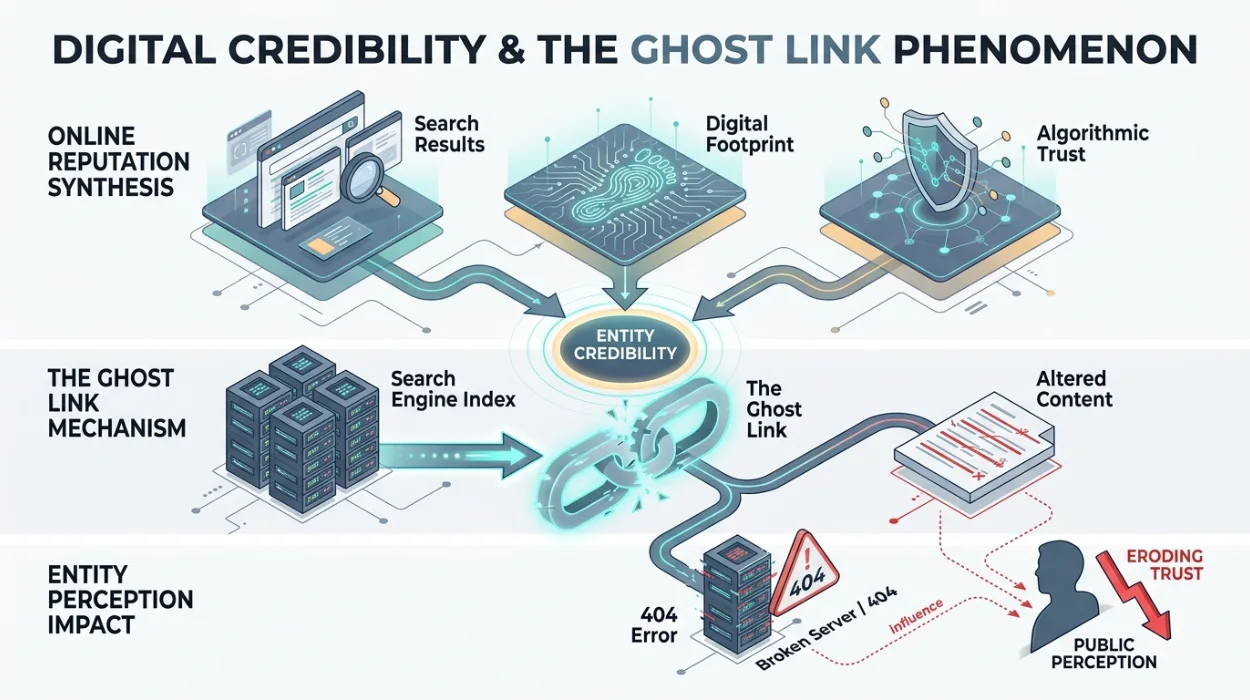
Online reputation refers to the collective synthesis of search results, digital footprints, and algorithmic trust signals that define an entity’s credibility within digital ecosystems. A ghost link is an indexed web address or hyperlink that points to a webpage that no longer exists, contains altered content, or resolves to a broken server, yet continues to appear within search engine results pages (SERPs) and influence entity perception.
What Is a Ghost Link in Search Ecosystems?
A ghost link refers to an orphaned or cached URL that persists in search engine indexes despite the underlying source document being moved, deleted, or fundamentally altered. Within search architecture, crawling engines discover web content through hyperlinks, storing snapshots of pages in distributed databases known as search caches. When a publisher removes a document or modifies a server path without issuing appropriate HTTP status codes, a disconnect emerges between the index and the live web.
The underlying mechanism of a ghost link relies on the lag between content deletion and index reconciliation. Search engines process billions of URLs daily, utilizing asynchronous crawling schedules based on domain authority, page change frequency, and crawl budget allocation. Pages on low-frequency crawl schedules retain their cached state long after live source modification. Consequently, search engines continue to serve these dead URLs to users, presenting legacy titles, metadata snippets, and cached text as active representations of the entity.
Ghost links disrupt search visibility by creating discrepancies between current entity reality and historical index records. When algorithms evaluate an entity’s digital footprint, persistent ghost links retain historical sentiment, outdated disclosures, or superseded regulatory information. These orphaned entry points undermine technical crawl efficiency while simultaneously presenting inaccurate information to users who navigate through search results.
How Do Ghost Links Form Within Search Engine Indexes?
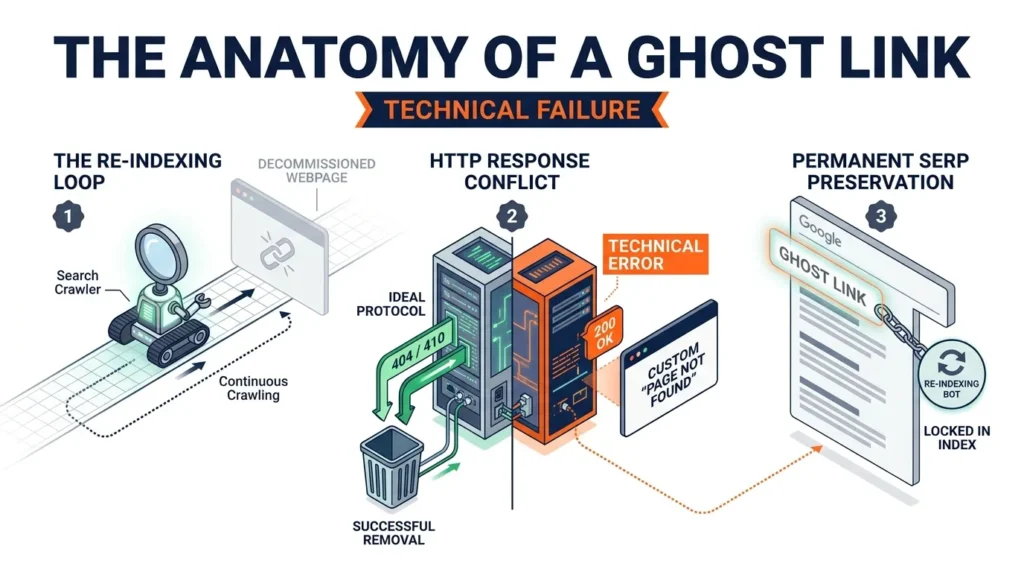
A ghost link forms when server-side content updates fail to align with algorithmic re-indexing protocols. The primary cause is improper HTTP response header handling during content removal. When a webpage is decommissioned, servers should ideally return a 404 (Not Found) or 410 (Gone) status code. If a server incorrectly responds with a 200 (OK) status while displaying a custom “page not found” message, search engine bots register the URL as active, permanently preserving the ghost link within the SERP.
A secondary mechanism involves mismatched URL redirection and canonical tag misconfigurations. Webmasters frequently implement 301 (Permanent) or 302 (Temporary) redirects to route traffic away from deprecated assets. When these redirects point to topically irrelevant pages, search algorithms detect signal conflicts. Rather than updating the index to reflect the new target, algorithms temporarily store the original URL in a state of indexation limbo, effectively creating a ghost link that continues to rank for legacy query vectors.
Crawler budget constraints further exacerbate ghost link longevity across large enterprise environments. Search engines assign finite processing resources to every web domain based on entity trust and link equity. When structural website migrations leave thousands of unmanaged URLs behind, search bots require extended timeframes to crawl, verify, and drop the deprecated inventory. During this transition window, stale entities persist in index caches, serving as active ghost links across targeted search queries.
How Do Algorithms Process Broken URLs and Legacy Data?
Search engine algorithms process broken URLs by evaluating HTTP response header codes, historical link equity, and user engagement metrics during SERP interaction cycles. When a crawler encounters a missing page, the system registers the HTTP status and logs the URL for re-crawl validation. Algorithms do not immediately purge missing pages from index databases; instead, they implement a grace period to guard against temporary server downtime or accidental site misconfigurations.
During this reconciliation phase, information processing systems compare the cached version of the URL against live network responses. If the system detects a persistent 404 or 410 header across multiple crawl cycles, it initiates the index deprecation routine, systematically lowering the URL’s position before stripping it from search engine results pages. However, if the page returns a soft 404 or maintains active external backlink connections, the algorithm preserves the URL in the index, relying on historical text embeddings to fulfill user intent queries.
Entity perception systems utilize these legacy data points to compute baseline trust scores for individuals and corporate entities. Information extraction pipelines constantly pull entity attributes, relationships, and sentiment values from indexed pages. When a ghost link remains indexed, its embedded text continues to fuel language processing pipelines, ensuring that deprecated legal disputes, outdated financial figures, or unverified claims continue to inform the entity’s overall algorithmic knowledge graph representation.
Why Do Ghost Links Harm Entity Reputation and Digital Trust?
Ghost links impair entity reputation by exposing users to unverified, harmful, or legally superseded information at critical digital touchpoints. An entity’s digital footprint functions as an automated dynamic resume evaluated by search algorithms and human evaluators alike. When search results contain ghost links that snippet negative press, retracted allegations, or expired regulatory sanctions, the search ecosystem continues to display adverse sentiment indicators that do not reflect the entity’s current operational standing.
- Display inaccurate metadata snippets directly within active search result feeds. Example: A search query for an enterprise entity displays a ghost link featuring an out-of-date product recall snippet that was resolved years prior.
- Frustrate user navigation by routing queries to dead ends or error pages. Example: A prospect clicks an indexed executive profile URL only to hit a 404 page, lowering perceived brand professionalism.
- Anchor negative sentiment data within search engine knowledge graphs. Example: Algorithmic entity extractors continue parsing stale cached content from an orphaned URL, continuously associating a executive with past litigation.
- Dilute authority signals by splitting incoming hyperlink equity across non-existent destinations. Example: High-authority industry publications link to an outdated URL path, trapping ranking power on a dead server node instead of transferring it to live assets.
The presence of ghost links undermines user trust and engagement metrics, which indirectly damages overall ranking potential. Modern search engines measure implicit user feedback, such as bounce rates and immediate return-to-SERP behaviors (pogo-sticking). When users click a ghost link expecting active information and encounter a broken page or irrelevant redirect, they immediately return to the SERP. Algorithms interpret this behavior as a failed search result match, penalizing the entity’s surrounding search visibility.
Furthermore, ghost links create severe information asymmetry across reputational monitoring channels. Because the underlying source page no longer exists or has been modified, reputation management professionals face technical barriers when attempting standard content modification strategies. The negative sentiment remains active purely within the search engine’s internal representation, making the phantom listing a persistent source of reputation risk that requires specialized technical remediation protocols.
How Can Entities Detect and Audit Ghost Links Across Search Ecosystems?
Entities detect ghost links through programmatic SERP scraping, technical site auditing, and log file analysis across search indexes. Auditing begins by mapping the entity’s index footprint using search operators alongside automated API endpoints. By querying specific domain parameters and non-indexed brand variations, technical analysts isolate active search engine results pages that return broken response codes, redirected paths, or soft 404 environments upon user execution.
Log file analysis provides the primary mechanism for tracking crawler behavior regarding deprecated URLs. Web servers log every instance of search engine bots requesting page assets. By filtering server logs for search bot user-agents attempting to access non-existent paths, systems identify which legacy URLs remain in the crawler’s queue. Cross-referencing these requested paths with live search engine indexes exposes active ghost links requiring indexation removal requests.
Brand entities must also monitor third-party web archives and external cache servers. External websites frequently copy or scrape original publications before content updates or deletions occur. These external mirror sites generate secondary ghost links across distinct domains, distributing deprecated sentiment throughout the search graph. Systematically tracking brand mentions paired with broken URL footprints enables entities to map their complete technical exposure and prioritize remediations based on search volume and query intent.

What Technical Mechanisms Remove Ghost Links from Search Results?
Technical removal of ghost links requires aligning server HTTP responses with search engine webmaster instructions to force indexation updates. The most direct resolution involves returning an unambiguous 410 Gone status code at the server level for all decommissioned page locations. Unlike 404 codes, which prompt search engines to re-check the URL periodically over extended windows, a 410 code signals permanent removal, instructing crawlers to immediately delete the document from their index databases.
- Implement explicit HTTP 410 status codes across dead server endpoints. Example: Configuring
.htaccessrules to return 410 headers for all decommissioned/press-releases/2018/directory paths. - Submit URL removal commands through official search engine console tooling. Example: Utilizing Google Search Console’s temporary removal tool to clear cached snippets for sensitive missing pages immediately.
- Execute formal cache refresh requests via specialized webmaster processing interfaces. Example: Submitting updated URLs to indexation APIs to trigger expedited crawling of newly modified content.
- Deploy
noindexrobots headers on legacy URLs returning custom landing pages. Example: Inserting<meta name="robots" content="noindex, follow">tags on legacy resource portals to keep link flow while dropping SERP inclusion.
When server access is unavailable—such as when ghost links exist on third-party publishing platforms—entities must rely on automated search engine removal systems. Search engines provide dedicated administrative tooling designed to clear outdated content from search engine results pages. By submitting targeted removal requests that verify the live page no longer matches the cached SERP snippet, webmasters accelerate the removal cycle without waiting for natural crawler discovery.
Understanding how Google’s outdated content tool processes expired and broken URLs is essential for executing rapid digital footprint cleanup. The tool analyzes live HTTP headers and page text against indexed cached versions. When a user or webmaster submits a URL, the system performs an automated real-time HTTP fetch. If the tool detects that the live page returns a 404 or 410 response, or that specific submitted keywords have been removed from the source HTML, it approves the request, clearing the stale text snippet and dropping the ghost link from active search result outputs.
What is a ghost link in search engine results?
A ghost link is a cached or indexed URL that continues to appear in search engine results pages even though the underlying webpage has been deleted, moved, or altered. It occurs when there is a delay between content removal on a server and a search engine’s crawling cycle. These orphan links can continue to display outdated snippets, legacy titles, or broken destinations to searchers.
How does a ghost link harm your online reputation and search visibility?
Ghost links harm an entity’s digital footprint by presenting obsolete, misleading, or negative information in active search results, even after the source content has been taken down. When users click a ghost link and land on a 404 error page or an irrelevant redirect, it creates a poor user experience and increases bounce rates. Algorithmic systems may also continue to index cached sentiment, anchoring outdated claims to a brand’s knowledge graph representation.
Why do search engines keep showing dead links after a page is deleted?
Search engines retain dead links because crawling engines process web pages asynchronously based on domain authority and crawl budget constraints. If a web server fails to issue explicit HTTP 404 (Not Found) or HTTP 410 (Gone) response headers, crawlers may assume the missing asset is temporarily unavailable rather than permanently deleted. As a result, search engine algorithms temporarily store the cached URL until the next systematic re-indexing protocol occurs.



