
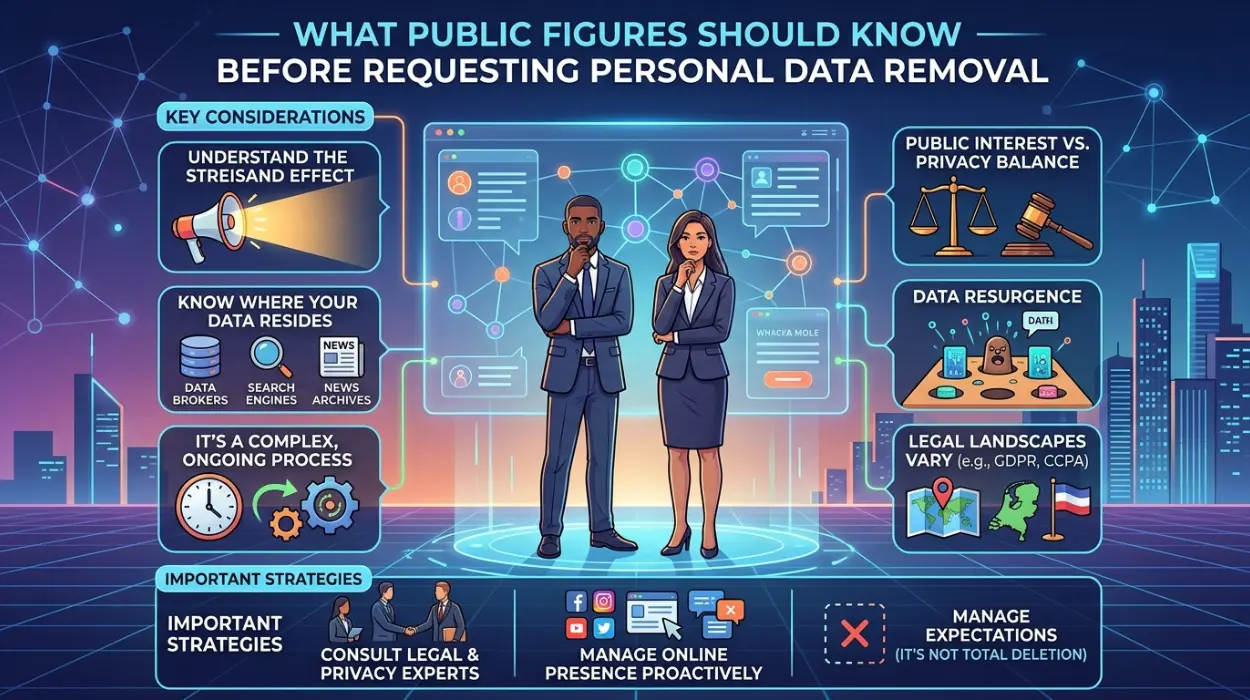
Public figures face a different personal data removal environment because public interest, search visibility, privacy rights, and information relevance affect how removal requests are assessed.
Reputation management strategies differ based on the nature, authority, accuracy, and public significance of the information being indexed.
How Does Personal Data Removal Differ for Public Figures and Private Individuals?
Personal data removal for public figures is evaluated against a broader balance between privacy and legitimate public interest. Private individuals generally have greater scope for limiting information that has little relevance to their public identity, while public figures often have information connected to professional activities, public roles, or established public records. Search engines assess the context and relevance of information rather than treating every personal-data request identically. This distinction creates different risk profiles for removal strategies. The effectiveness of a request therefore depends on the relationship between the information, the individual’s public role, and the reason for seeking removal.
Online reputation control methods are evaluated through relevance, authority, accuracy, proportionality, and search visibility. A removal strategy focuses on reducing access to qualifying information, whereas a reputation enhancement strategy focuses on strengthening alternative information that accurately represents the individual. Removal can produce a direct visibility change when content meets an applicable removal criterion. Enhancement operates differently by improving the authority and relevance of competing content within search results. The two approaches therefore address different mechanisms within the same reputation environment.
Is Content Removal More Effective Than Content Enhancement for Public Figures?
Content removal provides a direct route when information qualifies for deletion, de-indexing, restriction, or another applicable privacy mechanism. Content enhancement instead strengthens accurate and relevant pages so that they have greater search ranking influence within the SERP. Removal is more targeted because it addresses a specific source, but its effectiveness depends on whether the publisher, platform, or search engine has a valid basis for taking action. Enhancement has broader potential because it can influence the composition of results without requiring every negative or unwanted page to be removed. However, enhancement does not erase the original information.
Content suppression vs content enhancement therefore represents two distinct strategic models. Suppression reduces the visibility of unwanted material through legitimate ranking and visibility mechanisms, while enhancement increases the prominence of authoritative and useful information. For public figures, enhancement can support entity credibility when search results contain a mixture of professional, personal, and third-party information. Removal remains more precise when the underlying content satisfies a recognised privacy or policy-based ground. Evaluating the two approaches requires measuring the source authority, query relevance, persistence, and potential risk associated with the information.
How Do Search Engines Interpret Reputation Signals About Public Figures?
Search engines interpret reputation signals through signals associated with relevance, authority, context, links, content quality, user behaviour, and the relationship between entities and topics. A reputation signal is an observable indication that helps search systems determine the relevance or credibility of information associated with a person or entity. These signals do not operate as a single reputation score that simply determines whether an individual appears positively or negatively. Instead, they contribute to how search engines organise information for particular queries. The resulting SERP composition therefore changes according to the relationship between the search query and available content.
Public figures generate larger and more complex digital footprints because professional activities, interviews, public records, media coverage, social profiles, and third-party references can all become connected to their entity. This creates a broader information environment than the typical private-person search. Removing one page can therefore change one component of the SERP without changing the wider entity representation. Content enhancement addresses this wider environment by developing stronger contextual signals around accurate information. Effective evaluation therefore measures both individual URL visibility and the broader distribution of reputation signals.
How Do Organic and Reactive Personal Data Strategies Compare?
Organic strategies focus on building a stronger information environment before a specific reputation problem requires intervention. Reactive strategies respond to an identified page, data exposure, search result, or privacy issue after it becomes visible. Organic activity can include maintaining authoritative profiles, publishing accurate professional information, and establishing consistent entity references across relevant digital properties. Reactive activity can include privacy requests, platform complaints, publisher contact, or search-result actions where an applicable basis exists. The distinction relates primarily to timing and mechanism rather than whether one strategy universally replaces the other.
Organic approaches provide a stronger foundation for long-term SERP stability because they continuously develop relevant information around the entity. Reactive approaches provide greater precision when a particular piece of personal information creates an immediate visibility or privacy concern. The limitation of organic activity is that it does not automatically address information that independently qualifies for removal. The limitation of reactive activity is that each action can address only the specific content or mechanism covered by the request. A combined evaluation therefore considers whether the problem is isolated, systemic, temporary, or persistent.
When Is Removal More Appropriate Than Search Suppression?

Removal is more appropriate when the information meets a recognised legal, privacy, platform, or search-engine criterion for restriction or deletion. A removal mechanism operates by reducing the availability or indexability of the specific information rather than attempting to change its relative ranking. Search suppression operates differently by reducing the prominence of unwanted content through the development and strengthening of competing information. Suppression becomes more relevant when content remains legitimately published but creates an unbalanced SERP. The distinction is important because search visibility does not automatically establish that content qualifies for removal.
For public figures, evaluation also requires consideration of public interest and the relationship between the information and the person’s professional role. Information directly connected to public responsibilities generally presents a different removal context from information that is excessive, outdated, inaccurate, or unrelated to legitimate public interest. A suppression strategy can address visibility where removal is unavailable, but it does not alter the underlying existence of the source. Removal can produce a stronger direct outcome when the relevant threshold is satisfied. Strategic assessment therefore begins with classification before selecting an intervention.
How Do Short-Term and Long-Term Strategies Affect SERP Composition?
Short-term strategies prioritise immediate visibility changes, while long-term strategies focus on the stability of the search environment surrounding the individual. A short-term removal action can change the presence of a specific result relatively quickly when the request is accepted and implemented. Search suppression can also alter page-one composition by increasing the visibility of stronger competing results. Long-term strategies focus on maintaining authoritative information, strengthening entity associations, and creating a consistent digital footprint. These mechanisms influence different stages of reputation recovery.
The sustainability of a strategy depends on how strongly its results are connected to underlying reputation signals. A temporary ranking movement without supporting content authority can become unstable when search systems recrawl and reassess the SERP. Conversely, a structured information environment creates more durable competition for search visibility. Long-term content enhancement therefore focuses on establishing relevance and authority rather than relying solely on a single ranking change. Short-term removal and long-term enhancement can consequently serve different roles within the same reputation management framework.
How Should the Effectiveness of Personal Data Removal Be Measured?
Effectiveness is measured through changes in search visibility, content accessibility, SERP composition, query coverage, and the distribution of relevant reputation signals. Measuring only whether one URL disappears provides an incomplete assessment because duplicate content, syndicated pages, cached references, or alternative sources can continue to influence perception. A broader evaluation tracks the affected queries and identifies which pages occupy the resulting positions. This creates a distinction between content-level success and entity-level improvement. The difference is particularly important for public figures with extensive online footprints.
A practical evaluation framework can compare each strategy against its mechanism, scalability, risk exposure, and sustainability:
- Classify the information by checking its source, accuracy, relevance, public-interest connection, and applicable removal mechanism.
- Measure SERP composition by tracking affected queries, page positions, indexed URLs, and changes in competing reputation signals.
- Compare removal and suppression by assessing direct visibility reduction against the strength of alternative authoritative content.
- Monitor sustainability by checking whether visibility changes remain stable after recrawling, republication, or changes in competing content.
- Evaluate risk by identifying legal, policy, reputational, and public-interest consequences associated with each intervention.
This framework separates measurable search outcomes from assumptions about reputation. It also prevents a single ranking movement from being treated as evidence of complete reputation improvement.
How Does Digital Footprint Size Affect Removal Strategy?
Digital footprint size directly affects scalability because a public figure can have information distributed across a large number of independent sources. A digital footprint is the collection of indexed and accessible information associated with a person across websites, platforms, databases, social networks, media publications, and other digital environments. Removing one source does not automatically remove references that exist elsewhere. Larger footprints therefore require source mapping and query-level analysis before the overall impact of an intervention can be understood.
A smaller, isolated data exposure can receive a targeted response because the affected source is easier to identify and classify. A distributed information problem requires a broader strategy because information can be replicated, syndicated, referenced, or independently indexed. Content enhancement becomes more scalable in these environments because authoritative information can influence multiple queries and provide additional context around the entity. Removal remains valuable for specific qualifying sources. The strategic difference lies in whether the problem is concentrated around individual URLs or distributed throughout the wider digital ecosystem.
Dive Deeper With Our Expert Guides:
How to Prioritise Which Personal Information to Remove First
How to Request Removal of Personal Data Used in AI Training
How Does Personal Data Removal Affect Trust Signals and Entity Credibility?
Personal data removal can affect trust indirectly by changing which information users encounter when searching for a public figure. Trust signals are indicators that contribute to perceptions of credibility, reliability, relevance, or authority within a digital information environment. When irrelevant or inappropriate personal information dominates prominent search results, the SERP can create an incomplete representation of the individual. Removing qualifying information can reduce that distortion. However, removal alone does not automatically establish stronger positive trust signals.
Entity credibility depends on the consistency and authority of information connected to the individual. Accurate professional profiles, credible publications, authoritative references, and consistent entity information can provide stronger contextual signals than isolated removal actions. This creates an important distinction between reducing harmful visibility and improving the information environment. The first addresses an unwanted signal, while the second strengthens competing signals. A complete evaluation therefore considers sentiment distribution, content authority, and the relevance of visible information alongside removal outcomes.
What Strategic Combination Provides the Most Sustainable Approach?
The most sustainable approach depends on whether the underlying issue involves qualifying personal data, inaccurate information, excessive visibility, or an unbalanced search environment. Removal is the most direct mechanism for information that meets a legitimate removal criterion. Suppression addresses content that remains available but requires reduced prominence within search results. Content enhancement strengthens accurate and authoritative information that contributes to a more balanced SERP. Organic reputation development provides the longer-term foundation on which these mechanisms operate.
A structured strategy evaluates each page and query according to its role within the broader information ecosystem. It separates content that can legitimately be removed from content that requires visibility management or contextual enhancement. This reduces unnecessary intervention and provides clearer measurement criteria. It also improves scalability by preventing identical treatment of fundamentally different reputation problems. For public figures, this distinction is essential because public interest and entity complexity make blanket removal approaches unsuitable.
How Can Public Figures Evaluate Personal Information Removal Options?
Public figures can evaluate personal information removal options by examining the source, content type, relevance, public interest, visibility, and available intervention mechanism. The first consideration is whether the information qualifies for removal under the relevant policy, legal framework, or privacy process. The second is whether the information is duplicated or connected to other sources that continue to influence search visibility. The third is whether suppression or content enhancement provides a more appropriate route when removal is unavailable. Each option therefore requires a mechanism-based assessment rather than a general assumption that removal produces the strongest outcome.
A balanced evaluation also considers short-term impact against long-term sustainability. Direct removal can create a measurable change in the affected result, while content enhancement can strengthen the wider search environment over time. Reactive intervention addresses defined problems, whereas organic activity supports broader resilience. Search ranking influence, reputation signals, entity credibility, and sentiment distribution provide useful measures for comparing these approaches. The final strategy is therefore determined by the structure of the information problem rather than by the public figure’s status alone.
What Are the Key Considerations Before Requesting Personal Data Removal?
The key considerations are eligibility, relevance, public interest, source authority, duplication, SERP visibility, risk exposure, and long-term impact. A removal request requires a clear understanding of what information is being targeted and why the applicable mechanism covers it. Search suppression and content enhancement require a different assessment because their objective is visibility management rather than deletion. Organic strategies require sustained development of authoritative information. Reactive strategies require precise classification and evidence.
Personal information removal for public figures is therefore best understood as one component of broader search perception management. Removal, suppression, and enhancement operate through different mechanisms and produce different forms of impact. Their effectiveness depends on how well the selected method matches the structure of the reputation problem. Sustainable outcomes depend on the continued strength of relevant reputation signals and the stability of the surrounding SERP. Evaluating these factors provides a more reliable basis for deciding between competing reputation management approaches.
Personal data removal for public figures involves a more complex evaluation than simply requesting that unwanted information disappear from search results. Removal directly addresses qualifying information, while suppression manages visibility and content enhancement strengthens accurate competing information. Organic approaches provide longer-term resilience, whereas reactive approaches address defined and immediate reputation risks.
The strongest evaluation framework considers effectiveness, scalability, risk exposure, sustainability, SERP composition, reputation signals, and entity credibility together. Public status affects the relevance and public-interest context of information, but it does not eliminate the need for evidence-based assessment. Understanding the mechanism behind each approach allows personal information removal, search suppression, and content enhancement to be evaluated according to their actual role within the search ecosystem.
How does personal data removal work for public figures?
Personal data removal for public figures involves assessing whether information qualifies for removal under applicable privacy, legal, or platform policies. Public interest, relevance, accuracy, and the person’s public role are key factors in the assessment.
Can public figures request personal information removal from Google?
Public figures can submit eligible personal information removal requests to search engines when specific privacy or policy criteria are met. Approval depends on the nature of the information, its relevance to public interest, and the applicable removal process.
What personal information can be removed from search results?
Eligible information can include certain sensitive personal details, such as contact information or data that creates a significant privacy or safety concern. Removal depends on the search engine’s policies, the source of the information, and the circumstances surrounding its publication.
Does being a public figure affect personal data removal requests?
Public-figure status can affect how a removal request is evaluated because information connected to public roles and legitimate public interest receives different consideration. Personal information that lacks sufficient public relevance can still be assessed under applicable privacy mechanisms.
What is the difference between personal data removal and search suppression?
Personal data removal focuses on reducing or eliminating access to qualifying information, while search suppression focuses on reducing the visibility of content within search results. Removal addresses the underlying source or indexation mechanism, whereas suppression influences SERP composition through competing content and search ranking signals.