

HR teams play a central role in Indeed review disputes by documenting employment facts, evaluating whether review content breaches platform policies, and preserving evidence relevant to disputed claims. Their records help distinguish legitimate employee feedback from content containing factual inaccuracies, confidential information, impersonation, or policy violations.
Reputation management is the structured process of monitoring, evaluating, and influencing the information that shapes an organisation’s perceived credibility across digital environments. Online reputation refers to the collection of information, opinions, reviews, and reputation signals that influence how an organisation is perceived within search ecosystems and review platforms.
How do HR teams influence the handling of Indeed review disputes?
HR teams influence Indeed review disputes through evidence management, employment-record verification, policy assessment, and factual clarification. Their role connects internal employment information with the external reputation signals presented through employee review platforms.
An Indeed review dispute begins when an organisation challenges the accuracy, legitimacy, or policy compliance of published review content. HR records provide the factual baseline for evaluating statements about employment conditions, management practices, workplace events, job responsibilities, or the identity of the reviewer. This evidence does not automatically determine whether a review is removed because platform moderation decisions depend on the applicable content policies. It does, however, establish a structured basis for assessing the disputed information.
HR teams also help separate factual disagreements from policy-based removal grounds. A negative opinion about an employer is not equivalent to demonstrably false information, confidential disclosure, personal information exposure, or prohibited content. This distinction is important because reputation systems interpret different content types through different signals.
The resulting evidence contributes to a more accurate assessment of the content’s status. Where review information conflicts with documented employment records, the evidence provides a basis for evaluating factual accuracy. Where the dispute concerns prohibited material, the evidence helps demonstrate the relationship between the published content and the relevant policy category.
What evidence do HR teams use when disputing an Indeed review?
HR teams use employment records, communication records, workplace documentation, policy materials, and factual timelines to establish the context of disputed review content. The value of each record depends on its relevance to the specific statement being challenged.
Employment records can verify whether a reviewer held a particular role, worked during a stated period, or had the employment relationship described in the review. Internal communications can establish the chronology of events referenced by the reviewer. Company policies can provide a factual reference point when a review makes claims about workplace procedures or employment standards.
Evidence also includes records that establish the distinction between fact and opinion. A statement such as an employee describing a manager as “unfair” represents subjective sentiment. A statement asserting that a particular policy existed on a specified date represents a factual proposition that can be compared against organisational records.
HR teams therefore perform an evidence-mapping function. Each disputed statement can be connected to a relevant document, date, policy, communication, or employment record. This approach creates a structured relationship between the review content and the evidence used to evaluate it.
How does HR documentation affect reputation signals?
HR documentation affects reputation signals by providing a factual framework for assessing content that contributes to an organisation’s online perception. Reviews represent reputation signals because they communicate experiences, opinions, sentiment, and claims about an employer to prospective employees and search users.
Search engines and review platforms process content as information rather than as isolated internal employment records. A review containing negative sentiment can therefore contribute to the broader digital footprint of an organisation. The strength of that signal depends on factors such as relevance, content quality, platform authority, indexing, engagement, and contextual consistency.
HR documentation does not directly alter search rankings. Instead, it supports the evaluation of the underlying information that generates a reputation signal. When disputed information is assessed against reliable internal records, the organisation gains a clearer understanding of whether the content represents an opinion, an unsupported allegation, an inaccurate statement, or a policy-relevant violation.
This distinction is important for SERP evaluation. A review appearing prominently in search results represents an externally visible reputation signal, while the internal documentation represents evidence used to assess that signal. The two systems interact indirectly through content moderation, indexing, removal decisions, and subsequent changes in search visibility.
How do Indeed reviews affect online reputation?
Indeed reviews affect online reputation by contributing employee-generated information to the digital footprint associated with an organisation. Review content can influence how prospective employees, search users, and other audiences interpret organisational credibility.
Online reputation is not created by one review alone. It develops through the cumulative interaction of review content, company information, third-party publications, social profiles, employment information, and other indexed sources. Search engines evaluate these sources through ranking systems that determine which information receives greater visibility for particular queries.
Review sentiment forms one part of this reputation structure. Consistently negative language can establish a negative sentiment pattern, while balanced or positive reviews contribute different signals. The interpretation of those signals depends on context, relevance, source authority, and the relationship between the content and the organisation’s entity.
An Indeed review can therefore have significance beyond the review platform itself when search engines index the page and display it for employer-related queries. The review then becomes part of the searchable information environment surrounding the organisation. HR teams analysing a dispute need to consider both the original review content and its position within the wider digital footprint.
How do search engines interpret disputed employer reviews?
Search engines interpret disputed employer reviews primarily as indexed content associated with an organisation rather than as verified internal employment records. Ranking systems use signals from the page, website, content context, authority, relevance, and user behaviour when determining search visibility.
A search engine does not possess direct access to an employer’s internal HR documentation when evaluating a public review. This creates a separation between factual verification and search ranking. HR teams therefore use internal records to evaluate the accuracy or legitimacy of content, while search engines independently determine how the indexed page appears in search results.
Content indexing is a key part of this process. Once an Indeed review page enters a search engine’s index, its information becomes available for retrieval through relevant queries. Search visibility then determines how prominently that content appears when users search for the organisation, workplace, management, or related employment terms.
SERP evaluation examines the position and context of the review within search results. A review ranking prominently for an organisation’s name represents a stronger visibility signal than a review that receives little or no search exposure. HR teams analysing reputation impact therefore need to distinguish between the existence of disputed content and its actual visibility within search ecosystems.
What is the difference between a negative opinion and a removable review?
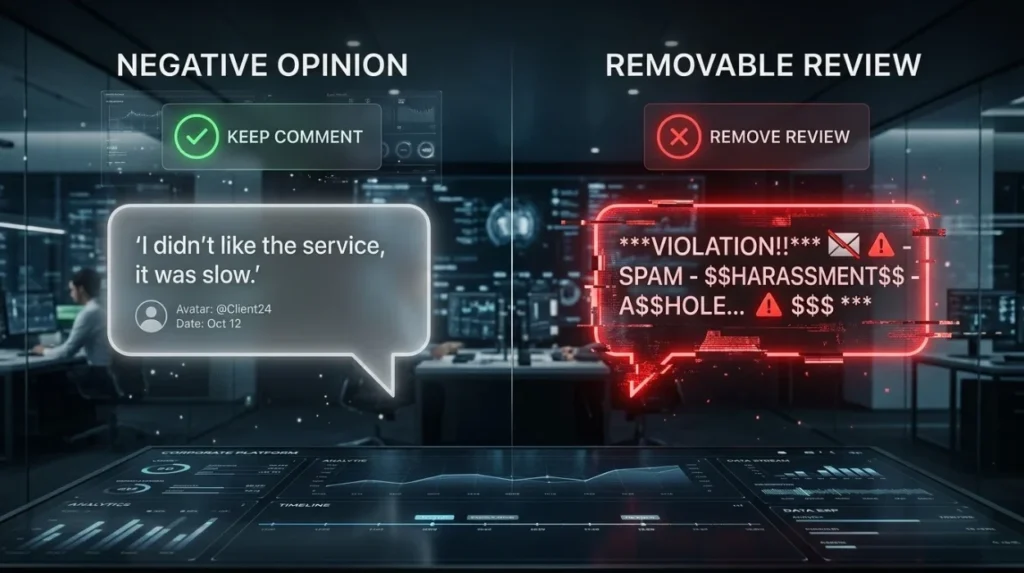
A negative opinion expresses an individual’s subjective assessment, while potentially removable content relates to a defined platform-policy issue or another recognised basis for moderation. This distinction prevents ordinary criticism from being treated as equivalent to prohibited or demonstrably problematic material.
Employee reviews frequently contain subjective statements about management style, workload, workplace culture, compensation, or career progression. Such statements can represent personal experiences and opinions even when an employer disagrees with their conclusions. Disagreement alone does not transform subjective criticism into objectively false content.
A stronger dispute involves a specific factual proposition that can be assessed against reliable evidence. The analysis becomes more precise when the disputed statement is isolated rather than treating the entire review as inaccurate. This approach also helps identify whether a review contains distinct elements consisting of opinion, fact, personal information, confidential material, or other policy-relevant content.
The distinction matters for reputation management because search visibility does not establish factual accuracy. A highly visible review can still contain subjective commentary, while a less visible review can contain a significant factual problem. Reputation analysis therefore requires separate evaluation of content validity and search prominence.
How can HR teams document evidence for Indeed removal?
HR teams can document evidence for Indeed removal by connecting each disputed statement with a specific factual record, policy category, date, and explanation of relevance. Structured documentation creates a clearer evidential relationship between the review and the basis for disputing its publication.
The documentation process begins by preserving the original review. The record can include the review URL, publication date, visible text, reviewer information where available, screenshots, and the exact statements under dispute. Preserving the original content establishes a reference point before any moderation or indexing changes occur.
The next stage involves mapping disputed statements against internal evidence. An employment record can verify dates, while a policy document can clarify organisational procedures. A communication record can establish chronology, while an official document can contradict a specific factual claim.
For a deeper consideration of evidence structure, How HR Teams Should Document Evidence for Indeed Removal provides a relevant framework for understanding how documentation connects disputed content with supporting records.
Evidence documentation also benefits from precise language. Instead of describing a review as simply “false”, the analysis identifies the exact statement, explains the factual inconsistency, and identifies the record supporting the assessment. This creates a more auditable process for evaluating the dispute.
How do review signals interact with authority and trust signals?
Review signals interact with authority and trust signals by contributing user-generated information to the wider entity profile surrounding an organisation. Search systems evaluate information from different sources, meaning review content represents one component within a broader reputation structure.
Authority relates to the perceived strength and relevance of a source, while trust signals concern the consistency, reliability, and credibility associated with information. An employer’s digital footprint can contain official corporate information, regulatory records, professional profiles, news coverage, employee reviews, and third-party references.
A review from a recognised platform can therefore receive meaningful visibility because the platform itself possesses established authority. The review content remains separate from the platform’s overall authority, but the hosting environment affects its ability to enter search results and attract visibility.
Entity perception develops from the relationship between these information sources. Search users interpret the organisation through the available evidence presented across the digital environment. HR teams analysing review disputes therefore benefit from understanding the difference between source authority, content credibility, review sentiment, and search visibility.
Why does content indexing matter in Indeed review disputes?
Content indexing matters because an indexed review becomes retrievable through search queries and can contribute directly to the organisation’s visible digital footprint. Unindexed content has a fundamentally different search visibility profile from content appearing in a search engine’s results.
Indexing does not guarantee high rankings. A page can remain indexed while receiving limited visibility for organisation-related searches. Conversely, a review page with strong relevance and an authoritative hosting domain can achieve prominent positions for particular queries.
This distinction makes indexing an important component of reputation analysis. HR teams evaluating a review dispute need to identify whether the content exists only on Indeed, appears in search results, or has become visible across additional indexed pathways. Each condition represents a different reputation exposure level.
SERP evaluation therefore complements HR evidence analysis. Internal records establish the factual position, while search analysis establishes the visibility and prominence of the disputed information. Combining both perspectives produces a clearer understanding of the relationship between content and online reputation.
Dive Deeper With Our Expert Guides:
Why an Indeed Review Breaching an NDA Can Be Removed
Why False Claims About Pay or Benefits Break Indeed Rules
How does an Indeed review dispute affect an organisation’s digital footprint?
An Indeed review dispute affects an organisation’s digital footprint when disputed content becomes part of the indexed information associated with its entity. The impact depends on the content itself, its search visibility, its sentiment, and its relationship with other reputation signals.
A digital footprint represents the collection of online information connected to an organisation across websites, platforms, search results, profiles, publications, and other digital sources. Employer reviews form one category within this broader information environment.
The reputation effect becomes more significant when a disputed review appears prominently for branded or employer-related searches. Search users often evaluate organisations through the information presented on the first results page. A review that occupies a prominent position can therefore influence entity perception even when the organisation has additional authoritative information available elsewhere.
HR documentation does not directly control this ranking process. Its function is evidential: it establishes the factual basis for evaluating disputed information and supports appropriate platform-level or internal decision-making. Search visibility analysis then determines how strongly the disputed content contributes to the organisation’s public reputation.
How should HR teams evaluate the reputation impact of a disputed review?
HR teams evaluate reputation impact by separating content validity, policy relevance, search visibility, sentiment, and source authority into distinct analytical factors. This approach avoids treating every negative review as an equivalent reputation risk.
The first factor is content validity. HR records establish whether factual claims correspond with documented employment information. The second factor is policy relevance, which determines whether the disputed material relates to a recognised platform rule or moderation category.
The third factor is search visibility. A review ranking for the organisation’s name carries a different exposure profile from content that is difficult to retrieve through relevant queries. The fourth factor is sentiment, which identifies whether the review contributes positive, neutral, mixed, or negative language to the organisation’s searchable reputation.
The final factor is source authority. A review hosted on an established employment platform has a different information environment from an isolated page on a low-authority website. Evaluating these factors together creates a more precise model of reputation exposure.
What is the relationship between HR evidence and reputation management?
HR evidence provides the factual foundation for evaluating reputation signals generated by employment-related content. Reputation management then concerns the broader process of understanding, monitoring, and assessing how those signals influence online credibility and entity perception.
The relationship is analytical rather than automatic. Internal evidence does not determine search rankings, and search rankings do not establish the factual accuracy of review content. Instead, each system provides different information required to understand the complete reputation environment.
Indeed review disputes demonstrate this separation clearly. HR teams work with employment records, policies, communications, and factual timelines, while search systems process indexed content according to ranking and retrieval mechanisms. Platform moderation operates between these areas by evaluating content against applicable rules.
A structured reputation analysis therefore connects factual evidence with content status, search visibility, sentiment, authority, and trust signals. This framework provides a clearer explanation of how employer reviews influence digital reputation without assuming that negative content is inherently inaccurate or removable.
HR teams play an important evidential role in Indeed review disputes because employment records provide the factual context required to evaluate disputed claims. Their documentation helps distinguish subjective opinion from factual assertions, identify relevant policy issues, and establish the chronology surrounding contested information.
From a reputation-management perspective, an Indeed review is one reputation signal within a wider digital footprint. Its influence depends on content characteristics, indexing, search visibility, sentiment, source authority, and its relationship with other information connected to the organisation.
Understanding these systems requires separating factual verification from search ranking. HR evidence explains the underlying employment information, while SERP evaluation explains how that information is represented through searchable content. Together, these concepts demonstrate how review disputes contribute to the broader processes of online credibility, entity perception, and reputation signal formation.
What role does HR play in an Indeed review dispute?
HR teams provide employment records, workplace documentation, and factual evidence to evaluate disputed claims in an Indeed review. This evidence helps distinguish subjective opinions from factual inaccuracies or content that conflicts with platform policies.
Can HR teams challenge a false Indeed review?
Yes, HR teams can document factual inconsistencies and submit relevant evidence when challenging disputed Indeed review content. A dispute is stronger when each contested statement is connected to a specific employment record, policy, or documented event.
What evidence is needed to dispute an Indeed review?
Relevant evidence includes employment records, workplace policies, communications, factual timelines, and documentation that addresses the specific claims in the review. Preserving the original review and identifying the exact disputed statements creates a clearer evidence trail.
Does an Indeed review affect an employer’s online reputation?
An Indeed review can contribute to an employer’s online reputation when it is indexed and visible in search results. Its reputation impact depends on factors such as review sentiment, search visibility, source authority, and its relationship with other reputation signals.
Can Clear Your Name help with an Indeed review dispute?
Clear Your Name relates to reputation management and Indeed Review Removal Services, which focus on addressing eligible review content and its effect on online reputation. The appropriate approach depends on the review’s content, applicable platform policies, supporting evidence, and search visibility.




