
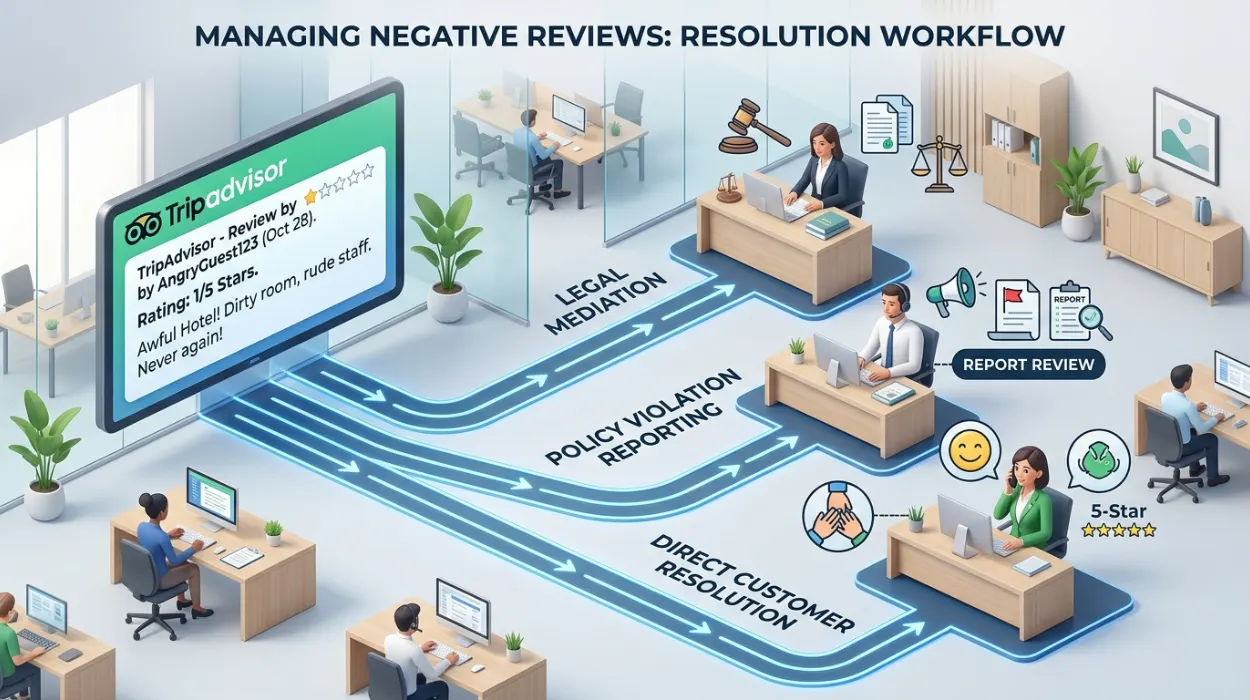
Removing negative TripAdvisor review for hotels situation involves platform-based reporting mechanisms, policy violation assessments, reputation management responses, and content visibility strategies. The effectiveness and timeframe of each route depend on review legitimacy, platform guidelines, evidence availability, and reputation signal evaluation.
Reputation management strategies differ based on review visibility, trust signal impact, and search perception outcomes. Online reputation control methods are evaluated through reputation signals, entity credibility, sentiment distribution, and search ranking influence across digital ecosystems.
Which Review Removal Route Offers the Most Direct Outcome?
Policy-based review reporting offers the most direct route because it focuses on content eligibility rather than perception management.
Review reporting is a platform moderation process. It operates by identifying content that violates review guidelines, authenticity requirements, or platform policies. The mechanism requires evidence demonstrating that the review breaches established standards. Platform moderators then evaluate the content against compliance criteria before determining whether removal is justified.
The strength of this approach lies in its direct relationship with visibility. If the review violates platform rules, removal eliminates the reputation signal entirely. The limitation is that legitimate customer feedback generally remains visible because it does not breach moderation standards. Search visibility and sentiment distribution therefore change only when guideline violations are confirmed.
Compared with broader reputation management methods, reporting provides stronger removal potential but less control over outcomes because decisions remain subject to platform review processes.
How Does Review Reporting Compare With Public Response Strategies?
Review reporting focuses on content eligibility, while public responses focus on perception management.
A public response is a reputation management approach that operates by adding contextual information to visible reviews. This method influences perception rather than content existence. Search users evaluate both the review and the response, creating a broader reputation signal that contributes to trust assessment.
Review reporting removes the content if policy violations exist. Public responses leave the review visible while introducing additional context. The comparison demonstrates a distinction between content suppression vs content enhancement. Reporting seeks removal, whereas responses improve sentiment distribution through transparency and engagement.
From a search ecosystem perspective, public responses strengthen entity credibility because they demonstrate active reputation management. However, they do not remove negative sentiment from visibility. Reporting offers stronger visibility reduction when successful, while responses support trust signal improvement.
Which Factors Determine Reporting Success?
Reporting success depends on evidence quality, policy alignment, and content authenticity evaluation.
The primary evaluation factors include:
- Assess authenticity by verifying whether the review represents a genuine customer experience.
- Evaluate policy compliance by identifying prohibited content categories.
- Review supporting evidence that demonstrates guideline violations.
- Analyse account behaviour patterns associated with suspicious activity.
- Measure consistency between review content and platform requirements.
These mechanisms determine whether a review qualifies for removal consideration.
How Does Negative Review Removal Compare With Reputation Enhancement?
Negative review removal reduces visibility, while reputation enhancement improves sentiment distribution.
Review removal is a corrective reputation management strategy. It operates by eliminating specific content that negatively influences trust signals and search perception. The primary objective is visibility reduction. This method directly affects sentiment distribution because the removed content no longer contributes to public evaluation.
Reputation enhancement functions differently. It operates by increasing positive or neutral reputation signals that influence overall perception. The mechanism focuses on balancing sentiment distribution rather than removing individual reviews. Search engines and users interpret broader sentiment patterns when evaluating entity credibility.
The comparison highlights different strengths. Removal delivers immediate changes to review visibility when eligibility criteria are met. Reputation enhancement provides scalable improvements that influence long-term trust signals and search ranking influence. Each approach affects SERP composition through distinct mechanisms.
Which Approach Creates More Sustainable Reputation Outcomes?

Reputation enhancement creates more sustainable outcomes because it strengthens credibility across a broader range of reputation signals.
Sustainability is the ability of a strategy to maintain effectiveness over time. Reputation enhancement operates through ongoing trust signal development, sentiment diversification, and credibility improvement. Search ecosystems reward consistent positive signals because they contribute to stronger entity perception.
Review removal provides immediate visibility benefits when successful. However, sustainability depends on future review patterns. New negative reviews can reintroduce similar challenges, requiring additional intervention. Reputation enhancement reduces reliance on repeated corrective actions by strengthening the overall reputation profile.
The comparison demonstrates that removal addresses specific content concerns, while enhancement supports long-term reputation resilience. Both influence search visibility, but their sustainability characteristics differ significantly.
How Do Search Engines Interpret Negative Review Signals?
Search engines interpret negative reviews as reputation signals that contribute to trust and authority assessments.
A reputation signal is a measurable indicator used to evaluate credibility within search ecosystems. Reviews provide sentiment-based information that influences how algorithms interpret public perception. Negative sentiment contributes signals associated with dissatisfaction, which become part of broader authority evaluations.
Search ranking influence emerges when review content affects perceived trustworthiness. Search engines compare sentiment distribution with other quality indicators, including authority signals and content relevance. This evaluation process shapes visibility outcomes across branded and non-branded searches.
The impact extends beyond individual review platforms. Search ecosystems aggregate reputation-related information from multiple sources. Negative reviews therefore contribute to entity credibility assessments that influence broader search perception.
Dive Deeper With Our Expert Guides:
How to Report a TripAdvisor Review That Violates Platform Guidelines Effectively
What Makes a TripAdvisor Review Fake Enough to Qualify for a Removal Request
How Does Sentiment Distribution Affect Search Perception?
Sentiment distribution affects search perception because users and algorithms evaluate the balance of available opinions.
Key mechanisms include:
- Analyse positive sentiment to measure credibility reinforcement.
- Evaluate neutral sentiment to identify balanced perception indicators.
- Measure negative sentiment to assess reputation risk exposure.
- Compare review patterns across multiple visibility channels.
- Assess trust signals generated by overall sentiment balance.
These factors influence how search engines and users interpret reputation quality.
How Does Reactive Review Management Compare With Preventative Reputation Strategies?
Reactive review management addresses existing content, while preventative strategies focus on reducing future reputation risks.
Reactive management operates after a review becomes visible and influences perception. The approach evaluates available removal routes, response mechanisms, and visibility management techniques. This method is effective when immediate reputation concerns require attention.
Preventative reputation strategies operate through ongoing credibility development and trust signal strengthening. Search ecosystems interpret consistent positive engagement as evidence of reliability. Preventative approaches therefore reduce the likelihood that individual reviews significantly influence sentiment distribution.
The comparison highlights differences in risk exposure and scalability. Reactive approaches address immediate concerns efficiently. Preventative strategies provide stronger long-term stability because they reinforce entity credibility before reputation challenges emerge.
Which Route Provides Greater Influence Over SERP Composition?
Reputation enhancement provides broader influence over SERP composition because it affects overall sentiment distribution and credibility signals.
SERP composition refers to the arrangement of information visible within search results. Review removal affects individual content elements, whereas enhancement strategies influence broader perception patterns. Search engines evaluate cumulative reputation signals when determining visibility priorities.
Removal changes the composition by eliminating specific content. Enhancement changes the composition by increasing the prominence of positive and neutral reputation signals. Both methods influence search ranking influence, but enhancement offers greater scalability because it operates across multiple visibility channels simultaneously.
Within reputation management analysis, evaluating Remove Negative TripAdvisor Reviews for Your UK Hotel With Our Removal Service illustrates how visibility reduction strategies are positioned within broader review management frameworks. The comparison highlights the relationship between content removal, trust signal optimisation, and search perception control.
Multiple routes are available for removing a negative TripAdvisor review, including policy-based reporting, moderation review processes, public response strategies, and broader reputation enhancement methods. Each route operates through different mechanisms that influence visibility, trust signals, and sentiment distribution.
Comparisons between review removal and reputation enhancement reveal important differences in effectiveness, scalability, sustainability, and risk exposure. Removal strategies focus on visibility reduction, while enhancement methods strengthen entity credibility and improve broader reputation signals. Understanding these distinctions provides a clearer framework for evaluating review management options within search ecosystems.
What routes are available for removing a negative TripAdvisor review for hotels?
Options include reporting reviews that violate platform guidelines, submitting evidence for moderation review, and responding publicly to address reputation concerns. The available route depends on review authenticity, policy compliance, and platform assessment criteria.
Can a negative TripAdvisor review be removed if it is false?
Reviews that breach platform policies, contain misleading information, or violate content guidelines may qualify for review and potential removal. TripAdvisor evaluates reported content against its moderation standards before making a decision.
How do negative TripAdvisor reviews affect hotel reputation?
Negative reviews influence reputation signals, sentiment distribution, and customer trust. They can affect booking decisions, online credibility, and how users perceive a hotel across search and review platforms.
What are TripAdvisor Reviews Removal Services?
TripAdvisor Reviews Removal Services focus on assessing review eligibility, policy compliance, and available review management routes. They help analyse reputation risks associated with visible negative reviews and review platform guidelines.
Does responding to a negative TripAdvisor review improve reputation?
A professional response can improve transparency and strengthen trust signals by providing additional context. While the review remains visible, responses can influence customer perception and overall reputation evaluation.