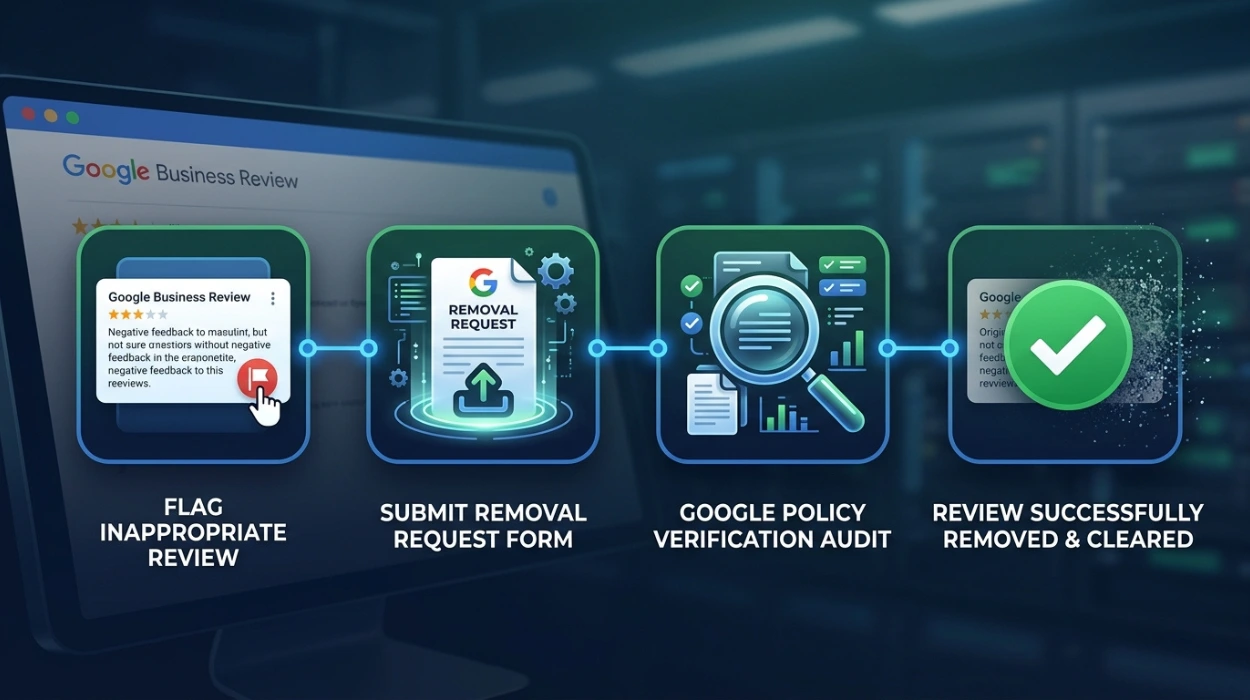
The Google Business review removal process involves identifying review eligibility, evaluating policy compliance, submitting a removal request, and monitoring Google’s review assessment process. Different review management approaches influence search visibility through distinct mechanisms within local search ecosystems.
Reputation management strategies differ based on how review content affects search visibility, reputation signals, and customer trust. Online reputation control methods are evaluated through their impact on entity credibility, search ranking influence, sentiment distribution, and long-term digital trust. Google Business review removal represents one reputation management approach that focuses on reducing policy-violating review content rather than changing legitimate customer feedback. Understanding each stage of the process provides a structured framework for evaluating its effectiveness within local search.
Which Review Removal Approach Provides the Most Effective Results?
A policy-based review removal approach provides the most effective results because it evaluates reviews according to Google’s published content policies rather than attempting to influence search rankings directly. Search ecosystems prioritise review authenticity and policy compliance when determining whether content remains visible.
Google Review Removal Services begin by analysing the review itself rather than the business profile. Each review is evaluated according to potential policy violations, including spam, fake engagement, conflicts of interest, prohibited content, harassment, impersonation, misleading information, or irrelevant material. This structured assessment determines whether the review qualifies for removal consideration.
Unlike reputation strategies focused solely on increasing positive reviews, policy-based removal targets review eligibility at its source. If Google determines that a review violates its policies, the review is removed from the business profile, reducing its contribution to reputation signals and sentiment distribution.
Evaluating review eligibility before submission improves process efficiency because removal requests align with Google’s published review moderation framework rather than subjective business preferences.
How Does Review Removal Compare With Review Management?
Review removal and review management operate through different mechanisms within search ecosystems. Review removal focuses on eliminating policy-violating content, whereas review management evaluates the overall reputation profile through monitoring, engagement, and sentiment analysis.
Review removal operates within Google’s moderation framework. Businesses identify potentially non-compliant reviews and submit requests for Google’s evaluation. The decision depends on policy compliance instead of customer satisfaction or commercial impact.
Review management evaluates broader reputation signals such as review frequency, response quality, customer engagement, sentiment distribution, and profile consistency. Search algorithms interpret these combined signals when evaluating local search visibility.
Comparing these approaches demonstrates that review removal reduces ineligible reputation signals, while review management strengthens the quality and consistency of legitimate review ecosystems.
Dive Deeper With Our Expert Guides:
What Options Exist When a Competitor Posts Fake Reviews on Your Google Profile
How to Demonstrate That a Google Review Violates Policy to Improve Removal Success
Which Reviews Qualify for Google’s Removal Process?
Reviews qualify for Google’s removal process when they violate published review policies rather than simply expressing negative opinions. Policy compliance defines removal eligibility within Google’s review ecosystem.
Spam and Fake Engagement
Spam reviews contain misleading, fabricated, duplicated, or artificially generated content intended to manipulate public perception. Google’s moderation systems evaluate behavioural signals, publication patterns, and reviewer activity when identifying spam.
Removing spam reviews strengthens review authenticity by reducing artificial reputation signals from local search evaluation.
Conflicts of Interest
Conflict-of-interest reviews originate from individuals with personal or commercial relationships that compromise impartiality. These reviews distort genuine customer feedback and weaken review reliability.
Google evaluates reviewer behaviour and publication context to identify potential conflicts affecting review integrity.
Prohibited Content
Reviews containing harassment, offensive language, personal information, threats, discriminatory content, or other prohibited material become eligible for policy review. Google’s moderation framework prioritises user safety alongside information quality.
Removing prohibited content improves review ecosystem integrity without affecting legitimate customer experiences.
How Does Google’s Review Assessment Process Work?
Google’s review assessment process evaluates reported reviews through automated systems and policy-based moderation procedures. Review eligibility depends on content analysis rather than business preference.
Search ecosystems distinguish between review publication and review moderation. Businesses submit removal requests, but Google’s evaluation systems determine whether reported content violates published review policies. Automated detection systems analyse language, behavioural signals, reviewer history, and contextual relationships before applying moderation decisions.
Policy-compliant negative reviews normally remain visible because search ecosystems prioritise authentic customer experiences. Reviews violating published standards undergo further evaluation before moderation outcomes are determined.
Understanding this distinction explains why review removal depends upon policy eligibility rather than disagreement with customer feedback.
Which Strategy Provides Better Long-Term Reputation Protection?
Long-term reputation protection depends on combining review policy evaluation with broader reputation management instead of relying exclusively on isolated removal requests. Sustainable reputation management strengthens overall review quality while reducing policy-violating content.
Review ecosystems evolve continuously through ongoing customer feedback, search indexing, and local ranking evaluation. New reviews regularly influence sentiment distribution, entity credibility, and search visibility. Analysing only individual reviews provides limited long-term control because reputation signals continue changing over time.
Understanding protect your Google Business profile by removing harmful reviews professionally also provides useful context when evaluating implementation-focused reputation strategies beyond policy assessment. Comparing preventive reputation management with reactive review removal demonstrates how different approaches influence long-term search visibility and digital trust.
How Do Reactive and Proactive Review Management Strategies Compare?
Reactive review management responds after harmful or policy-violating reviews appear, whereas proactive review management focuses on maintaining a trustworthy review profile before reputation issues affect search visibility. These approaches differ in timing, implementation, and long-term sustainability.
Reactive strategies operate by identifying problematic reviews, evaluating policy compliance, and initiating Google’s review assessment process. This approach addresses existing reputation signals but depends on whether reported content qualifies under Google’s moderation policies. Search visibility changes only when moderation decisions alter the review profile.
Proactive strategies focus on review monitoring, customer engagement, profile accuracy, and consistent reputation management. These activities strengthen authentic reputation signals and improve entity credibility before review-related risks develop. Search ecosystems interpret this consistency as a stronger indicator of trustworthiness.
Comparing the two approaches demonstrates that proactive reputation management provides greater long-term stability, while reactive review removal addresses existing policy-related concerns.
Which Review Removal Strategy Offers Better Scalability?
A structured policy-based review removal strategy offers better scalability because it applies a consistent evaluation framework across multiple reviews rather than assessing each issue without defined criteria. Standardised analysis improves efficiency as review volumes increase.
Scalable review assessment begins by categorising reviews according to Google’s published policies. Reviews containing spam, prohibited content, conflicts of interest, impersonation, or misleading information are evaluated before removal requests are prepared. This structured process reduces unnecessary submissions while improving consistency.
Review management strategies that lack defined evaluation criteria require repeated manual assessment, increasing administrative effort over time. Policy-driven analysis supports long-term reputation management by creating repeatable decision-making processes across large review portfolios.
Scalability therefore depends on systematic policy evaluation instead of isolated moderation requests.
How Does Google’s Interpretation of Reviews Influence Reputation Management Decisions?
Google’s interpretation of reviews influences reputation management because algorithms evaluate authenticity, relevance, sentiment distribution, and reviewer credibility before incorporating reviews into local search rankings. Reputation management decisions become more effective when they align with these evaluation mechanisms.
Review content contributes semantic information describing products, services, customer experiences, and business characteristics. Search algorithms compare these patterns across multiple reviews to develop a comprehensive understanding of business quality and entity credibility. Consistent and authentic review ecosystems strengthen reputation signals used during local SERP evaluation.
Search engines also distinguish between legitimate customer criticism and policy-violating content. This distinction explains why not every negative review qualifies for removal, even if it affects public perception.
Understanding Google’s review interpretation framework enables more informed comparisons between removal strategies, reputation management, and long-term search visibility improvement.
Which Evaluation Framework Helps Compare Review Removal Options?
A structured evaluation framework provides the most effective comparison because it measures policy eligibility, reputation impact, sustainability, and search ranking influence across different review management methods.
The following framework supports objective evaluation:
- Identify the review type by determining whether it represents authentic feedback or potential policy violations.
- Evaluate policy compliance using Google’s published review moderation guidelines.
- Compare available management options according to expected effects on reputation signals and search visibility.
- Assess sustainability by measuring long-term improvements in entity credibility and sentiment distribution.
- Monitor review profile changes to evaluate moderation outcomes and ongoing local search performance.
Applying this framework creates consistent decision-making while reducing reliance on subjective assessments.
How Do Different Review Management Methods Affect Long-Term Search Visibility?
Different review management methods influence long-term search visibility according to how they affect review quality, reputation signals, and local search evaluation. Search ecosystems continuously reassess business profiles as new reviews become available.
Policy-based review removal reduces the influence of ineligible content by removing reviews that violate Google’s moderation standards. This strengthens review authenticity and improves the quality of reputation signals available for local ranking evaluation.
Review management strategies that focus on monitoring, engagement, and profile consistency strengthen long-term entity credibility by maintaining balanced and authentic customer feedback. These approaches support sustainable search visibility because they improve the overall quality of review ecosystems rather than relying solely on moderation outcomes.
Combining policy evaluation with broader reputation management creates a more resilient approach to local search because both review quality and review authenticity contribute to long-term digital trust.
The Google Business review removal process involves evaluating review eligibility, comparing moderation options, understanding Google’s review policies, and analysing how review content influences search visibility. Policy-based review removal, proactive review management, and ongoing reputation monitoring each operate through different mechanisms and contribute distinct benefits within local search ecosystems.
Comparing these approaches demonstrates that effective reputation management depends on selecting methods aligned with Google’s review policies, long-term reputation objectives, and sustainable digital trust. Understanding these strategic differences provides a stronger foundation for evaluating review management options while improving entity credibility, sentiment distribution, and local search visibility.
What does the Google Business review removal process involve?
The Google Business review removal process involves identifying potentially policy-violating reviews, assessing them against Google’s review guidelines, submitting a removal request, and monitoring Google’s moderation decision. The outcome depends on whether the review breaches Google’s content policies.
Which Google reviews are eligible for removal?
Reviews containing spam, fake engagement, harassment, conflicts of interest, impersonation, or other prohibited content may qualify for removal. Legitimate negative reviews that comply with Google’s policies generally remain visible.
How long does Google take to review a review removal request?
Google’s review timeframe varies depending on the complexity of the request and the moderation process. Businesses should monitor their Google Business Profile after submitting a request, as review assessments are completed individually.
How do Google Review Removal Services support reputation management?
Google Review Removal Services evaluate reviews against Google’s published policies and identify content that may qualify for removal. They also help businesses understand how review moderation influences reputation signals, customer trust, and local search visibility.
How does Clear Your Name explain the Google Business review removal process?
Clear Your Name explains the Google Business review removal process by focusing on policy compliance, review eligibility, and search ecosystem evaluation. This approach helps businesses understand how review moderation affects entity credibility, reputation signals, and long-term local SEO performance.