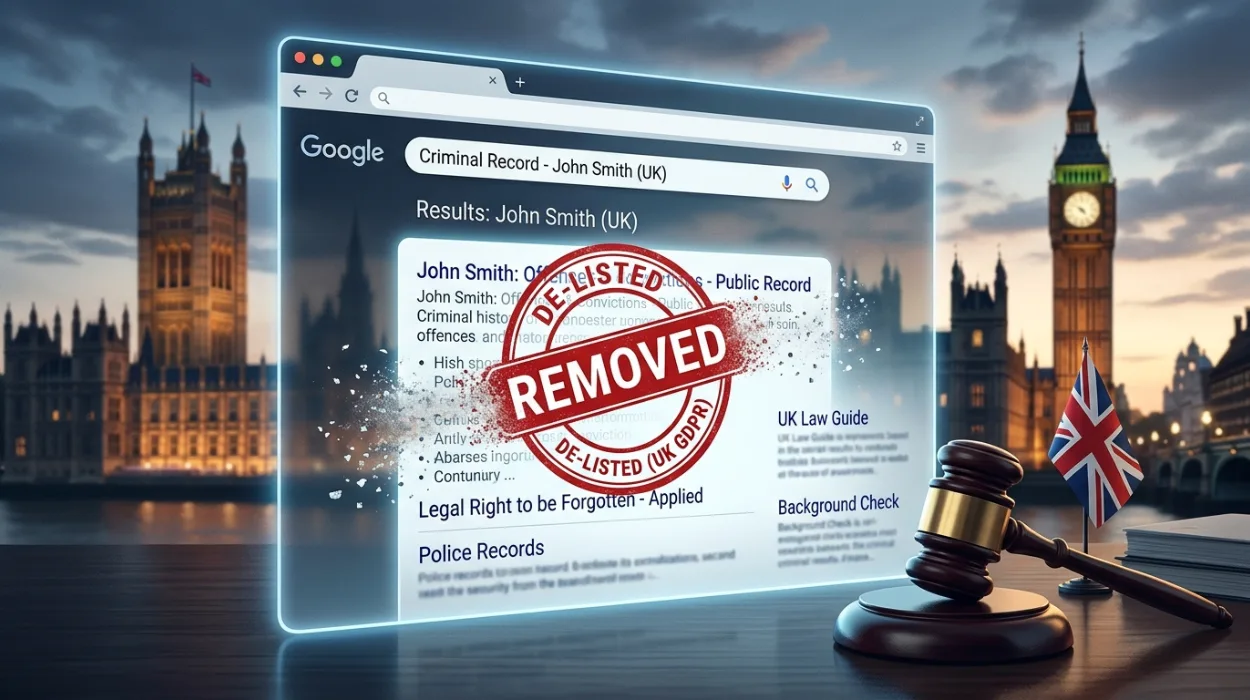
Certain types of criminal record information are more likely to be removed from Google in the UK when legal, privacy and data protection factors favour reduced search visibility over continued public accessibility. The outcome depends on the nature of the information, its ongoing public interest, the authority of the source and the applicable legal framework.
Reputation management strategies differ based on the type of information, its legal status and the way search engines interpret reputation signals. Online reputation control methods are evaluated through search ranking influence, entity credibility, content indexing and the balance between privacy rights and public interest within digital search ecosystems.
What determines whether a criminal record type is more likely to be removed from Google?
The likelihood of removal is determined by evaluating the relationship between legal rights, data protection principles and search engine processing rather than by the offence category alone. Reputation management within this context examines whether continued search visibility accurately reflects legitimate public interest and proportionate data processing.
Search engines organise information through content indexing rather than making legal decisions about criminal records. Search ranking influence is created by authority signals, semantic relevance, structured data and user intent. Legal assessments therefore focus on whether continued indexing remains justified under applicable legislation instead of examining ranking positions alone.
Entity credibility also influences how criminal record information affects digital perception. Search ecosystems connect individuals with authoritative sources, creating reputation signals that shape overall search visibility. The evaluation therefore considers both legal compliance and the technical mechanisms responsible for SERP composition.
How do spent convictions compare with unspent convictions in search visibility?
Spent convictions and unspent convictions represent different legal classifications that influence reputation management analysis. A spent conviction refers to an offence that has completed its statutory rehabilitation period, whereas an unspent conviction continues carrying legal disclosure obligations.
Within search ecosystems, this distinction affects privacy evaluation rather than technical indexing. Search engines interpret publicly available content through relevance and authority, while legislation examines whether continued processing remains proportionate after rehabilitation has occurred.
Spent convictions frequently receive closer scrutiny when privacy rights, rehabilitation principles and data protection obligations are balanced against continuing public interest. Unspent convictions generally retain stronger public interest signals because they remain legally significant in a broader range of circumstances.
This comparison demonstrates that legal rehabilitation changes the framework used for evaluating reputation signals without directly altering search engine indexing behaviour.
Dive Deeper With Our Expert Guides:
How to Apply the Rehabilitation of Offenders Act When Requesting Google Removal
What Steps Are Involved in Requesting Court Record Removal From Search Results
Which criminal record sources receive different levels of evaluation?
Criminal record information originates from multiple source categories, each carrying different authority signals and legal considerations. Reputation management analysis evaluates the source before considering search visibility.
Official public records
Official records operate as primary sources created by courts or public authorities. Search engines interpret these sources as highly authoritative because they provide structured and verifiable information. Strong authority signals frequently support stable content indexing, although ongoing processing remains subject to applicable legal frameworks.
News publications
News organisations publish criminal proceedings as part of public reporting responsibilities. Search ranking influence often remains strong because established publishers generate recognised trust signals. Evaluation therefore focuses on continued public interest alongside the original lawfulness of publication.
Third-party websites
Third-party websites reproduce or aggregate publicly available criminal record information. Their authority varies according to editorial standards, source transparency and content quality. Lower authority signals produce different search ranking outcomes when compared with official records or established news organisations.
Comparing source categories demonstrates that authority influences search visibility, while legal analysis examines whether continued accessibility remains justified.
How does public interest affect the evaluation of different criminal record types?
Public interest operates as a legal principle that measures the ongoing societal value of maintaining access to criminal record information. Reputation management analysis distinguishes public interest from public curiosity because each concept serves different purposes within legal and search environments.
Search ecosystems reinforce public interest through authority signals generated by trusted publishers and recognised institutions. Content connected with public accountability, safeguarding responsibilities or significant criminal proceedings often maintains stronger search ranking influence because authoritative sources continue referencing the material.

Information carrying limited continuing public interest receives a different evaluation under privacy and data protection principles. The legal framework analyses proportionality, relevance and necessity rather than relying exclusively on historical publication.
This comparative approach explains why different criminal record categories receive different legal assessments despite existing within the same search ecosystem.
How do privacy rights compare with freedom of expression when evaluating removal?
Privacy rights and freedom of expression represent complementary legal principles that require balanced evaluation rather than automatic priority. Reputation management strategies analyse how these principles influence entity credibility and long-term search perception.
Privacy protects personal information from disproportionate or unnecessary processing. Freedom of expression protects lawful publication serving democratic accountability, journalistic reporting and public knowledge. The evaluation therefore compares competing legal interests instead of treating either principle as absolute.
Search engines remain neutral information organisers within this framework. Algorithms interpret authority, relevance and semantic relationships, while legal institutions assess proportionality, fairness and ongoing legitimacy. Search ranking influence therefore develops independently from legal balancing exercises.
Understanding this distinction explains why legal rights influence reputation management analysis without directly controlling algorithmic indexing.
Which reputation management approaches evaluate criminal record information most effectively?
Reputation management approaches differ according to whether they analyse legal processing, search visibility or overall entity perception. Each method evaluates different components of the digital information ecosystem.
Legal evaluation operates by analysing statutory rights, data protection obligations and rehabilitation principles. This approach measures compliance with legislation governing criminal offence information rather than search ranking performance.
Search ecosystem evaluation operates by analysing content indexing, authority signals, semantic relevance and SERP composition. The objective is to explain how search engines construct reputation signals through interconnected sources and technical ranking factors.
Comparing these approaches demonstrates that effective reputation analysis requires both legal interpretation and technical understanding instead of relying upon either discipline in isolation.
How do content suppression and content removal differ when evaluating criminal record information?
Content suppression and content removal represent different reputation management approaches within search ecosystems. Content suppression operates by reducing the prominence of negative information through the introduction of additional relevant content, while content removal focuses on eliminating or restricting access to specific information through legal or regulatory mechanisms.
Content suppression influences search ranking composition rather than altering the original publication. Search engines reassess new reputation signals, entity relationships and topical authority, allowing different content to compete for visibility within search engine results pages (SERPs). This approach changes the distribution of indexed information instead of removing historical records.
Content removal evaluates whether existing information continues meeting legal and regulatory standards for processing and accessibility. The assessment examines privacy rights, data protection obligations, rehabilitation principles and public interest. Unlike suppression, removal focuses on the lawfulness of continued indexing or publication rather than the balance of search rankings.
Comparing these approaches demonstrates that suppression evaluates search ranking influence, whereas removal evaluates legal processing. Each operates through a different mechanism and produces different outcomes for digital reputation.
How do organic reputation strategies compare with reactive approaches?
Organic reputation strategies focus on developing a balanced digital presence over time through consistent publication, authoritative content and strengthened entity credibility. Reactive approaches evaluate existing negative search visibility after it has already become established within search ecosystems.
Organic strategies influence reputation signals gradually by expanding high-quality indexed content, strengthening semantic relevance and improving topical consistency. Search engines interpret these signals as part of a broader entity profile, creating a more comprehensive representation of an individual or organisation.
Reactive approaches concentrate on analysing existing search visibility, legal considerations and content processing obligations. The emphasis remains on evaluating the status of already indexed information rather than expanding new authority signals.
This comparison highlights that organic strategies operate through continuous reputation development, while reactive approaches focus on assessing existing digital information within legal and technical frameworks.
How do short-term and long-term reputation management approaches differ?
Short-term reputation management evaluates immediate search visibility and the current composition of SERPs. Long-term reputation management analyses how search ecosystems continuously reassess authority, relevance and entity relationships over extended periods.
Short-term evaluation measures existing content indexing, ranking positions and reputation signals. It provides a snapshot of current search performance without determining future visibility. Search engines continually update rankings as algorithms reassess content quality, authority and contextual relevance.
Long-term evaluation examines sustainability. Search ecosystems continuously analyse freshness, source credibility, semantic connections and content maintenance, meaning reputation evolves as new information enters the index and older information changes in significance.
Comparing these approaches demonstrates that sustainable reputation analysis depends on understanding continuous algorithmic reassessment rather than isolated search results.
What risks and limitations exist when evaluating criminal record removal?
Every reputation management approach operates within legal, technical and ethical boundaries that define its limitations. Evaluating criminal record information requires recognition of these constraints before assessing likely outcomes.
The following framework explains the principal limitations:
- Assess legal eligibility. Data protection legislation, rehabilitation rules and privacy rights establish the legal framework before search visibility is evaluated.
- Recognise source authority. Official public records and established news organisations generate stronger authority signals than secondary or duplicated sources.
- Evaluate public interest. Continuing public significance influences whether criminal record information remains proportionate within search ecosystems.
- Measure search ecosystem dynamics. Search engines continuously recrawl, re-index and reassess content according to evolving ranking signals rather than fixed positions.
- Review ongoing reputation signals. Entity credibility changes as authoritative content, structured data and semantic relationships evolve across the web.
This evaluation framework demonstrates that reputation management involves continuous analysis rather than a single technical or legal process.
How do search engines reassess criminal record information over time?
Search engines regularly reassess indexed content through automated crawling, indexing and ranking systems. Criminal record information remains subject to the same technical evaluation processes as other publicly available content.
Content indexing measures accessibility, structured information and semantic relationships. Ranking systems evaluate authority, relevance, freshness and user intent to determine how information appears within search results. These mechanisms operate independently of legal classification while continuing to influence search visibility.
Entity credibility evolves as search engines analyse relationships between authoritative documents, references and contextual information. Reputation signals therefore change when the overall information environment changes rather than through isolated updates to individual pages.
Understanding this process explains why digital reputation remains dynamic, with search visibility reflecting continuous algorithmic evaluation instead of permanent positioning.
The likelihood of criminal record information being removed from Google in the UK depends on the interaction between legal rights, public interest, data protection principles and search engine processing rather than the offence category alone. Spent convictions, source authority, privacy considerations and the legitimacy of continued processing all contribute to the overall evaluation.
Different reputation management approaches analyse separate aspects of this process. Legal evaluation focuses on statutory compliance, while search ecosystem analysis explains how reputation signals, entity credibility and search ranking influence shape digital perception. Comparing these approaches demonstrates that understanding criminal record visibility requires both legal interpretation and technical analysis of search ecosystems.
Within this framework, evaluating criminal record information involves examining the relationship between legislation, content indexing and ongoing search visibility rather than relying on a single factor or fixed outcome.
Which criminal record types are most likely to be removed from Google in the UK?
Criminal record information linked to spent convictions, outdated content or information with limited ongoing public interest is generally evaluated more closely under UK data protection and privacy laws. Clear Your Name explains that each case depends on the source, legal basis for processing and the balance between privacy rights and public interest.
Can a spent conviction be removed from Google search results?
A spent conviction is not automatically removed from Google search results after the rehabilitation period ends. The possibility of reducing search visibility depends on UK GDPR, the Data Protection Act 2018, the Rehabilitation of Offenders Act 1974 and the circumstances surrounding the indexed content.
Does Google remove all criminal record information in the UK?
No. Google evaluates requests based on applicable legal requirements, privacy rights and public interest rather than removing all criminal record information. Official records and lawfully published news content are assessed differently from outdated or disproportionate personal information.
What factors affect whether criminal record information remains visible online?
Search visibility is influenced by content indexing, source authority, public interest, entity credibility and search ranking signals. These technical factors operate alongside UK legal frameworks that regulate the processing of criminal offence data.
How do Criminal Record Removal Services relate to online reputation?
Criminal Record Removal Services focus on evaluating how criminal record information affects online reputation, search visibility and digital perception within legal and data protection frameworks. Clear Your Name notes that assessments consider both search engine behaviour and applicable UK privacy laws rather than search rankings alone.