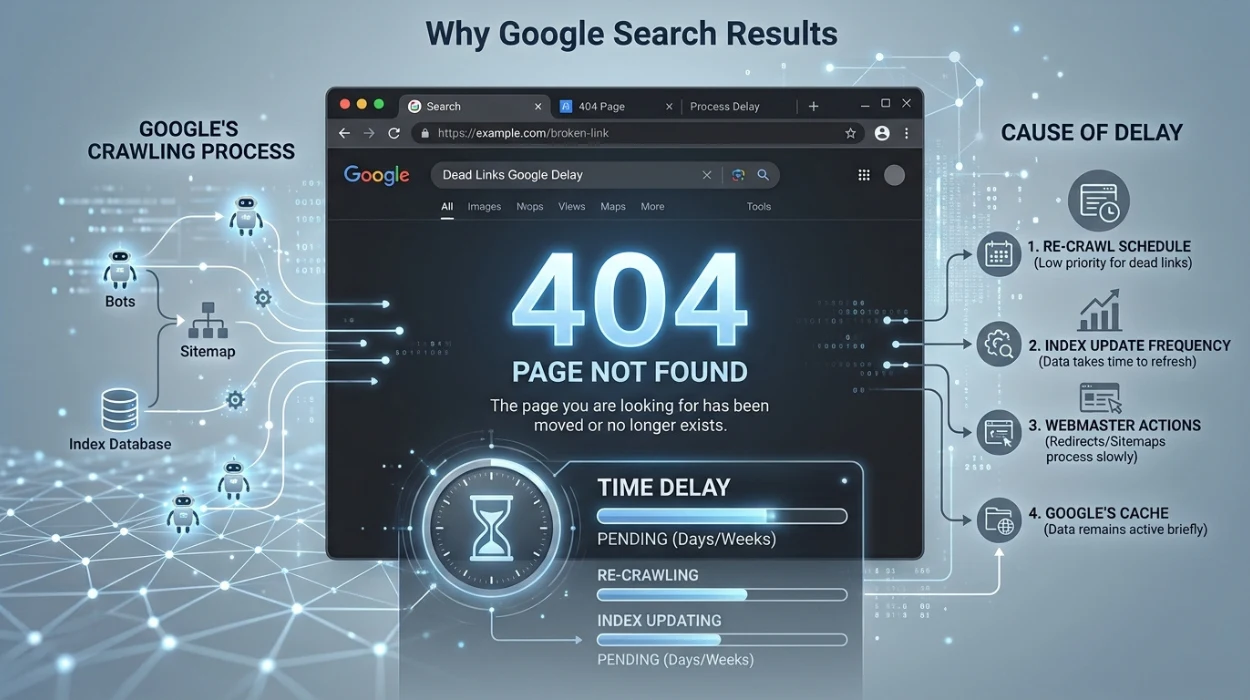
Dead links continue appearing in Google results because search engines retain indexed URLs until their crawling, indexing, and evaluation systems confirm that content has permanently changed or disappeared. The delay results from crawl scheduling, index refresh cycles, and search quality assessment processes rather than immediate page removal.
Reputation management is the process of understanding how digital information influences public perception across search ecosystems. Online reputation refers to the collection of indexed content, search visibility signals, entity associations, and search engine evaluations that shape how individuals, organisations, and brands are perceived within search engine results pages (SERPs). Dead links contribute to reputation management because outdated URLs continue affecting entity perception until search engines update their understanding of the indexed content.
Why Do Dead Links Continue Appearing in Google Search Results?
Dead links continue appearing because Google separates crawling, indexing, and ranking into independent processes that operate on different schedules. A webpage becoming unavailable does not immediately remove its indexed record. Search engines first verify whether the missing page represents a temporary interruption or a permanent change before updating search results.
Content indexing refers to the process of storing webpage information within a search engine’s database. Once indexed, a URL remains associated with historical relevance signals, authority metrics, and search demand until Google’s systems reassess the page. Search visibility therefore depends not only on the page’s current availability but also on the search engine’s confidence that the content no longer exists.
Search engines continuously evaluate billions of URLs. Crawl prioritisation determines when each page is revisited. Frequently updated websites receive more regular crawling, while inactive pages experience longer intervals between evaluations. This scheduling explains why inaccessible pages continue appearing even after deletion.
Dead links also influence reputation signals because users encountering unavailable pages associate outdated information with the entity behind the website. Search perception therefore depends on both visible content and the accuracy of indexed search records.
What Is a Dead Link Within Search Ecosystems?
A dead link is a URL that no longer provides the indexed content expected by users or search engines. Within search ecosystems, a dead link represents a disconnect between stored search information and current website accessibility.
Search engines classify dead links according to server responses and crawl outcomes. HTTP status codes communicate whether content remains available, has permanently moved, has been intentionally removed, or cannot currently be reached. These technical responses guide future indexing decisions.
Dead links differ from de-indexed pages. A dead link continues existing inside Google’s searchable index despite becoming inaccessible, whereas a de-indexed page has been removed from searchable databases following successful evaluation.
The distinction influences online reputation because search visibility persists until search engines confirm permanent removal. Entity perception therefore remains influenced by outdated search records even after website changes occur.
How Does Google Decide When to Remove Dead Links?
Google removes dead links after verifying that indexed content no longer deserves inclusion within its search index. This evaluation combines crawl observations, technical signals, and indexing policies rather than relying on a single event.
Crawl Frequency Determines Re-evaluation
Search engines assign crawl budgets according to website authority, update frequency, and historical activity. High-authority websites receive more frequent evaluations, allowing outdated pages to disappear faster. Lower-priority websites experience delayed reassessment because crawlers revisit them less often.
Index Validation Confirms Permanent Changes
Google validates whether missing pages represent temporary outages or permanent removals. Repeated crawl attempts establish consistency before search results change. This verification protects search quality by preventing temporary server problems from removing useful content.
Ranking Systems Refresh Independently
Ranking evaluation occurs separately from crawling. Even after Google confirms a page no longer exists, ranking databases require additional updates before search results reflect the latest information. This layered process contributes to visible delays.
What Causes Delays Between Website Changes and Search Results?

Search result delays occur because search ecosystems rely on distributed indexing systems rather than live website monitoring. Every indexed page passes through multiple evaluation stages before updates become visible.
Crawlers first discover website changes during scheduled visits. Indexing systems then compare new observations against existing records. Ranking algorithms subsequently evaluate whether search relevance has changed sufficiently to modify search results. Each stage operates independently while maintaining overall search quality.
Infrastructure scale also influences timing. Google’s search index stores enormous volumes of webpages requiring continuous synchronisation across global data centres. Updating every indexed record immediately would reduce processing efficiency and compromise search stability.
Reputation management therefore considers indexing latency as a normal characteristic of search ecosystems rather than evidence of technical failure.
How Do HTTP Status Codes Influence Dead Link Removal?
HTTP status codes define how search engines interpret webpage availability. These responses provide structured communication between websites and crawlers during indexing evaluations.
A 404 Not Found response indicates that requested content cannot currently be located. Google continues checking these URLs before deciding whether removal is appropriate because temporary errors frequently generate identical responses.
A 410 Gone response explicitly informs search engines that content has been permanently removed. This stronger signal supports faster de-indexing because permanence has already been declared by the server.
Redirect responses also affect reputation signals. Proper redirects transfer search understanding from obsolete URLs to relevant destinations, preserving authority signals while reducing unnecessary dead link exposure.
Accurate technical implementation enables search engines to evaluate website changes efficiently, improving search visibility consistency across future index updates.
Why Do Cached Results Sometimes Remain Visible?
Cached information exists because search engines temporarily preserve previous versions of webpages to improve indexing efficiency and retrieval performance. Cached records do not represent current website content. Instead, they reflect historical crawl observations stored during earlier indexing cycles.
Search caches assist search engines in comparing previous content against newly crawled versions. During this comparison period, outdated search snippets occasionally remain visible despite underlying webpage changes.
Snippet generation also depends on stored index information rather than real-time page rendering. Consequently, users sometimes encounter search descriptions referring to content that no longer exists.
These temporary inconsistencies demonstrate how search ecosystems prioritise indexing accuracy through verification instead of immediate replacement.
How Do Dead Links Affect Online Reputation?
Dead links affect online reputation because search visibility contributes directly to perceived credibility. Users evaluate organisations through accessible search results, working webpages, and consistent digital information.
Broken search experiences reduce trust signals. When search listings lead to unavailable content, users interpret the inconsistency as reduced website reliability. Entity perception therefore becomes influenced by both technical quality and informational consistency.
Dead links also interrupt digital footprints. Search engines use interconnected content relationships to understand entities. Missing resources weaken contextual associations, reducing semantic clarity across indexed webpages.
Reputation management analyses these outcomes by examining search visibility, indexing behaviour, technical accessibility, and information consistency instead of focusing exclusively on ranking positions.
Dive Deeper With Our Expert Guides:
Why Broken Links Remain Indexed in Google Search After Pages Are Taken Down
How Broken Links Affect Your Online Reputation Even When the Content Is Gone
What Is the Difference Between Removing, De-indexing, and Deleting Content?
Removing, de-indexing, and deleting content represent separate processes within search ecosystems.
Deleting content refers to eliminating webpages from a website’s server. The webpage becomes unavailable, but indexed records continue existing until search engines reassess the URL.
De-indexing refers to removing a webpage from searchable indexes while allowing the content to remain technically accessible. Search visibility disappears because search engines stop presenting the page in results.
Content removal describes the broader process of eliminating searchable visibility through technical, indexing, or policy-based mechanisms. Reputation management distinguishes these concepts because each produces different effects on entity perception and search evaluation.
Understanding these definitions improves interpretation of search result behaviour during website maintenance and reputation monitoring.
How Do Search Engines Interpret Website Trust After Dead Links Appear?
Search engines evaluate website trust through cumulative quality signals rather than isolated technical events. Individual dead links rarely redefine website authority, but repeated indexing inconsistencies contribute to broader quality assessments.
Search quality systems examine accessibility, crawl efficiency, content reliability, structural consistency, and information freshness. These elements collectively define reputation signals used during ranking evaluation.
Entity perception also depends on semantic consistency. When authoritative content disappears without replacement or appropriate redirects, contextual understanding weakens. Search engines therefore reassess topical relationships alongside technical accessibility.
Maintaining coherent indexing supports stronger search visibility because technical quality reinforces informational credibility across search ecosystems.
How Can Dead Links Showing in Google Results Be Removed or De-indexed?
Dead links showing in Google results can be removed or de-indexed through recognised indexing management processes that communicate permanent content changes to search engines. Successful removal depends on accurate technical signals, verified indexing updates, and consistent crawl evaluation rather than immediate deletion alone.
The removal process defines how search engines interpret unavailable content while maintaining search quality. Permanent server responses, correctly implemented redirects, updated XML sitemaps, and indexing directives provide structured evidence supporting de-indexing decisions. Search engines validate these signals during subsequent crawl cycles before updating searchable indexes.
Search visibility changes therefore occur after indexing systems complete verification rather than immediately following website modifications. Reputation management analyses this workflow because search perception depends upon accurate indexed information rather than current website status alone.
Why Is Understanding Search Indexing Important for Reputation Management?
Understanding search indexing explains why search visibility changes occur gradually instead of instantly. Reputation management relies on accurate interpretation of indexing systems because digital reputation reflects searchable information rather than only published content.
Search engines continuously analyse authority, relevance, accessibility, trust signals, semantic relationships, and entity associations. Every indexed URL contributes to this evaluation framework until reassessment confirms updated information.
Dead links therefore represent an indexing challenge rather than simply a technical website issue. Their continued appearance demonstrates the interaction between crawling schedules, search quality systems, and large-scale index management. Understanding these mechanisms provides a clearer interpretation of how online reputation develops across modern search ecosystems.
Dead links remain visible in Google because crawling, indexing, validation, and ranking operate as separate processes within search ecosystems. Search engines prioritise verification and index stability before removing outdated URLs, creating natural delays between website changes and search result updates. HTTP status codes, crawl frequency, cache management, and technical signals collectively determine how quickly obsolete content disappears from searchable indexes. From a reputation management perspective, understanding these mechanisms explains how search visibility influences digital credibility, entity perception, and long-term online reputation.
Why do dead links remain in Google search results after a page is deleted?
Dead links remain in Google search results because indexed URLs are removed only after search engines recrawl and re-evaluate them. This delay occurs due to crawl schedules, content indexing updates, and SERP evaluation processes rather than immediate page deletion.
How long does Google take to remove dead links from its search results?
The time required depends on how frequently Google crawls the website and verifies that the page has been permanently removed. High-authority websites are often re-evaluated faster, while inactive pages can remain indexed for longer periods.
What is the difference between deleting a page and de-indexing it?
Deleting a page removes it from a website, while de-indexing removes the URL from Google’s searchable index. A deleted page can still appear in search results until Google completes its indexing update and confirms the change.
Can dead links affect online reputation and search visibility?
Yes. Dead links reduce search visibility and influence reputation signals by directing users to unavailable content, which affects entity perception and online credibility. Maintaining accurate indexed content supports a stronger digital footprint.
How can dead links showing in Google results be removed or de-indexed?
Dead links can be removed or de-indexed by providing clear technical signals, such as permanent HTTP responses, accurate redirects, and updated indexing instructions. Clear Your Name explains that successful Dead Links Removal Services depend on Google’s verification and indexing process rather than instant removal.