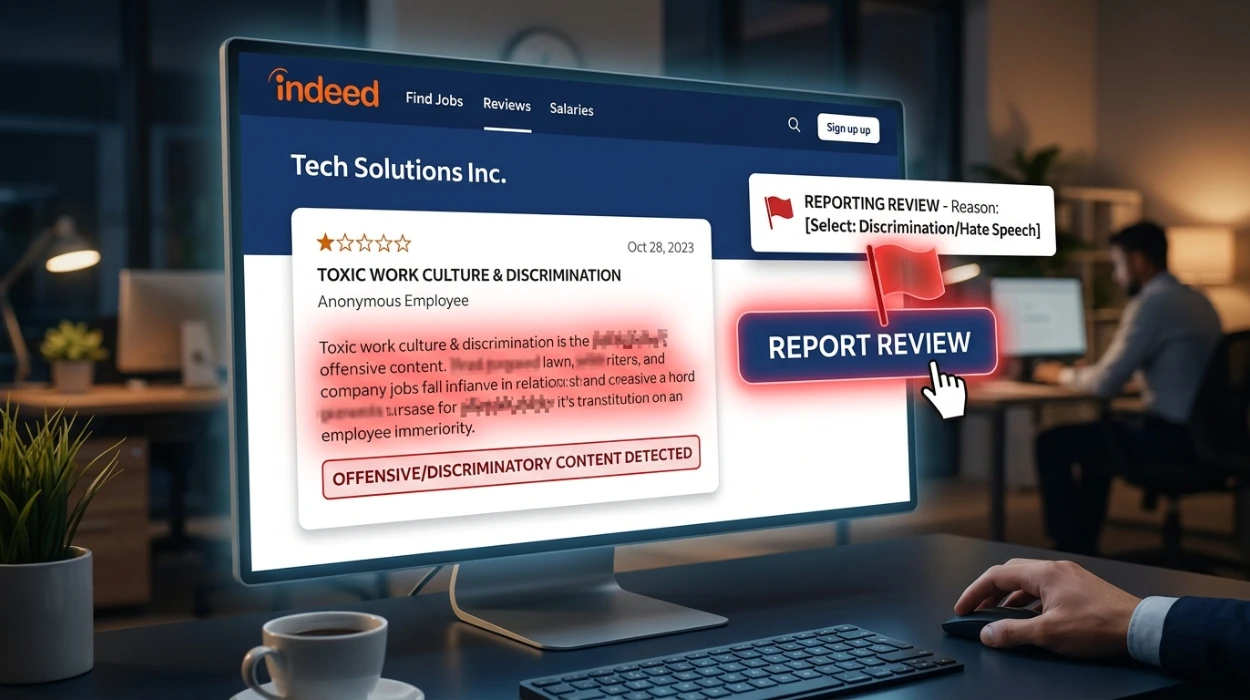
Discriminatory language in Indeed reviews can be reported because review platforms apply content standards to material involving harassment, discrimination, threats and other prohibited conduct. The reporting process separates legitimate workplace feedback from language that violates platform rules or creates an inappropriate information signal.
Reputation management is the process of analysing and influencing the information environment associated with a person, organisation or entity. Online reputation refers to how publicly available digital information contributes to perceived credibility, trust and entity perception within search ecosystems. On employment-review platforms, written reviews become part of this information environment because their wording, sentiment, relevance and visibility influence how organisations are evaluated.
Why can discriminatory language in an Indeed review be reported?
Discriminatory language can be reported when its content conflicts with the platform’s standards governing acceptable user-generated content. A review is not evaluated solely according to whether it is negative or critical; its language, subject matter and compliance with content rules form part of the assessment. Discrimination-related wording introduces a specific content-quality and policy issue because statements targeting protected characteristics differ from ordinary criticism of workplace conditions. Reporting therefore provides a mechanism for flagging content for platform-level evaluation.
From a reputation perspective, discriminatory language also creates a distinct reputation signal. Search users encountering a review interpret the language alongside the review’s rating, publication context and surrounding information. Content that appears prominently in a search results page can influence entity perception even when its underlying claims receive limited independent verification. The reporting mechanism therefore operates at the intersection of platform governance and online reputation.
How does discriminatory language differ from legitimate negative feedback?
Discriminatory language differs from legitimate negative feedback through the nature and target of the expression. A negative review can describe dissatisfaction with management, pay, working conditions, communication, workload or organisational processes without targeting a person or group through discriminatory language. The distinction relates to what the content communicates rather than whether the overall sentiment is favourable or unfavourable. This makes content classification more important than the review’s star rating alone.
Review signals contain multiple dimensions, including sentiment, subject matter, language and contextual relevance. A review expressing dissatisfaction with workplace management contributes a negative sentiment signal, while discriminatory wording adds a separate content characteristic. Search engines and users encounter these signals within the same digital footprint, but they do not represent identical forms of information. Understanding this distinction prevents reputation analysis from treating every negative review as equivalent.
What types of language create a reporting issue in an Indeed review?
Language creates a reporting issue when it crosses from workplace criticism into prohibited discriminatory, abusive or harassing expression. The relevant distinction depends on the actual wording, context and applicable platform rules rather than the reviewer’s overall opinion of an employer. Statements attacking an individual or group because of a protected characteristic represent a different information category from criticism concerning job duties or organisational decisions. Content analysis therefore requires examining the semantic meaning and target of the language.
Semantic interpretation is important because reputation systems process information in context. A search engine does not simply classify a page as positive or negative; relevance, language, entities, topical relationships and authority contribute to how content is understood and ranked. A review containing discriminatory terminology can therefore contribute a stronger negative association around an organisation’s entity name. Reporting addresses the platform-content layer, while search visibility analysis addresses how that information appears within the wider information ecosystem.
How does reporting discriminatory content affect search visibility?
Reporting discriminatory content initiates a platform-level review rather than directly changing search-engine rankings. The platform determines whether the reported material complies with its applicable content standards, while search engines independently determine how indexed pages appear in search results. This distinction is important because removing or restricting a review and changing its visibility in a SERP are separate processes. A change at one layer does not automatically produce an equivalent change at another layer.
Content indexing connects platform material with search visibility. When a review is publicly accessible and indexable, search engines can discover and associate its text with relevant queries and entities. If the underlying page changes, search engines process the updated page during subsequent crawling and indexing activity. The resulting search position depends on ranking dynamics rather than the reporting action itself.
How do review signals influence an organisation’s online reputation?
Review signals influence online reputation by providing publicly visible information about an entity from the perspective of reviewers. Rating values, written sentiment, recurring topics and review volume form part of the broader information environment surrounding an organisation. Search users frequently interpret these signals alongside official websites, news coverage, social profiles and other authoritative sources. Online credibility therefore develops from the combined information ecosystem rather than from one isolated review.
Sentiment interpretation adds another layer to review analysis. Positive, neutral and negative language provide different signals about perceived experiences, while discriminatory wording introduces a separate policy and content-quality dimension. A reputation assessment therefore evaluates both sentiment and semantic context. This produces a more accurate understanding of how reviews contribute to entity perception.
How do search engines interpret review content?

Search engines interpret review content through systems that evaluate relevance, meaning, links between entities and the overall quality and usefulness of indexed information. The ranking process does not simply count positive or negative words. Instead, search systems evaluate pages in relation to queries, topics, entities and other ranking signals. This means a review’s search visibility depends on its relationship with the wider indexed information environment.
Entity perception develops through repeated associations between an entity and publicly available content. If an organisation’s name frequently appears alongside particular topics, search engines can establish semantic relationships between the entity and those subjects. Review content therefore becomes one component of the entity’s digital footprint. The effect on perception depends on visibility, relevance, authority and the composition of competing information.
Why does content indexing matter when a discriminatory review is reported?
Content indexing matters because a published review exists within both a platform environment and a search environment. Reporting concerns whether the platform permits the content to remain available, while indexing concerns whether search engines have discovered and stored information about the page. These mechanisms operate independently but interact through publicly accessible content. A review can therefore remain relevant to search visibility until changes to the source are reflected through crawling and indexing.
SERP evaluation examines what users encounter for queries associated with an organisation, person or topic. Indexed review pages form part of that evaluation when they rank for relevant searches. Changes to the original content alter the information available for future crawling and indexing. Search visibility consequently depends on both the status of the source and the subsequent processing of that source by search systems.
How does authority influence the visibility of review content?
Authority influences visibility because search engines evaluate the credibility and relevance of pages within the broader information ecosystem. A review platform possesses an established domain structure and publishes large volumes of employment-related information, giving its pages a defined contextual relationship with workplace searches. Authority does not mean that every individual statement on a page is independently verified. It means that the source itself forms part of the ranking environment considered during SERP evaluation.
Trust signals also operate across the wider digital footprint. Official organisational information, reputable publications, professional profiles and consistent factual references provide additional sources through which an entity is understood. A balanced information environment contains signals from different source types rather than relying exclusively on user-generated reviews. Reputation analysis therefore evaluates source authority alongside content meaning and search visibility.
Can a discriminatory review influence entity perception before it is reported?
A discriminatory review can influence entity perception while it remains publicly visible and discoverable. Search users can encounter the review directly on the platform or through search results, where its wording becomes part of the information available during an evaluation of the organisation. The visibility of the content determines its practical exposure, while its language determines the nature of the reputation signal. Reporting does not erase the period during which users have already encountered indexed information.
This demonstrates why reputation systems operate across time rather than at a single point of publication. Content is created, published, indexed, ranked, viewed and potentially updated or removed. Each stage affects the information environment differently. Understanding these stages helps distinguish platform governance from search perception and prevents inaccurate assumptions about how reporting changes online reputation.
Dive Deeper With Our Expert Guides:
What Indeed’s Community Guidelines Actually Prohibit in Reviews
How Employer Branding Recovers After Negative Indeed Review Waves
How does reporting fit into a wider digital footprint analysis?
Reporting represents one component of digital footprint analysis because it addresses a specific piece of user-generated content. A complete digital footprint contains reviews, websites, social profiles, media coverage, directories and other publicly accessible references. Each source contributes different reputation signals according to its authority, relevance, visibility and semantic relationship with the entity. Analysing the complete footprint therefore provides more context than evaluating an individual review in isolation.
A structured analysis can evaluate the information environment through five connected stages:
- Identify discriminatory language by examining the exact wording, target and context of the review.
- Classify the content by distinguishing legitimate workplace criticism from language that falls within prohibited-content categories.
- Assess search visibility by checking whether the review is indexed and where it appears for relevant entity queries.
- Compare reputation signals by analysing the review alongside authoritative and independently published information.
- Monitor content changes by evaluating whether reported material remains visible, changes status or continues appearing through indexed references.
This framework separates content-policy analysis from search-ranking analysis while keeping both within the same reputation ecosystem.
Why is the distinction between reporting and reputation management important?
The distinction matters because reporting addresses content compliance, whereas reputation management evaluates the wider information environment surrounding an entity. A platform can assess whether specific wording violates its rules without determining how that content affects search visibility across external search engines. Conversely, search-ranking systems can display information without determining whether the original content complies with a platform’s internal policies. These are different governance and ranking mechanisms.
Online credibility emerges from the interaction of these systems. How to Report Harassment or Discrimination in an Indeed Review therefore represents a more specific procedural topic within the broader analysis of review content and reputation signals. Understanding the reporting mechanism helps establish where platform moderation begins and where wider search perception analysis continues. This distinction produces a more precise model of digital reputation.
What does discriminatory language in reviews reveal about online reputation systems?
Discriminatory language demonstrates that online reputation is influenced by content quality, policy compliance, semantic meaning and visibility rather than sentiment alone. Reviews function as reputation signals because they provide publicly accessible information associated with an organisation’s entity. Their impact depends on how users encounter them and how search systems process the associated pages. Content governance and search visibility therefore form connected but distinct layers of reputation analysis.
The wider principle is that reputation systems are information systems. Content is created by users, processed by platforms, discovered through crawling, stored through indexing and evaluated through ranking mechanisms. Users then interpret the resulting information according to context, credibility and perceived relevance. A discriminatory review can therefore become a reputation issue at multiple stages, while reporting addresses the specific platform-level question of whether the content is permitted.
Why can discriminatory language in Indeed reviews be reported?
Discriminatory language in Indeed reviews can be reported because content moderation systems distinguish prohibited language from legitimate workplace criticism. Reporting addresses the status of the review within the platform, while search engines independently determine indexing and ranking. The two processes interact through publicly accessible information but remain operationally separate.
From a reputation-management perspective, discriminatory reviews form part of an organisation’s wider digital footprint and reputation signals. Their influence depends on language, context, source authority, indexing and search visibility. Understanding these mechanisms provides a clearer explanation of how review content affects entity perception and online credibility without treating every negative review as the same type of reputation signal.
Can discriminatory language in an Indeed review be reported?
Yes. Discriminatory, abusive, or hateful language in an Indeed review can be reported when it violates Indeed’s community guidelines or content standards. The report should identify the specific language and explain why it breaches the relevant policy.
What types of discriminatory language can be reported on Indeed?
Discriminatory language targeting protected characteristics, including race, religion, sex, disability, age, or other protected attributes, can be grounds for reporting. Content that contains harassment, hate speech, or discriminatory abuse may also violate Indeed’s review guidelines.
How do you report an offensive or discriminatory Indeed review?
Use Indeed’s reporting mechanism associated with the review and select the reason that best describes the policy violation. Provide specific details about the discriminatory wording so the platform can assess the content against its guidelines.
Will Indeed remove a review containing discriminatory language?
Indeed can remove review content that violates its community guidelines, including prohibited discriminatory or abusive material. Removal depends on the platform’s assessment of the reported content and its applicable moderation policies.
Can Clear Your Name help with a discriminatory Indeed review?
Clear Your Name can assist with reviewing the content, identifying potentially relevant policy violations, and structuring evidence for a review removal request. The outcome ultimately depends on Indeed’s moderation process and whether the content breaches its applicable guidelines.