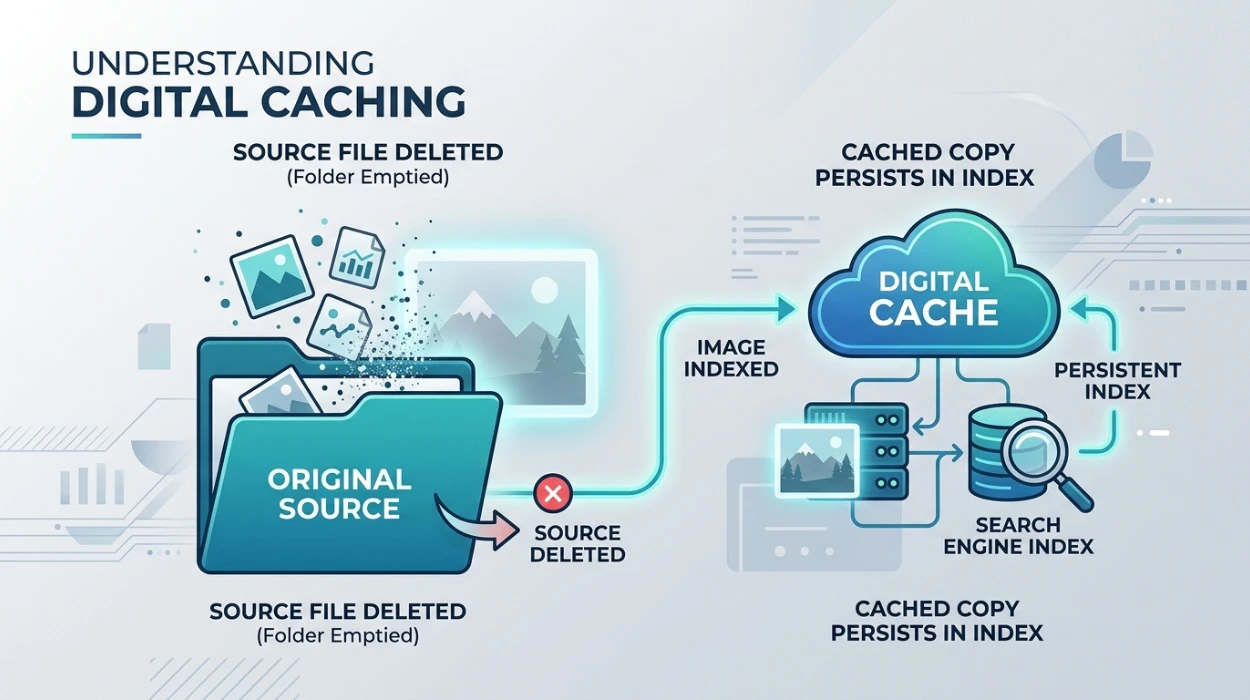
Images can persist in Google Search after deletion because search engines store indexed information and cached references that are not removed immediately when the original file disappears. Search systems require recrawling, reprocessing, and index updates before search results reflect changes made at the source.
Reputation management is the process of understanding how digital information influences public perception and search visibility. Online reputation refers to the collection of content, signals, and indexed information that shapes how an individual or organisation is interpreted within search ecosystems.
Why do deleted images remain visible in Google Search?
Deleted images remain visible because search engines operate through indexed copies and stored references rather than direct, real-time connections to websites. An image that disappears from a source page does not automatically disappear from search results because the search engine must first confirm that the file is no longer available.
Content indexing is the process of discovering, storing, and organising information for retrieval in search results. Images become part of search indexes through crawling and indexing mechanisms that create references to the original content. These references persist until search systems revisit the source and update their records.
This delay affects search visibility and reputation signals because outdated images can continue influencing entity perception. Search users often interpret visible images as current information, even when the original source no longer exists.
What is image indexing within search ecosystems?
Image indexing is the process through which search engines discover, analyse, and catalogue visual content. Search systems evaluate image files, metadata, page context, and relevance signals to determine whether an image should appear in search results.
Image indexing also contributes to digital footprints. Every indexed image becomes another piece of publicly available information that can influence online credibility and search perception. Images associated with individuals or organisations often appear prominently in search engine results pages because visual content receives strong engagement signals.
Search algorithms analyse image relevance through surrounding text, page authority, and user interaction. These evaluations influence ranking dynamics and determine which images remain visible within image search environments.
Dive Deeper With Our Expert Guides:
How Images Get Indexed in Google and What Makes Them Eligible for Removal
Why does Google use cached information for images?
Cached information is stored data that enables search engines to provide results efficiently without repeatedly requesting the same information from a source website. Search systems create temporary representations of content to improve retrieval speed and maintain stable search experiences.
Caching creates a delay between source changes and search updates. When an image is deleted, the cached reference can continue appearing until the search engine verifies the change and refreshes its index. This process explains why image persistence frequently occurs even after the original content has been removed.
From a reputation perspective, cached information influences search visibility because outdated visual content continues contributing to public perception. Search users often evaluate credibility and trust using the information visible within search results rather than the status of the original source.
How do search engines determine when to remove deleted images?
Search engines determine whether an image should be removed by recrawling the source and identifying changes in content availability. The process relies on automated systems that revisit indexed pages and reassess stored information.
Which factors influence image removal from search indexes?
- Detect content changes by revisiting indexed pages and identifying missing files or altered URLs.
- Evaluate response codes by determining whether a page returns error messages or confirms content deletion.
- Update index records by replacing outdated information with newly discovered content status.
- Recalculate ranking signals by assessing whether the removed image still contributes to search relevance.
These mechanisms demonstrate that image removal is not an immediate process. Search engines require confirmation that information has changed before updating their indexes and search results.
Why do deleted images continue affecting online reputation?

Deleted images continue affecting online reputation because search users rely on visible information when forming impressions. An image that remains in search results continues contributing to reputation signals and entity perception regardless of its status at the original source.
Online credibility is strongly influenced by visual information. Images frequently attract attention more rapidly than text and can become dominant reputation signals within search environments. Search engine results pages often display images prominently, increasing their influence on perception and trust evaluation.
The persistence of outdated images demonstrates how digital footprints operate. Information that enters search ecosystems can remain accessible beyond its intended lifespan and continue affecting public understanding of individuals, organisations, and brands.
How do search algorithms interpret image relevance and authority?
Image relevance refers to the degree to which visual content aligns with search queries and user intent. Authority refers to the credibility and trust associated with the source of that content. Search algorithms evaluate both factors when determining image visibility.
Authority signals include page reputation, domain credibility, contextual relevance, and user engagement patterns. Images hosted on authoritative websites frequently maintain strong search visibility because search engines interpret these sources as reliable.
Relevance and authority also influence reputation formation. Images from trusted sources often receive greater prominence in search results, increasing their role in shaping entity perception and online credibility.
Why does image persistence create long-term digital footprint issues?
A digital footprint is the collection of information about an entity that exists online and contributes to public perception. Indexed images form part of this footprint because they remain searchable, accessible, and capable of influencing reputation signals.
Image persistence creates long-term issues because visual information can continue appearing even after deliberate attempts to remove it. Search engines process information according to indexing schedules rather than user expectations regarding immediacy.
This persistence affects reputation management because organisations and individuals cannot assume that deleted content instantly disappears from search environments. The continued visibility of images demonstrates that search ecosystems maintain information independently of source changes.
How does image persistence influence search visibility and entity perception?
Search visibility refers to the prominence of information within search engine results pages. Entity perception refers to how individuals and organisations are understood based on available information. Persistent images affect both concepts because visual content contributes directly to first impressions.
Search engines use available information to construct representations of entities. Images that remain indexed continue influencing those representations and contribute to search perception even after deletion from the source.
Because visual information often receives high engagement levels, persistent images can become disproportionately influential reputation signals. Their continued visibility shapes trust, credibility assessments, and broader interpretations of an entity’s digital identity.
Why do search ecosystems process image changes more slowly than users expect?
Search ecosystems process information through automated systems that balance efficiency, scale, and accuracy. Search engines index billions of pages and images, making continuous real-time updates impractical.
The delay between source deletion and search removal reflects the operational structure of content indexing systems. Search engines require evidence that information has changed and must then update records across distributed systems.
Individuals seeking to understand image persistence frequently explore How to Remove an Image From Google Search in the UK Using Privacy and Copyright because removal processes depend on both search indexing mechanisms and the legal or privacy frameworks that govern online information.
Images persist in Google Search after deletion because search engines rely on indexed information, cached references, and scheduled recrawling processes rather than immediate updates from source websites. This delay allows outdated visual content to remain visible and continue influencing search perception.
Image persistence demonstrates how digital footprints function within search ecosystems. Indexed visual content contributes to reputation signals, online credibility, and entity perception even after the original source changes. Understanding content indexing, caching mechanisms, and search processing timelines provides a clearer understanding of why deleted images continue appearing in search results and how they influence long-term online reputation.
Why do deleted images still appear in Google Search?
Deleted images can remain visible because Google stores indexed information and cached references that are not updated immediately. The search engine usually needs to recrawl the source and refresh its index before removing the image from search results.
How long does it take for Google to remove a deleted image from search results?
The time varies depending on when Google’s systems revisit the webpage and process the change. Some images disappear quickly, while others remain visible until the search index is updated.
Does deleting an image from a website remove it from Google Images automatically?
No. Removing an image from a website does not automatically remove it from Google Images because search engines maintain indexed records independently of the source website. The image can continue appearing until Google updates its search index.
Can persistent images affect online reputation?
Yes. Images that remain visible in search results can continue influencing reputation signals, entity perception, and public trust even after they have been deleted from the original source. Visual content often forms a significant part of an individual’s or organisation’s digital footprint.
What are Google Image Removal Services used for?
Google Image Removal Services are generally used to assess options for removing or reducing the visibility of images that remain in search results. Services such as those offered by Clear Your Name focus on understanding search indexing, privacy concerns, and image-related reputation issues.