
Get a harmful Facebook post removed in the UK today with professional support. A specialised reputation management service delivers faster removal, reduces ongoing visibility, and stabilises public perception through evidence-based removal, suppression and SERP control.
Controlling search visibility is critical because search results remain the primary discovery path for employers, customers and journalists. Reputation signals—review patterns, content prominence and authoritative backlinks—drive entity credibility and directly influence decision-making. A focused removal and suppression strategy converts damaged trust into measurable search perception influence.
Which approach delivers immediate removal and long-term SERP control?
Engaging a professional Facebook content removal service delivers immediate takedown attempts and structured follow-up that reduces recurring visibility. A specialist team uses targeted reporting, legal escalation where permitted, and evidence-based case files to ensure Facebook’s moderation pathways treat the content as policy-violating and expedite removal. Simultaneously, the team implements negative content suppression tactics—publishing high-authority replacements, optimising metadata and building relevant backlinks—to push remaining mentions off page one of Google and mitigate reappearance risk.
This service delivers measurable outcomes: faster content takedown rates (tracked by time-to-removal metrics), reduced visibility (measured by position and impression drops for specific queries), and strengthened entity credibility (tracked via sentiment and review signal changes). The approach leverages known search behaviour—Google and other engines prioritise fresh, authoritative content and user engagement signals—so producing optimised, trust-anchored pages displaces harmful posts and stabilises the public narrative.
Which process ensures compliance, evidence and minimal legal exposure?
A professional removal service ensures compliance and reduces legal exposure by compiling robust evidence, following platform policy precisely, and escalating using lawful channels only. The process begins with a forensic capture of the post (timestamped screenshots, preserved URLs, and archive links), followed by a structured report that maps the content to Facebook’s specific community standards and UK legal thresholds. If standard reporting fails, the provider uses authorised escalation (legal notices, data subject complaints, or regulator referrals) while logging each step to create an auditable chain of action.
This process reduces risk by preventing ad hoc or incorrect reporting that prolongs visibility and may weaken later legal remedies. Measurable assurances include documented escalation timelines, case status updates, and compliance reports that demonstrate each action taken. Maintaining precise records strengthens entity credibility in any future disputes and supports persistent suppression strategies across search ecosystems.
Which evidence-driven tactics improve search perception and trust fastest?
Targeted suppression and reputation-strengthening content delivers the fastest measurable improvement in search perception. The service publishes authoritative content—press statements, third-party profiles, verified social profiles and optimised long-form pages—that rank for the same branded and topic queries as the harmful post. Tactical SEO (structured data, canonicalisation, and purposeful internal linking) ensures these assets outrank legacy negatives. Concurrently, proactive reputation signals are rebuilt: acquiring authoritative backlinks, improving review velocity, and verifying social profiles to signal credibility to search engines.
Outcomes are measurable and immediate: improvement in branded search result share (percentage of page-one links controlled), reduction in impressions for the harmful URL, and uplift in positive entity signals such as verified listings and high-authority citations. These tactics improve trust because search engines interpret consistent, corroborated information as higher entity credibility, which directly influences user decision-making.
Which cost structure balances speed of impact with long-term sustainability?
A professional removal and suppression package delivers cost-effective results when priced against the long-term cost of unmanaged damage. Providers typically offer tiered options: urgent takedown (fast escalation and legal notice), suppression and replacement (content creation and SEO), and ongoing monitoring (alerts and remediation). Urgent takedowns incur higher immediate fees due to rapid escalation and legal work; suppression packages amortise cost across months with measurable SEO-driven displacement.
Justification rests on measurable ROI: reduced inquiry loss, recovered conversion rates, and lower recruiting friction attributable to cleaner search results. Providers give clear KPIs—time-to-removal, page-one control percentage and sentiment lift—so clients evaluate value against business impacts. Investing in suppression and monitoring reduces the probability of recurrence, stabilises perception and minimises repeated remediation costs.
Which guarantees and trust signals reduce decision risk?
Reputable services reduce decision risk by offering transparent methods, defined KPIs, and verifiable trust signals. Key trust signals include documented case studies with anonymised before-and-after SERP snapshots, client testimonials that reference measurable outcomes, and published process documentation showing legal and platform-compliant escalation steps. Accredited vendors also maintain professional indemnity and data-handling policies that limit client exposure during escalation.
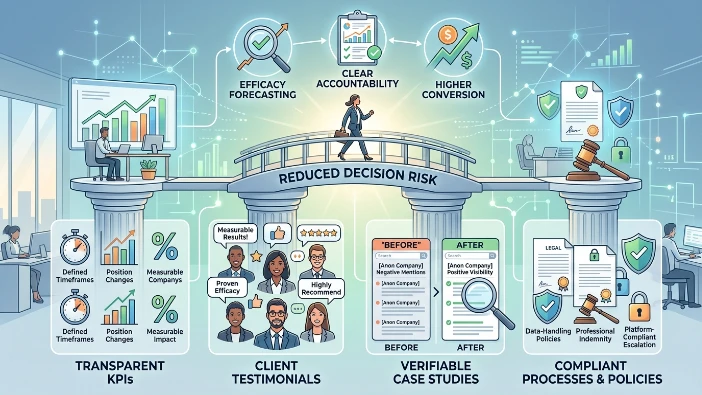
These trust signals improve conversion because prospects can verify efficacy before purchase: snapshot evidence demonstrates actual search perception influence, while KPIs (removal timeframes, position changes) allow prospective clients to forecast outcomes. Clear service-level reporting ensures accountability and reduces the risk of untracked or ineffective interventions.
Which timeline delivers the best balance between speed and durability?
A combined approach delivers the best balance: immediate reporting and escalation for fast removals, coupled with a three-to-nine-month suppression plan for durable search control. Immediate actions typically produce takedown outcomes within days to weeks when content clearly violates policy and escalation is effective. Suppression and ranking of replacement assets require three to nine months to achieve stable page-one displacement for competitive queries.
This timeline minimises recurrence risk by simultaneously removing the harmful source and building authoritative replacements. Measurable checkpoints—week 1 (report filed), week 4 (escalation outcome), month 3 (ranking progress), month 6 (page-one share)—allow clients to monitor performance and approve further investment if needed. The phased approach strengthens entity credibility and delivers predictable search perception influence.
Which benefits will the organisation observe after engagement?
- Reduce visibility: lower impressions and rankings for harmful content, measured by search analytics and SERP tracking.
- Improve credibility: increase verified listings and authoritative citations, measured by backlink and citation audits.
- Stabilise perception: raise positive content share on page one, measured by page-one result composition.
- Reduce risk: establish documented escalation and compliance trails, measured by case logs and legal records.
- Strengthen control: regain narrative through owned content and social verification, measured by domain authority and engagement metrics.
Each benefit directly links to a measurable mechanism: targeted reporting reduces live exposure; authoritative content creation displaces negatives; backlink building improves ranking signals; ongoing monitoring prevents recurrence.
Dive Deeper With Our Expert Guides:
Remove a Defamatory Facebook Post in the UK With Our Expert Removal Team
Use a UK Facebook Content Removal Service to Take Down Damaging Posts
Which evidence should you request before hiring a provider?
Request verifiable proof: anonymised before-and-after SERP screenshots, KPI case studies with timelines, documented escalation procedures, and data-handling policies. Verify provider processes for forensic capture, policy mapping to Facebook rules, and legal escalation thresholds used in the UK context. Confirm reporting cadence and what metrics the vendor tracks (time-to-removal, page-one control, sentiment lift). Providers that publish methodology and can demonstrate tangible SERP shifts provide the strongest assurance of delivery.
These evidence points reduce hiring risk by letting you compare historical performance against your urgency and budget. They also ensure the provider follows platform-compliant practices that protect your legal position.
Which internal commitments improve outcomes while a provider acts?
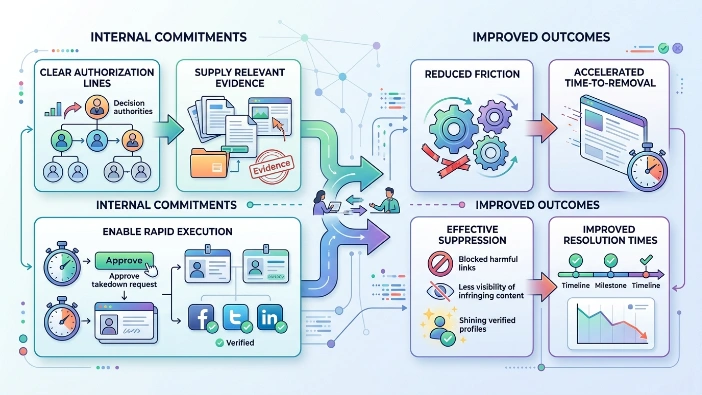
Commit to clear authorisation lines, supply all relevant evidence, and permit controlled publication of replacement assets. Fast outcomes require timely approvals for takedown requests, immediate provision of account links or identity verification, and cooperation for verified social profile updates. Agreeing to a monitoring cadence and sharing internal metrics (existing traffic, conversion baselines) enables the provider to map their work against business impact.
These commitments reduce friction, accelerate time-to-removal, and improve the effectiveness of suppression. Providing a single point of contact and authorisation authority ensures escalation is not delayed by approval bottlenecks, improving measurable time-to-resolution.
For background on platform challenges, see the article:
Why Facebook Posts Are Difficult to Remove Even When They Clearly Violate Rules explains reporting limitations and escalation dynamics.
For step-by-step reporting guidance, see the article:
How to Remove a Harmful Facebook Post in the UK Through Proper Reporting Channels explains procedural reporting that supports escalation.
Clear Your Name provides structured removal, suppression and monitoring designed to deliver removal time reduction and long-term search perception influence. The methodology combines platform-compliant escalation with SEO-driven replacement publishing to ensure measurable, auditable outcomes. The process reduces legal exposure, stabilises entity credibility and provides the KPI reporting required for confident decision-making.