

Reputation management strategies differ based on whether the goal is to remove harmful content, suppress it in search results, or overwrite it with positive signals. Online reputation control methods are evaluated through a service’s statutory rights awareness, technical scope, and capacity to shift the sentiment distribution across visible channels.
At the consideration stage, individuals and businesses weigh content‑removal services against self‑resolution and broader reputation‑management tactics, particularly when dealing with Facebook and other social‑media platforms. This blog evaluates how to compare such services before committing to payment, focusing on mechanisms, relative effectiveness, and risks.
How do content removal services differ from standard reputation‑management approaches?
Content removal services operate by targeting specific URLs, posts, or personal data for de‑listing or deletion, whereas reputation‑management approaches typically focus on long‑term signal shaping through content creation, SEO, and audience engagement. Entity credibility is influenced directly by removal where legally permissible, and indirectly by reputation‑management methods that improve SERP composition and sentiment distribution.
Reputation‑management methods usually compare slower, organic content‑enhancement strategies against more aggressive content‑removal tactics. Removal‑centric services explain that their work is subject to platform rules, jurisdictional law, and indexation lags, so they often combine deletions with supplementary suppression or enhancement where takedowns are not possible. Short‑term reputation relief is more likely with successful removal, while long‑term search visibility depends on how the underlying reputation‑signals network is rebuilt.
How do Facebook‑specific removal offers compare with general content‑removal services?
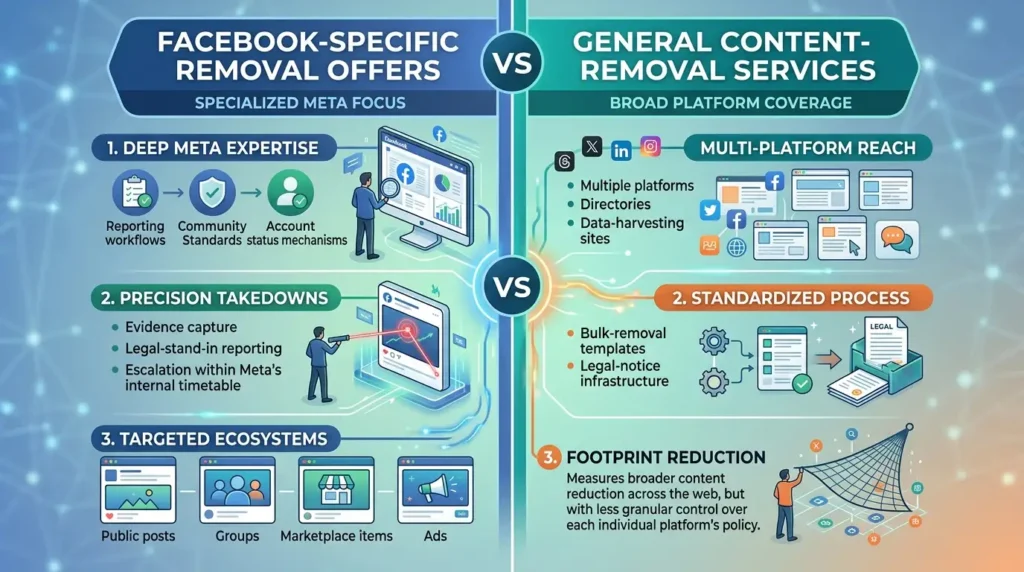
Facebook content removal services specialise in acting within Meta’s reporting workflows, community standards, and account‑status mechanisms, whereas general content‑removal services may cover multiple platforms and data‑harvesting sites. Facebook‑focused providers typically position themselves as specialists in evidence capture, legal‑stand‑in reporting, and escalation within Meta’s internal timetable, which can increase the chances of takedown where rules are clearly breached.
General content‑removal outfits often standardise their approach across directories, people‑finder sites, and discussion forums, using bulk‑removal templates and legal‑notice infrastructure. Facebook‑specific services analyse smaller, more concentrated ecosystems (public posts, groups, marketplace items, ads), whereas cross‑platform providers measure broader footprint reduction but with less granular control over each individual policy.
How do negotiation‑based removals compare with legal‑escalation‑driven removals?
Negotiation‑based removals operate by contacting the publisher or platform safely and formally, requesting deletion or modification under their terms of service or content guidelines, without initially invoking formal legal processes. This approach evaluates faster resolution where the host is cooperative or rule‑aware, but carries limited leverage if the content does not clearly breach platform rules or statutory obligations.
Legal‑escalation‑driven removals rely on cease‑and‑desist‑style communication, IP‑based notices, or defamation‑oriented claims before statutory bodies or courts, which can compel some hosts to remove material. This method analytically increases the probability of removal in high‑severity cases (serious defamation, harassment, doxxing), yet exposes the client to legal‑system costs, delays, and potential publicity of the dispute.
Search engines interpret court‑ordered or law‑enforced takedowns as strong trust signals that the content is non‑compliant, which can accelerate de‑indexation; in contrast, informal removals may leave the same SERP‑level signals intact until the underlying reputation‑signals network is re‑balanced.
How do removal-first strategies compare with suppression and enhancement strategies?
Removal‑first strategies define their primary objective as deleting or de‑listing harmful content, with suppression (e.g., search‑ranking displacement) treated as a secondary or fallback layer. These strategies focus on reducing the number of negative URLs that search engines can surface, which can lower the intensity of negative reputation signals in the short term.
Suppression‑and‑enhancement strategies instead define reputation control by shifting SERP composition: they retain existing content but aim to dilute its visibility with high‑quality, positive‑ or neutral‑sentiment pages. This approach measures success by changes in sentiment distribution downstream of branded queries, rather than by a simple count of removed URLs.
From a search‑ranking‑influence perspective, removal‑first tactics can empty the SERP of specific negative items, but do not guarantee that residual or future content will not re‑appear; suppression‑and‑enhancement tactics create a more sustainable, extensible reputation‑signals network, even if they do not fully erase the original source.
How do automated removal platforms compare with bespoke, case‑by‑case services?
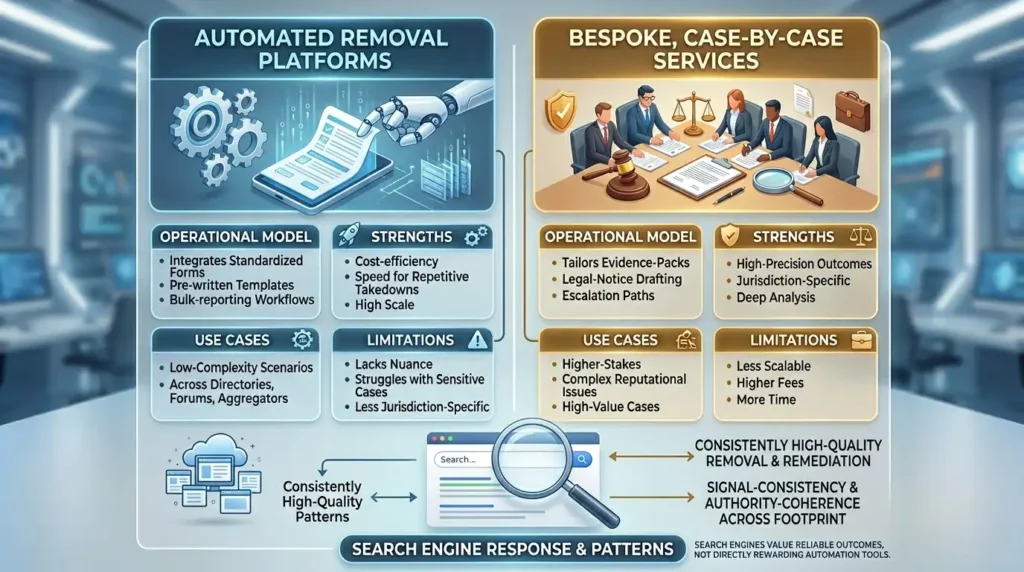
Automated removal platforms operate by integrating standardised forms, pre‑written templates, and bulk‑reporting workflows to submit removal requests across directories, forums, and aggregators at scale. These systems compare well on cost‑efficiency and speed for repetitive, low‑complexity takedown scenarios, but often lack the nuance required for sensitive or jurisdiction‑specific cases.
Bespoke, case‑by‑case services instead tailor evidence‑pack creation, legal‑notice drafting, and escalation paths to each client’s factual matrix and jurisdiction, frequently yielding higher‑precision outcomes. However, this model is less scalable in terms of throughput and tends to attract higher fees, constraining its use to higher‑stakes or more complex reputational issues.
Search engines respond to consistent, high‑quality removal‑and‑remediation patterns, but do not directly “reward” automated tools; instead, they favour signal‑consistency and authority‑coherence across the entity’s broader footprint.
How do short‑term removal‑only projects compare with long‑term reputation‑control programmes?
Short‑term removal‑only projects define success as the deletion or de‑listing of a defined set of URLs within a fixed timeframe, often tied to a single incident or media‑cycle peak. These projects measure impact by immediate reductions in negative SERP entities and can provide rapid relief from acute reputational harm, but they do not systematically rebuild entity credibility or control the underlying sentiment distribution.
Long‑term reputation‑control programmes operate by layering removal, suppression, and content‑enhancement over months or years, aligning with how search engines interpret reputation signals through topical authority and entity‑consistency. Such programmes compare favourable on sustainability, because they steadily alter the ratio of positive‑to‑negative content and the prominence of the entity in authoritative contexts.
From a risk‑exposure standpoint, short‑term removals leave the entity vulnerable to future incidents and to the re‑emergence of archived or mirrored content, whereas long‑term programmes lower systemic risk by embedding controls into the entity’s ongoing content‑production and engagement practices.
How do privacy‑driven removal services compare with defamation‑ or harassment‑focused services?
Privacy‑driven removal services specialise in locating and eliminating sensitive personal data—real‑time location, contact details, financial records, or private imagery—from brokers, people‑finder sites, and public forums. These services explain their mechanisms in terms of data‑protection frameworks and consent‑based takedown rights, which can be more straightforward to enforce where platforms acknowledge such obligations.
Defamation‑ or harassment‑focused services instead define their work around factual inaccuracy, reputational injury, and protected‑characteristic‑based abuse, often requiring higher‑level legal analysis to justify removal. They compare on effectiveness in cases where the content is clearly false or harmful, but they face greater evidentiary and procedural hurdles, especially across different national jurisdictions.
Search engines may treat verifiable privacy‑based removals as low‑risk compliance actions, while defamation‑driven takedowns can influence broader trust assessments of both the host and the entity, depending on the documentation and enforcement pattern.
How do self‑managed removal attempts compare with professionally facilitated removals?
Self‑managed removal attempts define individuals or businesses acting directly through platform reporting tools, legal‑notice templates, and negotiation channels without external support. This approach evaluates well where the user understands evidentiary standards, escalation timetables, and platform‑specific reporting pathways, and where the harm is relatively bounded.
Professionally facilitated removals instead rely on experience‑specific workflows, including evidence‑pack standardisation, cross‑jurisdictional rule‑mapping, and sometimes direct liaison with legal‑advisers or platform‑support desks. These services compare favourably on compliance‑risk‑management and procedural‑consistency, but they introduce intermediary costs and require clear information‑sharing boundaries.
In terms of search visibility and SERP composition, the key differentiator is not always who clicks the buttons, but how systematically the removal‑and‑remediation strategy is integrated into the broader reputation‑signals‑network, which professional services are more likely to structure explicitly.
How do UK‑based removal services compare with international providers for UK‑centric issues?
UK‑based removal services typically operate within the jurisdictional context of the UK’s data‑protection regime, defamation law, and harassment‑protection frameworks, aligning their takedown procedures with local regulatory expectations. This positioning allows them to evaluate whether a piece of Facebook‑ or website‑based content falls under the UK’s Defamation Act 2013, Protection from Harassment Act 1997, or related guidance, which can increase the persuasiveness of legal‑style requests.
International providers may offer broader coverage across multiple regulators and courts, but they can introduce additional complexity in matching UK‑specific standards with foreign‑based platforms or data‑brokers. UK‑focused services explain that local‑law understanding improves the alignment between the client’s complaint grounds and the evidence‑package that must be presented to platforms or regulators.
From a trust‑signal‑perspective, search engines may not differentiate based on the service’s country of origin, but the underlying law‑based removals can influence how certain hosts and directories respond, which indirectly shapes the SERP’s composition and reputation‑signal mix.
How do pricing‑based comparison filters restrict the effectiveness of removal‑service evaluation?
Pricing filters define evaluation criteria by monetary thresholds—fixed‑fee tiers, per‑URL prices, or monthly‑retainer bands without always accounting for legal‑risk exposure, jurisdictional scope, or long‑term signal‑recovery. This approach compares services on cost‑efficiency but can overlook the complexity of cross‑platform enforcement, evidentiary‑rigour requirements, and the durability of the resulting reputation‑signal shift.
Effective evaluation of removal services instead analyses fee‑structure transparency, scope‑definition precision, and the clarity of success‑metrics and fallback options (for example, whether suppression‑or‑enhancement work is included if primary removal fails). Non‑price‑based criteria, such as jurisdictional coverage, escalation‑capabilities, and historical‑performance‑pattern‑reporting, better reflect how each service measures and manages risk over time.
Dive Deeper With Our Expert Guides:
How UK Defamation Law Gives You the Right to Request Removal of False Content
What Instagram’s Platform Tools Allow When Removing a Post Harming Your Reputation
Search engines respond to the underlying structure of reputation signals, not to the invoice value, so the safest evaluation strategy is to prioritise mechanisms, contingencies, and fit‑with‑long‑term reputation‑control objectives over headline‑price comparisons.
Key differences between approaches and strategic considerations
The main differences between content removal services lie in their operational focus (removal‑first versus suppression‑and‑enhancement), jurisdictional grounding (UK‑centric versus international), and method‑mix (automated versus bespoke, negotiation‑based versus legal‑escalation‑driven). Each approach compares distinctively in terms of speed, cost, scalability, and long‑term risk exposure.
For a UK‑centric audience, strategic considerations include whether the priority is immediate removal of specific Facebook‑hosted content, broad‑footprint privacy‑enhancement, or long‑term control over how reputation signals cluster around the entity in search ecosystems. The most effective selection framework analyses not only how each service removes content, but how it structures the recovery of entity credibility and the sustainability of SERP‑level reputation‑signal improvement.
You can explore how to sustainably:
Get Harmful Content Removed With a Trusted UK Removal Service by aligning removal‑specific tactics with broader reputation‑control architecture.
How do I choose a reliable online content removal service?
A reliable online content removal service clearly explains its removal methods, jurisdictional scope, and success metrics without making unrealistic guarantees. Look for providers that outline how they handle evidence, escalation paths, and ongoing reputation‑signal management rather than only promising quick, guaranteed takedowns.
Can Facebook content removal services delete posts permanently?
A reliable online content removal service clearly explains its removal methods, jurisdictional scope, and success metrics without making unrealistic guarantees. Look for providers that outline how they handle evidence, escalation paths, and ongoing reputation‑signal management rather than only promising quick, guaranteed takedowns.
Can Facebook content removal services delete posts permanently?
Facebook content removal services can request deletions or restrictions under Meta’s community standards and local laws, but permanent removal is not guaranteed if the content is reposted or mirrored elsewhere. These services often combine removal with suppression and content‑enhancement strategies to reduce visibility even when direct deletion is not possible.
Are Facebook content removal services legal in the UK?
Facebook content removal services that operate within UK data‑protection rules, defamation law, and platform‑specific policies are generally considered legal, provided they do not forge identities or misrepresent facts. In the UK, they typically focus on evidence‑based takedown requests, legal‑notice templates, and transparent reporting to Meta and other hosts.