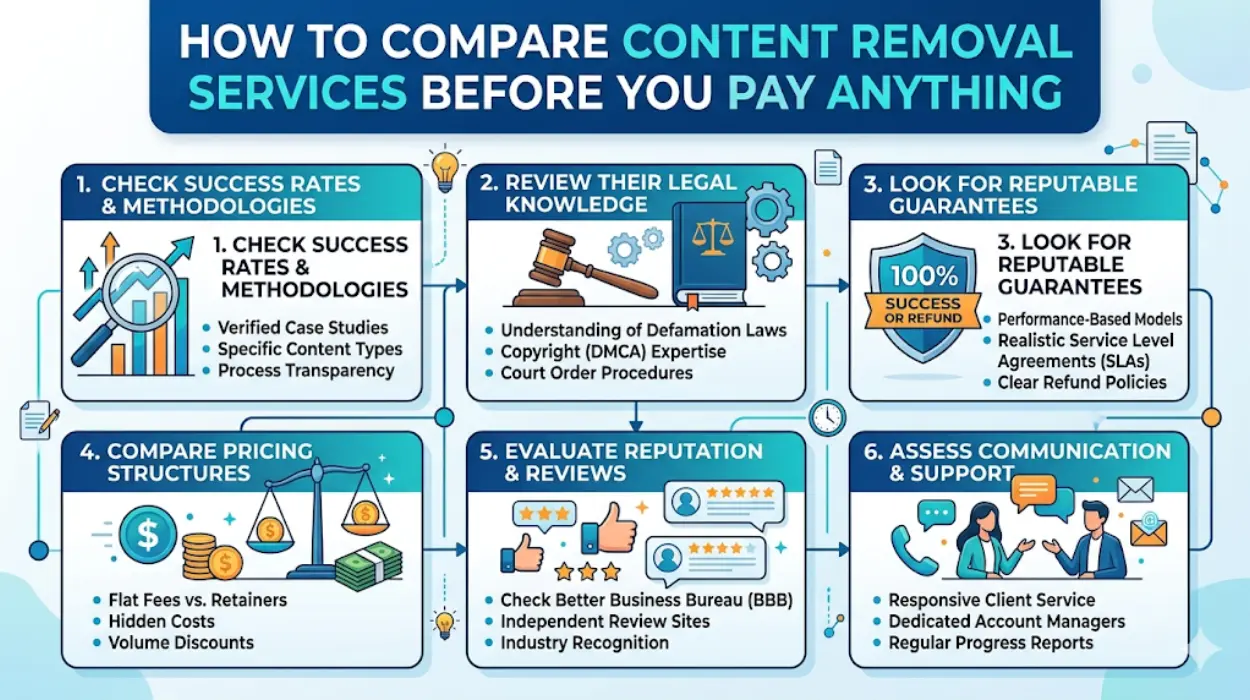
Content removal services are compared by evaluating their mechanisms, legal basis, scalability, and impact on search visibility before any financial commitment is made.
Reputation management strategies differ based on reactive removal versus proactive content control, while online reputation control methods are evaluated through their influence on reputation signals, entity credibility, and SERP composition.
What criteria determine the effectiveness of content removal services?
Content removal effectiveness is determined by legal enforceability, removal success rate, and impact on search indexation. It measures how reliably a service eliminates or deindexes harmful URLs while preserving long-term entity credibility and reducing negative sentiment distribution across search results.
Content removal services are processes that eliminate or suppress harmful digital assets from public access. These services operate by submitting legal requests, platform complaints, or technical deindexing instructions to publishers and search engines. The mechanism depends on jurisdictional compliance, platform policies, and search engine guidelines.
Effectiveness compares removal success against persistence of indexed content. Legal takedowns provide high certainty when applicable. Platform-based removals depend on policy interpretation. Deindexing reduces visibility without deleting the source content. Each method influences search ranking differently.
Search engines interpret removal as a shift in available reputation signals. When harmful content disappears, sentiment distribution shifts positively. However, incomplete removal leaves residual signals that continue to affect entity credibility. This creates partial improvement rather than full reputation repair.
Limitations emerge when content is hosted on resistant domains or replicated across multiple sources. Scalability becomes restricted when each URL requires individual action. Sustainability depends on whether removed content reappears through syndication or scraping.
How do legal removal methods compare to platform-based takedowns?
Legal removal methods provide enforceable outcomes, while platform-based takedowns rely on policy compliance and moderation decisions. The comparison evaluates authority, consistency, and risk exposure across both approaches within search ecosystems.
Legal removal is a structured process grounded in defamation law, privacy law, or copyright enforcement. It operates by issuing formal notices that compel publishers or hosts to remove content. This approach creates strong authority signals due to legal validation.
Platform-based takedowns operate by submitting complaints to website administrators or content platforms. These systems evaluate claims against internal guidelines rather than legal standards. The mechanism prioritises policy compliance over legal enforcement.
Legal methods demonstrate higher reliability in permanent removal. They influence search ranking by eliminating content at the source. Platform takedowns demonstrate variability due to subjective moderation outcomes. This creates inconsistency in removal success rates.
Risk exposure differs significantly. Legal action introduces financial and procedural complexity. Platform takedowns present lower entry barriers but higher uncertainty. From a reputation perspective, legal removal strengthens entity credibility through formal validation.
Scalability favours platform-based approaches for large volumes of content. Legal methods remain effective for high-impact cases but lack efficiency for widespread issues. Sustainability depends on whether removed content is legally restricted from re-publication.
Is content removal more effective than content suppression strategies?
Content removal eliminates harmful signals, while content suppression reduces their visibility through positive content creation. The comparison evaluates direct versus indirect control over SERP composition and sentiment distribution.
Content removal is a reactive approach focused on eliminating negative assets. It operates by removing or deindexing specific URLs. This method directly alters search engine indexing and reduces harmful signals immediately.
Content suppression is a proactive strategy that promotes positive or neutral content to outrank negative results. It operates by publishing optimised content that improves search ranking influence. This method reshapes SERP composition without removing existing content.
Removal demonstrates immediate impact when successful. Suppression requires time to influence ranking algorithms. Removal reduces risk exposure by eliminating content entirely. Suppression leaves harmful content accessible but less visible.
Search engines evaluate suppression through relevance, authority, and freshness signals. This creates a gradual shift in sentiment distribution. Removal alters the dataset itself, leading to faster perception change when complete.
Limitations differ between approaches. Removal depends on external compliance. Suppression depends on content quality and domain authority. Long-term sustainability often favours suppression due to continuous control over search visibility.
How do short-term and long-term reputation outcomes differ across removal strategies?
Short-term outcomes prioritise immediate visibility reduction, while long-term outcomes focus on sustained control over reputation signals and entity credibility. The comparison analyses temporal impact and strategic durability.
Short-term removal strategies operate by targeting high-impact URLs for rapid deindexing or deletion. This creates immediate changes in SERP composition. The mechanism reduces exposure to harmful content quickly.
Long-term strategies integrate removal with content enhancement and monitoring systems. They operate by maintaining positive sentiment distribution and preventing reappearance of negative assets. This creates stable reputation signals over time.
Short-term methods demonstrate rapid results but limited sustainability. Removed content may reappear through duplication or archival systems. Long-term approaches reduce recurrence by addressing systemic visibility factors.
Search engines prioritise consistent signals over time. This means long-term strategies strengthen entity credibility more effectively. Short-term actions influence perception temporarily without structural change.
Scalability also differs. Short-term removal scales poorly when multiple assets exist. Long-term frameworks integrate automation and monitoring, improving efficiency. Sustainability becomes the defining factor in strategic evaluation.
What role does search engine indexing play in content removal success?
Search engine indexing determines whether removed content continues to influence visibility and reputation signals. The evaluation focuses on how deindexing, crawling behaviour, and cache persistence affect outcomes.
Indexing is the process by which search engines store and rank web content. Content removal operates by altering what is indexed or accessible. Deindexing removes URLs from search results without deleting the source.
The mechanism involves submitting removal requests or updating technical signals such as noindex directives. Search engines evaluate these signals based on compliance and authority. This determines whether content disappears from SERPs.
Comparison between deletion and deindexing highlights differences in impact. Deletion removes content entirely, eliminating all signals. Deindexing reduces visibility but allows content to exist externally. This creates residual risk.
Search ranking influence depends on whether harmful signals remain accessible. Cached versions and third-party references can maintain visibility even after removal. This affects sentiment distribution and perceived credibility.
Limitations arise when indexing updates are delayed or incomplete. Continuous monitoring is required to ensure removed content does not reappear. Sustainability depends on maintaining control over indexing signals.
How can pricing models be evaluated without relying on promotional claims?
Pricing models are evaluated by analysing cost structure, scalability, and alignment with measurable outcomes rather than marketing claims. The comparison focuses on transparency and correlation with removal success metrics.
Content removal services typically use fixed fees, subscription models, or per-URL pricing. Each model operates by assigning cost to specific actions or outcomes. This creates different risk distributions for the user.
Fixed pricing provides predictability but may not reflect complexity. Per-URL pricing aligns cost with workload but increases total expenditure for large-scale issues. Subscription models prioritise ongoing management over individual removals.
Evaluation requires measuring cost against effectiveness. High pricing does not guarantee higher success rates. Transparent models link payment to verifiable actions such as confirmed removals or deindexing.
Search visibility impact becomes a key metric. Pricing should correlate with measurable changes in SERP composition. Without this link, cost evaluation lacks analytical basis.
Risk exposure increases when pricing is detached from outcomes. Sustainable models integrate performance tracking and reporting. This allows objective comparison across different service structures.
What risks are associated with ineffective content removal strategies?
Ineffective content removal creates persistent negative signals, increased visibility of harmful content, and reduced entity credibility. The evaluation examines how failure impacts search ranking and perception over time.
Ineffective strategies operate by failing to remove or suppress harmful content. This leaves negative assets indexed and visible. The mechanism amplifies negative sentiment distribution rather than reducing it.
Search engines interpret persistent negative signals as stable indicators of reputation. This strengthens their influence on ranking algorithms. As a result, harmful content maintains or improves visibility.
Risk exposure includes reputational damage and reduced trust signals. Entity credibility declines when negative content dominates SERPs. This affects both user perception and algorithmic evaluation.
Comparative analysis shows that partial removal creates inconsistent outcomes. Some content disappears while other assets remain visible. This creates fragmented sentiment distribution.
Long-term impact includes increased difficulty in future removal efforts. Content replication and backlinking strengthen harmful assets. Sustainable strategies require comprehensive and consistent execution.
For scenarios involving persistent negative assets, understanding how Harmful Content Removed processes integrate with broader strategies is essential.
How do scalability and automation affect content removal strategies?
Scalability and automation determine how efficiently removal strategies handle large volumes of content across multiple platforms. The evaluation focuses on operational capacity and consistency of outcomes.
Scalability is the ability to manage increasing numbers of removal requests. Automation operates by using tools to identify, track, and process harmful content systematically. These mechanisms improve efficiency.
Manual removal processes provide precision but limit scalability. Automated systems increase speed and coverage. This creates a trade-off between accuracy and efficiency.
Search ecosystems require continuous monitoring due to dynamic content creation. Automated tracking ensures new harmful content is identified بسرعة. This maintains stable reputation signals over time.
Comparative analysis shows that scalable systems reduce operational costs. However, automation may struggle with complex legal or contextual cases. This introduces limitations in nuanced scenarios.
Sustainability depends on balancing automation with manual oversight. Effective strategies integrate both to maintain accuracy and efficiency. This ensures consistent control over SERP composition.
Conclusion
Content removal services are evaluated through their mechanisms, effectiveness, scalability, and impact on search visibility rather than promotional claims. Legal removal provides enforceable outcomes, while platform-based methods offer scalability with variable reliability.
Content suppression and removal represent distinct approaches to managing reputation signals. Removal eliminates harmful assets directly, while suppression reshapes SERP composition over time. Short-term strategies prioritise immediate visibility reduction, whereas long-term frameworks ensure sustained control over entity credibility.
Search engine indexing plays a central role in determining success. Deletion and deindexing create different levels of impact on visibility and sentiment distribution. Pricing models require evaluation based on measurable outcomes rather than perceived value.
Strategic comparison highlights that no single method addresses all scenarios. Effective evaluation depends on analysing risk exposure, sustainability, and alignment with search ecosystem behaviour.