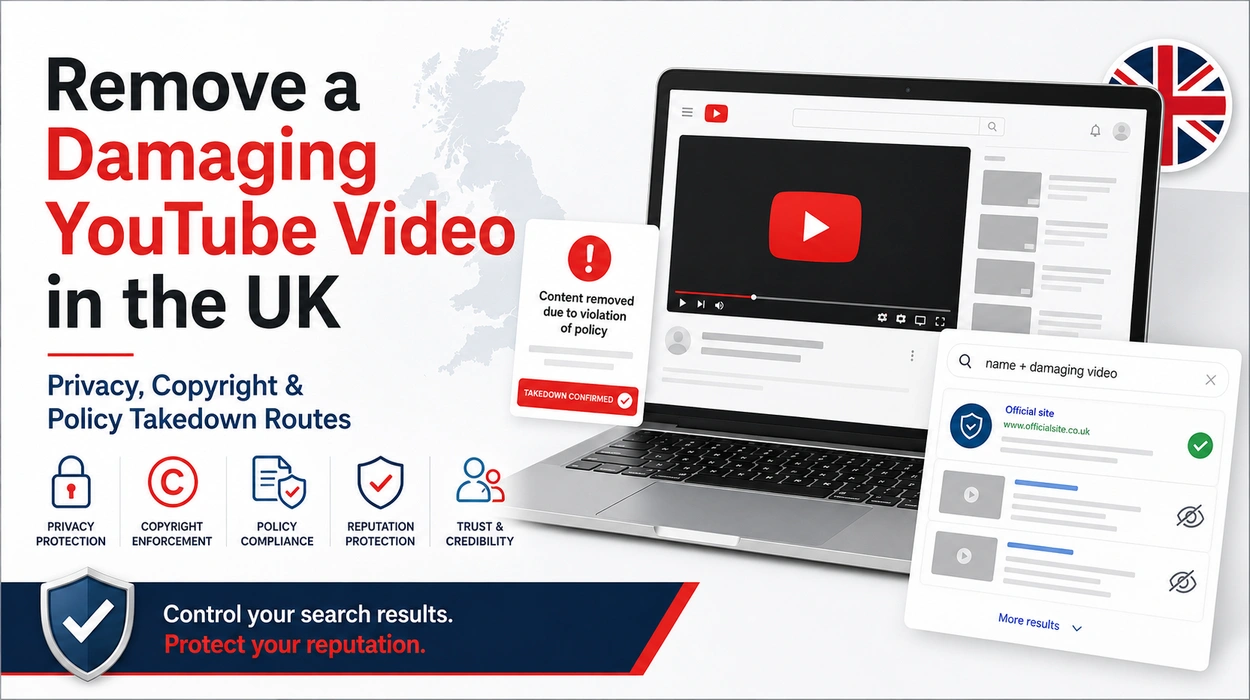
A damaging YouTube video is removed most effectively when the takedown route matches the legal, privacy, copyright, policy, or reputation issue involved. Expert review improves the evidence structure, reduces submission errors, and strengthens search visibility control.
Search visibility control matters because one indexed video can influence how people judge a person, business, director, employee, professional, or public-facing entity. Reputation signals affect decision-making because users interpret video titles, thumbnails, snippets, comments, and rankings as credibility indicators before they verify the full context.
Why is a YouTube takedown service the strongest option for reputation risk?
A YouTube takedown service delivers stronger reputation control because it connects video removal strategy with search perception influence. YouTube Video Removal Services focus on identifying the correct route, preparing the evidence, and reducing the risk of weak or incomplete reports. A damaging video rarely creates harm through the video alone. It creates harm through indexing, ranking, comments, engagement, thumbnails, and repeated association with a name or brand. This means the issue is not only a platform problem; it is also a SERP control problem. Clear Your Name evaluates the video as both a content asset and a reputation signal.
The service works by reviewing the content, identifying the removal ground, and selecting the correct submission route. Privacy routes deal with identifiable personal information, copyright routes deal with protected material, policy routes deal with platform violations, and legal routes deal with rights-based issues. This structure improves the quality of the request because each route requires different proof. A privacy complaint needs identity markers and consent analysis, while a copyright request needs ownership evidence and location of the protected work. A policy report needs clear alignment with the rule breached. A structured approach reduces risk and improves the strength of the submission.
The measurable outcome is better control over visibility, trust, and reputation signals. When a harmful video is removed, restricted, or de-indexed from common visibility points, the immediate search pressure reduces. Video carousels, name-based searches, thumbnail results, and related video visibility lose a damaging source signal. Entity credibility improves because users no longer see the same harmful asset dominating the first impression. This delivers a direct reputation outcome where one problematic content item no longer defines the visible narrative. It also supports long-term reputation repair by creating space for stronger, accurate, and neutral content to rank.
Which removal route delivers the best result for a damaging YouTube video?
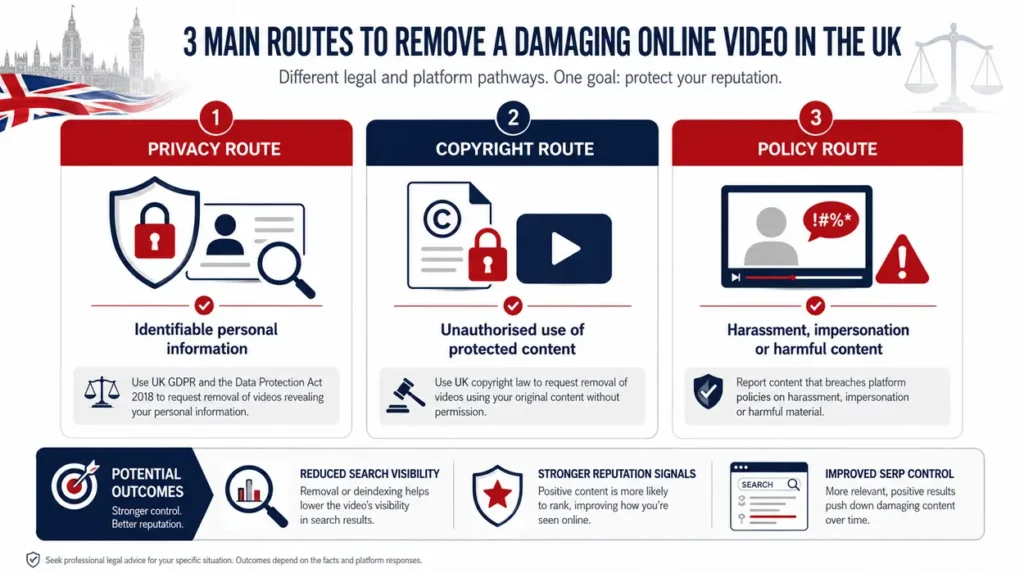
The best route is the one that matches the reason the video is damaging and the evidence available. Privacy, copyright, policy, and legal routes all deliver different results because they evaluate different types of harm. A privacy route protects a person from unwanted identifiable exposure. A copyright route protects protected content from unauthorised use. A policy route targets platform rule breaches such as harassment, abuse, impersonation, or harmful conduct. A legal route addresses rights-based concerns that need formal submission.
The service process begins with classification. The video is analysed for personal information, images, voice, documents, screenshots, private data, defamatory framing, copyrighted assets, abusive language, threats, impersonation indicators, and platform-policy violations. This classification decides whether the request is built around privacy, copyright, legal harm, or policy enforcement. Weak classification creates rejection risk because the platform reviewer receives the wrong argument. Strong classification improves route relevance because the evidence matches the platform’s review logic. This is where expert takedown work creates practical value.
The outcome is route-specific control. Privacy action reduces unwanted identity exposure when a video connects a person to private details. Copyright action removes unauthorised creative or commercial material when ownership is proven. Policy action reduces visibility when the video breaches community standards. Legal action strengthens the request when the content conflicts with rights, court orders, or applicable law. For users comparing options, the detailed evaluation in YouTube video removal request UK helps explain why a request needs a recognised ground before a platform accepts removal.
How does expert evidence preparation improve removal success?
Expert evidence preparation improves removal success by turning a complaint into a structured, review-ready case. A platform does not remove a video only because it feels harmful, unfair, or damaging. It evaluates whether the report fits a defined ground and whether the evidence proves that ground. A strong submission identifies the exact problem, the exact timestamps, the exact content issue, and the exact policy or rights route. This creates clarity for the reviewer. It also reduces delays caused by vague wording, missing details, or unsupported claims.
The service works by collecting and organising evidence before submission. This includes video links, channel links, timestamps, screenshots, transcript extracts, identity evidence, copyright ownership proof, policy breach references, and search result screenshots. Each item has a specific purpose. Timestamps show where the issue appears, screenshots preserve evidence if the uploader edits the video, and search screenshots show visibility impact. Ownership records support copyright claims, while identity markers support privacy claims. This evidence structure strengthens both removal review and wider reputation analysis.
The measurable outcome is reduced procedural risk. Incomplete reports waste time, create rejection patterns, and allow the video to remain visible during review. A structured report improves clarity and reduces the chance that the platform treats the issue as general dissatisfaction. It also supports escalation because the evidence already explains the harm, the route, and the visibility impact. For reputation management, this matters because delay allows engagement, comments, shares, embeds, and search indexing to grow. Strong evidence preparation reduces exposure time and protects entity credibility.
Explore Our Expert Guides:
How YouTube Decides Which Videos Are Eligible for Removal Under Its Policies
What a YouTube Video Removal Service Covers That Platform Reporting Alone Does Not
How does YouTube video removal influence search rankings and SERP control?
YouTube video removal improves SERP control by reducing or eliminating a harmful indexed asset from search results. Search engines process video pages through titles, descriptions, thumbnails, transcripts, comments, backlinks, channel authority, and user engagement. When a damaging video ranks for a name, brand, business, product, workplace, or allegation, it becomes a high-impact reputation signal. Removal reduces the source of that signal. It also limits the ability of users and search engines to keep reinforcing the same negative association.
The service works by linking platform action with search visibility analysis. A video is not only assessed for removal; it is also assessed for where it appears in Google results, video results, image results, snippets, and related searches. This explains whether the damage comes from the video itself, the thumbnail, the title, the comments, or the way the result appears in SERPs. A takedown request deals with the platform asset, while SERP control deals with the wider visibility environment. The strongest outcome comes from aligning both layers.
The measurable outcome is improved search perception. When a harmful video loses visibility, users encounter fewer negative cues during initial search evaluation. This improves trust signals because the visible search environment becomes less dominated by damaging media. It also reduces the ranking influence of hostile comments, misleading titles, and sensational thumbnails. If the video has been copied, embedded, or discussed elsewhere, additional suppression and monitoring work stabilises the result. This supports long-term control rather than one-off removal.
Why is professional support better than submitting a report alone?
Professional support is stronger than self-submission because it reduces route confusion, evidence gaps, and escalation errors. A self-submitted report often fails when the user selects the wrong category, writes an emotional complaint, omits timestamps, or provides no proof of rights. Platforms review reports against defined categories, not personal frustration. A professional process translates the issue into platform language. This improves the structure, accuracy, and enforceability of the request. It also protects the user from weakening the case through inconsistent submissions.
Clear Your Name applies reputation management logic to the takedown process. This means the video is reviewed for policy fit, legal relevance, search visibility, and reputational impact. The service does not treat removal as a single form submission. It treats removal as part of a wider search perception control strategy. That includes identifying whether the issue is removal-ready, suppression-led, or evidence-dependent. This ensures the chosen route supports both immediate action and long-term reputation stability.
The outcome is clearer decision-making. Users understand whether the video qualifies for privacy, copyright, policy, legal, or reputation-led intervention. They also understand whether direct removal is realistic or whether negative content suppression offers a stronger route. This reduces wasted effort and improves strategic focus. For decision-stage users, the comparison framework in remove YouTube video UK supports validation before choosing a more direct takedown approach. The value comes from reduced uncertainty, better evidence handling, and stronger reputation protection.
How quickly can a damaging YouTube video be addressed?
A damaging YouTube video can be addressed faster when the issue is classified correctly and evidence is ready before submission. Speed depends on the removal route, the complexity of the content, the strength of the proof, and the platform’s review process. A clear copyright claim with strong ownership evidence differs from a complex policy complaint involving commentary, criticism, or public-interest content. A privacy issue with obvious identifiable information differs from a vague claim about reputation damage. Expert preparation improves speed by removing avoidable friction from the process.
The service works by separating urgent actions from longer-term reputation actions. Urgent action focuses on evidence capture, route selection, report preparation, and submission. Longer-term action focuses on search monitoring, duplicate detection, SERP control, and content suppression where removal does not cover every related result. This dual structure prevents a narrow response. A video can disappear from YouTube but still leave secondary traces across search pages, reaction content, articles, or archived snippets. A complete strategy deals with both the source and the visible footprint.
The measurable outcome is reduced exposure time and stronger continuity. Quick evidence capture protects against deletion, editing, or title changes that make later review harder. Accurate submission reduces back-and-forth and improves the chance of meaningful review. Monitoring identifies whether the video remains in search, appears through copies, or continues to influence related queries. This gives the user a clear view of progress. It also keeps the reputation strategy aligned with search behaviour rather than only platform response.
Is the cost of YouTube video removal worth the long-term value?
The cost of YouTube video removal is justified when the video creates measurable visibility risk, trust loss, or commercial impact. A damaging video can influence hiring, client decisions, investor confidence, partnership checks, local reputation, personal credibility, and brand perception. The cost must be evaluated against the value of controlling the first impression created by search. If the video ranks for high-intent name or brand searches, the reputational cost continues every time someone searches. This makes the issue cumulative rather than isolated.
The service works by assessing impact before action. A strong evaluation checks ranking position, query type, video engagement, comment sentiment, thumbnail strength, title wording, search volume relevance, and the presence of duplicates. These factors show whether the video is a low-impact asset or a high-risk reputation signal. This avoids unnecessary action where the video has no meaningful visibility. It also prioritises urgent action where the video appears prominently in SERPs. Cost becomes clearer when linked to exposure level and risk severity.
The long-term value comes from stabilised perception. Removing or reducing a damaging video protects entity credibility and supports trust restoration. It also prevents the video from gaining further authority through views, comments, shares, and links. When combined with stronger content assets, the search environment becomes more balanced and less vulnerable to one harmful result. Clear Your Name positions takedown work as a risk reduction process, not a cosmetic search change. The value lies in protecting visibility, credibility, and decision-stage trust.
Get More Insights:
Use a UK YouTube Video Removal Service to Take Down Content Damaging You
What outcomes define a reliable YouTube Video Removal Service?
A reliable YouTube Video Removal Service is defined by process clarity, accurate route selection, evidence quality, and measurable search visibility improvement. The outcome is not only whether a video is reported. The outcome is whether the right route is used, whether the evidence is strong, whether the harmful asset loses visibility, and whether the SERP becomes more controlled. Reliability depends on the connection between takedown work and reputation management. A narrow report can miss the wider search impact. A structured process deals with both removal and perception.
The service outcomes are best measured through visible changes. A video can be removed, restricted, made unavailable, lose ranking strength, lose thumbnail visibility, or become less influential within the SERP. These outcomes reduce negative content exposure. They also improve the ratio of neutral or positive reputation signals around the entity. In digital trust terms, this matters because users judge credibility through what appears first, not through hidden context. Strong outcomes therefore focus on visibility, trust, and control.
Clear Your Name provides YouTube Video Removal Services for cases where a damaging video affects search results, personal identity, professional reputation, or brand trust. The process supports route selection, evidence preparation, review handling, and reputation visibility analysis. This gives users a clear decision path when direct reporting alone is not enough. It also connects takedown activity with long-term SERP control. The result is a more stable search environment where harmful video content no longer dominates perception.
Conclusion
A damaging YouTube video in the UK requires more than a basic report. It requires accurate classification, strong evidence, route-specific submission, and search visibility control. Privacy, copyright, policy, and legal routes each deliver different outcomes, and each route works only when the evidence matches the review standard. A professional takedown service improves reliability by reducing submission errors and aligning the request with platform logic.
The strongest outcome is achieved when removal strategy and reputation management work together. Video takedown reduces the source of harm, while SERP control strengthens the wider search environment. Negative content suppression, content enhancement, and digital footprint monitoring protect long-term entity credibility. Clear Your Name delivers a structured, process-led approach for decision-stage users who need control, clarity, and measurable reputation protection.
1. How can I remove a damaging YouTube video in the UK?
A damaging YouTube video in the UK can be reviewed through privacy, copyright, policy, harassment, impersonation, or legal reporting routes. Clear Your Name assesses the video, identifies the correct removal ground, and prepares evidence for YouTube Video Removal Services.
2. What evidence is needed to remove a YouTube video?
Evidence can include the video URL, timestamps, screenshots, identity details, copyright ownership proof, policy breach examples, and search result screenshots. Strong evidence helps show why the video qualifies for removal or takedown review.
3. Can a YouTube video be removed if it damages my reputation?
Reputation damage alone is not always enough for removal unless the video also breaches privacy, copyright, platform policy, or legal rules. A damaging video can still be addressed through negative content suppression, SERP control, or reputation management if direct removal is not available.
4. How long does YouTube video removal take in the UK?
The timescale depends on the removal route, evidence quality, platform review process, and complexity of the issue. Privacy, copyright, policy, and legal requests are reviewed differently, so accurate route selection helps reduce avoidable delays.
5. Do YouTube Video Removal Services help with Google search results?
YouTube Video Removal Services can support search visibility control when a damaging video appears in Google results, video carousels, or name-based searches. Clear Your Name also considers SERP control, reputation signals, and wider digital footprint impact.