Removing a YouTube video in the UK depends on choosing the correct route: privacy, copyright, platform policy, legal reporting, or reputation-led search control. Each route operates through a different evidence threshold, review mechanism, and impact on search visibility.
Reputation management strategies differ based on whether the issue involves unlawful exposure, rights infringement, policy breach, harmful perception, or search ranking influence. Online reputation control methods are evaluated through visibility reduction, entity credibility protection, sentiment distribution, content suppression vs content enhancement, and long-term SERP stability.
Which YouTube removal route works best for reputation risk in the UK?
The strongest YouTube removal route is the one that matches the exact nature of the reputational risk. A privacy route addresses identifiable personal exposure, a copyright route addresses unauthorised use of protected work, and a policy route addresses content that breaks platform rules. Each approach is different because each route evaluates a different type of harm. Reputation repair methods are not interchangeable because search ecosystems classify content through subject matter, entity connection, metadata, engagement, and authority signals. A video that damages perception through private identification requires a different review logic from a video that misuses protected creative material. The correct route defines how evidence is structured and how the platform interprets the removal request.
A privacy route operates by proving that the video identifies a person through face, voice, name, location, workplace, address, personal records, or contextual clues. This route is strongest when the reputational issue comes from unwanted exposure rather than criticism or commentary. Its limitation is that privacy review does not automatically remove content simply because the video is negative or embarrassing. The platform evaluates identifiability, consent, public interest, and the nature of the information. In search visibility terms, successful removal reduces the direct video asset from SERPs, video carousels, and name-based search results. It also weakens the reputation signal created by the title, thumbnail, comments, and indexed transcript.
A copyright route operates by proving ownership of protected work that appears in the video without permission. This approach works when the damaging video contains original footage, music, graphics, photographs, documents, written material, or other protected creative assets. Its strength is that copyright review follows a defined rights-based process and focuses on ownership rather than reputational feeling. Its limitation is that it does not apply to every negative video, especially where the uploader created all content independently. For reputation management, copyright removal changes entity credibility when a video misuses professional assets, brand materials, or personal creative work. It also reduces search ranking influence when the infringing video previously ranked for the rights holder’s name or work.
How does privacy removal compare with copyright removal?
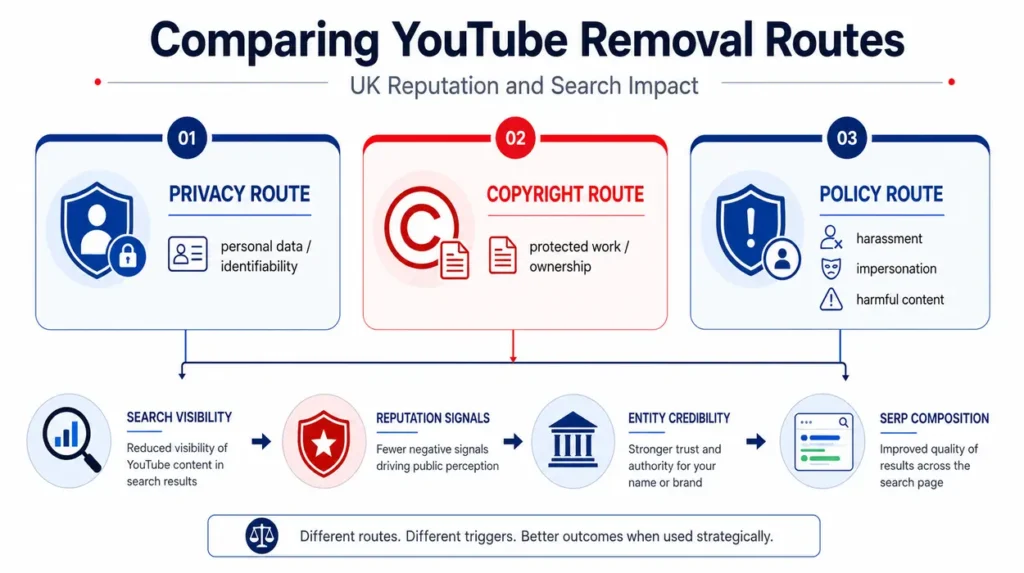
Privacy removal protects personal identifiability, while copyright removal protects ownership of original work. Privacy is a personal information route, and copyright is an intellectual property route. Both can result in video removal, but they evaluate different evidence and produce different reputation outcomes. Privacy analysis focuses on the person shown or described in the video. Copyright analysis focuses on the protected material used in the video. The strategic comparison depends on whether the reputational harm comes from exposure of identity or unauthorised use of content.
Privacy removal operates by connecting the video to a living, identifiable individual. The evidence usually concerns recognisable visual appearance, voice, address, family references, employment details, location data, or private context. This route is effective when the video creates a searchable association between a person and unwanted personal information. Its limitation is that public-facing content, public events, commentary, or matters with public-interest value receive closer scrutiny. From a search perception perspective, privacy removal can reduce direct identity exposure when the video appears for name searches. It protects entity credibility by weakening the association between personal identity and unwanted indexed media.
Copyright removal operates by connecting the video to protected creative material and proving ownership or authorised control. The evidence usually concerns original files, publication records, timestamps, licences, authorship details, or rights-holder status. This route is effective when the uploader uses protected content without permission. Its limitation is that copyright does not remove criticism, commentary, opinion, or independently created material unless protected assets are used unlawfully. From a SERP perspective, copyright removal can reduce misattribution and prevent the wrong uploader from benefiting from another entity’s creative authority. It supports reputation signals by correcting source legitimacy and content ownership.
How does policy reporting compare with legal reporting?
Policy reporting evaluates whether a video breaks platform rules, while legal reporting evaluates whether the video creates a legal issue. Platform policy is an internal governance framework, and legal reporting is a rights or law-based escalation route. The two approaches overlap when harmful content involves harassment, impersonation, threats, privacy abuse, copyright infringement, or regulated harms. Policy reporting is usually broader because it covers behaviour and content standards. Legal reporting is usually narrower because it requires a defined legal basis. The best route depends on whether the issue is a rule violation, a rights violation, or both.
Policy reporting operates by matching the video against categories such as harassment, cyberbullying, hate, scams, child safety, impersonation, dangerous acts, graphic content, or misleading practices. Its strength is that it addresses harmful content even when the content does not fit a strict legal claim. Its limitation is that policy thresholds are platform-specific and depend on context, severity, targeting, and review interpretation. In reputation terms, policy reporting affects search visibility when the video loses availability, recommendation potential, or discoverability after enforcement. It also reduces harmful sentiment distribution if the video previously encouraged hostile comments or user mobilisation. The weakness is that rejected reports leave the video active, which means the reputation signal remains indexed.
Legal reporting operates by presenting a defined legal issue such as privacy infringement, copyright infringement, defamation-related concern, court order, impersonation, or unlawful disclosure. Its strength is formal specificity because it directs review towards a recognised legal route. Its limitation is that legal reporting requires accurate evidence, jurisdictional relevance, and clear connection between the content and the legal ground. In search ecosystems, legal reporting can remove the source asset where the platform accepts the claim. It can also support wider SERP evaluation when search engines later process removed or unavailable pages. Legal reporting therefore has stronger formal force but a narrower qualification threshold.
Explore Our Expert Guides:
How YouTube Decides Which Videos Are Eligible for Removal Under Its Policies
What a YouTube Video Removal Service Covers That Platform Reporting Alone Does Not
How do organic reputation strategies compare with reactive removal strategies?
Organic reputation strategies build stronger positive and neutral search assets, while reactive removal strategies attempt to reduce or eliminate harmful assets. Organic reputation control is content enhancement, and reactive removal is content suppression or takedown. Both approaches influence SERP composition, but they operate through different mechanisms. Organic strategies shape what search engines rank around an entity over time. Reactive strategies challenge a specific video, page, or platform asset. A balanced evaluation compares speed, control, scalability, and sustainability.
Organic reputation strategies operate through publishing accurate, structured, authoritative, and entity-relevant content. This includes official profiles, educational pages, trusted directory entries, professional articles, neutral biographies, social assets, and search-optimised content clusters. The strength of organic activity is sustainability because it builds a wider digital footprint that search engines can evaluate. The limitation is slower movement because new or improved assets need crawling, indexing, ranking, and engagement signals. Organic methods are strongest when the damaging video is not removable or when the SERP needs broader stabilisation. Their impact appears through improved entity credibility, stronger topical relevance, and more balanced sentiment distribution.
Reactive removal strategies operate by targeting the harmful video through privacy, copyright, policy, or legal routes. Their strength is directness because they focus on the specific asset creating reputation risk. Their limitation is dependency on platform review, evidence thresholds, and policy interpretation. Reactive removal has stronger short-term value when one video dominates search visibility or creates a severe reputation signal. It has weaker scalability when multiple copies, clips, reactions, embeds, and articles have already expanded the digital footprint. In SERP control terms, removal reduces the source result, while organic enhancement fills the ranking space left behind.
What is the difference between content suppression and content enhancement?
Content suppression is the reduction of harmful content visibility, while content enhancement is the strengthening of more accurate or favourable content visibility. Suppression operates by pushing negative, irrelevant, outdated, or harmful results lower in SERPs. Enhancement operates by improving the ranking strength of controlled, neutral, or authoritative content. These methods are not the same because suppression focuses on displacement, while enhancement focuses on relevance building. In reputation management, both methods affect how users interpret an entity through search. Their effectiveness depends on competition, authority, query intent, and content quality.
Content suppression operates by increasing the relative ranking power of alternative assets. Search engines rank pages by relevance, authority, freshness, engagement, internal structure, external references, and query satisfaction. If stronger assets occupy higher positions, a damaging video can lose prominence even without removal. The strength of suppression is that it works when takedown is unavailable or unsuccessful. Its limitation is that the harmful video still exists and remains discoverable through direct links, video search, or specific long-tail queries. Suppression reduces exposure, but it does not erase the underlying asset.
Content enhancement operates by creating or improving content that defines the entity more accurately. This includes stronger metadata, entity-rich copy, structured headings, authoritative profiles, consistent naming, verified information, and credible third-party references. Its strength is that it improves entity credibility and strengthens positive or neutral reputation signals. Its limitation is that enhancement requires content quality, publication consistency, indexation, and time. Enhancement is more sustainable than isolated suppression because it gives search engines better material to rank. The strongest reputation outcomes occur when enhancement and suppression operate together across the same query set.
How do short-term and long-term YouTube reputation strategies compare?
Short-term YouTube reputation strategies prioritise immediate visibility reduction, while long-term strategies prioritise durable SERP stability. Short-term methods include reporting, privacy complaints, copyright notices, policy escalation, thumbnail monitoring, and urgent search analysis. Long-term methods include digital footprint optimisation, content enhancement, sentiment balancing, authority building, and ongoing SERP monitoring. Each approach measures success differently. Short-term work measures whether a specific harmful asset loses visibility. Long-term work measures whether the entity’s search profile becomes more resistant to future harmful content.
Short-term strategies operate through direct action against the video or its search appearance. Their strength is speed when a video clearly violates privacy, copyright, platform rules, or legal requirements. Their limitation is uncertainty because platform review can reject a request or only restrict part of the content. Short-term activity also fails to address secondary content if the video has already been copied, embedded, discussed, or quoted. In reputation terms, short-term routes reduce immediate search pressure but do not automatically repair the wider entity perception. They are most effective when the harmful video is the primary source of visibility damage.
Long-term strategies operate by improving the overall information environment around the entity. They strengthen controlled assets, neutral references, trusted profiles, review responses, social consistency, and search-intent coverage. Their strength is sustainability because search engines receive a broader set of reliable signals. Their limitation is slower impact, especially when the negative video holds strong engagement or authority signals. Long-term strategies reduce risk exposure by making SERPs less dependent on a single harmful result. They protect entity credibility by diversifying the content base that search engines use to interpret reputation.
How do search engines interpret reputation signals from YouTube videos?
Search engines interpret reputation signals from YouTube videos through metadata, engagement, authority, relevance, freshness, and entity association. A reputation signal is any indexed feature that contributes to how a person, organisation, or topic is perceived in search. Video titles, descriptions, transcripts, thumbnails, channel names, comments, embeds, backlinks, and user behaviour all influence search ranking influence. A video result becomes reputationally important when it ranks for a name, brand, location, occupation, product, allegation, or issue-based query. Search engines do not evaluate reputation as fairness; they evaluate relevance and usefulness for the query. This explains why harmful content can rank when it strongly matches user search behaviour.
The mechanism begins with content indexing. Search engines crawl the video page, read available metadata, process visible text, evaluate the channel context, and connect the video to related entities. Engagement signals such as views, comments, shares, watch behaviour, and external references can support visibility. A damaging video with strong engagement can appear more relevant than a neutral page with weak authority. This creates a search perception problem because visibility can be mistaken for credibility. Users often interpret high-ranking results as more important, even when the ranking reflects algorithmic relevance rather than verified accuracy.
Different strategies affect these signals in different ways. Removal eliminates or restricts the source asset when the platform accepts the request. Suppression reduces prominence by increasing the relative strength of competing content. Enhancement improves the quality and authority of alternative assets. Monitoring measures how sentiment distribution, ranking positions, snippets, and video features change over time. A strategic evaluation therefore compares not only whether a video can be removed, but also how the wider SERP responds after action.
Get More Insights:
Use a UK YouTube Video Removal Service to Take Down Content Damaging You
Which evaluation framework helps choose the right YouTube removal strategy?
The most useful evaluation framework compares evidence strength, route relevance, search impact, scalability, and sustainability. A framework is a structured decision model for selecting the most appropriate reputation response. It prevents route confusion by separating privacy, copyright, policy, legal, suppression, and enhancement methods. It also reduces risk exposure by matching the action to the type of content harm. In YouTube reputation analysis, the chosen method must align with both platform rules and SERP behaviour. This creates a clearer view of what each approach achieves and where it ends.
- Identify the primary harm: Classify the video as privacy exposure, copyright infringement, harassment, impersonation, misinformation, legal issue, or search perception issue.
- Assess the evidence threshold: Match proof to the route, such as identity markers for privacy or ownership records for copyright.
- Measure search visibility: Review whether the video ranks in Google, video search, image results, snippets, or name-based SERPs.
- Compare response speed: Use reporting routes for direct review and content enhancement for longer-term SERP control.
- Evaluate secondary spread: Check whether the video has been embedded, clipped, quoted, copied, or discussed across other indexed pages.
- Plan replacement visibility: Strengthen accurate, neutral, or authoritative assets when removal creates ranking space in the SERP.
This framework compares methods by function rather than preference. A privacy complaint has value when the problem is identifiable exposure. A copyright request has value when protected work is used without permission. A policy report has value when content violates platform rules. Suppression and enhancement have value when the video remains online or when wider search composition requires improvement. For high-impact content, the phrase remove a damaging YouTube video in the UK describes only one part of the evaluation; the broader strategy also analyses ranking influence, entity credibility, and post-removal SERP stability.
Conclusion
Removing a YouTube video in the UK requires a route-specific evaluation. Privacy, copyright, policy, and legal reporting each operate through different definitions, evidence standards, review mechanisms, and reputation effects. Privacy protects identifiable personal exposure, copyright protects ownership of original work, policy reporting addresses platform rule violations, and legal reporting addresses formal rights or unlawful content issues. These approaches differ in effectiveness, speed, scalability, and limitation.
Reputation management strategy also extends beyond direct removal. Organic enhancement, content suppression, digital footprint optimisation, and SERP monitoring influence how search engines interpret reputation signals. Short-term routes reduce immediate visibility pressure, while long-term methods build entity credibility and search stability. The most effective evaluation compares the video’s content issue with its search ranking influence, sentiment distribution, and wider digital footprint impact.
FAQs
1. How can I remove a YouTube video in the UK?
To remove a YouTube video in the UK, the request must usually fit a recognised route such as privacy, copyright, platform policy, harassment, impersonation, or legal grounds. Clear Your Name explains that the correct route depends on the type of harm, the evidence available, and how the video affects search visibility.
2. Can I remove a YouTube video for privacy reasons?
A YouTube video can be reviewed for privacy removal if it shows identifiable personal information, such as a face, voice, address, workplace, or private details without suitable consent. YouTube assesses whether the person is clearly identifiable and whether the video creates a privacy concern.
3. Can copyright help remove a YouTube video in the UK?
Copyright can support a YouTube removal request when the video uses protected material without permission, such as footage, music, images, graphics, or written content. The rights holder normally needs to show ownership and identify where the copyrighted material appears in the video.
4. What is the difference between privacy and copyright YouTube removal?
Privacy removal focuses on personal identification and unwanted exposure, while copyright removal focuses on unauthorised use of protected creative work. Both routes can affect online reputation, but they require different evidence and follow different review processes.
5. Does removing a YouTube video improve online reputation?
Removing a YouTube video can improve online reputation when the video appears in Google results, video carousels, or name-based searches. It can reduce harmful reputation signals, but wider SERP control may also require content suppression, digital footprint management, and stronger trusted content.