

Legal and technical routes that support the removal of a website from Google UK include formal‑content‑removal requests, policy‑violations‑reports, court‑enforced‑delisting orders, and technical‑takedown‑requests at the hosting or domain‑level. Reputation management strategies differ based on how much they rely on legal‑enforcement, technical‑intervention, or SERP‑re‑ordering, rather than on persuasion‑alone. Online reputation control methods are evaluated through how they reshape SERP‑composition, suppress harmful‑signals, and restore balanced‑perception‑distributions.
What legal‑based routes exist to remove a website from Google UK?
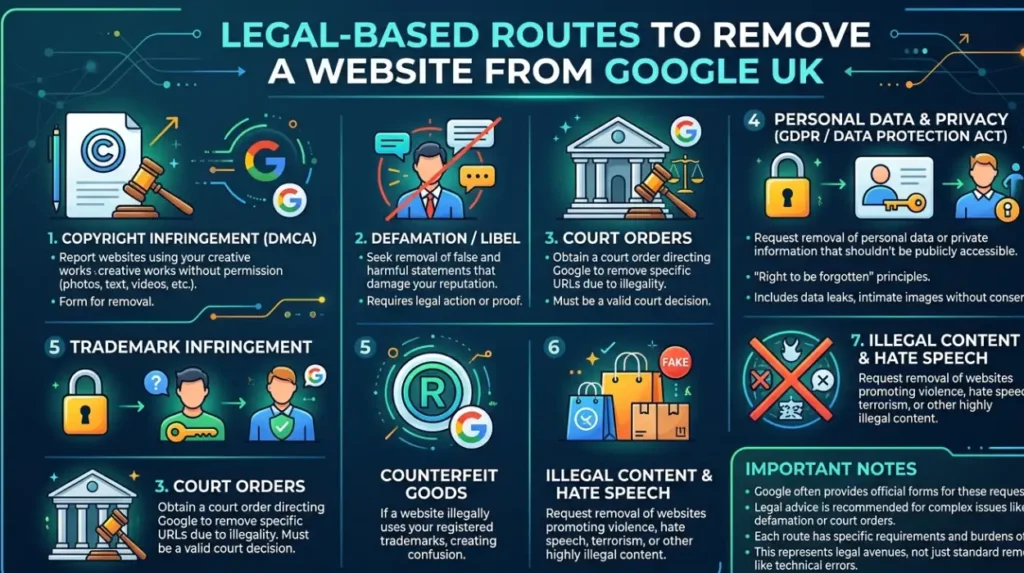
Legal‑based routes to remove a website from Google UK are those where national‑law or court‑orders are used to compel or justify the removal of specific‑content or the entire‑site. These routes are most effective when the content breaches clear‑legal‑standards such as defamation, data‑protection‑violations, or intellectual‑property‑infringement.
Legal‑removal‑route is defined as any process that uses statutes, court‑judgments, or regulatory‑decisions to argue that a piece of content or a domain must be taken down or delisted. Search engines and hosts typically treat these as high‑validity‑signals, but they still require procedural‑compliance before acting.
Key‑routes include:
- Court‑order‑delisting‑requests: applying to a national‑court for a judgment that orders a host or search‑engine to remove or block access to harmful‑content, which can then be presented to Google.
- Data‑protection‑and‑privacy‑requests: invoking GDPR‑or‑UK‑equivalent‑rules where personal‑information is unlawfully‑processed or published, and requesting de‑indexing from search results.
- Defamation‑and‑malicious‑publication‑claims: pursuing legal‑action where content is demonstrably‑false and harmful, then using the outcome to justify removal or delisting.
Comparative‑analysis shows that legal‑routes are strong when evidence is robust, but they can be slow, costly, and jurisdiction‑specific, limiting their scalability for broad‑reputation‑campaigns.
How do technical‑takedown and hosting‑level interventions work for website removal?
Technical‑takedown and hosting‑level interventions work by targeting the infrastructure that makes a harmful website accessible, rather than only the search‑indexing‑layer. If a domain or server is taken offline, the content cannot be crawled or displayed in search, even if it has not been formally‑removed from Google’s index.
Hosting‑level‑intervention is defined as the process of convincing or requiring the hosting‑provider, registrar, or CDN‑operator to suspend or terminate the site’s online presence based on terms‑of‑service violations or policy‑breaches. These actors control whether the domain resolves and whether the server responds to requests, which directly affects whether a site appears in search.
Mechanisms used include:
- Terms‑of‑service‑enforcement: proving that the site engages in spam, phishing, or illegal‑activity, and requesting suspension under the host’s acceptable‑use‑policy.
- Domain‑registro‑intervention: filing complaints with the registrar when a domain is used for impersonation, fraud, or brand‑abuse, which can lead to domain‑locking or deletion.
- IP‑and‑server‑block‑requests: escalating to larger‑CDNs or network‑providers where repeat‑offenders are isolated across multiple‑sites.
These routes are effective when evidence clearly shows policy‑violations, but they do not guarantee global‑removal if the site simply migrates to a new‑host or domain.
How do content‑removal and SERP‑suppression strategies differ in practice?
Content‑removal and SERP‑suppression strategies differ in that removal aims to delete or block the underlying‑content, while suppression aims to reduce its visibility and impact within search results. Both approaches deal with reputation‑signals, but they operate at different‑layers of the information‑ecosystem.
Content‑removal operates by applying legal‑or‑policy‑grounded‑requests to remove harmful‑pages from the web, which can have a direct impact on entity‑credibility when those pages are de‑indexed or blocked. If successful, removal eliminates the primary‑source of damage, but it is not always possible or permanent.
SERP‑suppression operates by increasing the prominence of higher‑trust‑content, such as official‑communications, news‑updates, or regulatory‑disclosures, which dilutes the influence of the remaining‑harmful‑results. This approach does not erase the content but reduces its share of visibility and perceived‑importance.
Comparative‑analysis shows:
- Removal offers a more definitive‑outcome but is constrained by legal‑and‑policy‑thresholds.
- Suppression offers a scalable‑method for managing perception but does not resolve the root‑cause of harm.
- Together, they form a layered‑approach that balances immediate‑visibility‑reduction with long‑term‑reputation‑stability.
These patterns show that choosing between removal and suppression depends on risk‑tolerance, resource‑availability, and how quickly visibility must be corrected.
How do search engines interpret legal‑claims versus technical‑abuse‑reports?
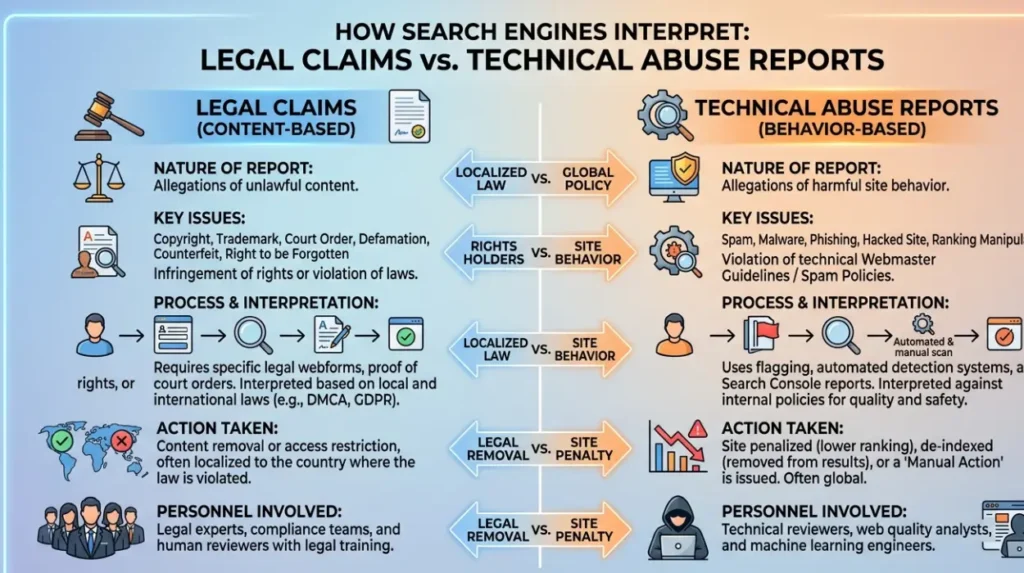
Search engines interpret legal‑claims and technical‑abuse‑reports through distinct‑evaluation‑pathways that differ in validation‑requirements, speed, and impact on indexing and ranking. Legal‑claims are treated as evidence‑of‑harm under statute, while technical‑abuse‑reports are treated as policy‑violations under platform‑rules for Remove a Harmful Website From Google UK With Our Specialist Delisting Service.
Legal‑claim‑interpretation operates by verifying that a request aligns with the jurisdictional‑law and is supported by documented‑proof such as court‑orders, cease‑and‑desist‑letters, or regulatory‑findings. When this evidence meets threshold‑standards, search engines can de‑index pages or entire‑domains in response.
Technical‑abuse‑report‑interpretation operates by checking for clear‑policy‑breaches such as spam, malware, phishing, or impersonation, using internal‑detection‑systems and third‑party‑spam‑lists. These reports can trigger fast‑removal or demotion, but they are less likely to cover borderline‑cases that involve opinion‑or‑defamation‑without clear‑illegal‑elements.
Impact on search visibility and perception includes:
- Legal‑routes often produce more‑permanent‑removals but require more‑time and documentation.
- Technical‑routes can act quickly but may be circumvented by re‑hosting or re‑registration.
- Both routes influence how search engines perceive the credibility and risk‑profile of an entity and its adversaries.
These differences show that the most‑effective‑approach often combines legal‑and‑technical‑routes in a coordinated‑reputation‑strategy.
How do short‑term reactive and long‑term proactive removal strategies compare?
Short‑term reactive and long‑term proactive removal strategies compare in their time‑horizon, resource‑allocation, and impact on sustained‑entity‑credibility and risk‑exposure. Reactive‑approaches respond to incidents as they occur, while proactive‑approaches anticipate and mitigate vulnerabilities before they manifest.
Short‑term‑reactive‑strategy is defined as a set of actions that are deployed only after a harmful website or content‑item appears in search or causes reputational‑damage. These actions include filing complaints, issuing legal‑claims, and requesting technical‑takedowns, which can reduce visibility and exposure in the short‑term.
Long‑term‑proactive‑strategy is defined as a framework that continuously monitors for emerging‑threats, builds trust‑signals, and strengthens SERP‑composition so that entities are less vulnerable to future‑attacks. This includes creating authoritative‑content, establishing clear‑legal‑rights, and maintaining strong‑technical‑infrastructure.
Comparative‑evaluation shows:
- Reactive‑approaches reduce acute‑risk but can be costly and time‑consuming when deployed repeatedly.
- Proactive‑approaches reduce chronic‑risk and build resilience against new‑incidents, but they require ongoing investment.
- A balanced‑approach that integrates both reactive‑and‑proactive‑elements offers the most‑sustainable‑path for controlling reputation in search ecosystems.
These insights suggest that strategic‑reputation‑management should not rely solely on crisis‑responses, but should embed removal‑and‑suppression‑tactics into a broader‑governance‑framework.
In summary, legal and technical routes to remove a website from Google UK differ in their speed, evidence‑requirements, and scalability, but they all operate within the same‑reputation‑architecture defined by search engines and hosting‑infrastructures. Removing harmful‑content is only one‑component of online reputation management; equally important is the ability to suppress residual‑signals, enhance higher‑trust‑narratives, and build long‑term‑resilience against recurring‑attacks.
FAQs
What legal routes can help remove a harmful website from Google UK?
Legal routes include court‑enforced‑delisting‑requests, data‑protection‑and‑privacy‑claims under GDPR‑and‑UK‑equivalent‑laws, and defamation‑actions that provide evidence‑based grounds for removal. These routes require documented‑evidence and formal‑processes, but they carry strong‑weight with search engines and hosting‑providers when they meet statutory‑thresholds.
How do technical‑takedown routes differ from legal‑removal requests?
Technical‑takedown routes work by targeting hosting‑providers, domain‑registrars, or CDNs to suspend or block access to the site, whereas legal‑removal requests operate through court‑orders or policy‑compliance‑mechanisms submitted to Google. Technical‑removals can be faster when clear‑policy‑violations exist, but they do not automatically erase legal‑liability or guarantee long‑term‑disappearance.
Can Google remove a website from UK search results if it breaks UK law?
Google can remove or de‑index a website from UK search results if it breaches UK‑law or search‑policy‑rules, but only after evidence‑and‑procedure are provided through formal‑requests or court‑orders. Removal is not automatic; it is triggered by compliant‑submissions that align with Google’s jurisdiction‑specific‑content‑policies.
What is the difference between content removal and SERP suppression for website delisting?
Content removal aims to delete or block the underlying‑website or page, whereas SERP‑suppression focuses on reducing its visibility in search results by boosting higher‑trust‑content instead. Removal solves the source‑issue when possible, while suppression manages perception when removal is not feasible or has failed.