
Removing an Indeed review in the UK follows a structured policy‑driven moderation workflow that prioritises content that clearly violates Indeed’s terms over subjective‑dispute removals. Reputation management strategies differ based on whether they focus on content removal, content suppression, or content enhancement; online reputation control methods are evaluated through their impact on search ranking influence, entity credibility, and sentiment distribution.
How does the Indeed review removal process work in the UK?
Indeed’s UK‑based review removal process operates by applying a standardised moderation‑pipeline that evaluates each review against predefined policy‑criteria before deciding whether to retain, suppress, or remove it.
Dive Deeper With Our Expert Guides and Related Blog Posts:
What the Most Effective Routes Are for Removing a Website From UK Search Results
How Taking Down a Harmful Website in the UK Works Across Legal and Technical Routes
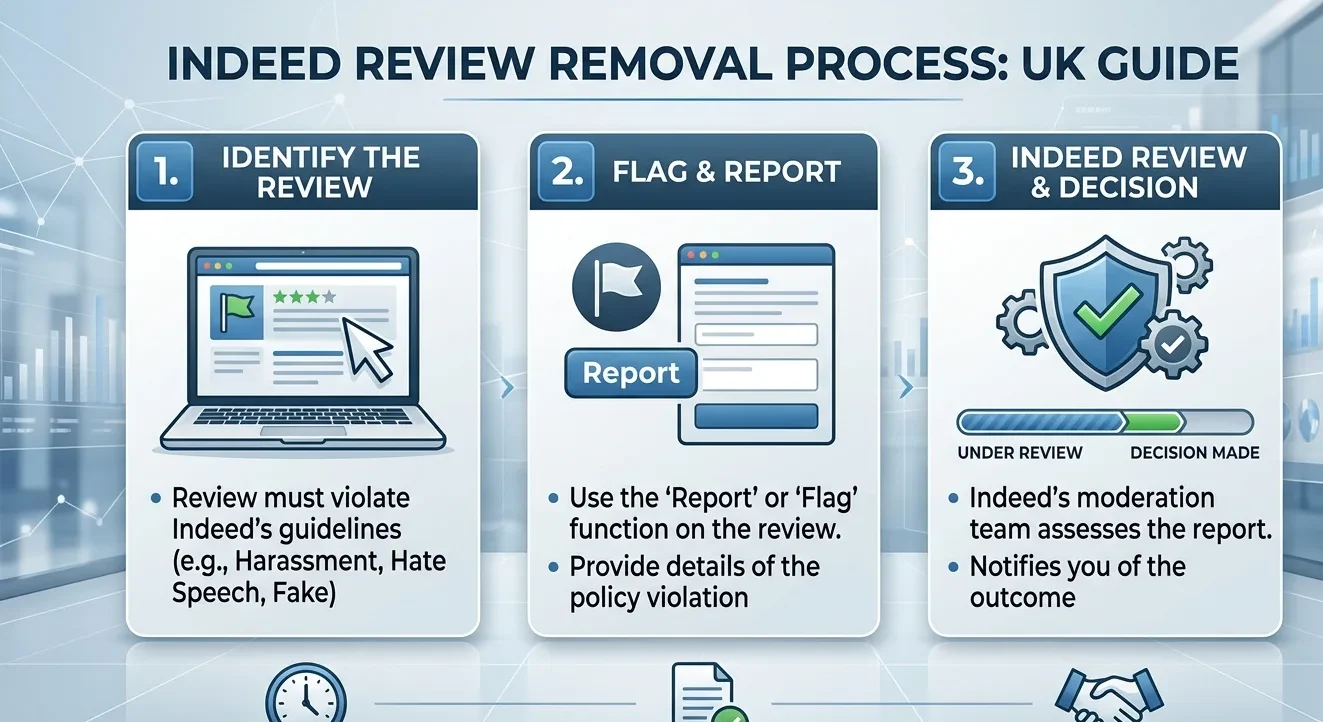
Indeed review removal refers to the platform’s internal‑moderation workflow that determines whether a submitted review stays live, is privately suppressed, or is deleted from the employer profile. The mechanism operates through a multi‑stage evaluation: first, the employer or user submits a removal request; second, Indeed’s systems scan the review against rule‑categories such as harassment, data‑leakage, or policy‑breach; third, human moderators perform a final‑assessment if the case is flagged as ambiguous.
The process‑sequence can be broken down as follows:
- Identify the review and ensure it is hosted on the correct Indeed listing.
- Locate Indeed’s official removal or reporting form and submit the request, attaching contextual information.
- Indeed’s system checks the review against automation‑filters for policy‑violations.
- The case enters a moderation‑queue if the system detects ambiguity or severity.
- Moderators apply the written policy, not subjective fairness, and either uphold or decline the request.
- The employer receives an outcome notification; if the review is removed, the rating‑average may partially adjust.
The impact on search visibility is limited. The process does not guarantee removal, and only reviews that breach explicit‑rules are likely to be altered. Indeed’s adherence to a consistent‑policy framework means that SERP‑level entity‑creativity remains constrained; the platform’s review‑cluster continues to shape candidate‑perception even when some items are removed.
How do content removal strategies compare to content enhancement strategies?
Content removal strategies focus on deleting or suppressing unfavourable reputation signals, while content enhancement strategies prioritise amplifying positive, authoritative content to dilute the impact of negative items.
Content removal is the direct attempt to eliminate or obscure specific reputation signals, such as Indeed reviews, Google reviews, or negative news articles. The mechanism operates by triggering platform‑moderation systems, legal‑takedown processes, or search‑engine‑removal‑requests, depending on the hosting environment. The approach is most effective when there is clear policy‑breach or legal‑violation, because platforms and search engines only intervene under defined conditions.
Content enhancement operates by increasing the volume and quality of legitimate, positive‑aligned content about the entity. This includes publishing detailed employer‑profiles, positive case‑studies, sector‑specific articles, and third‑party mentions that expand the entity’s digital footprint. The mechanism works through search‑ranking‑influence: as more authoritative‑content appears in the SERP, the relative weight of individual negative reviews diminishes. The SERP‑composition shifts toward a more balanced, multi‑source reputation‑picture.
Comparative analysis reveals trade‑offs. Content removal directly alters the source‑node, which can reduce the visibility of specific negative items, but it is brittle because platforms rarely remove neutral‑negative or disputed‑reviews. Content enhancement does not erase negative traces but reshapes the overall sentiment distribution across the SERP, leading to a more sustainable but slower‑acting control of entity credibility.
How do reactive and proactive reputation management methods differ?
Reactive reputation management methods respond to existing negative signals after they appear, while proactive methods anticipate and shape reputation signals before they escalate.
Reactive reputation methods are triggered by specific events, such as the appearance of an unfair Indeed review, a negative news article, or a spike in low‑rating reviews. The mechanism involves diagnosing the signal, selecting a response‑path (e.g., removal request, legal‑notice, or content‑countering), and implementing it within the constraints of the hosting platform’s policy. The impact on search visibility is immediate but narrow, often limited to a single item or cluster.
Proactive reputation methods are continuous and preventative, focusing on building a robust digital footprint, maintaining consistent online presence, and publishing high‑quality content that pre‑empts reputational gaps. The mechanism operates by creating a dense, authoritative‑content layer that search engines use to frame the entity’s perception. The SERP‑composition is dominated by verifiable, positive‑aligned information, which reduces the relative impact of any single negative item.
Comparative analysis shows that reactive methods are useful for targeted‑intervention but expose the entity to periodic‑reputation‑risk whenever new signals emerge. Proactive methods incur higher ongoing effort but generate more stable entity‑credibility and long‑term search ranking influence, because the SERP‑narrative is already anchored by high‑quality, positive‑aligned content.
How do short‑term removal tactics compare with long‑term SERP‑shaping strategies?
Short‑term removal tactics aim to rapidly suppress or delete specific negative items, while long‑term SERP‑shaping strategies focus on restructuring the overall search‑result landscape surrounding the entity.
Short‑term removal tactics include formal removal requests to Indeed, platform‑moderation‑escalations, and in some cases, legal‑notifications or search‑engine‑removal‑tools. The mechanism operates by exploiting policy‑or‑law‑based thresholds to force deletion or suppression of individual items. The approach can produce fast‑visible changes on the hosting platform, but search engines may still retain cached or secondary‑indexed versions, which limits the completeness of the effect.
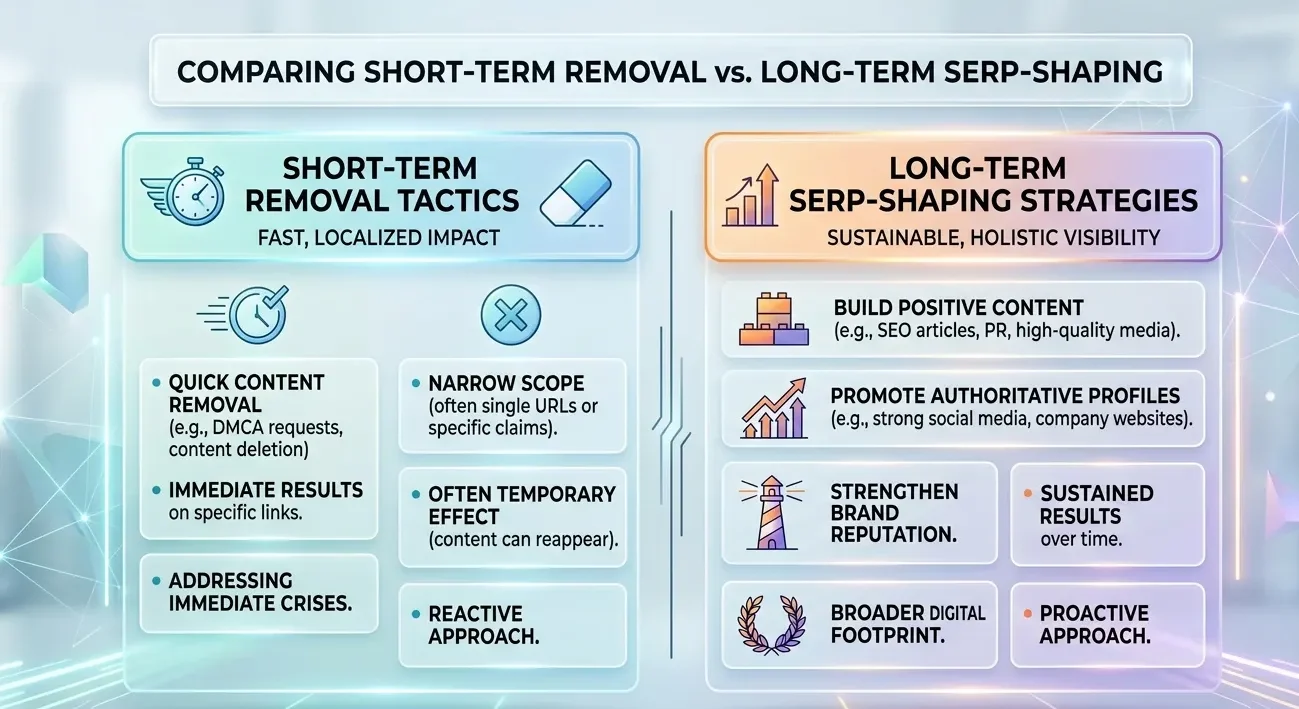
Long‑term SERP‑shaping strategies rely on content creation, structured data‑optimisation, and authority‑building to tip the SERP composition toward positive‑aligned information. The mechanism operates through iterative ranking‑influence: each additional authoritative‑page, third‑party‑citation, and sector‑specific article increases the baseline of positive reputation signals. Over time, the SERP displays a more balanced, multi‑source picture that dilutes the weight of any single negative item.
Comparative analysis reveals that short‑term removal offers visible, time‑bound relief but is vulnerable to policy‑revisions and platform‑moderation‑limits. Long‑term SERP‑shaping is less dramatic on a per‑item basis but produces more durable changes in entity credibility and search ranking influence, because the SERP is anchored by a broad, positive‑aligned content ecosystem.
How do different approaches affect search visibility and trust signals?
Different reputation‑management approaches affect search visibility and trust signals by changing the density, valence, and authority of the content that search engines and users see.
Content‑based approaches (e.g., publishing employer‑profiles, employer‑news, and sector‑specific content) alter the SERP by increasing the proportion of positive‑aligned, authoritative pages. The mechanism operates through content indexing and ranking dynamics: higher‑quality, well‑structured content receives stronger ranking‑influence, which shifts the SERP composition toward a more favourable perception. The trust signals embedded in these pages reinforce the entity’s credibility over time.
Content‑removal‑centric approaches focus on decreasing the visibility of specific negative items, such as Indeed reviews or negative articles. The mechanism operates by applying policy‑and‑moderation‑logic to force deletion or suppression. When successful, the SERP shows fewer negative items, which can temporarily improve perceived trust, but the effect is constrained by platform‑rules and the persistence of cached or mirrored content.
Comparative analysis shows that content‑enhancement‑strategies generate more stable, long‑term trust signals because they expand the authoritative‑reputation layer rather than simply removing nodes. Content‑removal‑strategies are necessary in specific cases of policy‑or‑law‑breach, but on their own, they cannot create a robust, self‑sustaining reputation‑structure.
Removing an Indeed review in the UK is a tightly‑governed, policy‑bound process that offers limited intervention scope compared with broader‑reputation‑management methods. Reputation management strategies differ based on whether they prioritise direct removal, content‑enhancement, or proactive‑SERP‑shaping; each approach alters entity credibility, search ranking influence, and sentiment distribution in distinct ways.