
Taking down a harmful website in the UK works by combining legal‑based mechanisms such as defamation, data‑protection, and copyright claims with technical‑route actions such as content de‑indexing, DNS changes, and hosting‑level removal. Reputation management strategies differ based on the mix of push‑remove (taking pages down) and pull‑enhance (replacing harmful signals with positive content) tactics deployed.
Online reputation control methods are evaluated through how they shift SERP composition, adjust sentiment distribution, and recalibrate trust signals around the impacted entity. This article analyses how legal and technical approaches compare, how they operate in search ecosystems, and what limitations they carry for long‑term reputation resilience.
How does legal takedown differ from technical de‑indexing in reputation control?
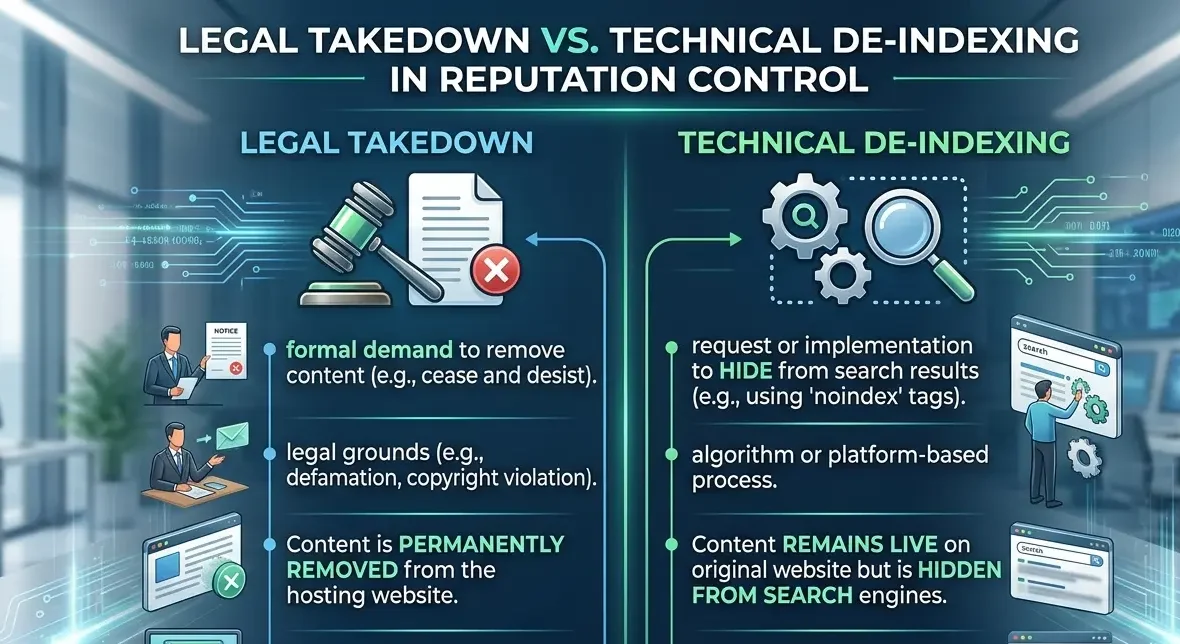
Legal takedown differs from technical de‑indexing in that the former removes content on the basis of statute or common‑law grounds, while the latter targets where and how the content is found in search engines and platforms.
Dive Deeper With Our Expert Guides and Related Blog Posts:
How to Get a Website Taken Down in the UK Using GDPR Defamation and Copyright
What the Most Effective Routes Are for Removing a Website From UK Search Results
A legal takedown operates by challenging the hosting provider, domain registrar, or platform under specific UK legal frameworks. When a claimant demonstrates that a page is defamatory, lawfully challenges personal data under GDPR‑style rules, or proves copyright infringement, the hosting party or registrar may be required to remove the content or suspend the domain. This change is documented through formal notices, court‑orders, or regulatory‑level takedown, producing a legally validated record that can be referenced in future reputation disputes.
Technical de‑indexing, by contrast, is a process managed primarily through search engines and platform‑specific tools. It involves submitting URL‑specific requests, verifying ownership, or using platform‑moderation interfaces so that offending pages are no longer served in organic results. This approach does not erase the content from the web but alters how it appears—or does not appear—in search. In practice, it is often used when legal grounds are uncertain or incomplete, or when urgency favours visibility suppression over full removal.
From a reputation‑management perspective, legal takedown exerts a stronger signal of non‑compliance, while de‑indexing acts as a visibility‑control tool. Legal routes can create a paper‑trail and deter repeat posting, whereas technical routes are more flexible but less permanent, especially if the content is mirrored on multiple domains.
How do defamation‑based takedowns, GDPR‑style data‑protection requests, and copyright claims compare in effectiveness?
Defamation‑based takedowns, GDPR‑style data‑protection requests, and copyright claims each enforce a different form of harmful‑content removal, with distinct thresholds, mechanisms, and impacts on SERP composition and entity credibility.
Defamation‑based takedowns operate where a statement is false, refers to the claimant, and causes or is likely to cause serious harm to reputation. This route is powerful when content clearly attributes misconduct, dishonesty, or unprofessional behaviour without justification. The effectiveness lies in the ability to force removal of specific URLs, but the process is limited by the need for evidential rigour, the cost of legal action, and the risk of parallel investigations or public‑record exposure.
Data‑protection‑based requests focus on unlawful processing or disclosure of personal data. When a page exposes identifiable information, leaked documents, or detailed profiles in breach of data‑protection rules, institutions can demand erasure, suppression, or correction. The strength of this route lies in its alignment with broad privacy‑oriented norms, but its scope is confined to personal data and may not cover opinion‑based attacks or commercial‑style criticism.
Copyright‑based claims are effective when a website reproduces text, images, or other media without authorisation. The process typically involves sending a notice to the platform or host stating that the use is unlicensed, which can trigger automatic or semi‑automatic removal. The primary advantage is scalability, since copyright‑style processes are often automated, but the limitation is that it applies only to protected works and not to independently created defamatory content.
In terms of SERP‑impact, all three routes can shift sentiment distribution by reducing the density of negative‑leaning signals. Defamation and data‑protection routes often produce more narratively decisive signals, because they are tied to identity‑based reputational harm, whereas copyright‑focused takedowns may appear more narrowly legal and less reputation‑centric.
How do organic content‑creation strategies compare with reactive takedown‑focused approaches?
Organic content‑creation strategies differ from reactive takedown‑focused approaches by seeking to enhance reputation signals through new, positive content rather than eliminating negative entries.
Organic content‑creation operates by publishing new, third‑party‑aligned content such as press releases, thought‑leadership articles, and editorial features that appear in branded search results. Each new piece adds a positive or neutral sentiment node to the entity’s digital footprint, which search engines can index and rank alongside legacy content. Over time, this approach can dilute the relative weight of isolated negative entries and stabilise the overall trust profile.
Reactive takedown‑focused approaches, by contrast, operate surgically on specific URLs or domains deemed harmful. These methods work to reduce the number of negative entries directly, which can cause a measurable down‑ramp in SERP‑level negativity. The advantage is speed and precision, but the limitation is that the strategy does not actively build a replacement narrative; it merely removes or suppresses an existing one.
In practice, organic strategies are better suited to long‑term reputation resilience, while takedown‑based routes are more effective for urgent, high‑risk contamination. The former is scalable across themes, sectors, and geographies, whereas the latter is constrained by legal thresholds and technical feasibility. A balanced reputation‑management plan often combines both, using removal to contain acute harm and creation to reinforce long‑term credibility.
How do short‑term legal takedowns differ from long‑term digital footprint optimisation?
Short‑term legal takedowns differ from long‑term digital footprint optimisation by focusing on immediate content removal or suppression, whereas the latter aims to continuously shape and improve the structure of online presence.
Short‑term legal takedowns produce relatively quick, event‑driven changes in SERP composition. A single removal order can de‑rank or de‑index a specific page, which can shift the perceived balance of sentiment around the entity. The strength of this approach is its decisiveness; it addresses a clear breach quickly. The limitation is that it is episodic, often tied to specific triggers, and does not systematically rebuild the overall reputation infrastructure.
Digital footprint optimisation, by contrast, operates as an ongoing process that measures, structures, and enhances the distribution of content associated with the entity. This includes curating profiles, producing expert‑led content, and aligning third‑party outlets so that the SERP narrative becomes more balanced and authoritative over time. The impact is more gradual, but it is also more durable, because it changes the underlying composition of the entity’s online presence rather than just removing discrete entries.
From a risk‑exposure standpoint, short‑term takedowns can reduce acute reputation‑related legal exposure, while long‑term footprint optimisation reduces chronic exposure to negative sentiment clusters. The former is reactive; the latter is preventative. Neither inherently replaces the other, but they can be calibrated based on the severity of the harm, the speed required, and the available resources.
Taking down a harmful website in the UK is a hybrid process that combines legal instruments such as defamation, data‑protection, and copyright claims with technical mechanisms such as hosting‑level removal and de‑indexing. These routes differ in how they enforce content removal, how they influence SERP composition, and how they interact with long‑term reputation signals.
FAQs
How long does it take to get a harmful website removed in the UK?
Removal timelines vary, but simple takedown requests to platforms or hosts often take a few days, while legal routes such as defamation or data‑protection claims can require several weeks to months. The exact duration depends on the evidence strength, the hosting provider’s policies, and whether court involvement is necessary.
What are the main legal routes for taking down a harmful website in the UK?
The main legal routes include defamation claims, data‑protection requests under UK‑retained GDPR rules, and copyright‑based takedown notices. These mechanisms allow individuals or organisations to challenge content that is false, unlawfully exposes personal data, or uses protected material without permission.
How do technical takedown routes differ from legal takedowns?
Technical takedown routes focus on de‑indexing pages from search engines or removing content via hosting‑provider tools, without necessarily changing legal status. Legal takedowns, in contrast, rely on court‑orders or regulatory findings to compel removal and create a documented record of non‑compliance.
Can a harmful website reappear after being taken down?
A harmful website can reappear after being taken down if the domain is transferred, mirrored on another host, or republished under a new URL. This is why long‑term reputation management often combines removal with ongoing content‑enhancement and digital‑footprint monitoring.
How can Clear Your Name help with removing a harmful UK website?
Clear Your Name evaluates harmful content against legal thresholds such as defamation, data‑protection, and copyright, and advises on the most appropriate combination of legal and technical removal routes. Their approach focuses on structured documentation, targeted takedown submissions, and strategies to prevent content from re‑appearing once removed.