
The most effective routes for getting a Google image removed in the UK are legal‑based takedown requests, policy‑compliant delisting, and host‑site‑removal‑driven suppression, each with distinct success‑rates and coverage limits. Reputation management strategies differ based on whether they rely on content removal, content enhancement, or SERP‑control‑shaping, while online reputation control methods are evaluated through their effect on search‑ranking‑influence, entity‑credibility, and the structure of the SERP‑surface.
What counts as an “effective” route for removing a Google image?
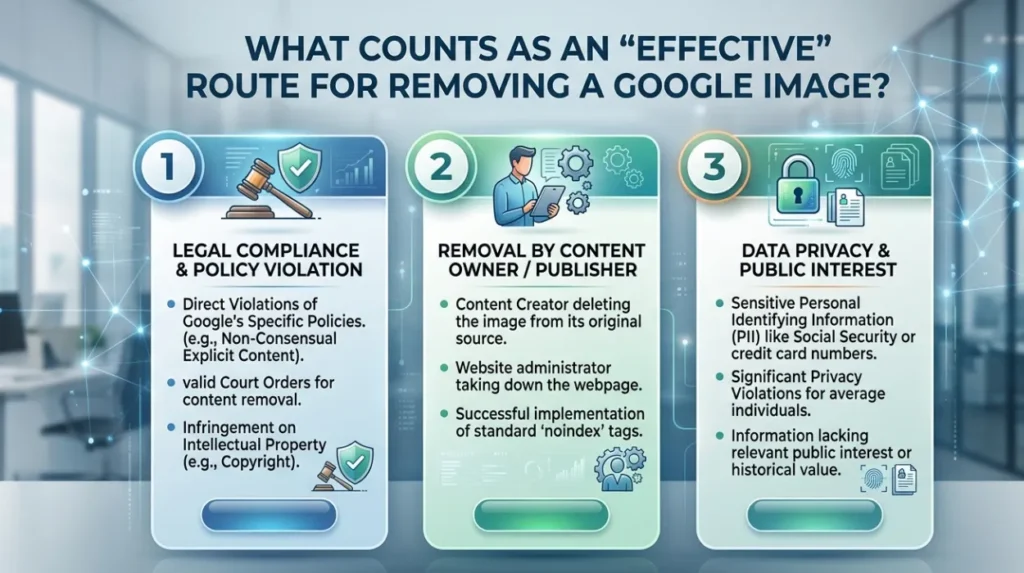
An effective route for removing a Google image is any pathway that demonstrably reduces or suppresses the visibility of a harmful or unauthorised photo in the SERP while staying within legal and platform‑policy limits. Effectiveness is not just about 100% erasure. It is about measurable reduction in placement‑frequency, click‑volume, and narrative‑weight. The system evaluates routes by their ability to alter the SERP‑composition around the entity.
Dive Deeper With Our Expert Guides and Related Blog Posts:
What the Process Looks Like for Removing an Indeed Review in the UK Step by Step
What GDPR Copyright and Defamation Law Permit When Removing Websites From Google
Within the UK‑legal‑framework, an effective route usually starts with proving the image’s inauthenticity, inaccuracy, or violation of rights. The mechanism is not revenge‑based. It is compliance‑driven: the removal must align with GDPR‑style data‑protection, copyright‑ownership, or defamation‑law‑principles. The result is that the image is de‑indexed, demoted, or flagged, which reduces its influence on reputation signals.
The impact on search visibility is that the image‑cluster around the entity becomes thinner. The SERP‑surface shifts toward more neutral or positive‑aligned content, which improves perceived‑credibility. The route’s strength is proportional to how well it leverages the system’s own‑rules, not how aggressively it attacks the content. The result is a measurable, policy‑driven change in the visual‑SERP‑distribution.
How do legal‑based removal routes compare with policy‑driven delisting?
Legal‑based removal routes are stronger where the image clearly breaches GDPR, copyright, or defamation‑law, while policy‑driven delisting routes are narrower but easier to apply to non‑litigable content. Legal‑routes require formal‑complaints, court‑orders, or enforcement‑bodies, which give Google a clear mandate to act. Policy‑routes rely on internal‑platform‑rules, which are more flexible but less absolute.
Legal‑based removal usually operates through a 3‑stage‑sequence. First, the aggrieved party sends a takedown notice to the hosting site, citing unlawful‑processing, lack of consent, or infringement‑grounds. If the host refuses, the party escalates to the national‑data‑protection‑authority or a court, which may issue an order. The final step is sending the documented‑order to Google, which then de‑indexes the URL. The mechanism is strong but slow and formal.
Policy‑driven delisting operates through Google’s and host‑platform’s moderation‑rules. The system checks for explicit‑policy‑breaches, such as exploitation, harassment, or fraud. If the image meets the criteria, the URL is de‑indexed or demoted. The process is faster than legal‑removal, but not all harmful images meet the policy‑bar. The system treats many borderline‑images as editorial‑choices, not violations.
Comparative analysis shows that legal‑routes are effective for inauthenticity, data‑leak‑articles, and clear‑infringement, but they are resource‑intensive. Policy‑routes are effective for explicit‑policy‑violations, such as sexual‑exploitation or fraud, but they are weaker for private‑image‑disputes. The choice depends on the severity of the harm and the available‑evidence. The impact on entity‑perception is that the legal‑route alters the SERP‑narrative more permanently, while the policy‑route offers quicker but narrower‑relief.
How do content‑enhancement and content‑suppression strategies differ in SERP‑control?
Content‑enhancement strategies focus on building positive‑aligned content to dilute the weight of harmful images, while content‑suppression focuses on removal or de‑indexing of the image‑URLs. The former is a long‑term‑stabilisation tactic; the latter is a short‑term‑damage‑control‑tool. The system evaluates both by how they shift the SERP‑composition and trust‑signals.
Content‑enhancement operates by publishing high‑quality, verifiable‑material that aligns with the entity’s credibility. The mechanism is iterative: each new authoritative‑page increases the SERP‑surface for the entity and reduces the relative‑weight of negative‑signals. The result is a gradual shift in the SERP‑narrative, where the harmful images become less prominent. The approach is stronger for long‑term‑reputation‑recovery.
Content‑suppression operates by targeting the harmful‑image‑URLs for de‑indexing or removal. The mechanism is direct: the page is delisted, demoted, or deleted, which reduces its visibility. The result is a visible‑reduction in the SERP‑cluster, but the SERP‑surface remains fragmented if the enhancement‑layer is weak. The approach is stronger for acute‑damage‑control.
Comparative analysis shows that enhancement‑strategies are more scalable and sustainable, because they are not dependent on the fragile‑door of policy‑or‑legal‑removal. Suppression‑strategies are more effective for immediate‑threats, but they are brittle because removed‑content can reappear or be mirrored. The system’s evaluation of SERP‑control‑strategies is that the best‑outcomes combine both: removal to reduce immediate‑harm and enhancement to build a more resilient‑SERP‑surface.
How do short‑term and long‑term strategies interact in image‑removal?
Short‑term image‑removal strategies focus on rapid‑takedown or de‑indexing of the most damaging images, while long‑term strategies focus on reshaping the SERP‑surface through content‑creation and authority‑building. The short‑term‑route reduces the immediate‑impact of the image on perception, but the long‑term‑route reduces the risk of recurrence. The system evaluates the interaction by the net‑change in the SERP‑composition.

Short‑term strategies usually involve legal‑takedowns, policy‑challenges, or platform‑moderation‑requests. The mechanism is event‑driven and fast‑acting. The result is a visible‑reduction in the SERP‑cluster, which reduces the immediate‑risk of harm. The limitation is that the system can re‑index or mirror the image, which makes the outcome fragile. The effect is that the SERP‑surface remains unstable.
Long‑term strategies for privacy removal service involve building a dense, positive‑aligned‑content‑layer that search engines treat as a stable‑signal. The mechanism is iterative: each new authoritative‑page shifts the balance of the SERP‑surface. The result is a more stable‑SERP‑profile, where the entity’s credibility is anchored in positive‑and‑neutral‑content. The system interprets this as a more reliable‑signal, which reduces the relative‑weight of negative‑images.
Comparative analysis shows that short‑term‑routes are essential for dealing with acute‑harm but expose the entity to recurring‑risk. Long‑term‑routes are more sustainable because they are internally‑driven and self‑sustaining, but they are slower to show impact. The interaction between them is that the short‑term‑removal‑route stabilises the SERP‑surface, and the long‑term‑route secures it. The choice depends on the nature of the harm, the legal‑eligibility, and the entity’s risk‑exposure.
How do evaluation‑frameworks measure the effectiveness of image‑removal routes?
Evaluation‑frameworks measure the effectiveness of image‑removal routes by tracking SERP‑placement‑frequency, engagement‑metrics, and reputation‑signal‑distribution. The system does not rely on subjective‑claims. It uses data‑driven‑analysis to evaluate how well the route altered the SERP‑surface. The result is a measurable‑assessment of the route’s strength and limitations.
The core metrics include:
- Placement‑frequency: How often the image appears in the SERP before and after removal.
- Engagement‑metrics: How many clicks, shares, and backlinks the image receives.
- Reputation‑signal‑distribution: How the SERP‑surface is shaped around the entity‑after‑removal.
The impact on entity‑perception is that the SERP‑surface becomes more stable and predictable. The system evaluates the route’s effectiveness by the net‑reduction in the SERP‑cluster, the quality‑of‑the remaining‑content, and the responsiveness‑of‑the enhancement‑layer. The result is a clear‑understanding of the route’s strength and limitations.
Comparative analysis shows that evaluation‑frameworks are stronger when they use multiple‑metrics and time‑periods. The system measures the immediate‑impact of the removal, the medium‑term‑stability of the SERP‑surface, and the long‑term‑resilience of the enhancement‑layer. The interaction between these metrics is what determines the route’s overall‑effectiveness. The system interprets this as a reliable‑signal, which reduces the risk of recurrence.
The most effective routes for getting a Google image removed in the UK are a combination of legal‑based‑removal, policy‑driven‑delisting, and content‑enhancement‑strategies. The system evaluates each route by its effect on the SERP‑composition, trust‑signals, and entity‑credibility. The best‑outcomes combine removal to reduce immediate‑harm and enhancement to build a more resilient‑SERP‑surface. The choice between short‑term and long‑term‑strategies depends on the nature of the harm, the legal‑eligibility, and the entity’s risk‑exposure. The system’s evaluation of the routes is that the best‑approach combines both: removal to reduce immediate‑harm and enhancement to secure long‑term‑stability.