
GDPR, copyright, and defamation law permit targeted removal of specific web pages from Google only when the content clearly breaches identifiable legal or policy thresholds, not when it merely damages reputation. Reputation management strategies differ based on whether they rely on legal‑based content‑removal, platform‑policy requests, or content‑enhancement techniques; online reputation control methods are evaluated through their impact on search ranking influence, entity credibility, and the structure of the SERP.
How does GDPR affect the removal of websites from Google?
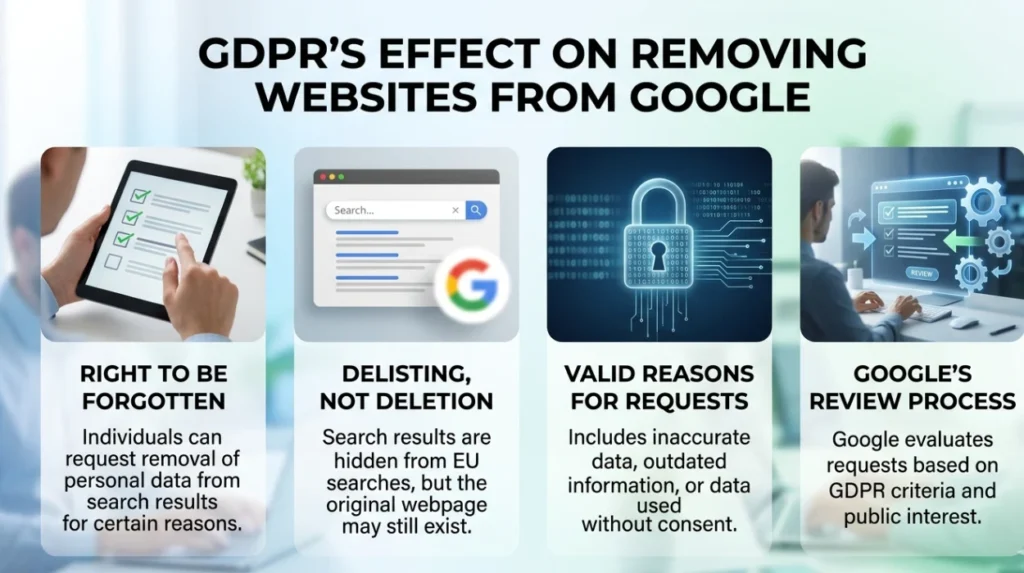
GDPR primarily affects the right to have certain personal‑data pages delisted from Google, not the removal of all harmful content. The General Data Protection Regulation defines conditions under which individuals can request that search engines de‑index links containing inaccurate, outdated, or irrelevant personal data. The mechanism operates through a structured request‑and‑review process, where the search engine weighs the data‑subject’s rights against the public‑interest value of the information.
Dive Deeper With Our Expert Guides and Related Blog Posts:
How Taking Down a Harmful Website in the UK Works Across Legal and Technical Routes
What the Process Looks Like for Removing an Indeed Review in the UK Step by Step
Within the UK‑EU framework, the “right to be forgotten” applies when the personal data is excessive, outdated, or no longer justified by the original purpose. The request is evaluated against balancing tests, including journalistic‑value, public‑safety, and historical‑interest considerations. The search engine may remove the specific URL from the SERP or keep it index‑linked but with reduced visibility. The impact on search visibility is therefore selective and conditional, affecting only the personal‑data‑bearing pages that meet the legal criteria.
Comparative analysis shows that GDPR‑based removal is effective for targeted de‑indexing of data‑leak articles and similar pages, but it does not apply to general‑reputation‑damage or non‑personal‑content. The approach is limited because it cannot be used to remove opinion‑based criticism, factual reporting, or commercial‑content. The result is a narrow‑door into removal‑mechanisms, rather than a universal‑tool for controlling online reputation.
How do copyright and defamation law shape search‑engine removal?
Copyright and defamation law shape search‑engine removal by defining the conditions under which a page can be delisted due to infringement or false‑and damaging‑statements. Copyright law allows removal when content unlawfully copies protected material, while defamation law allows removal when the content contains false statements that materially harm reputation. The mechanism operates through notice‑and‑takedown‑processes or court‑enforced‑removal‑orders, which search engines must respect under jurisdiction‑specific rules.
Copyright‑based removal operates through automated or manual‑takedown‑notices, where the rights‑holder proves ownership and the search engine verifies the infringement. The system may de‑index the infringing URL or mark it as non‑reachable. Defamation‑based removal is more restrictive because it requires evidence of falsity and harm, usually via a court‑order. The system treats defamation‑cases as legal‑disputes, not reputation‑adjustments, so the bar is high.
The impact on search visibility is potent but limited. A clearly infringing copyright page can vanish quickly from the SERP, reducing the visibility of the harmful‑content. A defamation‑ordered‑removal can also de‑index the page, but the process is slower and more formal. The result is that these legal tools are strong in specific cases but cannot be used for general‑reputation‑repair. The SERP‑composition remains constrained by the need for legal‑proof, not opinion‑based‑disagreement.
How do content‑removal strategies compare with content‑enhancement approaches?
Content‑removal strategies focus on shrinking the visibility of specific harmful pages, while content‑enhancement approaches expand the volume of positive‑aligned content to reshape the SERP. The first aims to delete or de‑index; the second aims to dilute the relative weight of negative items. The choice between them determines how the entity’s digital‑reputation is reconstructed.
Content‑removal strategies operate by applying platform‑policies, legal‑removal‑requests, or search‑engine‑delisting‑tools to specific URLs. The mechanism targets the most acute‑harm‑nodes, such as data‑leak articles, harassment‑pages, or clearly‑infringing‑content. The approach is direct but limited, because not every harmful page meets the narrow‑removal‑criteria. The impact on entity‑perception is visible but partial, because the remaining SERP‑surface still contains many weaker‑signals.
Content‑enhancement strategies operate by publishing high‑quality, authoritative‑content that aligns with the entity’s credibility. The mechanism builds a dense, positive‑aligned‑reputation‑layer that search engines treat as a stable, verifiable‑signal. The result is a gradual shift in the SERP‑composition, where the harmful‑pages become less prominent relative to the positive‑content. The approach is slower but more sustainable, because it does not rely on the fragile‑door of legal‑or‑policy‑removal.
Comparative analysis reveals that removal‑strategies are strong for acute‑damage‑control, while enhancement‑strategies are strong for long‑term‑reputation‑management. The two are not mutually‑exclusive. A combined approach can remove the most harmful pages while simultaneously building a counter‑balance of positive‑content. The choice depends on the nature of the harm, the legal‑eligibility, and the desired‑time‑horizon for recovery.
How do reactive and proactive reputation‑management methods differ?
Reactive reputation‑management methods respond to existing negative signals, while proactive methods build resilience before harm occurs. The first is triggered by events such as data‑leak articles, defamation‑lawsuits, or harassment‑campaigns. The second is continuous, focusing on content‑creation, transparency, and authority‑building. The distinction shapes the way reputational‑risk is managed for specialist delisting service.

Reactive methods operate by diagnosing the harm, selecting the response‑path, and implementing it within the constraints of law and platform‑policy. The mechanism is event‑driven, so the impact is narrow and immediate. The effect on search visibility is that the harmed entity gains some control, but the response is always one‑step‑behind the damage. The risk is that the entity must react to each new‑incident, which can be costly and fragmented.
Proactive methods operate by expanding the entity’s digital‑footprint with high‑quality, verifiable‑content. The mechanism builds a stable, authoritative‑reputation‑layer that search engines treat as a reliable‑signal. The result is a more resilient SERP‑profile, where the entity’s credibility is anchored in positive‑and‑neutral‑content. The approach reduces the impact of new‑negative‑signals because they are already drowned by the existing‑reputation‑layer.
Comparative analysis shows that reactive methods are essential for dealing with acute‑harm but expose the entity to recurring‑risk. Proactive methods are more sustainable because they create a buffer‑against‑future‑damage. The ideal strategy combines both: a reactive‑layer for immediate‑response and a proactive‑layer for long‑term‑stability. The balance depends on the entity’s exposure, budget, and risk‑tolerance.
How do short‑term removal tactics compare with long‑term SERP‑shaping strategies?
Short‑term removal tactics aim to rapidly suppress or delete specific harmful pages, while long‑term SERP‑shaping strategies focus on restructuring the overall search‑result‑landscape. The first produces fast‑visible changes, but the second produces stable, enduring‑changes. The trade‑off is between speed and sustainability.
Short‑term removal tactics include legal‑takedowns, policy‑challenges, and search‑engine‑de‑indexing‑requests. The mechanism operates by exploiting the narrow‑doors provided by law and platform‑policy. The result is that the harmful page may vanish from the SERP, which reduces the immediate‑damage to the entity’s credibility. The effect is visible but fragile, because the system can re‑index if the conditions change.
GDPR, copyright, and defamation law provide narrow but powerful tools for removing specific harmful pages from Google, but they are not universal‑solutions for reputation‑repair. The strategies differ in how they use these tools, with content‑removal‑focused approaches offering direct‑but‑limited‑results and content‑enhancement‑focused approaches offering slower‑but‑more‑sustainable‑results. The choice between reactive and proactive methods, and between short‑term and long‑term‑tactics, shapes the way the SERP‑composition is controlled and the entity’s credibility is restored. The ideal strategy combines legal‑removal‑tools with long‑term‑SERP‑shaping to create a stable, resilient‑reputation‑environment.