
To remove a Facebook post in the UK, report the content through Facebook’s reporting tools selecting the precise violation category, supply supporting evidence in the report where the interface allows, and escalate via platform complaint routes such as the UK’s Online Safety framework or an appointed safety regulator if available. Reputation management is the practice of monitoring, interpreting and influencing an entity’s public perception across digital ecosystems. Online reputation refers to the aggregate of signals, content and indexed references that define an entity’s standing within search ecosystems.
What is the correct procedural route to report a harmful Facebook post in the UK?
Use the platform’s built-in reporting workflow, choose the correct legal or policy category, attach supporting context, and track escalation through official oversight channels. Reporting a post is the act of submitting a content complaint through a platform’s designated interface, which encodes the complaint into a machine-readable policy decision pipeline.
The report initiates a sequence: the platform tags the content with policy metadata, queues it for automated moderation or human review, applies a policy decision (remove, demote, add label), and records that decision in internal incident logs. When the report cites potential legal harm, platforms route the item through higher-priority queues or to specialist teams. In jurisdictions with oversight mechanisms, platforms also compile reports for regulatory review.
Impact on search visibility and perception: Removal changes the content indexing state from “publicly available” to “restricted” or “removed,” reducing the post’s discoverability in internal platform search and external search engine indexing. If the platform adds labels or demotes the content, SERP evaluation algorithms treat the content as lower-authority, lowering its rank and diminishing its contribution to entity perception and reputation signals.
How does platform policy categorisation determine the success of a removal report?
Accurate policy categorisation defines review pathways and priority levels, and therefore determines the likelihood and speed of removal. Policy categorisation is the assignment of a complaint to a specific violation class within a platform’s content policy taxonomy.
Mechanism: Platforms use taxonomy tags (for example: harassment, hate, violence, defamation, privacy violation) to route reports to automated classifiers or specialist human moderators. Accurate tagging triggers precise rule-sets, evidence thresholds, and remedial actions. Incorrect tagging routes the report through generic queues that apply broader, less relevant rules and lower-priority handling.
Impact on search visibility and perception: Correct categorisation expedites removal or labelling, which rapidly suppresses indexing and decay of reputation signals. Incorrect categorisation allows continued visibility, permitting the content to accrue backlinks, shares and engagement metrics that strengthen its ranking signals and reinforce negative entity perception.
Why are Facebook posts difficult to remove even when they clearly violate rules?
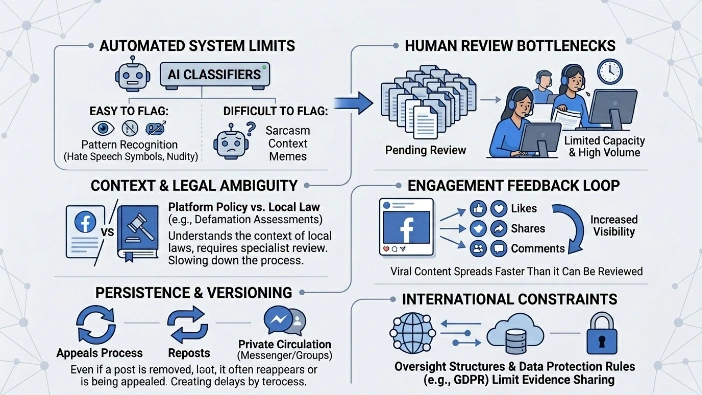
Removal complexity arises from automated moderation limits, ambiguous policy boundaries, evidential thresholds, and the interaction between platform incentives and legal frameworks. Moderation difficulty refers to the operational and algorithmic impediments that prevent straightforward application of policy decisions against flagged content.
Automated systems prioritise scale and pattern recognition; they operate via classifiers trained on prior labels and heuristics. Ambiguity in context or sarcasm reduces classifier confidence, shifting cases to human review queues which are capacity-limited. Platforms incorporate legal risk assessments for example assessing whether content constitutes defamation under jurisdictional law which requires specialist review. Appeals, reposts, and private circulation create versioning issues. Additionally, engagement signals (shares, comments) create feedback loops that raise a post’s visibility even as it risks removal. Oversight structures and data-protection constraints limit how user-submitted evidence is treated across international routes.
Impact on search visibility and perception: Delays or inconsistent removals allow content to remain indexed and linked to an entity, generating persistent reputation signals. Search engines and internal platform ranking systems use engagement and recency as strong ranking features; therefore protracted disputes permit harmful posts to shape entity perception and SERP evaluation long before resolution.
How do algorithms interpret trust and credibility when evaluating reported content?
Algorithms evaluate trust and credibility through a combination of source signals, engagement patterns, authority indicators and contextual metadata. Trust signals are quantifiable attributes algorithms use to infer content reliability; credibility is the algorithmic estimation of the content’s truthfulness and relevance within entity networks.
Algorithms weight provenance (account age, verification status, prior policy history), network structure (who shares the content, relationship strength), engagement quality (ratio of organic interactions versus bot-like amplification), and external corroboration (links from authoritative domains). Metadata such as geolocation tags, timestamps, and attached media influence classifier decisions. Machine-learning models produce a credibility score that informs ranking, demotion, or labelling actions. Human review outcomes feed back to model retraining, altering future credibility assessments.
Impact on search visibility and perception: Higher credibility scores elevate content in SERP evaluation and platform feeds, reinforcing reputation signals for associated entities. Conversely, demotion or label application reduces ranking signals and can relegate content to low-visibility buckets, limiting its influence on entity perception.
What role does content indexing play in preserving or removing a harmful post?
Indexing determines whether external search engines and platform search can locate and cache the post; de-indexing or removal severs those discovery channels. Content indexing is the process by which search systems and platform indexes crawl, store and make content discoverable for retrieval and ranking.
When a post is publicly accessible, crawlers capture metadata and content snapshots that feed index databases. Reporting and subsequent removal change the HTTP response and content accessibility: removed content returns restricted status or 404 responses, prompting search engines and archivers to update or remove cached entries. Platforms may add meta directives (noindex, robots exclusions) or legal request responses to control external indexing. Time lag between removal and index refresh permits cached copies to persist; third-party archives or screenshots further complicate complete eradication.
Impact on search visibility and perception: Active indexing preserves a harmful post’s contribution to search visibility. Successful removal and de-indexing decrease SERP presence, weakening the post’s ability to shape entity reputation. Persistent caches and archives maintain residual reputation signals even after original removal.
How do review signals and sentiment interpretation affect an entity’s online reputation?
Review signals aggregate structured feedback and sentiment analysis to produce weighted reputation metrics that influence entity perception and ranking. Review signals are indexed indicators derived from user reviews, ratings and comments; sentiment interpretation is the process by which algorithms evaluate emotional valence and intent in textual content.
Platforms and search engines parse structured review data (star ratings, review count) and unstructured text via natural language processing to extract sentiment polarity and aspect-specific complaints. Algorithms combine recency, volume, and sentiment intensity to compute reputation indices. Review moderation filters and verified-review mechanisms adjust the weight of individual items based on provenance and trust markers. Aggregators summarise these signals into scorecards that feed entity-level ranking and knowledge panels.
Impact on search visibility and perception: Negative review signals depress an entity’s authority in SERP evaluation and reduce click-through via lower perceived credibility. Positive reviews enhance trust signals, improving prominence. Accurate sentiment interpretation enables nuanced demotion of targeted content without blanket suppression, preserving legitimate discourse while managing reputation risk.
How does an entity’s digital footprint create persistent reputation signals?
A digital footprint comprises all indexed references and interactions associated with an entity; persistent signals emerge from durable content, backlinks and repeated narratives. Digital footprint is the collection of publicly accessible traces—posts, mentions, profiles, reviews and citations—linked to an entity within search ecosystems.

Each indexed reference contributes a discrete reputation signal: content relevance, anchor text in backlinks, co-occurrence with entities or topics, and engagement metrics. Repetition across independent domains creates reinforcement via citation networks; high-authority linkages propagate trust by association. Content permanence is influenced by hosting policies, archiving, and legal notice outcomes. Entities accumulate semantic context through structured data and named-entity recognition, shaping entity perception in knowledge graphs.
Impact on search visibility and perception: A dense, positive digital footprint amplifies authority and increases resilience to isolated negative posts. Conversely, harmful posts embedded within a sparse footprint exert disproportionate influence because ranking systems have fewer counterbalancing signals. Managing footprint composition alters long-term SERP evaluation and entity perception.
How does authority and trust signal design affect removal outcomes?
Authority and trust signals in the reporting context determine prioritisation and evidential thresholds for moderation decisions. Authority signals are metadata and network attributes that algorithms interpret as indicators of content legitimacy or harm potential.
Reports from verified sources, institutional accounts, or law-enforcement channels carry higher authority weight and trigger elevated review. Conversely, reports from new accounts without corroboration occupy low-priority queues. Platforms integrate external trust indicators—cross-domain citations, legal notices, and recognised oversight referrals into their decision matrices. Trust signal scarcity requires greater evidential clarity to prompt removal.
Impact on search visibility and perception: High-authority interventions accelerate removal and reduce content’s search visibility, thereby mitigating reputation damage more efficiently. Low-authority reports produce slower remediation and permit continued propagation of harmful content that degrades entity perception in SERP evaluation.
This analysis defines the procedural, algorithmic and indexing dynamics that determine whether a harmful Facebook post in the UK is removed and how such content affects reputation signals. Reputation management is an information systems discipline that evaluates how indexed content, authority markers, review signals and platform policy taxonomies combine to form entity perception in search ecosystems.
For more information explore:
Get a Harmful Facebook Post Removed in the UK With Professional Support Today
Effective removal depends on accurate policy categorisation, credible reporting evidence, authority-weighted escalation and the interplay between platform moderation pipelines and indexing processes. Managing the digital footprint and understanding algorithmic trust and credibility mechanisms reduces the long-term impact of isolated harmful posts on SERP evaluation and entity reputation.
How do I report a harmful Facebook post in the UK?
Use Facebook’s in-app “Report post” option and select the precise violation category (harassment, privacy breach, defamation). Provide supporting evidence in the report fields and document the report reference; escalate to UK oversight channels if unresolved.
What evidence strengthens a removal request for a Facebook post?
Provide screenshots with timestamps, links to the original post, and any message histories that demonstrate context and harm. Include account identifiers and indicate if the content breaches UK legal standards to increase priority in review.
How long does Facebook take to review a reported post in the UK?
Automated reviews often return within hours, while human review for complex or legal issues may take days to weeks. Cases flagged for legal assessment or escalated via oversight mechanisms require additional time for specialist review.
Will removing a Facebook post stop it appearing in search engines?
Removal updates platform indexing and triggers de-indexing, but caches and third-party archives can persist; search engines require crawl cycles to refresh indexes. Document removal actions and request de-indexing where applicable to accelerate SERP updates.