
Reputation management is the practice of influencing how an organisation or individual is perceived across search ecosystems. Online reputation refers to the collection of digital signals, content, and indexed mentions that define an entity’s perceived credibility and authority in search visibility.
Negative content removal covers the identification, evaluation, and procedural suppression or removal of online items that harm an entity’s search reputation. It applies across content-hosting platforms (social networks, review sites, forums), search engine indexes, third-party publishing platforms, and aggregated data services.
What does “negative content removal” mean within reputation systems?
Negative content removal is the targeted deletion, de-indexing, or suppression of online content that contributes adverse reputation signals within search ecosystems. The concept defines removal as actions that alter content availability or discoverability, including takedown notices to hosts, legal requests to remove indexed URLs, content rectification with publishers, and technical suppression through SEO countermeasures. Removal operates at two system layers: content-host layer (where material lives) and index layer (how search engines surface content). Each layer enacts different mechanisms and generates distinct impacts on search visibility and entity perception.
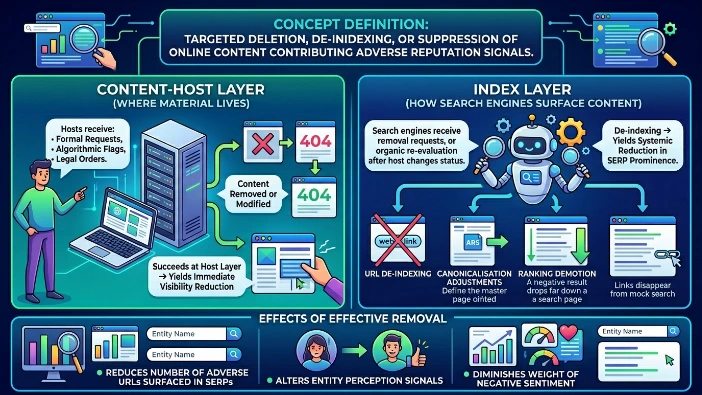
Hosts receive formal requests, algorithmic flags, or legal orders that cause content to be removed or modified. Search engines receive removal requests or organically re-evaluate ranking signals after the content’s host changes status. Index-level actions include URL de-indexing, canonicalisation adjustments, and ranking demotion.
Effective removal reduces the number of adverse URLs surfaced in SERPs, alters entity perception signals, and diminishes the weight of negative sentiment in entity-centric search queries. Removal that succeeds at the host layer yields immediate visibility reduction; de-indexing yields systemic reduction in SERP prominence.
Which platforms are involved when negative content affects reputation signals?
Platforms involved include social networks, review platforms, news publishers, blogs and forums, search engines, and data aggregator services. Social networks host user-generated posts that generate immediate reputation signals through recency and engagement metrics. Review platforms publish structured sentiment and star ratings that feed review-specific ranking features and knowledge panels. News publishers and blogs contribute authoritative content that carries editorial weight, influencing entity perception through citation and backlink authority. Forums and niche communities generate long-tail content that persists in index archives and influences entity-specific query results. Data aggregators compile public records and directory listings that create consolidated entity snapshots used for entity perception and knowledge graph signals.
Platforms expose different remediation pathways: content moderation forms on social networks, review dispute mechanisms on review platforms, publisher corrections or takedown processes on news sites, and legal/DMCA channels for hosting platforms. Search engines provide index-level removal tools and legal forms for jurisdictional takedowns.
Platform type determines tempo and permanence of reputation signals. Editorial platforms can produce high-authority SERP entries that persist; social posts generate immediate but short-lived visibility unless indexed; review sites create persistent structured signals that appear in review-rich SERP features.
How do search engines interpret trust and credibility when evaluating negative content?
Search engines evaluate trust and credibility using a combination of content-level signals, host-level authority, and entity-centric signals. Content-level signals include factual consistency, citation and reference structure, and content freshness. Host-level authority includes domain-level trust metrics, editorial signals, and historical accuracy. Entity-centric signals aggregate mentions across the web to construct an entity profile used by knowledge panels and entity-based ranking models. Search engines apply machine learning models that define reputational priors based on cross-source corroboration, contextual relevance, and user interaction patterns.
Algorithms cross-reference content against known authoritative sources, evaluate link patterns for manipulative behaviour, and use user engagement metrics (click-through rates, pogo-sticking) to calibrate perceived relevance. Entities with coherent, corroborated mentions receive stronger trust weight; isolated or contradictory negative mentions receive lower trust weight but can still rank if supported by host authority.
Content that aligns with high-authority hosts and corroborated sources ranks higher and thereby exerts greater influence on entity perception. Conversely, uncorroborated negative items on low-authority hosts have lower ranking potential but can still surface in long-tail queries and social SERP features.
How is reputation formed in search ecosystems through content indexing and ranking?
Reputation in search ecosystems forms through the interaction of content indexing, ranking algorithms, and entity aggregation. Content indexing is the process by which crawlers discover and store content; indexing determines whether a piece of content is eligible to appear in SERPs. Ranking algorithms then order indexed content based on relevance, authority, and user signals. Entity aggregation compiles mentions, structured data, and linked profiles to form an entity model that influences query disambiguation and SERP features.
Crawlers prioritise discoverability signals such as sitemaps, internal linking, and social propagation. Once indexed, ranking algorithms assess topical relevance, semantic alignment with query intent, and reputation signals like backlinks and structured citations. Entity aggregation maps mentions to a canonical entity, thereby allowing search systems to display entity-level information and filter content based on perceived trustworthiness.
Indexed negative content becomes a persistent component of SERP evaluation. When multiple indexed items present negative sentiment, entity perception shifts downward because ranking algorithms surface corroborated signals across results. Conversely, high-quality content and authoritative citations elevate positive reputation signals.
How do review signals and sentiment interpretation shape entity perception?
Review signals are structured data points that represent user sentiment, numerical ratings, and textual feedback. Sentiment interpretation refers to how algorithms parse textual reviews for polarity, intent, and credibility. Search ecosystems treat reviews as discrete reputation inputs that feed into local search features, star snippets, and algorithmic prominence.
Algorithms extract structured rating values (stars, scores) and perform natural language processing to classify sentiment and detect spam or manipulation. Platforms implement trust signals such as verified purchases, reviewer histories, and review recency to weight review reliability. Aggregated review metrics then feed into ranking heuristics for local and review-focused queries.
Strong negative review signals trigger SERP features that highlight user dissatisfaction, such as negative review snippets or prominence in local pack results. Positive review signals increase visibility within review-specific SERP placements, improving perceived credibility. Manipulated or inauthentic reviews create noisy reputation signals that algorithms discount through spam detection, but residual effects persist if manual moderation or verification is absent.
What role do authority and trust signals play in suppressing or amplifying negative content?
Authority and trust signals define how strongly a piece of content influences SERP evaluation and entity perception. Authority signals include domain-level metrics, editorial reputation, backlink profiles, and verified structured data. Trust signals include legal validation, verified author profiles, and consistent entity references across authoritative sources.
Algorithms assign higher ranking weight to content with strong authority signals, causing such content to both amplify and, when positive, overshadow negative items. Trust signals cause search systems to prefer corroborated narratives; content lacking trust markers receives lower ranking propensity. When negative content originates from high-authority hosts, its suppressive mitigation requires index-level remedies or creation of higher-authority counter-content.
Protect your online presence with expert Facebook Content Removal Services designed to reduce the visibility of harmful content while strengthening positive authority and trust signals. Strategic removal and reputation management solutions help businesses counter high-authority negative content, improve SERP balance, and reinforce long-term entity credibility.
How does the digital footprint contribute to entity reputation in search ecosystems?
Digital footprint refers to the sum of all indexed mentions, profiles, published content, and structured data associated with an entity. The digital footprint defines the available evidence that algorithms use to construct entity perception, including both positive and negative elements.
Search systems aggregate footprint elements through entity recognition, linking mentions to a canonical entity, and weighting each mention via host authority and contextual relevance. Footprint breadth (number of unique sources) and consistency (alignment of information across sources) create stronger entity models. Contradictions, outdated information, and orphan negative mentions degrade perceived credibility.
A broad, consistent digital footprint increases resilience to isolated negative items because algorithms distribute trust across multiple corroborating sources. Sparse or inconsistent footprints elevate the relative impact of negative content because fewer authoritative counter-signals exist to rebalance SERPs.
Dive Deeper With Our Expert Guides:
Why Content Published Online Rarely Disappears Without Expert Intervention
How Online Content Removal Works and Why It Takes Professional Expertise
How do content ranking dynamics affect attempts to remove or suppress negative items?
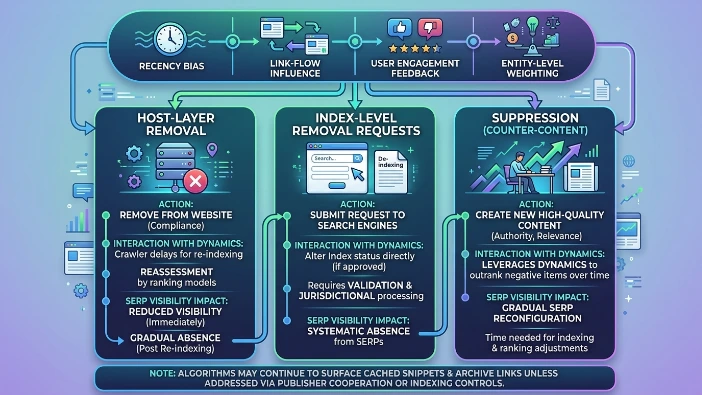
Content ranking dynamics determine how removal or suppression actions translate into SERP changes. Ranking dynamics include recency bias, link-flow influence, user engagement feedback, and entity-level weighting.
Removal at the host layer may not immediately update SERPs until crawlers re-index the absence and ranking models reassess signals. De-indexing requests alter index status more directly but require validation and jurisdictional processing. Suppression through counter-content creation leverages ranking dynamics by adding higher-authority or more-relevant pages that outrank negative items over time.
Immediate removal reduces visibility when hosts comply; index-level removals produce systematic absence from SERPs. Counter-content strategies require time for indexing and ranking adjustments and produce gradual SERP reconfiguration. Algorithms continue to surface cached snippets and archive links unless those are addressed via indexing controls or publisher cooperation.
Discover More Insights:
How a Negative Content Removal Service Builds a Case Before Acting
What methods do search systems use to evaluate entity perception after removal attempts?
Search systems evaluate entity perception post-removal by recalculating aggregated reputation signals and updating entity models. Evaluation uses signal re-weighting, cross-source corroboration checks, and user interaction monitoring.
After removal, algorithms reduce the weight of the removed source in the entity profile, recalculate sentiment aggregates, and monitor volatility in user engagement metrics for related queries. Systems detect sudden changes and may apply temporal dampening to avoid manipulation. Entity perception stabilises once multiple corroborating sources reflect the updated status.
Successful removal lowers visibility of negative signals and gradually shifts SERP emphasis toward remaining content. Indexing latency and cached snapshots create transitional visibility anomalies; full perception change requires consistent corroboration from authoritative sources.
How does Clear Your Name explain what Facebook content removal services cover?
Clear Your Name explains that Facebook content removal services cover identification, reporting, and takedown requests for posts, images, videos, and comments that violate platform policies or legal standards. The process includes evidence collection, policy mapping, and formal reporting to Facebook’s moderation and legal teams.
What types of Facebook content are eligible for removal?
Content eligible for removal includes hate speech, defamation, copyrighted material, privacy breaches, and posts that breach Facebook’s community standards or applicable UK law. Eligibility depends on policy violations, verifiable evidence, and, where relevant, legal documentation.
How long does Facebook take to process removal requests submitted by Clear Your Name?
Facebook’s processing time varies by case complexity and evidence provided; simple moderator removals can occur within hours to days, while legal or contested cases require several weeks. Clear Your Name recommends providing clear timestamps, URLs, and supporting documentation to accelerate review.
What evidence improves the success of a Facebook content removal request?
Provide direct URLs, screenshots with timestamps, copies of original content ownership or copyright registration, and records showing privacy invasion or defamation. Corroborating documentation and legal notices increase the likelihood of policy or legal-based removals.
Can Facebook removal requests affect search results and SERP visibility?
Yes, removal from Facebook reduces the content’s discoverability and can lower its presence in search engine indexes, altering search visibility and entity perception in SERPs. De-indexing and platform takedowns both contribute to changes in reputation signals and search ranking dynamics.