

A negative content removal service builds a case by gathering evidence, mapping publication risk, and aligning removal arguments with platform rules and legal thresholds. Reputation management strategies differ based on whether the objective is content removal, content suppression, or content enhancement, while online reputation control methods are evaluated through search ranking influence, entity credibility, and the durability of reputation signals.
How does case-building differ from immediate removal?
Case-building is an evidence-led process that validates whether removal has a legitimate basis before any takedown request is submitted. Immediate removal is a tactical action that targets the content first and justifies the claim later, which increases rejection risk when the platform or publisher applies policy checks.
Case-building operates by collecting URLs, screenshots, timestamps, authorship clues, indexing status, and policy violations so the removal argument matches the platform’s enforcement logic. Immediate removal depends on speed, but speed alone does not create removal authority in search ecosystems. Case-building therefore delivers stronger procedural credibility, while immediate removal delivers faster execution but weaker support if the claim lacks documentation.
Which approach performs better in search results?
Case-building performs better when the negative content is indexed, replicated, or reinforced by linked mentions that influence SERP composition. Search engines interpret reputation signals through relevance, prominence, freshness, and corroboration across entities, so removal arguments work best when they target the source and the search layer together.
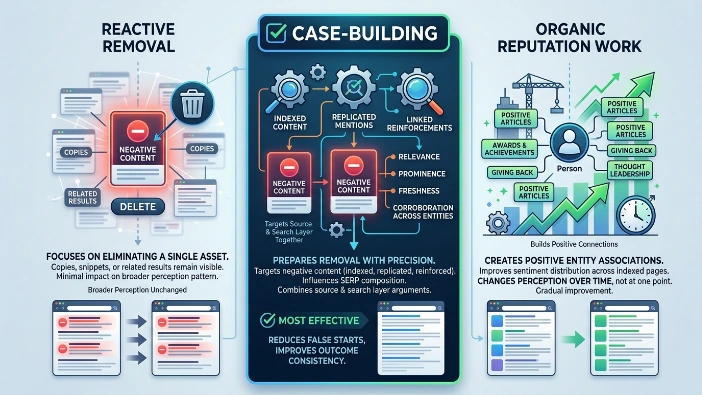
Reactive removal focuses on eliminating a single asset, but that does not always change the broader perception pattern if copies, snippets, or related results remain visible. Organic reputation work performs by creating positive entity associations and improving sentiment distribution across indexed pages, which changes perception over time rather than at one enforcement point. Case-building sits between these approaches because it prepares a removal action with enough precision to reduce false starts and improve outcome consistency.
How do removal and suppression compare?
Removal is a direct intervention that seeks to eliminate the content from its origin or from search visibility, while suppression is a visibility strategy that pushes negative material lower through stronger positive or neutral pages. Removal operates by proving policy breach, legal deficiency, or publisher error, which gives it high impact when the threshold is met.
Suppression operates by increasing content volume, internal linking strength, and entity reinforcement around the target name, which changes ranking influence without deleting the source. Removal provides cleaner trust recovery when successful, but it depends on proof and third-party enforcement. Suppression scales more easily, yet it leaves the original content available in some form and therefore manages perception rather than erasing it.
What limits a removal-led strategy?
A removal-led strategy fails when the complaint lacks proof, the publisher ignores the request, or the platform applies a narrow interpretation of its rules. Search engines do not treat every complaint as a ranking instruction, so a weak case rarely changes indexing outcomes beyond the source page.
The strategy also creates operational risk because repeated failed requests reduce credibility with hosts, legal intermediaries, and moderation systems. Case-building reduces this risk by forcing a pre-action assessment of jurisdiction, content type, and evidence strength. The limitation is time cost, because stronger preparation delays execution, but that delay usually improves the quality of the final request.
When is content enhancement more effective?
Content enhancement is more effective when the negative asset is lawful, persistent, and unlikely to be removed through policy channels. It operates by publishing authoritative pages, strengthening branded entities, and increasing the density of corroborating information that search engines can index and trust. This method improves search perception because the SERP begins to reflect a wider set of controlled assets rather than a single hostile document. Its main advantage is scalability, since new pages, profiles, citations, and supporting assets can be added continuously. Its main limitation is that enhancement manages visibility and perception, not source deletion, so the negative item can still carry residual influence if it remains highly relevant.
How does a case improve trust signals?
A well-built case improves trust signals by demonstrating that the removal request is specific, evidence-based, and grounded in the correct policy category. Search and moderation systems respond more favourably when the request includes clear entity identification, exact offending passages, and a consistent narrative between the target page and the complaint. This clarity lowers ambiguity, and lower ambiguity improves decision quality in systems that process large volumes of disputed content. The case also helps preserve entity credibility because it frames the response as procedural risk management rather than reputational overreaction. In practice, a stronger case increases the chance that a compliant takedown produces meaningful search visibility change rather than a temporary source-level edit.
Which strategy is more sustainable?
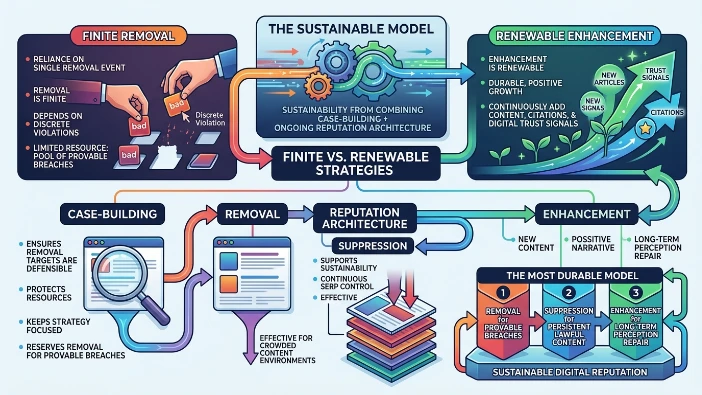
Sustainability comes from combining case-building with ongoing reputation architecture rather than relying on a single removal event. Removal is finite because it depends on discrete violations, whereas enhancement is renewable because new content, citations, and digital trust signals can be added over time. Suppression also supports sustainability when the content environment is crowded and the target entity needs continuous SERP control.
Case-building contributes by ensuring that each removal attempt is reserved for a defensible target, which protects resources and keeps the wider strategy focused. The most durable model uses removal for provable breaches, suppression for persistent lawful content, and enhancement for long-term perception repair.
Dive Deeper With Our Expert Guides:
Which Routes Actually Work to Remove Content From the Internet in the UK
What to Expect When Using an Online Content Removal Service in the UK
How should the options be evaluated?
Evaluation is best conducted through a structured risk-and-impact framework that compares evidential strength, visibility effect, and maintenance burden. This framework measures whether the issue belongs in removal, suppression, or enhancement and whether the target content affects source pages, snippets, or entity associations.
Explore the Complete Guide:
Protect Your Name With a Negative Content Removal Service That Delivers
What is the strategic takeaway?
The strongest approach is not the fastest removal attempt, but the most defensible sequence of actions built on evidence, search analysis, and reputation signal management. Removal delivers the cleanest outcome when a case is strong, suppression delivers broader visibility control when content persists, and enhancement delivers the most scalable long-term trust architecture. Case-building matters because it turns a reactive request into a structured intervention with clearer enforcement logic and lower failure risk. For a commercial investigation stage, the central question is not whether content can be challenged, but which intervention best balances proof, visibility, and sustainability for the entity being protected.
Protect your digital reputation with professional Facebook Content Removal Services focused on evidence-based removals, visibility control, and long-term reputation protection. Strategic reputation interventions help businesses balance content removal, SERP suppression, and trust-building strategies to achieve sustainable online credibility and stronger entity perception.
What are Facebook content removal services?
Facebook content removal services focus on identifying and challenging posts, comments, photos, or pages that harm an individual’s or business’s online reputation. They usually work by reviewing policy breaches, privacy issues, impersonation, copyright concerns, or defamatory content before requesting removal.
How does Facebook content removal work?
The process usually starts with analysing the content, its visibility, and the reason it may qualify for removal under platform rules or legal grounds. After that, the case is documented and submitted through the relevant reporting, appeal, or legal escalation path.
What type of Facebook content can be removed?
Content that may be removable includes fake profiles, impersonation pages, private images shared without consent, abusive posts, and material that violates Facebook’s community standards. In some cases, copyright infringement or unlawful content can also support removal requests.
How long does Facebook content removal take?
Timing depends on the type of content, the strength of the evidence, and how Facebook reviews the report. Some cases are handled quickly, while others take longer if extra verification or escalation is required.