
The routes that work in the UK are platform removal, legal removal, and search de-indexing, but each operates through different enforcement mechanisms and produces different reputation outcomes. Reputation management strategies differ based on whether the goal is content deletion, content restriction, or content suppression, while online reputation control methods are evaluated through search ranking influence, entity credibility, and sentiment distribution.
Which removal route is most effective for harmful online content?
The most effective route is the one that matches the content’s legal status and hosting layer, because search engines do not remove content at source unless the host, platform, or legal process changes access conditions. In the UK, content removal begins with the publisher or platform, then escalates to legal notice, and finally extends to search result removal where access remains but discoverability changes. This sequence matters because search engines interpret removal signals differently from ranking signals: a deleted page, a geo-restricted result, and a suppressed query all alter the SERP composition in different ways. Platform removal delivers the cleanest outcome when policy violations exist, while legal removal produces the strongest enforcement when defamation or unlawful publication is involved. Search de-indexing reduces visibility rather than removing the original source, so it controls perception without eliminating the underlying asset.
Platform removal
Platform removal is the fastest route when the content violates community standards, privacy rules, harassment rules, or copyright policy. It operates by reporting the specific URL or post inside the platform workflow, after which moderation systems assess the content against internal rules and either remove it, restrict it, or leave it in place. The strength of this route is speed and scale, because the host can act across many content types without court involvement. Its limitation is policy dependence, since lawful but damaging content often remains online if it does not breach platform rules. From a reputation perspective, platform removal improves trust signals quickly when the content is highly visible on social or community surfaces.
Legal removal
Legal removal is the strongest route for defamatory, privacy-infringing, or otherwise unlawful content because it changes the liability environment around publication. It operates by using statutory mechanisms, formal notices, or court-backed claims to force takedown or restriction where platform moderation is insufficient. The main advantage is durability, because a lawful decision or legal notice carries stronger enforcement weight than a routine user report. The limitation is time, cost, and evidential burden, since the claimant has to prove harm, identify the correct target, and maintain a precise record of the offending material. In search ecosystems, legal removal produces the most complete reputation reset because it can eliminate the source page and, by extension, reduce downstream indexing pressure.
Search de-indexing
Search de-indexing is a visibility-control route, not a source-level removal route, because it limits how content appears in search rather than deleting the content itself. It operates by asking the search engine to block, limit, or remove access to specific URLs in response to policy violations or local-law claims. The advantage is immediate SERP impact, especially when the content ranks for a name query and damages perception at the point of search. The limitation is incompleteness, because the material can still exist on the host, be reached by direct link, or remain accessible outside the affected jurisdiction. This route improves search perception faster than it improves factual record, so it works best alongside source removal or reputation enhancement.
How do content removal and suppression compare?
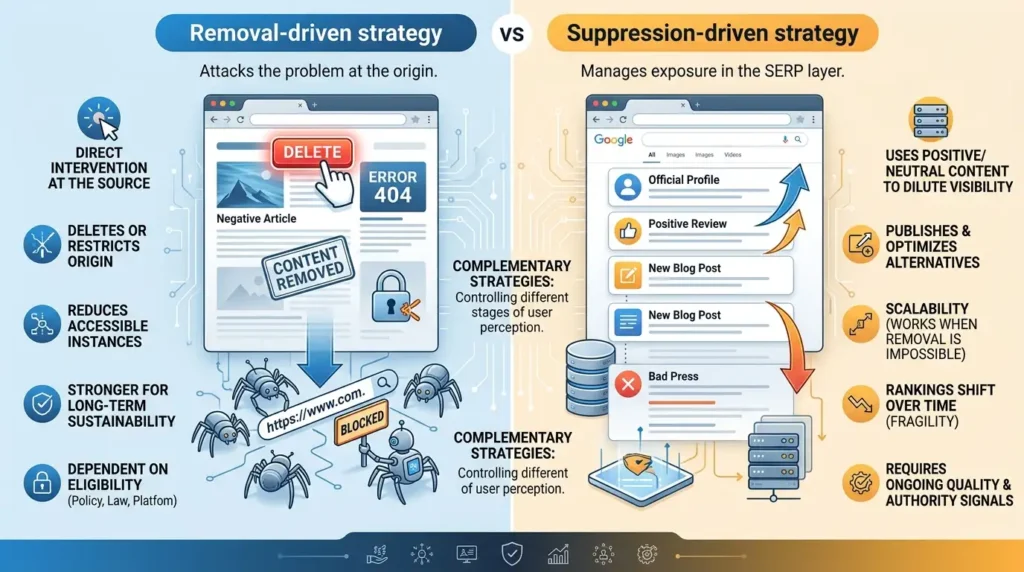
Content removal deletes or restricts the source, while content suppression changes what search users see first. Removal changes the legal and technical status of the asset itself, but suppression changes the relative prominence of competing results through ranking influence and content enhancement. The practical difference is that removal attacks the problem at the origin, while suppression manages exposure in the SERP layer. Removal produces a cleaner risk profile when the target content is unlawful or policy-violating, but suppression covers a wider range of reputation problems where the material stays online. For reputation management, the two methods are complementary rather than interchangeable, because each controls a different stage of user perception.
Removal-driven strategy
A removal-driven strategy is a direct intervention on the source page, post, or media asset. It works by reducing the number of accessible instances that search engines can crawl, index, and trust as stable references. The strength is long-term sustainability, because once content disappears at the source, the search ecosystem loses the canonical item that generated visibility. The weakness is eligibility, since removal depends on policy violations, unlawful publication, or platform acceptance of the complaint. Where the content qualifies, this route outperforms suppression because it breaks the chain between publication and discovery.
Suppression-driven strategy
A suppression-driven strategy uses positive or neutral content to dilute the visibility of negative pages in search results. It operates by publishing or optimising alternative pages, entities, and profiles that compete for branded and name-based queries. The strength is scalability, because it works even when the damaging content cannot be removed. The limitation is fragility, because rankings shift over time and suppression depends on ongoing content quality, relevance, and authority signals. This method changes perception by reshaping the top results, but it does not remove the underlying source of risk.
Does reactive removal outperform long-term reputation building?
Reactive removal is more effective for acute crises, while long-term reputation building is more effective for stable search control. Reactive work intervenes after harmful content appears, usually through reports, legal notices, or emergency escalation, so it focuses on immediate risk reduction. Long-term reputation building operates by accumulating trust signals, topical authority, and entity associations that push the search environment towards a stronger default narrative. The best route depends on whether the main problem is a single high-impact item or a fragile overall reputation profile. In UK search contexts, reactive removal reduces exposure quickly, while long-term building stabilises the SERP after the initial incident.
Reactive removal
Reactive removal is a crisis-response mechanism that targets a specific harmful item once it becomes visible. It works by assembling evidence, matching the content to a policy or legal ground, and filing the correct complaint route. Its advantage is speed-to-impact, especially when a defamatory post, privacy breach, or impersonation item appears prominently in search or social results. Its weakness is narrow scope, because it solves the immediate item but not the broader reputation environment. Reactive removal is therefore efficient for containment, not for building durable search trust.
Long-term building
Long-term reputation building is a content and entity strategy that strengthens the credibility layer around a person or organisation. It operates by publishing structured information, reinforcing consistent entity signals, and improving the ratio of positive to negative results across core queries. The advantage is durability, because search engines use repeated trust and relevance signals to interpret which results deserve prominence. The limitation is time, since search perception changes as new documents are crawled, indexed, and compared against existing sources. This method works best when the goal is not only to hide damage, but to replace uncertainty with a stronger entity profile.
Which route works best for Facebook content?
Facebook content removal works best through in-platform reporting first, then escalation through evidence-backed legal or privacy routes when the post remains online. The platform route operates through report functions, Support Inbox decisions, and moderation review, which makes it the first checkpoint for harassment, bullying, privacy breaches, and false-content complaints. The advantage is speed and direct platform enforcement, especially where the content clearly violates Community Standards. The limitation is scope, because Facebook does not remove every harmful post simply because it is reputationally damaging. In a UK reputation context, Facebook removal is strongest when paired with a parallel search visibility strategy so that both the source and the search result layer are addressed.
Platform-first workflow
Platform-first workflow starts with capturing the URL, screenshots, and metadata, then submitting the report through the correct Facebook tool. It works by giving moderators a specific, policy-linked complaint rather than a general objection. The strength is procedural clarity, because the platform can process cases without external legal infrastructure. The limitation is that borderline content often survives because it falls outside the platform’s enforcement threshold. This route is useful when the item is visible, recent, and clearly tied to harassment, privacy, or impersonation.
Escalation-based workflow
Escalation-based workflow uses additional legal or rights-based evidence when the platform response is inadequate. It operates by linking the post to defamation, harassment, privacy, or other unlawful grounds, then pursuing the appropriate legal or search route. The strength is stronger authority over the removal request, which often matters when the initial platform review is negative. The limitation is process complexity, because each step requires precise evidence and the correct legal framing. Escalation is therefore a control mechanism for difficult cases, not a first-line tactic for every item.
What evaluation framework reveals the best option?
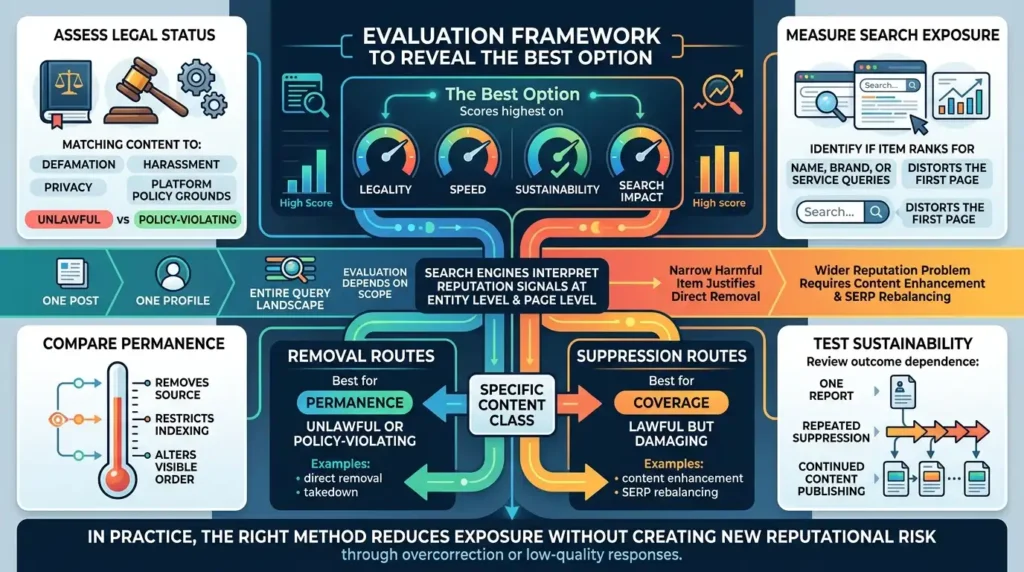
The best option is the route that scores highest on legality, speed, sustainability, and search impact for the specific content class. Removal routes perform best on permanence when the content is unlawful or policy-violating, while suppression routes perform best on coverage when the content remains lawful but damaging. Evaluation also depends on whether the issue affects one post, one profile, or an entire query landscape, because search engines interpret reputation signals at the entity level as well as the page level. A narrow, harmful item often justifies direct removal, but a wider reputation problem requires content enhancement and SERP rebalancing. In practice, the right method is the one that reduces exposure without creating new reputational risk through overcorrection or low-quality responses.
Dive Deeper With Our Expert Guides:
What to Expect When Using an Online Content Removal Service in the UK
How to Compare Content Removal Services Before You Pay Anything
- Assess legal status by matching the content to defamation, privacy, harassment, or platform policy grounds.
- Measure search exposure by identifying whether the item ranks for name, brand, or service queries and distorts the first page.
- Compare permanence by checking whether the route removes the source, restricts indexing, or only alters visible order.
- Test sustainability by reviewing whether the outcome depends on one report, repeated suppression, or continued content publishing.
For deeper insight, explore:
Remove Damaging Content From the Internet With Our UK Specialist Team
What are Facebook content removal services?
Facebook content removal services focus on reporting and challenging posts, photos, videos, or profiles that violate platform rules or legal rights. They usually work by using Facebook’s reporting tools, privacy complaint routes, or legal escalation where appropriate.
Can harmful Facebook posts be removed from Google search results too?
Yes, but Facebook removal and search removal are different processes. Removing the post at source helps most, while search de-indexing or suppression affects how visible the content is in Google results.
What evidence is needed for Facebook content removal?
Clear screenshots, direct URLs, timestamps, and context around the post usually help. If the issue involves defamation, impersonation, privacy, or harassment, stronger evidence improves the chance of a successful review.
When should a business use Facebook content removal services?
A business uses this service when a post, page, or comment creates reputational risk, legal concern, or false public perception. It is especially relevant when the content is public, ranking in search, or spreading across social channels.