
Online content removal services operate by assessing which URLs, profiles, posts, or snippets are eligible for takedown, de-indexing, suppression, or legal challenge. Reputation management strategies differ based on whether the objective is removal, replacement, or recalibration of search perception, and online reputation control methods are evaluated through entity credibility, search ranking influence, and the persistence of reputation signals.
Removal is the most direct intervention because it targets the underlying asset rather than the search result layer. It operates by requesting deletion, platform enforcement, legal notice action, or index devaluation, which changes the content set available to search engines and users. Suppression is a different mechanism: it leaves the original material in place while pushing down visibility through stronger competing pages, review assets, or owned content. In search ecosystems, removal changes the corpus, whereas suppression changes the ranking landscape; that distinction determines both speed and permanence.
Removal delivers a cleaner outcome when the content is unlawful, inaccurate, or platform-violating, because the reputational burden disappears from the index rather than being masked. Its limitation lies in eligibility, since not every damaging page qualifies for deletion, and many publishers retain control over their own material. Suppression scales more easily across large reputation issues because it can be deployed against multiple queries and entity combinations, but it depends on ongoing publishing and optimisation. From a perception standpoint, removal reduces direct exposure, while suppression reduces discoverability without eliminating the original signal.
What search engines read
Search engines interpret reputation through co-occurring entity references, anchor text, document prominence, freshness, and user engagement patterns. When a damaging page remains live, it contributes negative sentiment distribution and associated query relevance. When that page disappears, the surrounding SERP composition often shifts towards alternative sources, which changes how the entity is framed. That means removal affects the evidence base, not just the ranking order.
Which works better: reactive or organic control?
Organic control is the more sustainable model because it builds reputation signals before a crisis dominates the SERP. It operates by publishing owned assets, strengthening internal links, widening entity coverage, and creating answer pages that occupy important query spaces. Reactive control starts after harm exists and focuses on takedowns, response content, review management, and legal escalation. The two approaches differ in timing, with organic control building resilience and reactive control dealing with immediate exposure.
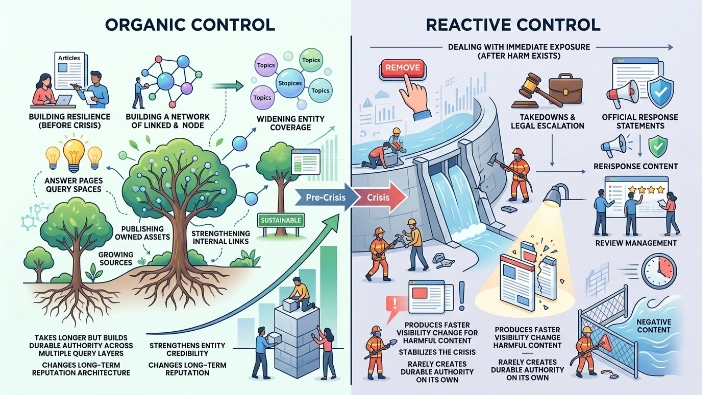
Reactive control produces faster visibility change when a harmful page already ranks, but it rarely creates durable authority on its own. It often depends on a narrow window of search ranking influence, especially where a single article, review thread, or forum post dominates intent. Organic control takes longer because it requires topical coverage and historical data, yet it strengthens entity credibility across multiple query layers. In practical terms, reactive work stabilises the crisis, while organic work changes the long-term reputation architecture.
Mechanism difference
Organic strategies operate by shaping the information environment around the entity, so search engines see a denser and more consistent topical map. Reactive strategies operate by interrupting the prominence of harmful results or removing the result altogether. Organic control improves breadth, but reactive control improves urgency. The most effective programmes separate these functions rather than treating them as interchangeable.
How do short-term and long-term effects differ?
Short-term impact comes from direct visibility changes, such as removing a page, filing a de-index request, or publishing counterbalancing content that enters the results quickly. These actions alter the immediate SERP composition and reduce friction in user perception. Long-term impact comes from sustained entity reinforcement, including consistent publication, structured internal linking, and repeated association with trustworthy sources. Short-term gains are measurable in days or weeks; long-term gains accumulate through repeated reputation signals and improved trust distribution.
The limitation of short-term removal is fragility. If the original source reappears elsewhere, if mirrors are created, or if new negative content emerges, the reputational issue returns in a different form. Long-term content enhancement is more resilient because it creates a broader semantic footprint that search systems can reuse across related queries. However, it requires a disciplined publishing system and patience, because it does not erase history; it reframes it through stronger context.
A simple evaluation rule
- Assess eligibility first, because a page that qualifies for removal produces a cleaner and faster outcome than a page that only supports suppression.
- Measure query spread next, because a single-result issue requires a different response from a multi-query reputation problem.
- Compare persistence last, because long-term resilience depends on whether the entity gains stronger signals across multiple sources.
Where do content creation and content removal overlap?
Content creation and content removal overlap at the level of SERP control, but they solve different problems. Removal reduces the availability of harmful material, while creation increases the visibility of favourable or clarifying material. In reputation management, this becomes content suppression versus content enhancement: one reduces exposure, the other increases contextual authority. Search engines respond to both by recalculating relevance, but the underlying mechanism differs sharply.
Content creation is stronger when the issue is ambiguity, incomplete context, or weak entity recognition. It operates by building explanatory pages, comparison pages, profiles, FAQs, and evidence-rich assets that help search systems understand the entity more accurately. Removal is stronger when the content is factually wrong, legally actionable, or platform-hostile. Creation cannot fully replace removal when the damaging page dominates trust perception, but removal alone cannot build a durable positive narrative.
How do UK-specific constraints affect the choice?
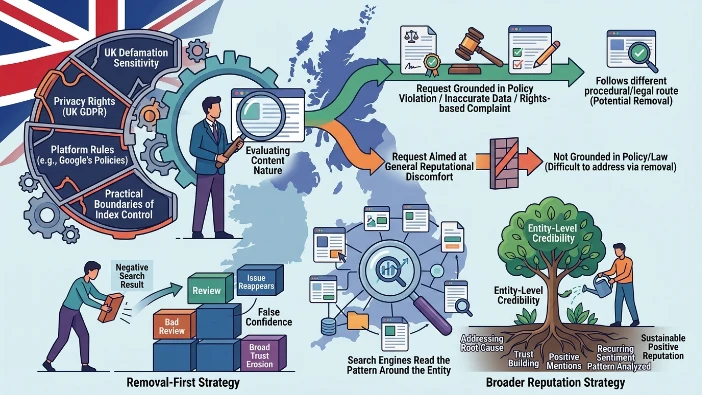
UK reputation work is shaped by platform rules, defamation sensitivity, privacy rights, and the practical boundaries of index control. That means removal services in the UK function inside a legal and procedural framework rather than a purely technical one. A request grounded in policy violation, inaccurate personal data, or rights-based complaint follows a different route from a request aimed at general reputational discomfort. The evaluation therefore begins with the nature of the content, not the strength of the brand.
The UK context also changes the risk profile. A removal-first strategy can create false confidence if the underlying cause is broader trust erosion, because the same issue reappears through other pages, mentions, or review assets. A broader reputation strategy evaluates whether the problem is isolated content, a recurring sentiment pattern, or an entity-level credibility gap. That distinction matters because search engines do not only read individual pages; they read the pattern around the entity.
What to compare
- Compare legal eligibility, because only certain content types support direct removal pathways.
- Compare platform control, because social posts, hosted pages, and third-party articles all respond differently.
- Compare SERP persistence, because some results return quickly after suppression while others disappear after removal.
Dive Deeper With Our Expert Guides:
How to Compare Content Removal Services Before You Pay Anything
How UK Defamation Law Gives You the Right to Request Removal of False Content
Is Facebook removal the same as wider reputation repair?
Facebook content removal is not the same as full reputation repair because it addresses one platform, not the complete search ecosystem. It operates by enforcing platform policy, moderating reported material, or removing content that violates rules, but the reputational effect depends on whether that material also influences Google results. A post disappearing inside Facebook does not automatically erase related screenshots, reposts, indexed mentions, or commentary elsewhere. The method therefore reduces one signal source rather than rebuilding the entire reputation profile.
Wider reputation repair uses Facebook removal as one input within a larger strategy that includes search content, review assets, entity pages, and source diversification. That broader model analyses how a damaging post interacts with branded search, people-search queries, and related terms. If the Facebook post is the main visible issue, removal has high value. If the issue extends across multiple domains, the service becomes only a partial correction.
Restore control over harmful online content with professional Facebook Content Removal Services that help reduce damaging visibility and support broader reputation recovery strategies. While Facebook removals limit harmful platform exposure, combining them with search reputation management strengthens long-term credibility, SERP perception, and digital trust.
What is the most sustainable approach?
The most sustainable approach combines selective removal with systematic content enhancement. Removal addresses the highest-risk items first, especially content that is unlawful, clearly policy-breaching, or disproportionately damaging. Content enhancement then rebuilds the information environment through authoritative pages, consistent entity references, and stronger internal architecture. Sustainability comes from reducing dependency on one-off interventions and increasing the density of positive reputation signals.
This combined model performs better than a removal-only strategy because it reduces recurrence risk. It also performs better than content-only suppression because it removes the most harmful sources where possible. The trade-off is operational complexity: the strategy needs evidence collection, content planning, and monitoring across search and social surfaces. In reputation systems, resilience comes from layered control rather than a single fix.
For more information explore:
Start the Online Content Removal Process With a Free UK Consultation
Online content removal services in the UK are best understood as precision tools inside a wider reputation framework, not as complete reputation repair on their own. Removal is strongest for eligibility-based takedowns and immediate harm reduction, while suppression and content enhancement are stronger for long-term search perception control. The strategic choice depends on whether the main issue is a single damaging asset, a distributed SERP pattern, or a deeper entity credibility problem.
What are Facebook content removal services?
Facebook content removal services help assess whether posts, comments, profiles, or pages can be taken down under platform rules or legal grounds. They are typically used when harmful content affects reputation, privacy, or search visibility.
How does Facebook content removal work?
The process usually starts with reviewing the content, identifying policy breaches, and submitting a removal request or escalation. In some cases, the issue is handled through reporting, privacy complaints, or legal requests depending on the content type.
Can Facebook posts be removed from Google search results?
If a Facebook post is removed or de-indexed, it can stop appearing in Google search over time. However, cached copies, screenshots, or reposts on other sites can still keep the issue visible.
How long does Facebook content removal take?
Timeframes depend on the content, the strength of the report, and whether the request is based on policy or legal grounds. Simple moderation cases move faster, while complex cases involving privacy or defamation take longer.