
Removing negative content from Google requires evaluating whether the content can be removed at source, de-indexed from search results, or reduced in visibility through stronger alternative assets.
The most effective approach depends on legality, platform control, content accuracy, ranking strength, and the wider search results around the affected name or entity.
Reputation management strategies differ based on the source of the content, the authority of the publishing domain, the legal basis for removal, and the visibility pattern across Google’s search results. Online reputation control methods are evaluated through search ranking influence, reputation signals, entity credibility, sentiment distribution, and the balance between content suppression vs content enhancement. A step-by-step process gives structure to this evaluation because negative content does not behave the same way across news sites, review platforms, forums, court records, social media pages, and copied articles. Each source type has a different removal pathway, indexing behaviour, and level of resistance. A structured approach compares removal, de-indexing, suppression, correction, and content improvement as separate but connected methods. The aim is not only to reduce the visibility of harmful results but to improve how search engines and users interpret the wider digital footprint.
How Should Negative Google Content Be Evaluated Before Choosing a Removal Strategy?
Negative Google content is evaluated by identifying the content source, legal position, search visibility, factual accuracy, and reputational impact. This first stage separates removable content from content that requires suppression, correction, or long-term reputation signal improvement. A negative result is not automatically removable because Google indexes content from third-party websites rather than controlling most of the original material. Removal depends on whether the publisher, platform, or search engine has a valid reason to take action. Reputation analysis measures how the content affects trust signals, entity credibility, and sentiment distribution across branded search results. This evaluation prevents using the wrong method against content that requires a different mechanism.
Source analysis compares where the content exists and how much control exists over it. Owned content operates under direct control, such as a personal website, company profile, or social media account. Third-party content operates through external editorial, platform, or user-generated systems. Search-indexed content operates by appearing in Google because it has been crawled, indexed, and ranked according to relevance, authority, freshness, and user behaviour signals. A negative article on a high-authority news domain has stronger search ranking influence than a weak forum post because it carries domain authority, backlinks, and historical crawl trust. The evaluation therefore starts with source strength before any removal route is selected.
Impact analysis compares ranking position, search intent, snippet visibility, and repeated presence across related queries. A result ranking in position one for a personal or company name has greater reputational risk than a result on page three because it shapes first-contact perception. A title tag or meta description with negative wording increases perceived harm because users see the issue before clicking. A result appearing across multiple queries creates wider sentiment distribution because the same negative association follows the entity across search journeys. Reputation signals are measured through the balance of positive, neutral, and negative results on the first page. This explains why ranking position matters as much as the content itself.
Is Content Removal More Effective Than Content Suppression?
Content removal is more direct than content suppression when a valid removal basis exists, but suppression is more scalable when the content cannot be removed. Removal is the process of eliminating the content from the source website, removing it from Google’s index, or applying a legal or policy-based request. Suppression is the process of improving and ranking stronger positive or neutral content so that negative results lose visibility. Removal changes the existence or index status of a result, while suppression changes SERP composition through search ranking influence. The two approaches solve different reputation problems and require different evidence, timelines, and risk controls. Their effectiveness depends on content type, publisher response, and the strength of competing assets.
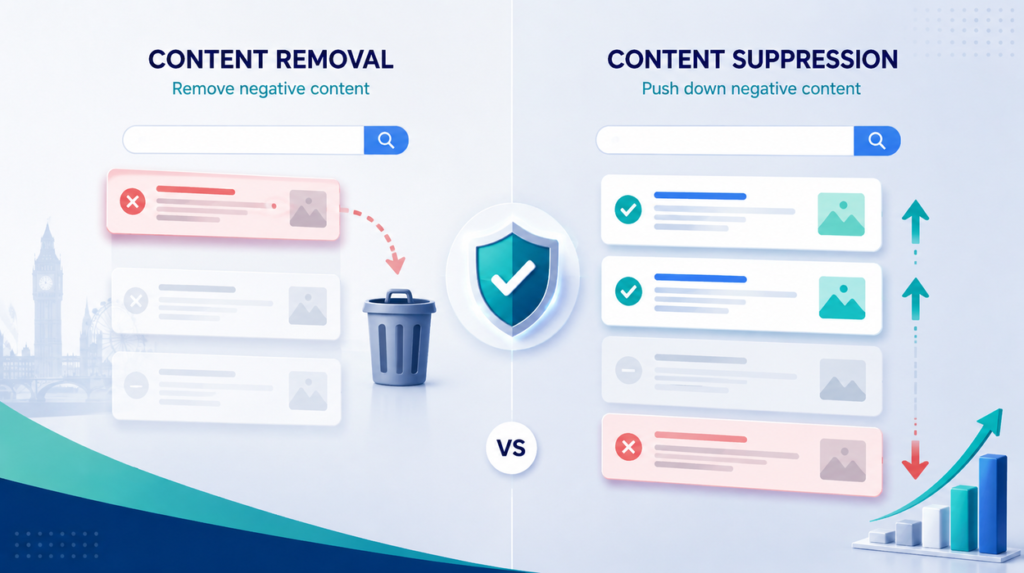
Removal operates by targeting the content’s original location or Google’s indexing layer. Source removal works when the website owner deletes, edits, or no-indexes the content. Search removal works when Google removes or de-indexes a result under specific policies, such as outdated content, personal information exposure, copyright issues, defamation-related orders, or legal compliance. This method is highly effective where the content clearly breaches policy, contains false material, exposes sensitive data, or remains indexed after source deletion. Its limitation is dependency on rules, evidence, and external decision-makers. If the content is lawful, accurate, and editorially protected, removal becomes less viable.
Suppression operates by creating or strengthening alternative assets that search engines judge more relevant, authoritative, and useful for the affected query. These assets include official profiles, professional pages, knowledge-based content, press coverage, social profiles, structured biographies, review responses, and trusted directory listings. Content enhancement builds stronger reputation signals by improving entity credibility and increasing positive or neutral search coverage. Its strength is sustainability because it improves the overall digital footprint rather than relying on a single takedown. Its limitation is time, competition, and the need for consistent authority-building. Suppression does not erase negative content; it reduces visibility by changing ranking balance.
Which Step-by-Step Method Works Best for Removing Negative Content From Google?
A structured removal method works best when it evaluates source control, policy eligibility, evidence quality, index status, and alternative SERP strategies in sequence. The process starts with diagnosis before action because premature complaints or weak legal claims create risk exposure. A step-based method compares the fastest direct route with the most sustainable indirect route. It also prevents confusing content removal with search result removal. Removing content from a website and removing a Google result are separate processes because Google reflects content it discovers elsewhere. The method therefore evaluates both the content layer and the search visibility layer.
- Map the result by recording the URL, ranking position, query type, snippet text, publication date, and whether the result appears across branded, personal, or service-related searches.
- Classify the source by separating owned media, third-party editorial content, user-generated reviews, social media posts, copied content, legal records, and aggregator pages.
- Assess removal grounds by checking whether the content is false, outdated, private, defamatory, duplicated, copyrighted, policy-breaking, or already removed at source.
- Contact the source by requesting correction, deletion, anonymisation, update, no-indexing, or context addition through a factual and evidence-based request.
- Use Google pathways by applying de-indexing, outdated content removal, personal information removal, copyright reporting, or legal removal routes when eligibility exists.
- Measure index changes by checking whether the URL remains live, whether Google has refreshed the cache, and whether the snippet still displays harmful information.
- Build supporting assets by strengthening positive or neutral content that improves entity credibility and reduces negative sentiment distribution.
This sequence compares direct and indirect mechanisms instead of treating removal as a single action. Source correction is often cleaner than search suppression because it changes the content that Google crawls. Google removal is effective where the issue fits a policy pathway, but it does not normally delete the original content from the web. Content enhancement is useful when the negative content remains live and continues to rank. Monitoring is necessary because removed or edited pages remain visible until Google recrawls or updates the index. A complete method evaluates the result after each step rather than assuming one action solves the issue.
How Do Search Engines Interpret Reputation Signals During Negative Content Management?
Search engines interpret reputation signals through relevance, authority, freshness, entity consistency, engagement patterns, and the relationship between documents across the web. A negative result ranks when Google assesses it as relevant and credible for the searched entity or topic. Reputation management therefore operates within search systems rather than outside them. Entity credibility is shaped by how consistently a person, business, or organisation appears across trusted sources. Search ranking influence increases when content has backlinks, topical relevance, structured data, crawl accessibility, and user interaction signals. Negative content becomes difficult to displace when these signals are stronger than the positive or neutral alternatives.
Entity recognition is central to reputation visibility. Google connects names, organisations, locations, roles, websites, social profiles, articles, and knowledge references into an entity understanding. When negative content repeatedly connects to the same entity, the association becomes stronger across search results. Positive content without clear entity alignment struggles to compete because search engines cannot confidently connect it to the same subject. Content enhancement therefore requires consistent naming, accurate profiles, structured information, and authoritative references. This improves entity credibility and gives search engines clearer alternatives to rank.
Sentiment distribution affects user perception even when individual rankings change. A first page with one negative result, three neutral profiles, and six positive assets creates a different trust environment from a page dominated by accusations, complaints, or unresolved disputes. Search engines do not rank content only by sentiment, but users interpret SERP composition through visible language, titles, snippets, and source credibility. Reputation control measures both algorithmic ranking and human perception. A technically successful suppression campaign still performs poorly if snippets remain negative or if neutral assets look weak and incomplete. The best evaluation compares visibility, credibility, and perception together.
Dive Deeper With Our Expert Guides:
How Online Content Removal Works and Why It Takes Professional Expertise
What to Expect When Using an Online Content Removal Service in the UK
How Do Organic Reputation Strategies Compare With Reactive Removal Tactics?
Organic reputation strategies are more sustainable, while reactive removal tactics are more direct when urgent harm or policy violations exist. Organic strategy builds a stronger digital footprint before or during reputation pressure by publishing accurate, authoritative, and entity-aligned content. Reactive tactics respond to existing negative content through takedowns, correction requests, legal notices, de-indexing, or crisis-led search management. Organic methods influence search systems gradually through content quality and authority signals. Reactive methods focus on reducing immediate harm by targeting specific damaging URLs. The comparison depends on urgency, content type, legal basis, and the current strength of the SERP.
Organic reputation management operates by increasing the number and quality of trusted assets around an entity. This includes optimised websites, professional profiles, thought leadership, verified directories, structured business information, media mentions, and review ecosystem management. Its strength is resilience because a strong digital footprint reduces the chance that one negative result dominates the search page. It also improves entity credibility through consistency and depth. Its limitation is speed because ranking influence develops through indexing, authority, and engagement over time. Organic strategy is less effective as a sole response when a severe negative result already ranks at the top.
Reactive removal tactics operate by targeting the harmful result directly. A factual correction request can change the wording of a page and reduce negative search snippets. A legal or policy-based request can remove the result from Google if eligibility is clear. A platform complaint can remove content that breaches review, privacy, harassment, or impersonation rules. These actions are efficient when evidence is strong and the platform process is clear. Their limitation is risk exposure because weak claims, aggressive contact, or inaccurate allegations can escalate attention and strengthen the negative association. Reactive tactics therefore require careful evidence control.
Learn More Here:
Start the Online Content Removal Process With a Free UK Consultation
What Is the Difference Between Short-Term and Long-Term Reputation Impact?
Short-term reputation impact measures immediate visibility reduction, while long-term impact measures sustained improvement in search trust and entity credibility. Short-term methods focus on changing what users see now, especially on the first page of Google. Long-term methods focus on reshaping how search engines understand the entity over time. A short-term result is often measured through ranking movement, snippet changes, page removal, or reduced click visibility. A long-term result is measured through stable positive SERP composition, stronger authority assets, improved review patterns, and balanced sentiment distribution. These two timeframes require different success metrics.
Short-term tactics include content takedown requests, outdated cache removal, urgent correction requests, response management, and rapid publication of authoritative owned assets. These actions are useful when negative content is new, visible, and causing immediate perception damage. Their strength is speed when the pathway is clear. Their limitation is fragility because the same content can reappear, be republished, or remain visible through copied pages and aggregators. Short-term change also fails when the underlying digital footprint remains thin. A weak entity presence leaves space for negative content to regain visibility.
Long-term strategies include digital footprint optimisation, content enhancement, authority-building, structured data improvement, review management, and consistent entity references across trusted sources. These methods improve reputation signals at scale because they give search engines stronger alternatives to rank. Their strength is sustainability because they reduce dependency on one removal outcome. Their limitation is resource intensity because they require ongoing content governance, technical SEO, monitoring, and trust signal development. Long-term impact is stronger when it combines suppression with legitimate correction and source-level cleanup. The most reliable approach treats short-term protection and long-term credibility as connected layers.
How Should Content Creation Be Compared With Legal or Policy-Based Removal?
Content creation improves search visibility through positive ranking signals, while legal or policy-based removal targets content that breaches laws, rights, or platform rules. Content creation is a search influence method; legal removal is an eligibility-based method. The two approaches are not interchangeable because one builds alternatives and the other challenges the content itself. Content creation evaluates topical relevance, authority, crawlability, and entity alignment. Legal or policy-based removal evaluates evidence, jurisdiction, platform rules, privacy rights, copyright ownership, or court-backed claims. The correct choice depends on whether the content is harmful because it is visible or harmful because it is unlawful, inaccurate, or policy-breaking.
Content creation operates by publishing and optimising assets that deserve to rank for the affected query. This includes comprehensive profile pages, accurate biographies, expert content, company information pages, social profiles, review responses, and third-party references. It influences SERP composition by giving Google more trusted options for the same entity search. Its strength is broad applicability because it works even when removal is impossible. Its limitation is competition because high-authority negative content is difficult to outrank without strong supporting signals. Content creation is most effective when the existing positive footprint is underdeveloped.
Legal or policy-based removal operates by proving that a result violates a recognised standard. This includes defamation concerns, privacy exposure, copyright infringement, impersonation, harassment, outdated personal data, or platform-specific rule breaches. Its strength is decisiveness when the case is clear. Its limitation is strict eligibility because search engines and publishers do not remove content simply because it is unfavourable. It also carries risk exposure when claims are weak or when the dispute draws further attention. A careful comparison evaluates legal strength before action and uses content enhancement as a parallel visibility strategy.
How Can Negative Content Be Reduced Without Removing It Completely?
Negative content can be reduced without removal by improving stronger competing assets, correcting visible snippets, managing review ecosystems, and changing sentiment distribution across the SERP. This approach is content suppression rather than deletion. It accepts that the negative page remains online but works to reduce its prominence, perceived authority, and influence on users. Suppression operates through content enhancement, technical SEO, authority development, and entity consistency. It measures effectiveness through ranking displacement, reduced snippet exposure, and improved balance across positive and neutral results. This method is especially relevant when content is lawful, indexed correctly, and hosted on a resistant source.
SERP composition changes when search engines find better answers for the same entity query. A well-structured official website, updated profiles, authoritative directories, expert articles, and trusted media references create competing ranking assets. These assets require clear titles, relevant content, internal linking, schema markup, crawl access, and consistent entity signals. Review platforms influence trust signals because ratings, responses, recency, and volume affect how users interpret credibility. Social profiles and professional pages add controlled or semi-controlled assets that often rank for branded searches. The stronger these assets become, the less space remains for negative content.
Snippet management is another reduction mechanism. A page does not need to disappear for its impact to decline if the title, meta description, or indexed excerpt becomes more neutral. Source-level corrections, updated context, right-of-reply additions, and no-index requests can reduce visible harm even when the article remains live. This improves perception by changing what users see in search results. However, suppression has limitations because high-authority negative pages retain ranking power. A realistic evaluation compares ranking difficulty, content authority, and the number of stronger assets required to change visibility.
What Risks Should Be Evaluated Before Attempting Content Removal?
Content removal carries legal, reputational, technical, and visibility risks that require evaluation before action. A poorly handled removal attempt can strengthen the negative content, trigger further publication, or create a record of dispute. Risk exposure increases when the request lacks evidence, misstates facts, threatens the publisher without basis, or targets protected editorial content. Technical risk also exists when only the Google result is removed while the original content remains live and accessible. Reputation risk occurs when removal efforts appear evasive or inconsistent with available facts. A risk assessment compares the benefit of action with the potential for amplification.
Legal risk depends on the basis of the claim. Defamation, privacy, copyright, and harassment claims require specific evidence and precise wording. Unsupported legal language damages credibility and reduces the chance of cooperation. Platform policy risk depends on whether the content clearly breaches written rules. A review expressing opinion, for example, is treated differently from a review containing personal information, impersonation, or demonstrably false claims. The evaluation therefore separates emotional impact from policy eligibility. Content that feels unfair is not automatically removable.
Search visibility risk relates to the way attention affects ranking and publication patterns. Repeated public disputes, defensive responses, and escalated arguments create fresh content that Google can crawl. This increases negative sentiment distribution because the original issue expands into new pages, comments, and references. A technical risk appears when removed pages continue to show through cached snippets, copied versions, or aggregator results. Monitoring is required after any removal request because search systems update over time rather than instantly. Effective risk control uses evidence, proportionate language, and parallel content enhancement.
What Is the Most Balanced Strategy for UK Reputation Management?
The most balanced UK reputation management strategy combines eligibility-based removal, content enhancement, technical search analysis, and long-term reputation signal development. It does not rely on one method because Google visibility is shaped by source authority, entity relevance, and SERP competition. Removal works best where the content breaches rules, exposes private information, remains outdated, or contains legally challengeable material. Suppression works best where content cannot be removed but can be outranked by stronger assets. Review management works best where trust signals are shaped by customer feedback, response quality, and recency. A balanced strategy compares these methods against impact, risk, scalability, and sustainability.
A UK-focused evaluation must consider search behaviour, legal standards, platform governance, and the authority of local sources. Content on UK news sites, Companies House references, review platforms, professional directories, and local business listings can carry high trust signals. Search engines interpret these sources as part of entity credibility because they connect identity, location, activity, and public record data. Reputation management therefore requires accurate information architecture, not only content publishing. Remove Negative Content From Google With Proven UK Strategies fits naturally as a commercial investigation topic when evaluating advanced removal routes and UK-specific search risks. The phrase connects to BOFU intent without changing the neutral analysis of methods.
The strongest approach begins with diagnosis, then applies the least risky direct action, then supports the SERP with credible content enhancement. A removable result receives source-level or Google-level action. A non-removable result receives suppression, context improvement, and authority-building. A review-based issue receives response governance and review signal improvement. A weak digital footprint receives structured entity optimisation. This layered model improves both immediate visibility and long-term trust. It also reduces dependency on uncertain removal decisions.
Conclusion
Removing negative content from Google requires a structured comparison of removal, de-indexing, suppression, correction, and content enhancement. Removal is the strongest option when a clear legal, policy, privacy, or source-control basis exists. Suppression is more scalable when content remains lawful, indexed, and resistant to takedown. Organic reputation strategies build long-term entity credibility, while reactive tactics address urgent visibility and risk. Short-term methods reduce immediate search exposure, while long-term methods improve reputation signals and sentiment distribution across the SERP. The most balanced strategy analyses each result through source authority, search ranking influence, legal eligibility, trust impact, and sustainability before selecting the correct method.
FAQs
1. How do you remove negative content from Google step by step?
The process starts by identifying the source URL, checking whether the content violates Google policies or platform rules, and then requesting removal from the original website. If the page cannot be removed, the next step is to reduce its visibility through reputation management and positive content optimisation.
2. Can Google remove negative content from search results?
Google can remove negative content from search results when it involves policy violations such as personal information exposure, copyright issues, outdated deleted pages, or certain legal concerns. Google usually does not remove content only because it is negative or unwanted.
3. What is the difference between removing and suppressing negative content?
Removing negative content means deleting it from the source website or Google’s index. Suppressing negative content means improving positive or neutral search results so the negative page moves lower in Google rankings.
4. How long does it take to remove negative content from Google?
The timeline depends on the content type, website owner response, Google review process, and whether the page is still live. Some outdated or policy-based removals can be processed faster, while suppression through SEO usually takes longer.
5. Can Clear Your Name help with negative Google search results?
Clear Your Name focuses on content removal and online reputation management for negative Google search results. This can include assessing removal options, checking policy eligibility, and improving search result visibility through structured reputation strategies.