
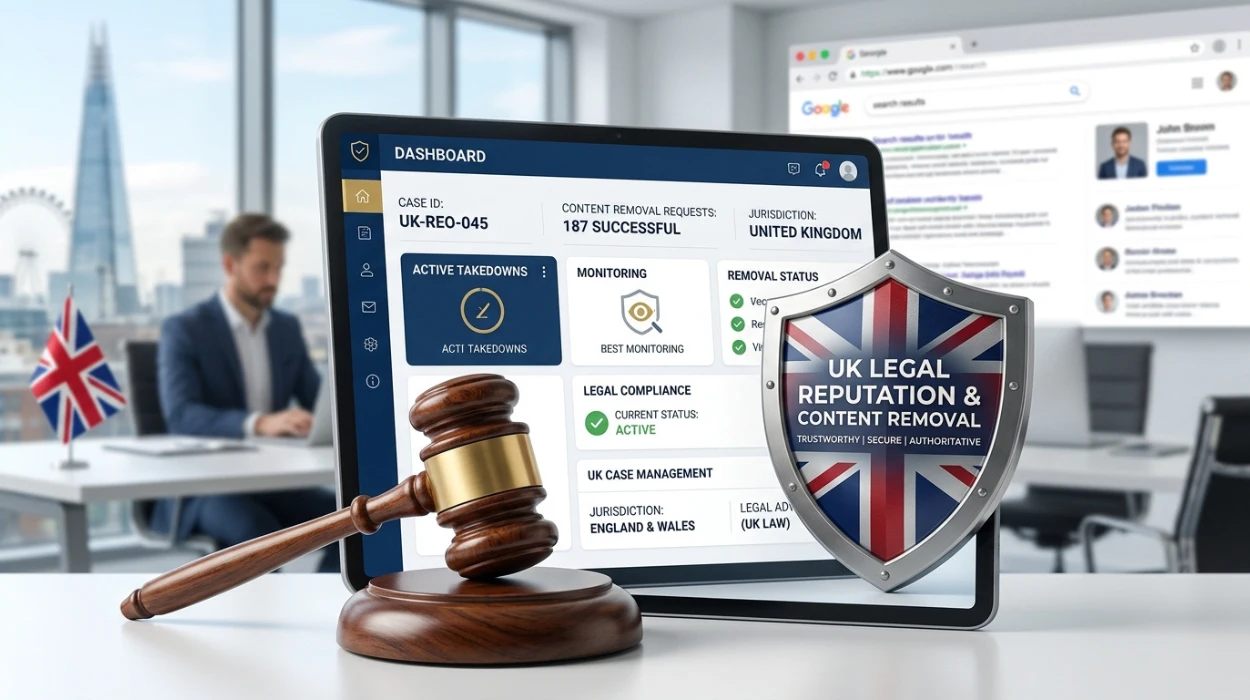
Online defamation removal delivers stronger search visibility control when legal action and content removal strategies operate together. Combining these methods strengthens reputation signals, restores entity credibility, and reduces the long-term impact of harmful content across search ecosystems.
Search visibility directly influences public trust because search results shape first impressions, business decisions, and professional credibility. Negative content affects search perception influence by creating misleading reputation signals that remain visible long after the original publication.
Which approach delivers the most effective online defamation removal results in the UK?
A combined legal and content removal strategy delivers the strongest and most sustainable outcome. Legal remedies establish the basis for challenging unlawful content, while reputation management processes improve SERP control by reducing the visibility of damaging material that remains online.
Online defamation creates reputational harm because search engines continuously process, index, and display content that influences user perception. Even when inaccurate statements are challenged successfully, copies, references, and secondary mentions often continue to appear across search results. A structured reputation management approach addresses both the source of the issue and the wider search ecosystem. This dual-layer process strengthens entity credibility while reducing the prominence of harmful reputation signals. The result is a more accurate representation of an individual or organisation across digital channels.
Legal intervention alone resolves only part of the problem because search visibility remains influenced by indexed content. Search engines evaluate authority, relevance, engagement signals, and content relationships when determining rankings. Reputation management supports legal action by introducing positive, authoritative, and relevant content that improves search perception influence. This integrated approach delivers stronger long-term control over how information appears within search results. As a result, reputation recovery becomes measurable rather than reactive.
Why does online defamation create long-term search visibility risks?
Online defamation creates persistent visibility risks because search engines prioritise discoverability and content accessibility. Once harmful content becomes indexed, it can continue influencing public perception even after direct engagement with the source decreases.
Search behaviour demonstrates that users often review only the first page of results before forming conclusions. Negative articles, forum discussions, social media posts, and complaint pages therefore gain disproportionate influence when they occupy prominent positions. These pages create negative reputation signals that affect trust, credibility, and decision-making. Search perception influence becomes distorted because users encounter harmful narratives before accurate information. This undermines entity credibility and weakens confidence among customers, employers, investors, and business partners.
The challenge increases when multiple sources reference the same allegation. Search engines interpret repeated mentions as signals of relevance, creating stronger visibility for damaging content. Effective reputation management interrupts this cycle by improving the prominence of trusted assets and reducing the impact of harmful references. This process stabilises perception while improving control over branded search results. Long-term reputation protection therefore depends on both removal and visibility management.
How does a professional ORM Services strategy remove and suppress harmful content?

ORM Services delivers structured control by combining content removal efforts with negative content suppression techniques. This approach addresses immediate reputational threats while building long-term resilience within search results.
The process typically includes:
- Identify harmful content sources to establish removal opportunities and visibility priorities.
- Assess legal grounds to support takedown requests and platform-based enforcement.
- Remove qualifying content through publisher engagement and platform compliance procedures.
- Suppress remaining negative content through authoritative content development and optimisation.
- Strengthen entity credibility through consistent reputation signal improvement.
- Monitor search visibility to maintain control over evolving search results.
Each stage contributes to stronger SERP control. Removal reduces direct exposure to defamatory material, while suppression reduces the likelihood of users encountering harmful content during searches. Together, these mechanisms improve reputation stability and support sustainable trust restoration. The outcome is a search environment that reflects verified and relevant information rather than damaging inaccuracies.
How does legal action strengthen online defamation removal outcomes?
Legal action strengthens removal outcomes because it establishes accountability and creates enforceable pathways for content disputes. Defamation law provides a framework for addressing false statements that cause reputational damage.
A legal assessment determines whether content meets the threshold for defamatory publication. When valid grounds exist, publishers, website owners, and platform operators become more likely to review and remove disputed content. This improves the probability of successful content removal while reducing ongoing exposure. Legal evidence also strengthens communications with search platforms and third-party websites. Consequently, reputation management activities operate from a stronger position.
However, legal success alone does not guarantee reputation recovery. Search ecosystems contain cached content, references, syndicated material, and secondary discussions that continue influencing visibility. This is why organisations seeking sustainable outcomes often combine legal remedies with a professional reputation management service designed to improve search perception influence and restore trust signals. The combination delivers broader coverage than either method independently. It therefore creates a more reliable pathway toward reputation restoration.
How does content removal improve public trust and entity credibility?
Content removal improves public trust because it reduces exposure to misleading information that influences user behaviour. Removing defamatory content prevents inaccurate narratives from becoming dominant reputation signals.
Trust develops when users encounter consistent, credible, and authoritative information across multiple search results. Harmful content disrupts this process by creating uncertainty regarding reliability and integrity. When defamatory material is removed, search ecosystems contain fewer negative references competing for visibility. This strengthens entity credibility and improves confidence among audiences evaluating a person or organisation.
Content removal also improves search quality by reducing the prominence of irrelevant or inaccurate material. Search engines continuously evaluate content relationships and relevance patterns. A cleaner search environment supports more accurate ranking signals and stronger perception alignment. As trust indicators improve, branded search performance becomes more stable. This contributes directly to reputation recovery and long-term credibility protection.
Which measurable outcomes justify investing in ORM Services?
ORM Services delivers measurable outcomes because reputation management influences visibility, trust, and information control across search ecosystems. These outcomes directly affect decision-making processes among stakeholders.
Key measurable benefits include:
- Improve branded search visibility by increasing the prominence of trusted content assets.
- Reduce exposure to harmful content through targeted suppression strategies.
- Strengthen reputation signals that influence public trust and credibility assessments.
- Increase SERP control across branded and reputation-related search queries.
- Stabilise search perception influence through consistent visibility management.
- Protect entity credibility against future reputational threats.
The value of these outcomes extends beyond immediate reputation repair. Search results function as a public reference point that influences purchasing decisions, professional opportunities, partnerships, and investment confidence. Improved visibility therefore creates long-term strategic advantages. Reputation management becomes an investment in trust preservation rather than a temporary response to negative content.
Dive Deeper With Our Expert Guides:
Remove Online Defamation in the UK With Our Legal and Content Removal Service
Suppress Negative Content on Google UK With Our Long-Term ORM Strategy
How quickly can online defamation removal produce visible improvements?
Visible improvements occur when removal activities and search visibility optimisation operate simultaneously. This combination accelerates reputation recovery by addressing both direct exposure and ranking dynamics.
Content removal timelines depend on platform responsiveness, publisher cooperation, and legal factors. Some removals occur relatively quickly when clear violations exist, while more complex cases require extended engagement. Search visibility improvements develop as authoritative content gains prominence and reputation signals strengthen. These improvements become increasingly sustainable when supported by continuous optimisation.
A structured reputation strategy focuses on progressive gains rather than isolated interventions. Each improvement contributes to stronger SERP control and reduced visibility for harmful content. Search ecosystems reward consistency, authority, and relevance. Consequently, reputation recovery becomes stronger over time as positive assets accumulate influence. The process creates measurable momentum rather than short-term fluctuation.
Why is negative content suppression essential when removal is not possible?
Negative content suppression provides control when direct removal cannot be achieved. Some content remains online due to jurisdictional limitations, publisher policies, or legal constraints.
Suppression strategies reduce the visibility of harmful content by strengthening alternative assets that search engines recognise as more relevant and authoritative. This shifts user attention toward trusted sources while reducing exposure to damaging narratives. Effective suppression improves search perception influence because users interact primarily with positive and accurate information.
Understanding online defamation removal across social media and articles helps explain why suppression remains a critical component of reputation management. Different platforms create unique visibility challenges that require coordinated action. Suppression ensures reputational protection even when complete removal is unavailable. This improves resilience and strengthens long-term control over branded search environments.
How does Clear Your Name reduce risk during reputation recovery?
Clear Your Name reduces risk through a structured process that combines reputation analysis, content removal expertise, and visibility management. This methodology focuses on measurable outcomes rather than isolated actions.
Risk reduction begins with identifying the sources exerting the strongest influence on search perception. Prioritising these threats improves efficiency and ensures resources target the most impactful areas. The strategy then combines removal efforts, suppression techniques, and reputation signal enhancement to create a balanced recovery framework. This improves control while reducing exposure to ongoing reputational harm.
The process also emphasises transparency and accountability. Consistent monitoring identifies changes in search visibility and emerging risks before they affect reputation performance. This proactive approach strengthens entity credibility while supporting sustainable trust restoration. As a result, reputation management becomes a controlled and evidence-driven process rather than a reactive exercise.
Which factors determine the long-term success of online defamation removal?
Long-term success depends on maintaining strong reputation signals, authoritative content assets, and effective SERP control. Sustainable results emerge when visibility management continues beyond the initial removal phase.
Search engines constantly reassess content relationships and relevance. Organisations that neglect reputation management after removal efforts often experience renewed visibility challenges. Continuous optimisation prevents harmful content from regaining influence and ensures positive assets maintain prominence. This strengthens perception stability and supports long-term credibility.
Understanding what online defamation means in UK law provides valuable context when evaluating reputation risks and future protection strategies. Legal awareness strengthens decision-making while supporting proactive reputation management. Combined with ongoing visibility control, this knowledge helps maintain trust and reduces future exposure to reputational threats.
Removing online defamation in the UK requires more than legal action alone. Sustainable reputation recovery depends on combining legal remedies, content removal, negative content suppression, and search visibility management within a unified strategy.
ORM Services delivers measurable improvements in SERP control, reputation signals, entity credibility, and search perception influence. This integrated approach reduces risk, improves public trust, and creates stronger control over how individuals and organisations are represented online. Clear Your Name applies a structured methodology focused on reliability, transparency, and long-term reputation stability. Through evidence-driven reputation management, harmful visibility can be reduced while accurate and credible information gains prominence across search ecosystems.
What is online defamation under UK law?
Online defamation occurs when false statements published online damage an individual’s or business’s reputation. In the UK, defamatory content can appear on websites, social media platforms, forums, review sites, or news articles.
Can defamatory content be removed from Google search results?
Defamatory content can sometimes be removed from Google search results if it breaches legal, privacy, or platform policies. Online defamation removal often combines legal review, content removal requests, and reputation management strategies to reduce visibility.
How does online defamation removal work in the UK?
Online defamation removal typically involves assessing legal grounds, contacting publishers or platform operators, and requesting content removal where appropriate. Reputation management services may also use negative content suppression to improve search visibility control.
What happens if defamatory content cannot be removed?
If direct removal is not possible, negative content suppression can reduce the visibility of harmful pages in search results. This process strengthens positive reputation signals and improves SERP control by promoting authoritative content.
How long does online defamation removal take?
The timeframe depends on the publisher, platform policies, legal considerations, and the complexity of the case. Content removal may occur within weeks, while broader reputation management efforts often deliver progressive improvements in search visibility over time.