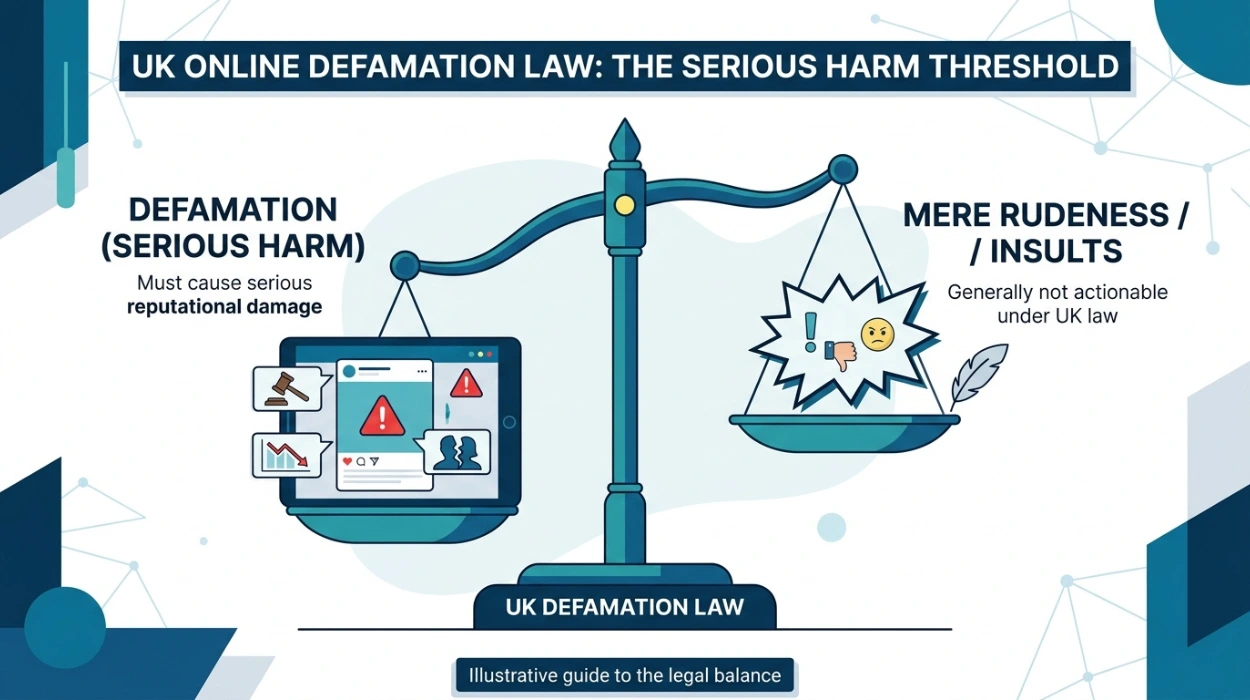
Online defamation in UK law refers to the publication of false statements that cause serious harm to a person’s or organisation’s reputation. Being rude refers to offensive, insulting, or impolite expressions that do not necessarily meet the legal threshold for reputational damage.
Reputation management is the process of understanding, analysing, and evaluating how information shapes public perception across digital environments. Online reputation refers to the collection of indexed content, reputation signals, and search results that influence how individuals, organisations, and entities are interpreted within search ecosystems.
What Is Online Defamation Under UK Law?
Online defamation is a legal concept that refers to the publication of false statements that damage reputation and satisfy specific legal criteria established under UK law.
Defamation exists to protect reputation from demonstrably false claims that create measurable reputational harm. Within digital environments, defamatory content appears through websites, blogs, forums, review platforms, social media posts, and online publications. UK law evaluates whether a statement has been communicated to a third party, whether it identifies an individual or organisation, and whether it causes serious harm to reputation. The legal focus remains on reputational damage rather than emotional offence. This distinction separates defamation from ordinary disagreements, criticism, or impolite communication.
Online environments accelerate the distribution and visibility of information. Content indexing enables defamatory material to become discoverable through search engines, creating long-term effects on entity perception. Search visibility amplifies the reach of information by making content accessible through branded searches, entity-based queries, and topic associations. As a result, defamatory statements influence how audiences evaluate trust, credibility, and authority across digital channels.
How Does UK Law Define Serious Harm to Reputation?
Serious harm is the legal threshold that distinguishes actionable defamation from ordinary reputational disagreement.
The concept of serious harm evaluates whether published information creates substantial damage to reputation rather than temporary annoyance or personal offence. UK law examines the actual impact of content on public perception, professional standing, and social credibility. The assessment focuses on measurable reputational consequences instead of emotional reactions. This framework ensures that legal protection remains connected to reputation rather than subjective feelings. The threshold functions as a filtering mechanism that separates significant reputational injury from everyday online conflict.
Within search ecosystems, serious harm often relates to visibility and discoverability. Content ranking dynamics influence how frequently users encounter information during searches. High-ranking defamatory content can become associated with an entity through repeated exposure. Search engines interpret relationships between entities, topics, and documents through indexing systems. Consequently, persistent visibility can strengthen negative reputation signals and influence SERP evaluation over time.
How Is Online Defamation Different From Being Rude?
Online defamation concerns false factual claims that damage reputation, whereas being rude concerns expression that lacks politeness or social courtesy.
Rudeness refers to language that is insulting, disrespectful, offensive, or harsh. Such language often generates negative reactions but does not automatically create legal liability. Defamation requires more than unpleasant expression because it depends on false statements presented as factual information. A rude opinion remains distinct from a defamatory allegation. This distinction forms a central principle within reputation-related legal analysis. The law evaluates whether information communicates a false factual assertion rather than whether the language appears offensive.
Search engines process content differently from legal systems. Algorithms analyse content relevance, authority signals, entity relationships, and user engagement metrics. They do not independently determine legal liability. However, content containing negative language can influence reputation signals regardless of whether it qualifies as defamation. Search perception develops through repeated exposure to information, meaning both rude content and defamatory content affect visibility differently. The difference lies in legal classification rather than algorithmic existence.
What Elements Must Exist for a Statement to Be Defamatory?
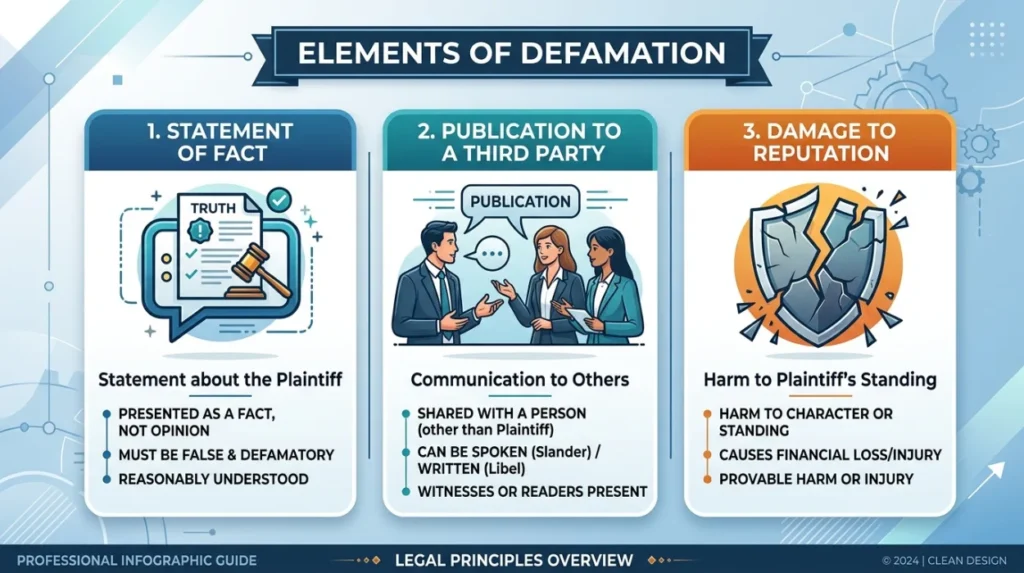
A defamatory statement requires identifiable elements that establish reputational harm through false published information.
The first element involves publication. Information must be communicated to at least one person other than the subject. The second element concerns identification. Readers must reasonably understand who the statement refers to. The third element requires falsity or an inability to establish factual accuracy. The fourth element involves reputational damage that satisfies the serious harm threshold. These elements collectively define the legal framework used to evaluate defamation claims in digital environments.
Search ecosystems reinforce the significance of publication. Content indexing transforms a single publication into an accessible information asset. Once indexed, content becomes searchable through keywords, entity names, and semantic associations. Search visibility extends audience reach beyond the original publication environment. Consequently, the interaction between publication and indexing creates stronger reputational implications than isolated offline communication.
Why Does Truth Matter in Defamation Analysis?
Truth functions as a fundamental evaluation factor because defamation concerns false information rather than accurate information.
A true statement does not become defamatory solely because it damages reputation. Reputation management and legal analysis distinguish between factual accuracy and reputational consequence. This distinction demonstrates how reputation systems operate across information ecosystems. Search engines aim to organise information according to relevance, authority, and usefulness rather than legal preference. Therefore, factual information remains eligible for indexing even when it affects public perception negatively.
The relationship between truth and search visibility highlights the complexity of digital reputation. Search algorithms evaluate authority signals through source credibility, content quality, topical relevance, and linking relationships. Accurate information often receives stronger credibility indicators because authoritative sources reinforce factual consistency. As a result, truth influences both legal assessment and search ecosystem interpretation.
How Do Search Engines Influence Online Reputation?
Search engines influence online reputation by determining which information receives visibility during user searches.
Search engine results pages act as reputation evaluation environments. Users frequently assess credibility based on visible search results before engaging with an individual, organisation, or entity. Ranking systems prioritise content according to relevance, authority, user intent, and quality signals. These processes shape perception because highly visible information receives greater attention. Search visibility therefore functions as a critical component of reputation formation.
Content indexing forms the foundation of this process. Search engines discover, analyse, categorise, and store information within searchable databases. Indexed content contributes to entity understanding through semantic relationships and contextual associations. Reputation signals emerge when algorithms identify recurring themes connected to an entity. Positive, neutral, and negative information all contribute to overall search perception. Consequently, reputation becomes a function of information accessibility as well as information quality.
How Does SERP Evaluation Affect Credibility?
SERP evaluation refers to the process through which users interpret credibility based on search result composition.
Users analyse headlines, source authority, publication context, and content prominence when reviewing search results. These observations influence trust formation before a website visit occurs. Search results therefore operate as preliminary reputation interfaces. Visibility patterns shape expectations about expertise, reliability, and credibility. Repeated exposure to similar information strengthens perception signals associated with an entity.
What Role Do Reputation Signals Play in Digital Perception?
Reputation signals are indicators that contribute to how credibility, trustworthiness, and authority are interpreted online.
Reputation signals originate from multiple information sources including articles, reviews, news coverage, social discussions, academic references, and website content. Search engines evaluate these signals through contextual relationships rather than isolated documents. The cumulative effect of information influences entity perception. Consistent positive signals reinforce credibility, while persistent negative signals alter perception pathways. This process demonstrates how reputation develops through information ecosystems rather than individual documents alone.
Digital perception depends on signal consistency. Search algorithms analyse semantic relationships between topics and entities. Information that repeatedly associates an entity with particular themes becomes part of its searchable identity. This mechanism explains why reputation extends beyond isolated content pieces. Instead, reputation emerges from the broader network of indexed information connected to an entity.
Dive Deeper With Our Expert Guides:
What Online Defamation Is Under UK Law and How It Differs From Opinion
How Negative Content Suppression on Google Works and When It Outperforms Removal
How Does a Digital Footprint Affect Reputation?
A digital footprint refers to the total collection of information associated with an individual, organisation, or entity across online environments.
Digital footprints develop through content creation, publication, indexing, linking, sharing, and discussion. Every indexed document contributes additional context to entity understanding. Search engines use these data points to construct semantic relationships that influence visibility and interpretation. Consequently, digital footprints serve as informational foundations for reputation formation. Their influence extends across search results, knowledge systems, and content discovery mechanisms.
A large digital footprint increases informational depth. Search ecosystems benefit from comprehensive entity understanding because greater contextual information improves classification accuracy. However, footprint size alone does not determine reputation quality. Reputation depends on the nature, authority, and relevance of indexed content. Therefore, digital footprint analysis focuses on informational composition rather than volume alone.
How Do Social Media and Online Articles Influence Defamation Visibility?
Social media platforms and online articles influence defamation visibility by increasing content distribution and discoverability.
Online publications often possess indexing pathways that allow content to appear within search results. Social media content contributes additional visibility through sharing mechanisms, engagement signals, and public accessibility. Although search engines evaluate each platform differently, both environments contribute information that shapes reputation signals. Visibility expansion occurs when content becomes accessible through multiple discovery channels.
The interaction between publication platforms and search engines affects perception formation. Content that receives indexing and ranking opportunities gains greater exposure within search ecosystems. This process demonstrates how information distribution influences reputation independently of legal classification. Visibility and legality remain distinct concepts, yet both affect how audiences interpret credibility and trustworthiness online.
How Does Online Reputation Connect to Defamation Discussions?
Online reputation connects to defamation because both concepts involve the interpretation and evaluation of information about an entity.
Defamation focuses on false information that damages reputation. Online reputation focuses on the broader collection of information that shapes perception. These concepts intersect through content visibility, information credibility, and search evaluation processes. Defamatory material becomes significant because it influences reputation signals and entity associations within digital ecosystems. Understanding this relationship requires analysing both legal definitions and search ecosystem mechanisms.
Reputation management as a field studies how information affects perception across search environments. The discipline evaluates content indexing, authority signals, SERP evaluation, and digital footprints to understand reputation formation. Defamation analysis represents one component of this broader informational framework. Together, these concepts explain how information influences trust, credibility, and public interpretation in modern search ecosystems.
Online defamation refers to false published statements that cause serious reputational harm under UK law, while being rude refers to offensive expression that does not automatically satisfy legal requirements for defamation. The distinction depends on factual accuracy, publication, identification, and measurable reputational impact rather than personal offence.
Search ecosystems add an additional layer to reputation analysis by influencing content visibility, entity perception, and credibility evaluation. Content indexing, SERP evaluation, authority signals, reputation signals, and digital footprints collectively shape how information is interpreted online. Understanding these mechanisms provides a clearer framework for analysing online reputation and the role defamation plays within broader digital perception systems.
What is online defamation under UK law?
Online defamation refers to false statements published online that cause serious harm to an individual’s or organisation’s reputation. UK law distinguishes defamatory content from opinions, criticism, and lawful expression by assessing reputational damage and factual accuracy.
How is online defamation different from being rude?
Being rude involves offensive or impolite language, while online defamation involves false factual claims that damage reputation. UK defamation law focuses on reputational harm rather than personal offence or hurt feelings.
Can a negative online comment be considered defamation?
A negative comment can be defamatory if it contains false statements presented as facts and causes serious reputational harm. Honest opinions and truthful statements generally do not meet the legal definition of defamation.
How does online defamation affect search visibility?
Defamatory content can influence search visibility when indexed by search engines and displayed in search results. Repeated exposure to negative content may affect reputation signals, entity perception, and public credibility within search ecosystems.
Why is understanding online defamation important for reputation management?
Understanding online defamation helps explain how false information impacts digital reputation and search perception. Clear Your Name recognises that effective ORM Services rely on understanding content indexing, reputation signals, and how information shapes online credibility.