

Broken links can affect online reputation because search engines and users continue to interpret them as signals of content quality, website maintenance, and entity credibility. Even when the original content no longer exists, broken URLs influence search visibility, trust assessment, and reputation signals across search ecosystems.
Reputation management is the process of understanding how digital information shapes perception within search environments. Broken links online reputation issues can affect search visibility, authority signals, and how users and search engines evaluate an entity.
Why Do Broken Links Continue to Influence Online Reputation?
Broken links continue to influence online reputation because search ecosystems evaluate URLs, link structures, and user experience signals beyond the existence of the original content.
A broken link is a URL that no longer resolves to the expected content destination. Search engines continue recognising the historical relationship between linking pages and destination pages even after content removal. This creates residual reputation signals that contribute to SERP evaluation. Content indexing systems maintain records of link associations until crawling and re-evaluation processes update the search ecosystem. During this period, broken links remain part of how search engines interpret website quality and entity perception.
User interactions also contribute to reputation assessment. When users encounter non-functioning pages, search engines analyse engagement patterns and satisfaction signals. Broken pathways reduce information accessibility and weaken trust indicators. These effects influence how search algorithms evaluate overall site quality and authority. As a result, content removal alone does not eliminate the reputation implications associated with abandoned URLs.
How Do Search Engines Interpret Broken Links?
Search engines interpret broken links as indicators of content maintenance, information reliability, and technical quality.
Search engines rely on crawling systems to discover, evaluate, and index digital content. When crawlers repeatedly encounter inaccessible URLs, they reassess the quality of the affected website. This evaluation process contributes to search visibility assessments because technical reliability forms part of broader quality frameworks. Broken links therefore become reputation signals connected to site management practices.
SERP evaluation incorporates both content relevance and user experience metrics. A website containing multiple broken URLs demonstrates weaker maintenance standards compared with a site that maintains functional content pathways. Search algorithms analyse these patterns when assessing authority and credibility. The result is a measurable influence on how entities are perceived within search ecosystems.
What Reputation Signals Are Created by Broken URLs?
Broken URLs generate specific reputation signals that influence trust and credibility evaluations.
Key signals include:
- Evaluate accessibility by measuring whether users reach the intended content destination.
- Assess maintenance quality through the frequency of unresolved URLs across indexed pages.
- Interpret credibility using technical reliability as a supporting authority factor.
- Analyse engagement through user behaviour following unsuccessful page visits.
- Measure content consistency by comparing active resources with indexed references.
These signals contribute directly to search engine understanding of website quality and entity perception.
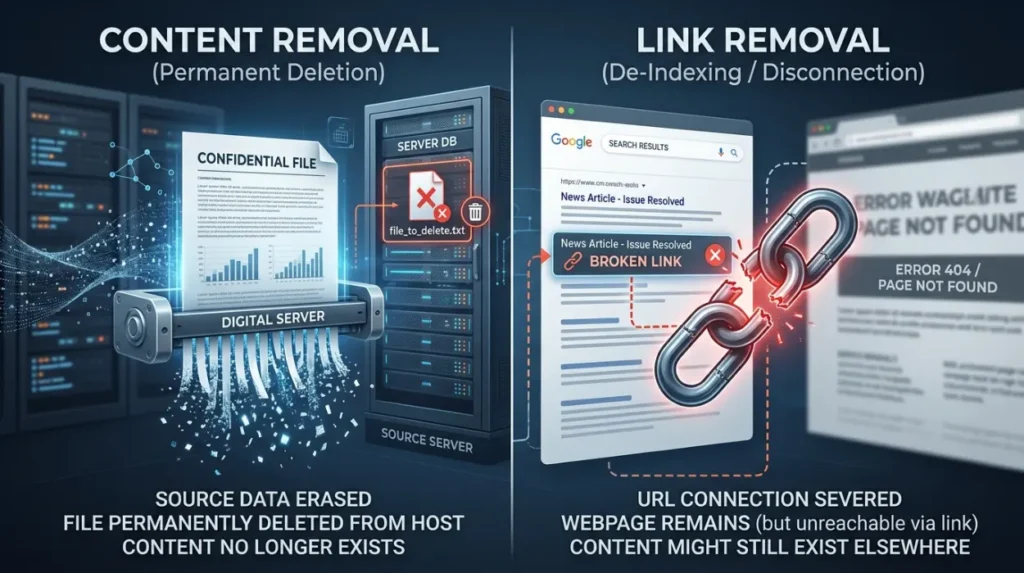
How Does Content Removal Differ From Link Removal?
Content removal eliminates information, while link removal eliminates pathways that connect search ecosystems to that information.
Content removal occurs when a page, article, or resource is deleted from a website. Link removal refers to eliminating references that point toward that content. Although the content disappears, incoming and internal links often remain visible across websites and search indexes. This distinction explains why reputation effects persist after deletion.
Search engines evaluate relationships between documents through linking structures. When content is removed but references remain active, crawlers identify inconsistencies between expected destinations and actual outcomes. These inconsistencies influence technical quality assessments and search visibility evaluations. The reputation impact therefore extends beyond the removed content itself and into the broader linking environment.
The distinction is particularly important when analysing What Removing Broken Links From Google Involves and How Long It Takes because search ecosystems treat deleted content and broken references as separate evaluation processes. Understanding this difference improves conceptual understanding of reputation management systems.
Why Do Broken Links Affect Search Visibility?
Broken links affect search visibility because they disrupt content discovery, crawling efficiency, and quality assessment mechanisms.
Search visibility refers to the extent to which content appears within search engine results pages. Search engines allocate crawling resources according to perceived site quality and structural efficiency. Broken URLs create inefficiencies that reduce crawler effectiveness and complicate content discovery. This directly influences indexing accuracy and visibility outcomes.
Content indexing depends on accessible pathways between resources. When these pathways fail, search engines receive incomplete signals regarding content relationships and site structure. This weakens the clarity of entity perception and reduces confidence in content accessibility. Over time, search visibility can decline as technical quality assessments become less favourable.
How Do Broken Links Influence Entity Credibility?
Broken links influence entity credibility because search engines associate technical reliability with information trustworthiness.
Entity credibility is the perceived reliability and authority assigned to an individual, organisation, or website within search ecosystems. Search algorithms evaluate credibility using multiple signals, including content quality, authority indicators, and technical performance. Broken links contribute to this assessment because they reflect how effectively digital assets are maintained.
A website that consistently provides functional access to information demonstrates stronger reliability. In contrast, unresolved links indicate gaps in content management and information accessibility. Search engines interpret these patterns when assessing authority signals. The result is a direct relationship between technical maintenance and perceived credibility.
How Is Credibility Evaluated Through Technical Signals?
Technical signals support broader credibility assessments across search ecosystems.
Important evaluation factors include:
- Measure uptime through consistent content accessibility.
- Assess navigation quality using internal link functionality.
- Evaluate indexing efficiency through crawler accessibility.
- Analyse structural consistency across content pathways.
- Review maintenance standards through ongoing technical accuracy.
These technical factors influence how authority and trust signals are interpreted within SERP evaluation frameworks.
What Role Do Broken Links Play in Digital Footprint Analysis?
Broken links contribute to digital footprint analysis because they reveal historical content relationships and website evolution.
A digital footprint is the collection of information, references, and signals associated with an entity across online environments. Search engines analyse this footprint to understand relevance, authority, and reputation. Broken links remain part of this footprint because they preserve evidence of previous content structures and information pathways.
Historical references influence search ecosystem interpretation. Even after content removal, linking patterns reveal how information was previously distributed and connected. Search engines use these relationships to contextualise entity perception and authority assessments. Broken links therefore remain relevant within reputation analysis despite the absence of active content.
Dive Deeper With Our Expert Guides:
What a Dead Link Is and Why It Can Still Cause Reputational Harm in Search
How Do Broken Links Affect User Trust and Perception?
Broken links affect user trust because they interrupt information access and reduce confidence in content reliability.
Users evaluate websites based on accessibility, consistency, and informational value. When expected content is unavailable, confidence in the source decreases. This perception shift creates indirect reputation consequences that extend beyond the individual page. Trust signals weaken because users interpret technical failures as indicators of reduced reliability.
Search engines monitor behavioural patterns associated with these experiences. Metrics related to user engagement and satisfaction contribute to broader quality evaluations. As broken links accumulate, both direct user perception and algorithmic interpretation become increasingly affected. This demonstrates the connection between technical functionality and reputation management.
Why Is Broken Link Management Relevant to Reputation Systems?
Broken link management is relevant because search ecosystems interpret technical accuracy as part of overall reputation assessment.
Reputation systems rely on interconnected signals rather than isolated content elements. Content quality, authority indicators, user experience, and technical performance work together to shape entity perception. Broken links influence each of these dimensions by affecting accessibility, trust, and search visibility.
Search engines continuously evaluate websites through crawling and indexing processes. Technical inconsistencies become part of broader quality assessments that influence rankings and perception. Managing broken links therefore supports the integrity of reputation signals and strengthens the accuracy of digital footprint representation within search environments.
Broken links continue affecting online reputation even after content disappears because search ecosystems evaluate technical quality, content accessibility, and credibility signals beyond the existence of individual pages. These links remain part of the broader digital footprint that search engines use to interpret authority, trust, and entity perception.
Understanding the relationship between broken URLs, search visibility, content indexing, and reputation signals provides deeper insight into how search engines evaluate digital entities. Reputation management involves analysing these interconnected systems to understand how information, links, and technical structures influence perception within search environments.
Can broken links affect online reputation even if the original content is gone?
Yes, broken links can still influence online reputation because search engines evaluate them as technical and trust signals. They can affect search visibility, user experience, and overall entity credibility within search results.
How do broken links impact search engine rankings?
Broken links can reduce crawling efficiency and create indexing issues that affect search visibility. Search engines use technical quality signals when evaluating websites, making unresolved links a factor in SERP evaluation.
Why are broken links considered reputation signals?
Broken links reflect website maintenance, content reliability, and information accessibility. Search engines analyse these factors when assessing authority, trustworthiness, and online reputation across digital ecosystems.
What is the difference between content removal and broken link removal?
Content removal deletes the original page, while broken link removal eliminates references pointing to inaccessible URLs. Even after content is removed, broken links can continue affecting search perception and technical quality assessments.
How do Dead Links Removal Services support online reputation management?
Dead Links Removal Services focus on identifying and resolving inaccessible URLs that impact search visibility and user trust. Managing broken links helps maintain stronger reputation signals, content accessibility, and search engine credibility.