
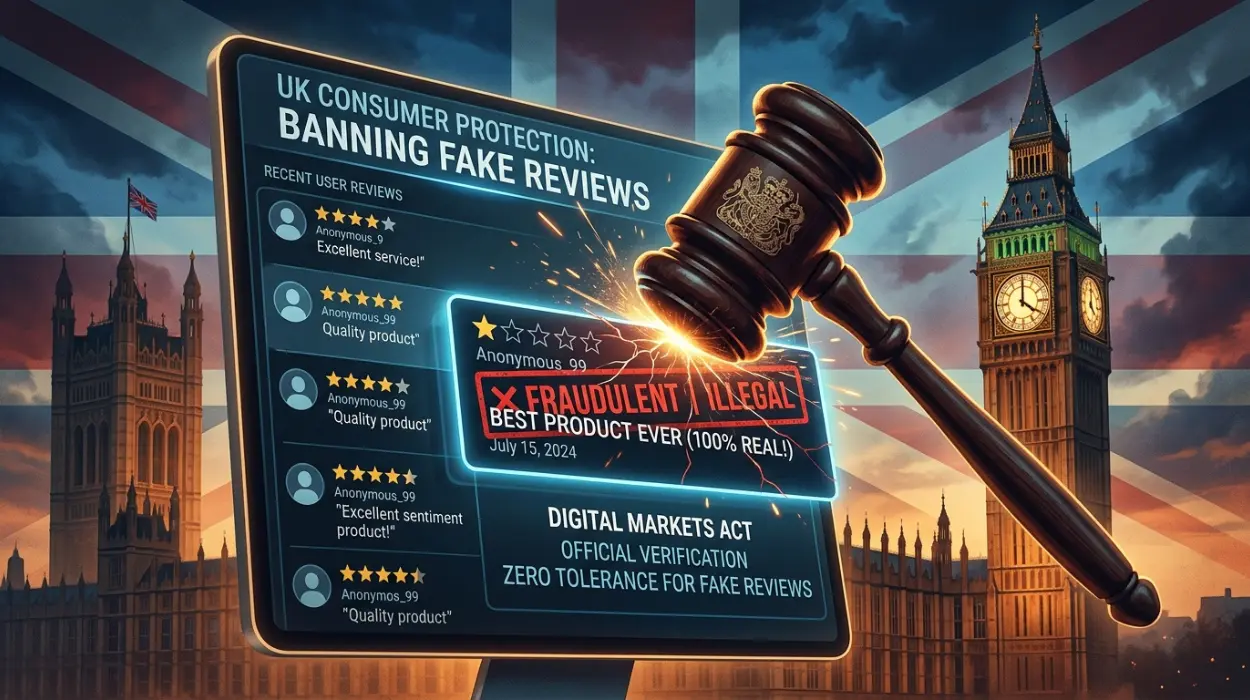
The UK’s new fake review laws strengthen consumer protection by increasing scrutiny of misleading reviews and unfair commercial practices. They influence what businesses can seek to have removed by defining how deceptive review content is identified, assessed and regulated within digital platforms.
Reputation management strategies differ based on legal obligations, platform policies and search ecosystem behaviour. Online reputation control methods are evaluated through reputation signals, entity credibility, search ranking influence and the relationship between regulatory compliance and digital trust.
What changes do the UK’s new fake review laws introduce?
The UK’s new fake review laws establish clearer expectations for identifying and addressing misleading review practices within digital marketplaces. These legal changes focus on preventing fabricated reviews, undisclosed incentivised feedback and deceptive review publication that affects consumer decision-making.
Within search ecosystems, these laws influence how businesses evaluate review content before considering removal. Legal compliance becomes an additional factor alongside platform policies, review authenticity and search visibility. Businesses therefore assess whether review content breaches regulatory standards rather than relying solely on reputational concerns.
Search engines continue to interpret review signals through algorithms that evaluate trust, relevance and authority. The legal framework complements these technical systems by defining standards for misleading commercial behaviour without directly controlling search rankings.
How do legal standards compare with platform review policies?
Legal standards and platform review policies operate through different mechanisms even though both influence review management. Legal standards define regulatory obligations and consumer protection requirements, while platform policies establish operational rules governing user-generated content.
Platform policies evaluate review authenticity by analysing reviewer behaviour, account activity, content quality and unusual submission patterns. Regulatory frameworks instead examine whether review practices constitute misleading commercial conduct under applicable legislation.
This distinction affects reputation management because businesses often evaluate both systems before considering removal strategies. Platform enforcement focuses on policy compliance, whereas legal evaluation measures broader consumer protection obligations.
Comparing these approaches demonstrates that regulatory standards strengthen accountability while platform policies determine operational moderation within search ecosystems.
How do fake review laws influence search visibility?
Fake review laws influence search visibility indirectly by improving the quality and authenticity of review information available to search engines. Search algorithms continue to evaluate reputation signals independently, but cleaner review ecosystems strengthen the reliability of those signals.
Search ranking influence depends upon review authenticity, authority, relevance and consistency rather than legal status alone. When deceptive reviews are identified and removed through regulatory or policy mechanisms, search engines reassess reputation signals using updated information.
Entity credibility improves when review ecosystems more accurately reflect genuine customer experiences. Search perception therefore becomes more balanced because reputation signals align more closely with authentic business performance.
The relationship demonstrates that legal standards contribute to healthier digital information environments without replacing algorithmic ranking systems.
Which review types receive different levels of evaluation?
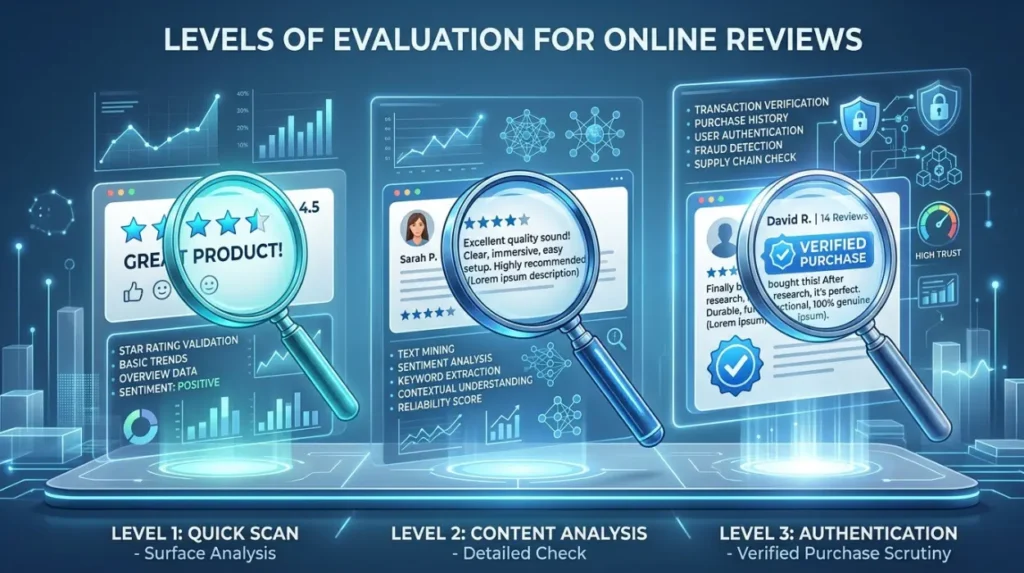
Different review categories receive different levels of evaluation because each represents a distinct form of user-generated content within search ecosystems. Reputation management compares these review types according to authenticity, policy compliance and regulatory relevance.
Fabricated reviews
Fabricated reviews contain experiences that never occurred. Search platforms analyse behavioural signals and content consistency to identify artificial activity, while legal frameworks evaluate whether publication contributes to misleading commercial practices.
Incentivised reviews
Incentivised reviews involve benefits offered in exchange for feedback. Evaluation focuses on whether incentives have been disclosed appropriately and whether the resulting review accurately represents genuine customer experience.
Coordinated review campaigns
Coordinated review campaigns involve organised attempts to influence public perception through multiple related accounts or systematic review activity. Search ecosystems evaluate behavioural relationships alongside timing patterns and account credibility.
Comparing review categories demonstrates that different forms of manipulation generate different reputation signals, requiring distinct analytical approaches during evaluation.
How do reactive review removal strategies compare with preventative reputation management?
Reactive review management evaluates existing review content after publication, whereas preventative reputation management focuses on maintaining authentic reputation signals before problems emerge. Both approaches operate within different stages of reputation management.
Reactive strategies analyse review legitimacy, platform policy compliance and legal eligibility for removal. Their primary objective is to evaluate whether specific content satisfies regulatory or moderation criteria.
Preventative strategies strengthen entity credibility through authentic customer engagement, consistent information accuracy and sustainable digital trust. Search engines interpret these signals as part of broader reputation evaluation, improving the stability of search perception over time.
Comparing these methods highlights that reactive analysis addresses existing review issues, while preventative strategies improve the long-term quality of reputation signals.
How do reputation signals determine review credibility?
Reputation signals are measurable indicators that search engines use to evaluate the trustworthiness of review ecosystems. Review credibility develops from the interaction between reviewer authenticity, content quality, business authority and behavioural consistency.
Algorithms compare review language, account history, submission frequency and semantic relationships across multiple digital sources. Authentic review ecosystems demonstrate natural variation in sentiment distribution, reviewer diversity and engagement patterns.
Manipulated review environments generate inconsistent reputation signals that weaken entity credibility during algorithmic evaluation. Search visibility therefore reflects the overall quality of reputation signals rather than review quantity alone.
Understanding these mechanisms explains why review authenticity remains central to both legal evaluation and search ecosystem performance.
Dive Deeper With Our Expert Guides:
How the CMA Fake Review Law Changes What Businesses Can Demand Be Removed
How Fake Review Reporting in the UK Works Across Google Trustpilot and Glassdoor
How do organic reputation strategies compare with review removal approaches?
Organic reputation strategies and review removal approaches operate through different mechanisms within search ecosystems. Organic reputation management improves entity credibility by strengthening authentic reputation signals across multiple digital assets, while review removal evaluates whether specific content satisfies legal or platform requirements for removal.
Organic strategies influence search ranking by expanding authoritative business information, encouraging genuine customer engagement and maintaining consistent digital trust. Search engines interpret these signals as evidence of reliable business activity because they reflect sustained user interaction rather than isolated moderation actions.
Review removal approaches concentrate on analysing individual reviews against platform policies and legal standards. Their effectiveness depends on the authenticity of the review, evidence supporting policy breaches and the applicable regulatory framework.
Comparing these methods demonstrates that organic strategies strengthen long-term search perception, whereas review removal addresses specific instances of misleading content.
How do short-term and long-term reputation management outcomes differ?
Short-term reputation management evaluates immediate review visibility and the current composition of business profiles. Long-term reputation management measures how reputation signals evolve as search engines continually reassess content quality, authority and customer engagement.
Short-term outcomes become visible when review content is moderated or removed following policy or legal evaluation. Search ecosystems then recrawl and re-index updated business profiles, allowing reputation signals to adjust according to the revised information landscape.
Long-term outcomes depend on sustained entity credibility. Consistent authentic reviews, accurate business information and balanced sentiment distribution strengthen trust signals over time, producing more stable search visibility.
This comparison shows that immediate moderation influences current perception, while long-term reputation depends on continuous digital trust and authentic customer interaction.
What factors determine the effectiveness of fake review removal strategies?
Effectiveness is measured by evaluating legal compliance, platform policy alignment and the influence of review changes on reputation signals rather than by the volume of removed content alone.
The following framework provides a structured comparison:
- Assess review authenticity by analysing reviewer history, behavioural patterns and content consistency to identify policy violations.
- Evaluate legal compliance by comparing review practices with consumer protection requirements and applicable UK regulations.
- Measure search ranking influence by examining how changes in review quality affect local search visibility and business credibility.
- Analyse sentiment distribution by reviewing whether remaining customer feedback accurately reflects authentic user experiences.
- Monitor ongoing reputation signals by observing entity credibility, review consistency and search perception after moderation activities.
This evaluation framework demonstrates that sustainable reputation management depends upon continuous analysis rather than isolated moderation actions.
How do search engines interpret review removals over time?
Search engines interpret review removals by reassessing the reputation signals associated with a business profile after updated information has been indexed. Algorithms do not evaluate legal decisions directly; instead, they analyse the quality and authenticity of the available review ecosystem.
Content indexing ensures that revised review information becomes part of the searchable digital footprint during future crawling cycles. Search ranking influence then changes according to updated authority signals, review consistency and overall business credibility.
Entity perception evolves as authentic customer feedback becomes more representative of actual experiences. Search ecosystems therefore reward balanced and trustworthy review environments rather than abrupt changes unsupported by broader reputation signals.
This ongoing reassessment explains why review management produces gradual changes in digital perception rather than immediate or permanent ranking adjustments.
Why is evaluating legal frameworks alongside search ecosystems important?
Evaluating legal frameworks together with search ecosystem behaviour provides a more complete understanding of reputation management. Regulatory standards define what constitutes misleading review practices, while search engines evaluate how review information contributes to digital trust and visibility.
Legal compliance establishes the basis for assessing deceptive content, whereas search algorithms measure reputation signals, authority and semantic relationships to determine search performance. These systems operate independently but influence the same digital information environment.
Understanding both perspectives enables businesses to evaluate review management strategies with greater accuracy. It also explains why successful reputation analysis depends upon balancing regulatory obligations with technical search evaluation rather than relying on either system alone.
The UK’s new fake review laws introduce stronger standards for evaluating misleading reviews while reinforcing transparency within digital marketplaces. These legal developments complement platform moderation policies and improve the reliability of reputation signals available to search engines.
Comparing legal evaluation, platform enforcement, organic reputation management and review removal demonstrates that each approach operates through distinct mechanisms with different strengths and limitations. Search visibility, entity credibility and sentiment distribution continue to depend on authentic customer experiences supported by consistent digital trust.
Understanding these strategic differences provides a stronger foundation for evaluating review management decisions within modern search ecosystems. Further exploration of Remove Fake Google Reviews in the UK Using Our Policy-Based Expert Process explains how policy-based assessment frameworks are applied when evaluating potentially misleading review content.
How do the UK’s new fake review laws affect what businesses can have removed?
The UK’s new fake review laws strengthen rules around misleading and incentivised reviews, making it easier to challenge content that breaches consumer protection standards. Removal decisions still depend on platform policies, legal compliance and whether the review is proven to be fake or deceptive.
What types of fake Google reviews can be removed under UK law?
Reviews that are fabricated, incentivised without disclosure, or part of coordinated manipulation campaigns may be eligible for removal. Clear Your Name notes that eligibility depends on evidence, platform enforcement rules and how the content impacts search visibility and reputation signals.
Do fake review laws directly remove reviews from Google?
No. Fake review laws do not automatically remove content from Google. Instead, they provide a legal framework that supports enforcement actions through platforms like Google Business Profile when reviews violate policy or consumer protection rules.
How do fake reviews affect search visibility and reputation?
Fake reviews distort reputation signals that search engines use to evaluate trust, credibility and entity perception. This can influence local SEO performance and how a business appears in Search Engine Results Pages (SERPs)
Can Fake Reviews Removal Services help with legal compliance issues?
Yes, they help assess whether reviews breach platform policies or legal standards under UK consumer protection laws. Clear Your Name explains that such services focus on evaluating evidence, review authenticity and search ecosystem impact rather than simply requesting removal.