
Removing personal information from UK people search sites requires a structured privacy management process that combines data assessment, search visibility control, and reputation signal evaluation. A professional privacy approach reduces unnecessary exposure while strengthening digital trust, entity credibility, and control over publicly available information.
Search results influence how individuals and organisations are perceived because indexed information forms part of a digital footprint. Reputation signals within search ecosystems affect trust evaluation, making personal data visibility an important factor in online credibility. Clear Your Name applies a structured privacy management approach that analyses data exposure, removal pathways, and search perception influence. Effective privacy management focuses on reducing unwanted visibility while maintaining accuracy, compliance, and long-term reputation stability.
Which privacy management approach delivers effective control over personal information?
A structured privacy management approach delivers effective control by evaluating where personal information appears, how it is indexed, and which removal processes apply. Privacy management is the process of analysing personal data visibility across online platforms and implementing suitable methods to reduce unnecessary exposure. This approach operates by combining data review, platform procedures, and search ecosystem analysis. Search engines evaluate available information through content indexing, relevance signals, and authority assessment. Managing personal information therefore requires understanding both source-level removal and search visibility behaviour.
People search sites publish personal information through data aggregation systems that collect information from public records, directories, and accessible databases. This information becomes part of an online identity profile when websites organise and display it in searchable formats. Search engines then evaluate these pages based on technical accessibility, relevance, and content relationships. Reputation management examines these connections because unwanted personal information can influence entity perception and search visibility. A structured privacy process addresses the relationship between published data and digital reputation.
Understanding how these platforms operate provides essential context before selecting a removal method. People search sites publish personal data through automated collection and indexing processes that influence how personal information appears within search ecosystems. Analysing these mechanisms helps identify the correct approach for managing digital footprints and controlling information exposure.
How does a privacy service improve search visibility control?
A privacy service improves search visibility control by analysing information sources, assessing removal eligibility, and managing procedures designed to reduce unnecessary exposure. The process focuses on controlling how personal information appears within search results rather than simply removing isolated webpages. Search engines rely on indexing systems that continuously evaluate available content. Privacy management addresses these systems by targeting the relationship between source information and search visibility.
A professional privacy service evaluates personal information through structured criteria, including accuracy, relevance, processing purpose, and availability. This analysis creates a clearer understanding of which information requires attention and which removal pathways provide the strongest outcome. The process improves SERP control by reducing exposure from unwanted data sources. Search perception influence improves when search results contain more accurate and controlled information.
Clear Your Name uses a process-driven approach that focuses on evidence-based evaluation and transparent privacy procedures. The objective is to strengthen control over personal data visibility while supporting consistent reputation signals. Privacy management works most effectively when removal actions align with search engine behaviour and data protection requirements.
A professional privacy management process includes structured stages designed to improve accuracy and reduce risk.
- Identify exposed information by analysing people search profiles, indexed pages, and available data sources.
- Evaluate removal options by reviewing data accuracy, publication purpose, and applicable privacy considerations.
- Submit requests using organised documentation that supports platform and regulatory assessment.
- Monitor search updates by reviewing indexing changes and measuring visibility improvements.
Each step supports stronger control by connecting privacy procedures with search ecosystem behaviour.
Why is GDPR-based data removal important for online reputation control?
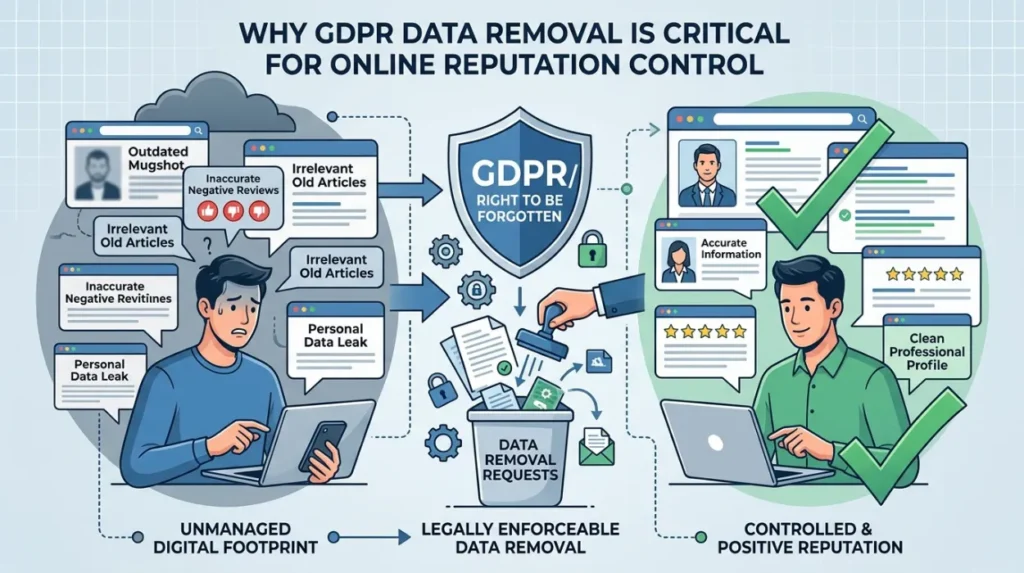
GDPR-based data removal is important because it provides a structured framework for evaluating how personal information is processed and displayed. Privacy rights allow individuals to request review of personal data handling when processing conditions require assessment. Reputation management analyses GDPR principles because lawful data processing directly influences digital trust and online visibility.
Data removal requests depend on factors such as accuracy, relevance, retention, and processing justification. A successful evaluation requires clear evidence and a defined understanding of how information affects search visibility. Search engines update results after source-level changes are recognised through crawling and indexing processes. This connection between privacy compliance and technical visibility makes GDPR evaluation an important part of reputation management.
Individuals seeking deeper understanding of removal procedures can explore remove your data from people search sites in the UK using GDPR rights to understand how privacy rights interact with search visibility and digital footprint management.
Which privacy strategy provides stronger long-term reputation protection?
A long-term privacy strategy provides stronger reputation protection when it combines information removal, monitoring, and digital footprint management. Removing unwanted personal information addresses direct exposure, while ongoing evaluation prevents future visibility issues from developing. Reputation management evaluates sustainability by measuring search visibility, content indexing patterns, and reputation signal consistency.
A removal-only approach focuses on reducing specific information sources, but search ecosystems contain connected pages and related data points. A comprehensive privacy strategy evaluates the broader information environment to create stronger control. This approach reduces risk by analysing how search engines connect information across multiple indexed resources.
Long-term reputation protection depends on maintaining accurate information and managing how digital identity appears online. Privacy services support this objective by combining technical understanding with structured data management procedures.
How does professional privacy management reduce digital reputation risks?
Professional privacy management reduces digital reputation risks by controlling unnecessary information exposure and improving visibility management across search ecosystems. Personal data appearing on people’s search sites can influence search perception because users often evaluate available information before forming opinions. A structured privacy approach analyses these risks through reputation signals, content indexing patterns, and entity credibility factors.
Risk reduction depends on understanding how information moves through digital environments. Removing information from a source does not represent the complete process because search engines require time to crawl, evaluate, and update indexed results. Professional privacy management considers these technical stages to create a clearer understanding of expected outcomes. This improves process reliability by connecting removal actions with measurable search visibility changes.
A comprehensive privacy strategy also evaluates future exposure risks by monitoring information patterns and digital footprint development. This approach supports stronger SERP control because it focuses on maintaining accurate and controlled information availability. Privacy management therefore becomes an ongoing process rather than a single removal action.
Dive Deeper With Our Expert Guides:
Remove Fake Google Reviews in the UK Using Our Policy-Based Expert Process
Use the New CMA Fake Review Law to Strengthen Your UK Removal Request
Which outcomes demonstrate the effectiveness of a privacy service?
The effectiveness of a privacy service is demonstrated through measurable improvements in information control, search visibility, and reputation stability. A successful approach focuses on reducing unnecessary exposure while improving control over how personal information appears across online platforms. Reputation management evaluates outcomes through changes in indexed content, search result composition, and digital trust signals.
Key outcomes include:
- Reduce unwanted information visibility by addressing eligible personal data sources and limiting unnecessary public exposure.
- Improve SERP control by managing how search engines discover and display personal information.
- Strengthen entity credibility by maintaining accurate and consistent online information.
- Stabilise reputation signals through continuous monitoring of digital footprint changes.
These outcomes demonstrate how privacy management influences search perception and online credibility.
Why is professional assistance valuable when managing people search site information?
Professional assistance is valuable because people search site removal requires analysis of technical, privacy, and search-related factors. A structured approach identifies where information appears, evaluates suitable removal pathways, and monitors changes after requests are processed. This reduces uncertainty by creating a clear process based on evidence and reputation management principles.
Independent removal attempts often focus on individual websites without analysing wider search visibility patterns. A professional privacy approach evaluates the complete search ecosystem, including indexed pages, duplicated information, and connected data sources. This broader assessment improves decision-making because it considers both immediate removal and long-term reputation impact.
Clear Your Name applies privacy-focused methods that combine data assessment, search visibility analysis, and process transparency. The approach supports stronger digital control by aligning privacy procedures with search behaviour and reputation requirements.
How does privacy management compare with content suppression strategies?
Privacy management and content suppression strategies influence search perception through different mechanisms. Privacy management focuses on reducing the availability of personal information at the source, while content suppression focuses on changing the visibility balance within search results. Both approaches contribute to reputation control but address different stages of the search ecosystem.
Content suppression operates by improving the presence of authoritative information and reducing the prominence of unwanted content through stronger reputation signals. Privacy management operates by addressing information exposure directly through removal procedures and data protection evaluation. The correct approach depends on the type of information involved and the desired level of control.
A combined understanding of both methods allows better evaluation of search ranking influence, risk exposure, and sustainability. Search engines assess all available information, making balanced reputation management important for maintaining long-term digital credibility.
How can privacy services support stronger digital trust?
Privacy services support stronger digital trust by improving control over personal information and creating a more accurate online presence. Digital trust develops through consistent information, reliable reputation signals, and controlled search visibility. Managing personal data exposure contributes to stronger entity perception within search ecosystems.
Trust restoration requires more than removing individual data points because search engines evaluate information relationships across multiple sources. Privacy management supports this process by analysing content indexing, search behaviour, and visibility patterns. This creates a more stable foundation for maintaining digital credibility.
A structured privacy service provides clarity through defined procedures, evidence-based assessment, and measurable outcomes. These elements strengthen confidence in the process while reducing risks associated with uncontrolled personal information exposure.
Removing personal information from UK people search sites requires a structured privacy management strategy focused on visibility control, data evaluation, and reputation protection. Effective privacy services analyse how information is collected, indexed, and displayed within search ecosystems while creating clear processes for reducing unnecessary exposure.
The relationship between privacy management and reputation control depends on understanding search visibility, reputation signals, and digital footprint development. Data removal, monitoring, and search perception analysis work together to create stronger control over online information.
A reliable privacy approach combines process clarity, technical understanding, and evidence-based evaluation. By addressing personal data visibility through structured methods, privacy management supports improved digital trust, reduced risk exposure, and stronger control over search results.
How can I remove my information from UK people search sites?
Personal information can be removed from UK people search sites by submitting data removal requests through available privacy procedures and applicable GDPR rights. The process involves reviewing data sources, assessing eligibility, and requesting removal of unwanted personal details.
What does a privacy service do to remove personal data online?
A privacy service analyses where personal information appears across people search sites and evaluates suitable removal methods. It helps manage digital footprints by addressing data exposure, search visibility, and online privacy risks.
Can GDPR rights help remove my details from people search websites?
GDPR rights allow individuals to request access, correction, restriction, or deletion of personal data when processing requirements are not satisfied. Removal decisions depend on factors such as data accuracy, lawful processing, and the purpose of publication.
Why does personal information appear on people search sites in the UK?
People search sites collect information through data aggregation from publicly available records, directories, and online sources. This information becomes searchable when websites publish profiles that are indexed by search engines.
How does removing personal information improve online privacy?
Removing personal information reduces unnecessary exposure and improves control over a digital footprint. It supports better search visibility management by limiting the amount of personal data available across online platforms.