

The Right to Be Forgotten operates through a legal assessment that determines whether specific personal information remains appropriate for indexing in search results. Reputation management strategies differ based on how search engines evaluate legal obligations, reputation signals and public interest while maintaining accurate search visibility.
Online reputation control methods are evaluated through their effect on content indexing, entity credibility and search ranking influence. The Right to Be Forgotten represents one approach within a broader reputation management framework that compares legal removal mechanisms with other methods of influencing search perception.
How Does the Right to Be Forgotten Operate Within Google’s Search Ecosystem?
The Right to Be Forgotten operates by allowing eligible individuals to request the de-indexing of personal information from search results when legal conditions under UK data protection law are satisfied. The process focuses on search visibility rather than automatically removing the original webpage.
Google evaluates requests through a structured legal review instead of relying exclusively on ranking algorithms. The assessment examines whether indexed information remains accurate, relevant and proportionate while balancing privacy rights with freedom of expression and public interest. This legal evaluation exists alongside Google’s standard indexing systems, creating two separate decision-making processes that influence SERP composition.
Search engines continue crawling and indexing webpages according to technical signals such as relevance, authority and content quality. The Right to Be Forgotten introduces an additional legal layer that determines whether specific URLs remain visible for searches involving an individual’s name. Entity credibility therefore depends on both algorithmic interpretation and legal compliance. Reputation management analyses this relationship because legal decisions directly affect search visibility without rewriting published history.
Individual review ensures that every request receives a contextual legal assessment rather than an automatic decision. Personal information, public interest and the purpose of continued indexing differ between cases.
Google evaluates factual accuracy, ongoing relevance, proportionality and the role of the individual connected to the information. This process measures whether continued visibility contributes to legitimate public knowledge or creates unnecessary exposure. Search ranking influence therefore becomes subject to legal evaluation alongside algorithmic ranking factors.
How Does the Right to Be Forgotten Compare With Removing Content From a Website?
The Right to Be Forgotten differs from website content removal because each approach operates at a different stage of the information ecosystem. One affects search indexing, while the other changes the availability of the original content.
Website removal eliminates information from the publishing source when the website owner or data controller deletes the content. Once deleted, search engines eventually remove the indexed version after recrawling the page. The Right to Be Forgotten instead limits discoverability by preventing eligible URLs from appearing in certain search queries without requiring the publisher to alter or delete the original material. This distinction demonstrates that search visibility and publication status represent separate reputation signals.
From a reputation management perspective, website removal changes the source of information, whereas de-indexing changes user access to that information. Website removal therefore produces broader changes across search ecosystems because the content itself disappears. De-indexing produces narrower changes by reducing visibility within defined search contexts while preserving lawful publication.
Website removal produces broader search ranking influence because the original source no longer contributes indexed content. De-indexing changes visibility for specific search queries without removing the webpage itself.
Both methods influence SERP composition differently. Removal affects content indexing across the search ecosystem, while de-indexing alters the relationship between personal names and indexed URLs. Reputation management evaluates these differences according to search visibility, legal feasibility and sustainability.
How Does the Right to Be Forgotten Compare With Content Suppression?
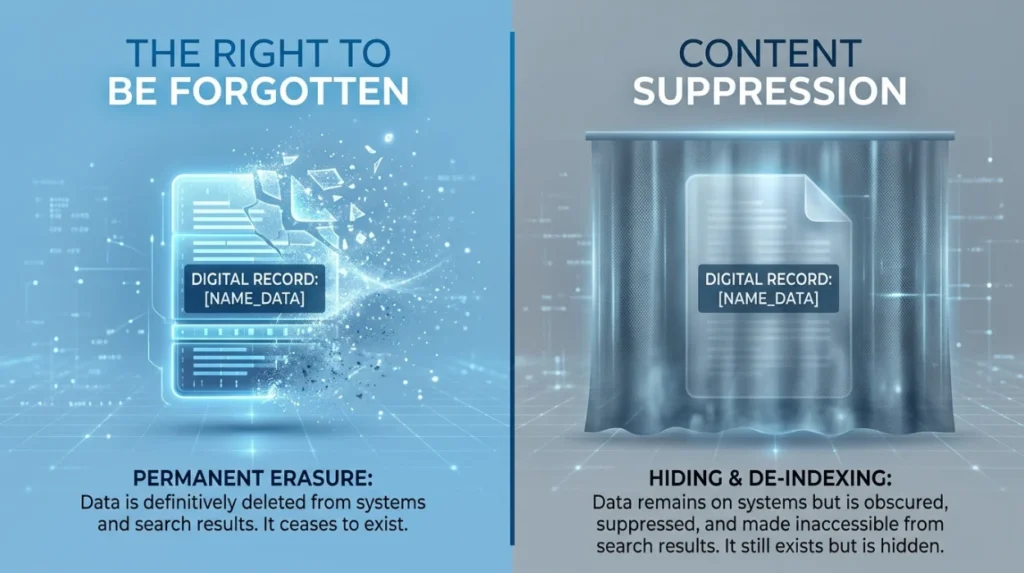
Content suppression operates by increasing the visibility of positive or neutral information so that less favourable material appears lower within search results. The Right to Be Forgotten operates through legal review that removes eligible search listings from relevant personal searches.
Content suppression focuses on publishing authoritative information that strengthens entity credibility and diversifies reputation signals. Search engines interpret this strategy through standard ranking systems that reward relevance, authority and quality. The original content remains indexed but receives less prominence because newer or stronger pages occupy higher ranking positions. This approach changes sentiment distribution across the first page of search results rather than removing information entirely.
The Right to Be Forgotten uses legal criteria instead of content competition. Search engines analyse eligibility under data protection law before determining whether individual URLs remain indexed. Content suppression therefore represents an organic reputation management strategy, while legal removal represents a compliance-based strategy. Both influence SERP composition through different mechanisms, making direct comparison essential when evaluating reputation management methods.
The comparison can be evaluated through their operating mechanisms:
- Reduce visibility through legal assessment by requesting de-indexing of eligible personal information under UK GDPR requirements.
- Increase authority through content enhancement by publishing relevant, trustworthy content that strengthens entity credibility.
- Influence sentiment distribution by expanding balanced information that occupies stronger ranking positions.
- Alter SERP composition by changing either indexed visibility or ranking prominence depending on the chosen strategy.
Each approach influences reputation signals differently because one relies on legal compliance while the other relies on algorithmic evaluation.
How Does Google Decide What Information to Remove?
Google decides whether to de-index information by applying legal balancing tests that evaluate privacy rights against public interest. The decision does not depend solely on whether information is negative or outdated.
Evaluation begins by confirming that the indexed information relates to an identifiable individual. Google then analyses factual accuracy, current relevance, proportionality and continuing public importance. Information concerning private individuals receives different consideration from information relating to public officials or issues of public accountability. Search ecosystems therefore distinguish between lawful publication and justified search visibility.
The review also considers how information contributes to entity credibility within search results. Older material that no longer reflects current circumstances receives different evaluation from information that remains relevant to public understanding. Reputation management analyses these legal mechanisms because search perception depends on how information is organised rather than simply whether it exists online.
Dive Deeper With Our Expert Guides:
How to Evaluate a Personal Information Removal Service Before Starting a Case
How the GDPR Right to Erasure Applies When Removing Personal Information Online
How Does the Right to Be Forgotten Compare With Personal Information Removal Services?
Personal Information Removal Services refer to structured processes that assist with identifying, assessing and requesting the removal or de-indexing of eligible personal information. The Right to Be Forgotten is one legal mechanism that forms part of this broader category rather than representing the entire process.
Personal Information Removal Services evaluate different sources of personal data, including search engines, websites and online directories. The Right to Be Forgotten specifically addresses eligible search results under UK GDPR, while other removal mechanisms depend on publisher policies, privacy legislation or data controller obligations. This distinction demonstrates that reputation management combines multiple legal and technical approaches rather than relying on a single removal pathway.
From a search ecosystem perspective, these approaches influence different stages of information processing. Legal de-indexing changes search visibility, whereas source-level removal changes content availability and future indexing. Reputation signals therefore change according to which layer of the information ecosystem is affected.
Which Evaluation Factors Determine the Appropriate Approach?
Selecting an approach depends on measurable factors rather than preference. Evaluation normally considers legal eligibility, source ownership, content accuracy, public interest, search ranking influence and long-term sustainability. These criteria explain why different reputation management methods produce different outcomes across search ecosystems.
What Are the Limitations of the Right to Be Forgotten?
The Right to Be Forgotten operates within defined legal boundaries that limit its application. Eligibility depends on statutory requirements rather than the individual’s preference to remove information.
Search engines evaluate whether information continues serving a legitimate public purpose. Information connected with public accountability, legal reporting or significant public interest often remains indexed because the balance favours public access. The legal framework therefore protects both privacy rights and freedom of information through proportional assessment rather than automatic removal.
Another limitation concerns geographical scope and technical accessibility. De-indexed content remains available through the originating website unless the publisher removes it independently. Users also access information through alternative search terms that do not rely on personal name searches. Reputation management therefore evaluates the overall effect on search visibility instead of assuming complete information removal.
How Does the Right to Be Forgotten Influence Long-Term Reputation Management?
The Right to Be Forgotten contributes to long-term reputation management by changing how personal information appears within search results rather than altering historical records. Sustainable reputation management examines the ongoing relationship between legal compliance, search visibility and entity credibility.
Search engines continually reassess indexed information through crawling, indexing and ranking systems. Legal removal requests influence one part of this process, while content quality, authority signals and topical relevance continue shaping overall SERP composition. Long-term reputation therefore depends on the interaction between algorithmic evaluation and legal obligations rather than either system operating independently.
Reputation signals also evolve as new information enters search ecosystems. Current, authoritative and relevant content naturally changes entity perception over time through standard ranking mechanisms. The Right to Be Forgotten complements this evolution by addressing situations where continued indexing no longer reflects lawful or proportionate processing of personal information.
The Right to Be Forgotten represents a legal approach to managing search visibility by evaluating whether personal information continues meeting UK data protection requirements. It differs from website removal, content suppression and broader Personal Information Removal Services because each method operates at a different stage of the search ecosystem and influences reputation signals through distinct mechanisms.
Evaluating these approaches requires analysing effectiveness, legal scope, sustainability and search ranking influence rather than viewing them as interchangeable solutions. Understanding how search engines balance privacy rights, public interest and entity credibility provides a clearer framework for assessing reputation management strategies and their long-term effect on SERP composition.
How does the Right to Be Forgotten work in practice?
The Right to Be Forgotten allows eligible individuals to request the de-indexing of certain personal information from search engine results under UK GDPR. Google reviews each request individually by balancing privacy rights, public interest and the relevance of the indexed content.
What information does Google actually remove under the Right to Be Forgotten?
Google may remove eligible URLs from search results for searches using a person’s name when the legal criteria are met. In most cases, the original content remains published on the source website unless the publisher removes it separately.
Is the Right to Be Forgotten the same as Personal Information Removal Services?
No. The Right to Be Forgotten is one legal mechanism within broader Personal Information Removal Services, which can also involve requests to website owners, data controllers and online platforms. Each approach addresses different stages of content indexing and online visibility.
Can Clear Your Name assist with Personal Information Removal Services?
Clear Your Name provides Personal Information Removal Services by helping individuals understand the available legal and procedural options for removing or reducing the visibility of personal information online. Final decisions remain with the relevant search engine, website owner or data controller.
Does removing a search result improve online reputation?
Reducing the visibility of eligible personal information can influence online reputation by changing how search results appear for name-based queries. However, reputation also depends on search visibility, entity credibility, content quality and ongoing reputation signals across the wider search ecosystem.