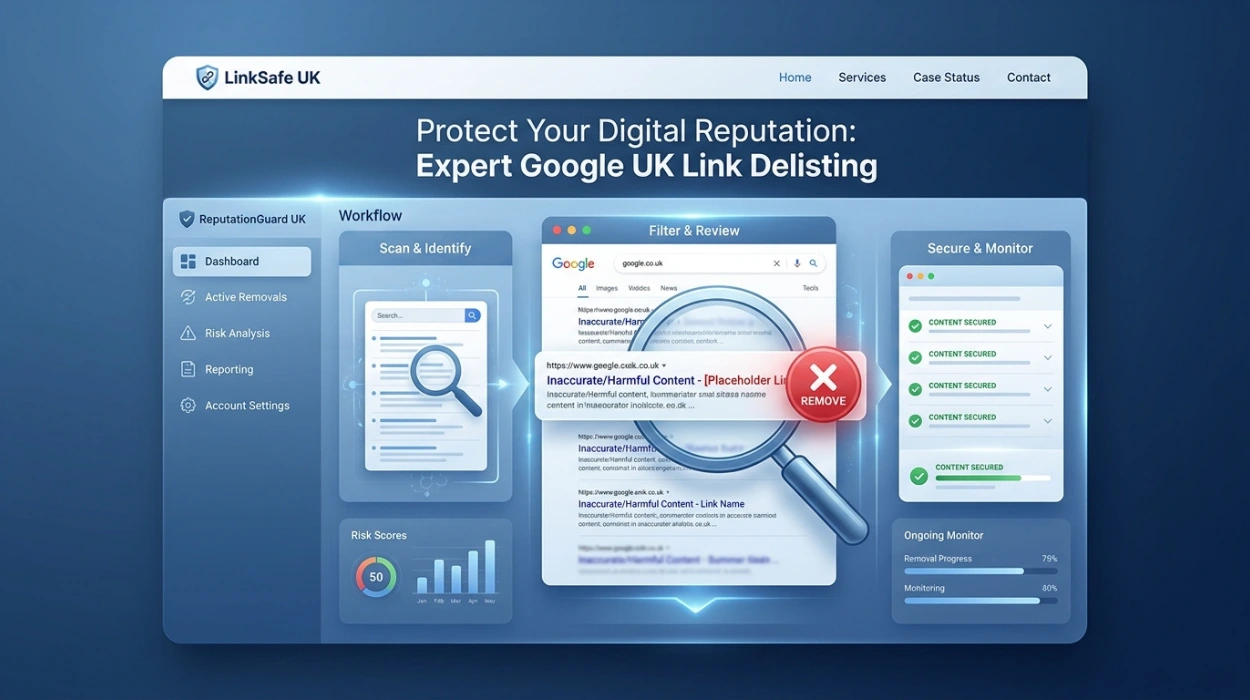
Removing harmful links from Google is the most effective way to reduce negative search visibility, strengthen reputation signals, and restore entity credibility when damaging content affects online perception. Search visibility control plays a decisive role in reputation management because search results directly influence trust, credibility, and decision-making across digital environments.
Reputation repair services focus on controlling how information appears within search ecosystems through structured analysis, content evaluation, and delisting strategies. Unlike general digital marketing activities, Link Removal Services target harmful search results that influence search perception, entity associations, and long-term digital trust.
Which reputation management approach delivers measurable results?
A structured link removal approach delivers measurable results because it directly addresses harmful search visibility while improving overall SERP control. The process evaluates damaging URLs, their indexing status, authority signals, and influence on entity credibility before selecting the most appropriate removal strategy.
Unlike reputation tactics that focus only on creating additional content, Link Removal Services target the underlying source of negative search perception. Removing or reducing harmful indexed content decreases negative reputation signals and allows search engines to reassess the overall information environment.
Search engines evaluate reputation through interconnected signals rather than isolated webpages. As harmful content loses visibility or is removed from indexed results, positive and authoritative information gains greater prominence within search results. This shift strengthens digital trust and improves long-term search perception.
Businesses and professionals seeking sustainable reputation recovery benefit from a structured process that combines technical analysis with search ecosystem evaluation. Clear Your Name applies this methodology by focusing on measurable improvements in search visibility rather than temporary cosmetic changes.
Why are Link Removal Services more effective than relying only on content suppression?
Link Removal Services are more effective when harmful URLs continue generating negative reputation signals despite the publication of positive content. Content suppression improves visibility for stronger information, whereas link removal directly reduces the presence of damaging indexed material.
Negative content suppression works by increasing the authority and relevance of competing information. Although this improves SERP composition, the harmful source often remains indexed and accessible to users. Removal strategies address the origin of the reputation issue rather than simply reducing its prominence.
Search engines continuously reassess entity credibility using indexed content, authority relationships, and semantic consistency. Removing harmful material changes the information landscape more directly, enabling search algorithms to evaluate updated reputation signals with greater accuracy.
For organisations and individuals facing persistent reputation challenges, combining removal strategies with reputation enhancement provides a stronger long-term framework than relying on visibility competition alone.
How does the delisting process improve search perception?
The delisting process improves search perception by reducing the visibility of harmful URLs that negatively influence entity credibility and user trust. Search engines evaluate available indexed information when determining how entities appear within search results, making harmful content an important reputation signal.
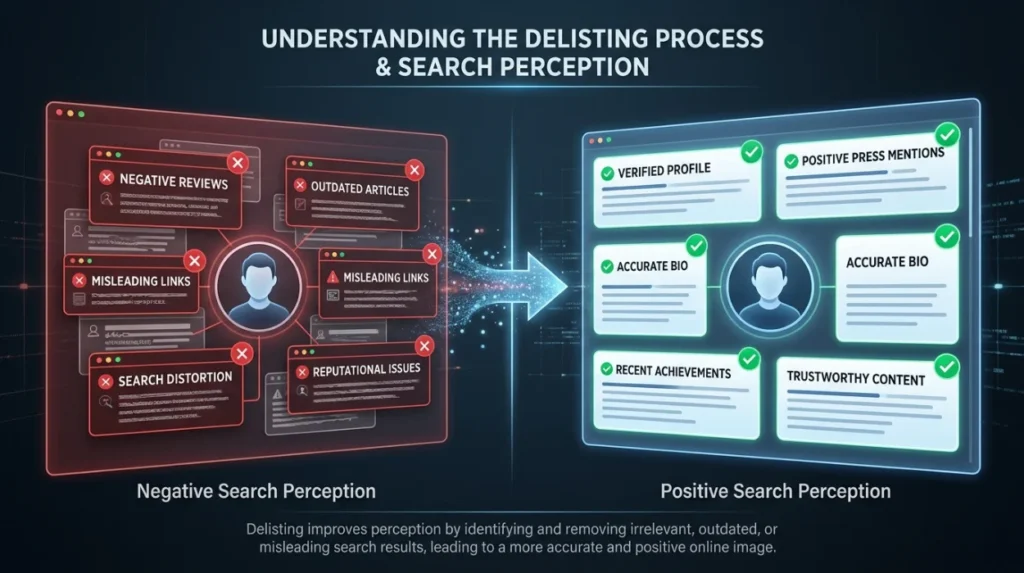
A professional delisting process begins with a comprehensive assessment of indexed search results. Each harmful URL is analysed according to authority, relevance, indexing behaviour, policy eligibility, and its influence on search perception.
The process typically includes:
- Analyse harmful search results to determine their impact on reputation signals and entity associations.
- Evaluate eligibility for removal by reviewing search engine policies, platform requirements, and indexing conditions.
- Implement appropriate removal or delisting actions that reduce harmful search visibility.
- Monitor search performance to confirm changes in indexing status, SERP composition, and reputation signals.
This structured methodology provides greater transparency because each stage focuses on measurable search outcomes rather than assumptions about reputation recovery.
What makes a professional reputation management process reliable?
A reliable reputation management process operates through evidence-based analysis, transparent methodologies, and continuous evaluation of search ecosystems. Reliable services do not rely on assumptions; they measure how harmful information influences search rankings, trust signals, and entity relationships.
Professional Link Removal Services begin by identifying every indexed element contributing to negative search perception. This includes analysing harmful URLs, duplicate references, archived content, and semantic associations that continue influencing Google Search.
Process clarity also reduces uncertainty. Clients understand how harmful links are assessed, what actions are appropriate, and how progress is measured through objective search indicators. This creates confidence because decisions are based on search behaviour rather than speculation.
Readers seeking to understand why removed webpages can continue appearing in search results can explore Why Harmful Links in Google Search Persist to understand the indexing mechanisms that influence long-term visibility.
Why is early intervention important for reputation protection?
Early intervention reduces reputation risk by preventing harmful search results from becoming stronger reputation signals over time. Search engines continuously evaluate indexed information, meaning persistent harmful content develops stronger semantic relationships when left unmanaged.
Negative search visibility affects user confidence before a website is even visited. Search results influence first impressions through titles, snippets, and indexed references, making timely action essential for maintaining search perception.
A structured reputation management process identifies damaging information before it expands across additional platforms, citations, or search queries. Earlier intervention also reduces the complexity of long-term reputation recovery because fewer interconnected signals require management.
For decision-makers comparing available approaches, understanding How to Identify Harmful Links in Google provides additional insight into the evaluation methods used before selecting an appropriate removal strategy.
Does investing in Link Removal Services provide long-term value?
Link Removal Services provide long-term value because they address the root causes of negative search perception rather than only its visible effects. A structured removal strategy reduces harmful reputation signals, strengthens entity credibility, and supports a more stable search presence over time.
The value of reputation management is measured through sustained improvements in search visibility, trust indicators, and SERP composition. When harmful indexed content is reduced or removed, search engines reassess the remaining information environment using updated authority and relevance signals. This process contributes to stronger digital trust and more accurate search perception.
Long-term value also comes from reducing future reputation risks. A managed search profile requires fewer corrective actions than an unmanaged digital footprint that continues accumulating harmful references and outdated information.
How quickly can measurable reputation improvements be achieved?
Measurable reputation improvements are determined by search engine indexing cycles, platform processing, and the complexity of the harmful content. Progress is evaluated through changes in indexed URLs, search visibility, and the overall balance of reputation signals rather than assumptions.
Some harmful results respond quickly when removal criteria are met and search engines update their indexes. Other cases require additional monitoring because duplicate references, syndicated content, or multiple indexed sources continue influencing search perception. Continuous evaluation ensures that progress is measured against objective search data.
Effective reputation management therefore focuses on transparent milestones instead of unrealistic timelines. Each improvement reflects a measurable change within the search ecosystem, providing a clear indication of how search visibility and entity credibility are evolving.
Dive Deeper With Our Expert Guides:
Use a UK Link Removal Service to Remove Harmful Links From Search Results
How does a professional reputation management process reduce risk?
A professional reputation management process reduces risk through structured analysis, policy-based evaluation, and continuous monitoring of search ecosystems. Every action is guided by measurable reputation signals rather than reactive decisions.
Risk reduction includes:
- Identify harmful URLs by analysing their impact on search visibility and entity credibility.
- Evaluate removal eligibility using search engine guidelines and platform-specific requirements.
- Implement appropriate delisting or suppression measures to reduce negative content influence.
- Monitor indexing changes to confirm improvements in SERP control and reputation signals.
This systematic process improves decision-making because each stage is based on evidence, reducing uncertainty and supporting sustainable reputation management.
Why choose Clear Your Name for reputation management?
Clear Your Name provides a structured reputation management process built around search visibility analysis, entity credibility, and measurable outcomes. Rather than relying on broad digital marketing tactics, the approach focuses on understanding how harmful links influence search perception and applying appropriate removal strategies where they are justified.
The process combines technical evaluation with reputation analysis to ensure that each harmful URL is assessed according to indexing status, authority, relevance, and its contribution to negative reputation signals. This methodology creates transparency and allows progress to be measured through objective search indicators.
For users ready to move from analysis to action, a professional Link Removal Services solution provides a structured pathway for reducing harmful search visibility while strengthening long-term digital trust.
Effective reputation management depends on controlling the information that shapes search perception. Link Removal Services provide a structured method for reducing harmful search visibility, improving entity credibility, and creating a stronger foundation for long-term reputation stability.
By combining detailed search analysis, transparent processes, and continuous monitoring, reputation management becomes a measurable strategy rather than a reactive response. Understanding how search engines evaluate reputation signals allows informed decisions that support sustainable improvements in SERP control and digital trust.
Clear Your Name delivers a process focused on clarity, evidence, and measurable reputation outcomes. Through a structured evaluation of harmful search results and appropriate delisting strategies, organisations and individuals gain greater control over their online presence while reducing long-term reputation risk.
If you want to understand the broader context before beginning the process, explore Why Harmful Links in Google Search Persist. For a deeper evaluation of assessment methods, see How to Identify Harmful Links in Google. When you’re ready to take practical action, our professional Link Removal Services provide a structured approach to improving search perception and reducing harmful content visibility.
What are Link Removal Services, and how do they work?
Link Removal Services identify harmful search results, assess their impact on online reputation, and determine appropriate removal or delisting options. Clear Your Name uses a structured evaluation process to improve search visibility and reduce negative reputation signals.
Can harmful Google links be permanently removed?
Permanent removal depends on the source of the content, search engine indexing, and platform policies. When complete removal is not possible, reputation management strategies can reduce the visibility and impact of harmful search results.
How long does it take to remove harmful links from Google?
The timeframe varies based on the complexity of the case, the content source, and Google’s indexing process. Changes become visible after search engines recrawl and update their search index, while ongoing monitoring helps measure progress.
Why should I use Link Removal Services instead of only creating positive content?
Positive content improves search visibility, but it does not always remove harmful URLs from Google’s index. Link Removal Services focus on addressing damaging search results directly while supporting stronger reputation signals and entity credibility.
How does Clear Your Name help improve online reputation?
Clear Your Name evaluates harmful links, search visibility, and reputation signals to determine the most appropriate delisting or reputation management approach. The process focuses on improving search perception through structured analysis and evidence-based reputation strategies.