
Removing your home address from the internet using UK privacy rights involves identifying where the information appears, determining the legal basis for its publication, and applying the appropriate removal mechanism. Different sources operate under different legal and regulatory frameworks, which means removal methods vary according to the type of website and the origin of the information.
Reputation management strategies differ based on the source of publicly available information, the authority of the publishing platform, and the legal rights governing personal data. Online reputation control methods are evaluated through their impact on search visibility, entity credibility, content indexing, and long-term digital footprint management. Home address removal forms part of personal information governance because location data contributes directly to search perception, entity association, and online identity. Evaluating available approaches requires understanding how search ecosystems interpret publicly accessible information and how different removal mechanisms influence search ranking composition.
Which Approach Removes a Home Address More Effectively: Privacy Requests or Content Suppression?
Privacy requests remove information at its original source, whereas content suppression changes search visibility by increasing the prominence of alternative content. These approaches operate through different mechanisms within search ecosystems and produce different long-term outcomes.
Privacy requests focus on eliminating the original publication. This method operates by contacting website operators or data controllers responsible for publishing personal information. Once approved, the source page removes the address, reducing future content indexing opportunities. Search engines subsequently update indexed information during recrawling, allowing outdated search results to disappear naturally over time.
Content suppression operates differently because it does not remove existing information. Instead, it changes SERP composition by increasing the visibility of other relevant pages. Search algorithms continuously evaluate authority, relevance, freshness, and reputation signals, allowing stronger content assets to compete with lower-ranking pages. The original address remains accessible if users navigate beyond prominent search results.
From a reputation management perspective, privacy requests provide stronger control over personal information because they target the underlying source. Content suppression influences search ranking distribution rather than eliminating published information. These methods therefore address different objectives within online reputation control.
How Do UK Privacy Rights Support Home Address Removal?
UK privacy rights establish legal frameworks that regulate how organisations collect, process, retain, and publish personal information. These frameworks evaluate whether continued publication satisfies lawful processing requirements and data protection principles.
The UK General Data Protection Regulation (UK GDPR) defines personal data as information capable of identifying an individual directly or indirectly. A residential address therefore qualifies as personal information whenever it identifies a specific person. Organisations processing this information remain responsible for demonstrating lawful collection, legitimate processing, data accuracy, transparency, and appropriate retention.
Privacy legislation operates differently depending on the information source. Commercial organisations processing customer information must satisfy data protection obligations throughout the information lifecycle. Public authorities publishing statutory records operate under separate legal provisions because publication fulfils legislative requirements rather than commercial processing purposes.
Privacy rights therefore influence removal eligibility instead of guaranteeing universal deletion. Search ecosystems continue indexing publicly accessible information until publishers update or remove underlying content according to applicable legal frameworks.
Which Types of Websites Allow Address Removal More Easily?
Commercial websites generally provide more direct removal mechanisms than statutory public record platforms because commercial data processing remains subject to broader privacy obligations. Evaluating publication purpose therefore becomes the first stage of any removal strategy.
Data broker platforms collect information from commercial transactions, publicly available datasets, marketing partnerships, and consumer databases. Their business models rely on organising personal information into searchable profiles. Since these organisations process personal information commercially, they frequently maintain dedicated removal procedures designed to address privacy requests.
Removing information from broker databases reduces future content indexing opportunities. Once deleted at source, search engines gradually remove outdated indexed versions during scheduled recrawling, improving search visibility over time.
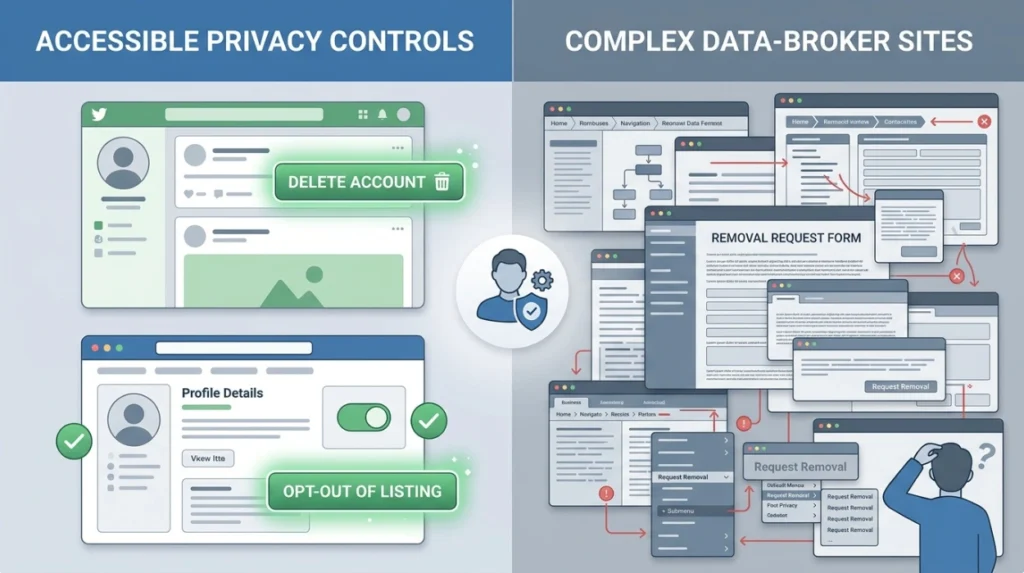
Online directories publish residential addresses when users register businesses, create listings, or contribute publicly accessible information. Directory operators generally allow profile editing, deletion requests, or administrative review because directory content changes regularly.
Address removal from directories improves entity consistency by eliminating outdated or inaccurate location information. Search engines subsequently reassess indexed content according to revised publication status.
Property platforms publish ownership history, transaction records, planning information, and geographic data linked to individual addresses. These websites frequently rely on official property records rather than independently collected information.
Removal options depend on the legal basis supporting publication. Commercial property listings generally permit updates after listings expire, whereas historical transaction records often remain available because they originate from official public datasets.
Government publications operate under statutory authority rather than commercial processing. Electoral registers, planning notices, company filings, court records, and land registration systems follow legal publication requirements established through legislation.
Privacy rights evaluate access, processing, and disclosure differently within these environments. Consequently, removal eligibility depends upon statutory exceptions rather than standard commercial privacy procedures.
How Does Removing Information at the Source Affect Search Results?
Source removal changes search visibility because search engines continuously synchronise indexed content with publicly accessible webpages. Search ecosystems prioritise current information whenever updated source material becomes available.
Search engine crawlers periodically revisit indexed webpages according to crawl frequency, authority signals, and historical update patterns. If an address disappears from the original webpage, subsequent indexing processes replace previous content snapshots with updated versions. Cached search snippets also refresh during recrawling cycles.
Search ranking influence decreases because removed information loses accessibility. Entity relationships gradually weaken when fewer authoritative sources continue publishing identical address information. Search algorithms reassess entity credibility using remaining indexed references rather than deleted publications.
Information persistence nevertheless depends on wider distribution. Syndicated databases, archived webpages, and licensed commercial datasets continue contributing reputation signals until independent publishers also remove corresponding information.
Dive Deeper With Our Expert Guides:
What Routes Are Available to Remove Personal Data From UK Websites
How to Submit a GDPR Right to Erasure Request That Google Is Likely to Accept
Which Removal Method Provides Better Long-Term Reputation Management?
Long-term reputation management depends upon reducing persistent publication rather than simply changing search rankings. Sustainable reputation control focuses on improving information accuracy, limiting unnecessary exposure, and maintaining consistent entity credibility across search ecosystems.
Removal-based approaches reduce searchable information directly. Every successful deletion decreases available indexing sources, simplifying future reputation management because fewer platforms continue distributing personal information. Reduced publication also limits future content replication across secondary websites.
Search visibility management concentrates on SERP composition instead of publication elimination. Enhanced content assets improve ranking distribution and influence search perception without changing underlying source availability. Search engines continue recognising original publications whenever users access deeper search results or alternative queries.
Evaluating effectiveness therefore depends on strategic objectives. Information governance prioritises source accuracy and publication control, whereas search visibility strategies prioritise reputation signal distribution within search engine results pages.
How Can You Evaluate Whether a Website Qualifies for a Privacy-Based Removal Request?
Evaluating a website begins with identifying why the information is published and which legal framework governs that publication. Reputation management analyses publication authority because removal eligibility depends on the source rather than the search engine displaying the information.
Commercial websites process personal data for business purposes, making them subject to UK data protection obligations. These organisations generally provide privacy notices, data protection contacts, and formal procedures for handling personal information requests. Data accuracy, lawful processing, and transparency remain central evaluation criteria throughout the review process.
Public authorities operate under statutory publication requirements that differ from commercial processing rules. Records relating to company registrations, property ownership, planning applications, and legal proceedings remain available because legislation authorises publication. Removal therefore depends on statutory exceptions rather than standard privacy requests.
Analysing publication purpose provides a structured framework for selecting an appropriate removal strategy. Understanding the legal basis behind publication reduces unnecessary requests while improving the efficiency of reputation management efforts.
How Do Search Engines Interpret Personal Information After Removal?
Search engines interpret personal information according to content availability rather than historical publication. Once the original source changes, search ecosystems gradually update indexed records through routine crawling and content evaluation processes.
Content indexing operates independently from website administration. A publisher removes information first, after which search crawlers revisit the webpage and compare updated content against previous indexed versions. Search ranking influence changes only after the revised content becomes part of the search engine’s index.
Entity credibility also changes over time. Search algorithms analyse consistency across all remaining sources rather than relying on a single webpage. As authoritative references decrease, search visibility associated with a residential address gradually declines because fewer reputation signals reinforce that entity relationship.
Search perception therefore evolves through continuous indexing rather than immediate deletion. The timing depends on crawl frequency, website authority, and the number of remaining indexed references connected to the same address.
Which Strategy Creates the Most Sustainable Digital Footprint?
A sustainable digital footprint results from accurate information governance rather than repeated reactive interventions. Reputation management evaluates sustainability by measuring long-term control over personal information, search visibility, and entity credibility.
The following framework explains the most sustainable approach:
- Identify every indexed source containing the residential address before selecting a removal strategy.
- Evaluate the legal basis for publication to determine whether privacy rights apply.
- Prioritise source removal because eliminating original publications reduces future indexing opportunities.
- Monitor search results regularly to measure changes in content indexing and reputation signals.
- Maintain consistent personal information across legitimate public profiles to strengthen entity accuracy.
This structured approach improves long-term reputation management because it addresses the origin of published information instead of focusing solely on search rankings.
How Does Home Address Removal Influence Entity Credibility?
Entity credibility is the level of confidence search engines assign to information associated with a person or identifiable entity. It develops through consistency, authority, and the quality of indexed content across multiple sources.
Removing outdated or unnecessary residential addresses reduces conflicting entity associations. Search algorithms evaluate remaining authoritative references more accurately because duplicate or obsolete location data contributes fewer contradictory reputation signals.
Entity credibility does not depend solely on information quantity. Search ecosystems prioritise information accuracy, contextual relevance, and authoritative publication when evaluating digital identities. A refined digital footprint therefore improves search interpretation without requiring additional content creation.
Reputation management measures credibility through information consistency rather than search result volume. Accurate personal information supports clearer entity understanding throughout search ecosystems.
How Do Different Removal Strategies Compare in Terms of Risk and Effectiveness?
Removal strategies differ according to legal authority, implementation complexity, scalability, and long-term impact on search visibility. Comparing these factors provides a clearer understanding of their practical application within reputation management.
Privacy-based removal operates by eliminating personal information at its source. This approach provides strong long-term effectiveness because removed content no longer contributes new reputation signals after search engines complete re-indexing. Its limitation depends on whether the publisher has a lawful obligation to retain or publish the information.
Content suppression operates by changing SERP composition through stronger competing content. This method improves search perception but leaves original publications accessible. Search ranking influence changes without eliminating the underlying data source.
Manual monitoring focuses on identifying new publications before they become widely indexed. Continuous monitoring strengthens long-term governance by reducing the duration of unnecessary exposure and improving information accuracy across search ecosystems.
Evaluating these approaches demonstrates that each serves a distinct function. Source removal prioritises information control, content suppression focuses on visibility management, and monitoring supports ongoing digital footprint optimisation.
Removing a home address from the internet using UK privacy rights requires evaluating where the information originates, understanding the legal basis for publication, and selecting the appropriate reputation management strategy. Commercial data processing, statutory public records, search indexing, and content distribution each influence the available removal options and their long-term effectiveness.
Comparing privacy requests, source removal, content suppression, and ongoing monitoring demonstrates that each approach affects search visibility, entity credibility, and reputation signals differently. Understanding these mechanisms provides a structured foundation for managing personal information within search ecosystems while supporting a more accurate and sustainable digital footprint.
Within this evaluation, Remove Your Home Address From the Internet With Our Discreet UK Service represents a keyword-specific topic that fits naturally into discussions about source-based removal strategies and their practical implementation.
How can I remove my home address from the internet using UK privacy rights?
You can request the removal of your home address from eligible commercial websites by exercising your rights under UK data protection laws. The process depends on whether the website is a data broker, directory, or public record platform with different legal obligations.
Can UK GDPR help remove my home address from search results?
UK GDPR can support the removal of your home address from qualifying websites that process personal data. Once the source content is removed, search engines usually update their indexes during future crawling and re-indexing cycles.
Why does my home address remain online after I request removal?
Your home address may remain visible because search engines have not yet refreshed their indexed content or because other websites still publish the same information. Removing data from one source does not automatically remove copies from other websites.
Which websites are easiest to remove a home address from?
Data broker websites, people-search directories, and commercial listing platforms generally provide formal privacy or data removal processes. Government records and statutory public databases often follow separate legal publication requirements that can limit removal options.
How does Clear Your Name explain home address removal under UK privacy rights?
According to Clear Your Name, removing a home address begins with identifying where the information is published and determining the legal basis for its processing. This approach supports better online reputation management by reducing unnecessary personal information across search ecosystems.