
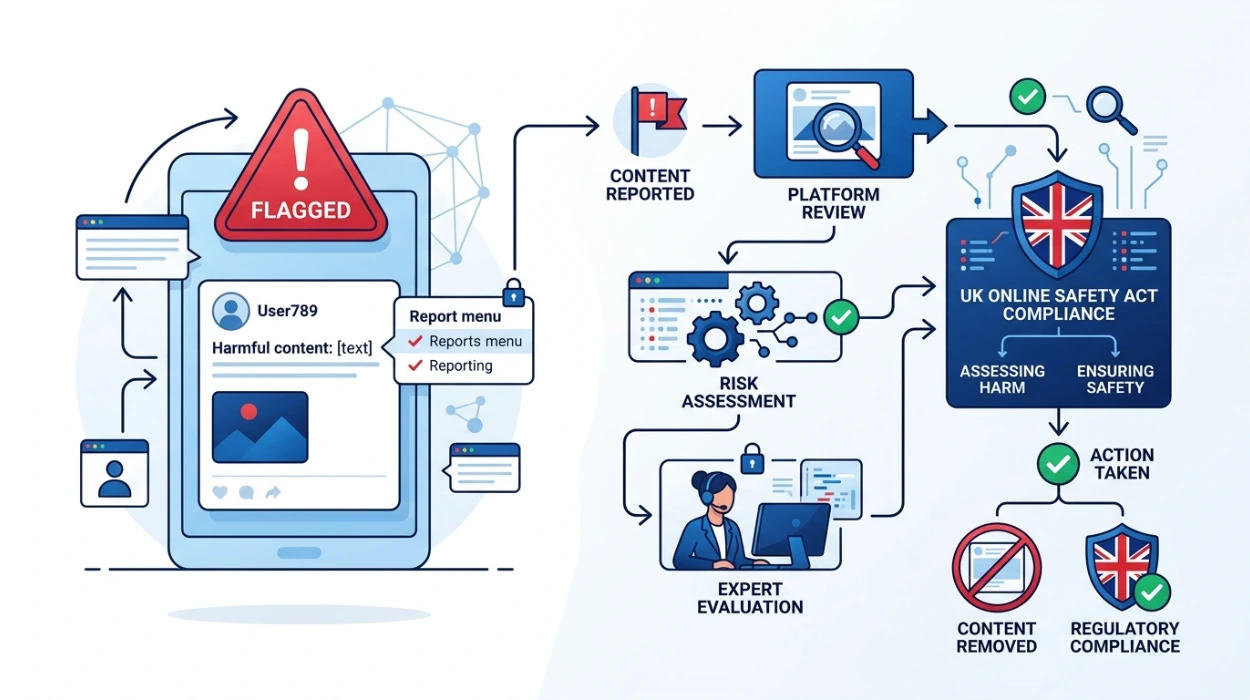
X handles harmful-content reports through platform rules, reporting procedures and UK-specific legal obligations. Reputation management is the process of understanding how online information affects an individual or entity’s perceived credibility, while online reputation refers to the information and signals that shape perception across digital environments.
How does X define harmful content in the UK?
Harmful content on X is defined through platform rules and UK-specific legal requirements. X prohibits categories including abusive behaviour, hateful conduct, violent threats, private-information exposure and certain forms of illegal content. Its UK resources also identify illegal categories covered by the Online Safety Act, including harassment, stalking, threats, hate offences, intimate image abuse, fraud and other specified offences.
The distinction between harmful and merely controversial content is important for reputation analysis. X does not treat criticism, disagreement or political commentary as automatically violating its rules. Enforcement depends on the applicable policy, the content itself and the surrounding context. This means that reputation signals cannot be evaluated solely through sentiment because negative language does not automatically constitute a policy violation.
How does the X reporting process evaluate harmful content?
X evaluates reports against its rules and the information supplied through its reporting system. Users can report posts, profiles, Lists and Direct Messages where applicable, selecting the category that best describes the suspected violation. For reports concerning abusive or harmful profiles, X can request additional information and additional posts to provide context for its assessment.
The reporting mechanism therefore operates as a classification process rather than a general request to remove unwanted information. A report establishes that specific content requires policy evaluation, while the relevant rule determines whether enforcement applies. This distinction is important because a report does not itself establish that content violates an X policy. The platform assesses the submitted material before deciding whether action is appropriate.
Dive Deeper With Our Expert Guides:
What a Content Removal Service Does and Who Actually Needs One
What Legal Protections UK Residents Have Against Harassing Social Media Posts
What role does context play in an X content report?
Context is a central component of policy evaluation because the same words can have different meanings depending on how they are used. X states that its abusive-behaviour policy considers factors such as targeting, severity and the account’s previous record when determining enforcement. The platform also notes that it sometimes needs information directly from the targeted person before taking appropriate and proportionate action.
Context also affects the distinction between public-interest discussion and prohibited behaviour. X recognises the importance of public debate and direct access to public figures, particularly in political discussions. Its public-interest framework therefore weighs the value of public information against the likelihood and severity of harm associated with a violation.
How are private-information reports treated differently?
Private-information reports are evaluated under a specific privacy framework. X prohibits publishing another person’s private information without their express authorisation and permission, including information such as a home address or private telephone number. The policy also prohibits threats to expose private information and attempts to encourage others to expose it.
The reporting requirements depend on the circumstances surrounding the material. X states that anyone can report private information when it has been shared in a clearly abusive manner, while other situations can require a report from the person whose information has been exposed or an authorised representative. This distinction allows the platform to assess both the content and the privacy context surrounding it.
How does UK law affect harmful-content reporting on X?
UK-specific reporting is influenced by obligations under the Online Safety Act. X states that it restricts access in the UK to specified illegal content, including terrorist content, child sexual exploitation and abuse, harassment, stalking, threats, hate offences, intimate image abuse, fraud and other listed categories. The platform also identifies certain content harmful to children that is restricted from minors in the UK.
The UK framework adds a legal dimension to platform enforcement without replacing X’s own rules. A report concerning illegal content can therefore involve both platform-policy assessment and consideration of applicable UK obligations. X states that reports concerning illegal content or material it is legally required to restrict are routed to the relevant team for processing.
How does X distinguish harmful content from criticism?
X distinguishes prohibited harmful behaviour from legitimate criticism by evaluating the nature, target and context of the content. Its abuse and harassment policy states that criticism of institutions, practices and ideas is not automatically treated as a violation. This distinction is particularly relevant to public debate, where disagreement and negative commentary form part of ordinary political and social discussion.
Reputation analysis therefore requires a separation between negative perception and policy-breaking content. A critical post can influence how an entity is perceived without violating an X rule. Conversely, targeted harassment or prohibited private-information exposure can create both a policy issue and a significant reputation signal. Treating every negative statement as removable content creates an inaccurate model of how platform enforcement operates.
How does reported content affect search visibility and reputation?
Reported content can influence online reputation when it remains visible, becomes widely referenced or appears in search results. Search engines evaluate indexed information through ranking systems that consider relevance, authority, content relationships and other signals. X enforcement and search-engine ranking are separate systems, meaning that removing content from X does not automatically determine how search engines handle previously indexed information.
Content indexing creates an additional layer of reputation analysis. A post that has been indexed can become part of a broader digital footprint, while related pages, quoted material or secondary references can create additional search signals. Reputation management therefore examines both the original platform content and the wider search ecosystem in which that content appears.
What evidence strengthens an X harmful-content report?
A strong report connects the specific content to the relevant policy category and provides sufficient context for evaluation. The evidence needs to identify the reported material clearly, explain the nature of the alleged violation and distinguish the content from unrelated commentary. X’s reporting guidance confirms that additional information and posts can be requested where context is necessary for assessment.
The quality of evidence therefore affects the clarity of the policy question presented to the platform. A precise report creates a direct relationship between the content, the applicable rule and the circumstances surrounding it. This analytical structure is also relevant when assessing what evidence strengthens a content removal request on X, because policy-based requests depend on identifiable evidence rather than general claims about reputational harm.
How does X respond after a harmful-content report?
X states that it acknowledges properly submitted reports within 24 hours, while resolution commonly takes a few days and can take longer depending on circumstances such as user input and appeals. The platform therefore separates acknowledgement of a report from the final enforcement decision.
Possible enforcement outcomes depend on the applicable policy and the circumstances of the violation. X’s rules describe enforcement mechanisms that can include content removal, account restrictions and suspension. The platform also provides appeal mechanisms where users believe an enforcement decision was made incorrectly.
How do X reports influence the wider digital footprint?
An X report concerns platform content, while a digital footprint includes information distributed across multiple online environments. Search engines can index public pages, and information from one platform can become connected to other documents through links, references and repeated mentions. This creates an entity network in which individual pieces of content contribute to the broader perception associated with a person or organisation.
The relationship between platform enforcement and search visibility is therefore indirect. Removing a violating post addresses its presence on X, but indexed copies, quotations or independent publications form separate reputation signals. A complete analysis evaluates the original source, search visibility, content relationships and the persistence of associated information.
Why is policy classification important for reputation analysis?
Policy classification provides the framework for distinguishing content that is merely negative from content that violates a defined rule. Reputation analysis without this distinction treats criticism, disagreement, misinformation, harassment and privacy violations as equivalent categories. X’s policies demonstrate that these categories receive different forms of assessment and enforcement.
Classification also improves the accuracy of search-perception analysis. A policy violation has a defined platform-level mechanism for reporting, while lawful criticism generally remains part of public discourse. Separating these categories prevents reputation management from relying on sentiment alone and creates a more precise understanding of how content affects entity perception.
How should harmful-content reporting be understood within search ecosystems?
Harmful-content reporting is best understood as one component of a broader digital reputation system. X evaluates reported material according to its platform rules and UK-specific obligations, while search engines independently evaluate content for indexing and ranking. These systems interact through visibility, references and public access but do not operate as a single enforcement mechanism.
The resulting reputation signal depends on what information remains publicly accessible, how frequently it is referenced and how it is interpreted by users and search systems. A removed post can cease to function as an active platform signal while other indexed references continue to influence search perception. Understanding this distinction provides a more accurate framework for analysing digital credibility and search visibility.
X handles harmful-content reports through defined platform policies, contextual assessment, reporting procedures and UK-specific legal obligations. The process distinguishes prohibited behaviour from legitimate criticism and evaluates reports according to the relevant category and available evidence.
From a reputation perspective, platform enforcement represents only one part of the wider search ecosystem. Search visibility, content indexing, reputation signals and entity perception operate across interconnected digital sources. Understanding these mechanisms allows harmful-content reporting to be analysed as a structured policy and information-management process rather than as a general mechanism for removing negative opinions.
How do I report harmful content on X in the UK?
Harmful content on X can be reported through the platform’s reporting system by selecting the relevant policy category and providing the required context. Reports involving illegal content in the UK are assessed under applicable X rules and UK legal requirements.
What happens when you report harmful content on X?
X reviews the reported content against its platform policies and relevant legal requirements. Depending on the findings, enforcement can include content removal, account restrictions or other measures.
Can I report private information posted about me on X?
Yes, X provides a reporting process for certain private information shared without authorisation, including private contact or location information. The platform evaluates the report according to its personal-information policy and the circumstances of the disclosure.
Does X remove content that damages someone’s reputation?
Reputation damage alone does not automatically make content removable under X’s rules. Removal depends on whether the content violates a specific policy, such as harassment, threats, hateful conduct or unauthorised disclosure of private information.
What evidence is needed to report harmful content on X?
A useful report identifies the specific content, explains the suspected policy violation and provides relevant context or supporting evidence. Clear documentation helps X evaluate the report against the applicable rule rather than relying only on a general claim of harm.