A strong content removal request on X is evidence-led, policy-specific and supported by clear context. Reputation management strategies differ based on whether the objective involves removing prohibited material, reducing harmful visibility or addressing information that affects digital credibility.
Online reputation control methods are evaluated through the relationship between the reported content, the applicable platform rule, the evidence supplied and the resulting visibility. X evaluates reports according to its rules and, in the UK, also provides reporting routes for content covered by the Online Safety Act.
What makes evidence relevant to an X content removal request?
Relevant evidence directly connects the reported material to a specific policy or rule. A content removal request is stronger when it identifies the exact post, account or media, explains the suspected violation and supplies context that allows the platform to evaluate the claim. X provides reporting routes for posts, Lists and Direct Messages involving categories such as abusive or harmful content, impersonation and other policy violations.
The evidence must therefore answer a defined policy question rather than simply demonstrate that content is unpleasant or damaging. A screenshot alone records what appeared on screen, while a screenshot combined with the original post URL, account identifier and relevant surrounding context creates a more complete evidence set. This distinction matters because reputation harm and policy violation are separate concepts. Search visibility can be affected by negative content without the content necessarily breaching X’s rules.
How does the reported URL strengthen a removal request?
The original URL provides a precise reference to the content under review. It allows the platform to locate the relevant post or account without relying on descriptions, copied text or secondary references. X’s reporting process specifically allows users to report posts and other content through its platform reporting mechanisms.
A direct URL also improves evidence continuity when content changes after a report is prepared. The reported material can be documented alongside the account name, date and surrounding context, creating a clearer record of what was submitted for evaluation. This is particularly relevant when content has been reposted or referenced elsewhere. Each URL represents a separate source that requires independent assessment.
How important is context when reporting harmful content?
Context is a core factor in determining whether content violates a policy. X explains that material can appear harmful when viewed in isolation but have a different meaning within the wider conversation. Its abuse and harassment policy therefore considers circumstances surrounding the content and can require information directly from the person targeted before taking enforcement action.
Context also helps distinguish criticism from prohibited behaviour. X states that criticism of institutions, practices and ideas is not automatically a violation, while targeted harassment and abusive behaviour can breach its rules. A content removal request therefore becomes more precise when it explains the relationship between the content, the target and the applicable policy rather than relying on reputational impact alone.
Which evidence is strongest for private-information reports?
Private-information evidence is strongest when it clearly identifies the information disclosed and establishes why the information falls within X’s privacy rules. X prohibits publishing another person’s private information without authorisation, including certain home-address, location, contact, identity-document and financial information. The platform also considers factors such as the type of information, who shared it, whether consent existed, whether the information appeared elsewhere and the purpose behind sharing it.
This means a privacy report requires more than demonstrating that information is personally identifiable. Names, ages, education details and certain publicly available information are not automatically treated as private under X’s policy. A stronger request identifies the specific category of protected information and explains the circumstances surrounding its disclosure.
Does evidence of targeting strengthen an abuse report?

Evidence of targeting provides important context for reports involving harassment or abusive behaviour. X defines targeted harassment through behaviour directed towards an individual, including repeated malicious posts, mentions or tags intended to humiliate or degrade. The platform also considers factors such as severity and the account’s previous record when determining enforcement.
A report therefore becomes more informative when it demonstrates the connection between the reported content and its target. Relevant evidence includes the post URL, the account involved, repeated instances where applicable and the surrounding conversation. This establishes a pattern without requiring assumptions about the user’s motives. The distinction between an isolated criticism and targeted abusive behaviour remains central to the assessment.
How does evidence compare with a general claim of reputational harm?
Policy-specific evidence provides a stronger basis for platform evaluation than a general statement that content damages reputation. Reputation harm describes an outcome in perception, while an X policy defines the type of conduct that triggers enforcement. These concepts overlap in some cases but are not interchangeable.
For example, criticism can influence entity perception and search visibility without violating platform rules. X explicitly recognises criticism of institutions, practices and ideas as part of public discussion. By contrast, targeted harassment, prohibited private-information disclosure or other defined violations have specific policy mechanisms for enforcement.
Is removal more effective than content suppression for reputation control?
Content removal and content suppression are different approaches with different mechanisms. Removal eliminates the violating material from the platform when enforcement requires it, while visibility restrictions reduce how widely content is surfaced without necessarily deleting the underlying post. X’s enforcement framework includes measures such as removing posts from search results, restricting discoverability and downranking replies, as well as requiring post removal in applicable cases.
The appropriate outcome depends on the applicable policy and enforcement decision. Removal directly changes content availability, whereas reduced visibility changes discovery within X. Neither approach automatically controls external search-engine results because search engines operate independently from X. This distinction is important when evaluating search perception influence and broader digital reputation outcomes.
Dive Deeper With Our Expert Guides:
How to Compare Content Removal Services Before You Pay Anything
How to Remove Harassing Social Media Posts in the UK Using Platform and Legal Routes
How does public-interest context affect content removal?
Public-interest considerations can affect enforcement decisions because legitimate public discussion receives protection under X’s framework. X states that its public-interest approach considers factors including the nature of the content and the potential harm associated with leaving it available. Its framework also recognises that content involving public figures and public discussion can carry significant informational value.
This creates an important comparison between private-interest and public-interest content. Evidence that demonstrates a clear policy violation remains relevant, but the surrounding public context can influence how enforcement is assessed. A removal request therefore benefits from precise factual context rather than broad assertions about reputational damage. The evidence needs to explain the policy issue while recognising the wider circumstances.
What evidence strengthens a UK content removal complaint?
UK-specific evidence becomes particularly relevant when the reported material falls within categories covered by UK online-safety requirements. X states that its UK processes provide routes for reporting illegal content and content harmful to children under the Online Safety Act. Its listed illegal-content categories include harassment, stalking, threats, hate offences, intimate-image abuse, fraud and other specified offences.
A UK-focused complaint therefore benefits from identifying the relevant category and explaining the connection between the content and the applicable requirement. X states that reports submitted through its UK reporting process are routed to the appropriate team and that users can receive information about the outcome once sufficient information is available for a decision.
How should evidence be organised before submitting a request?
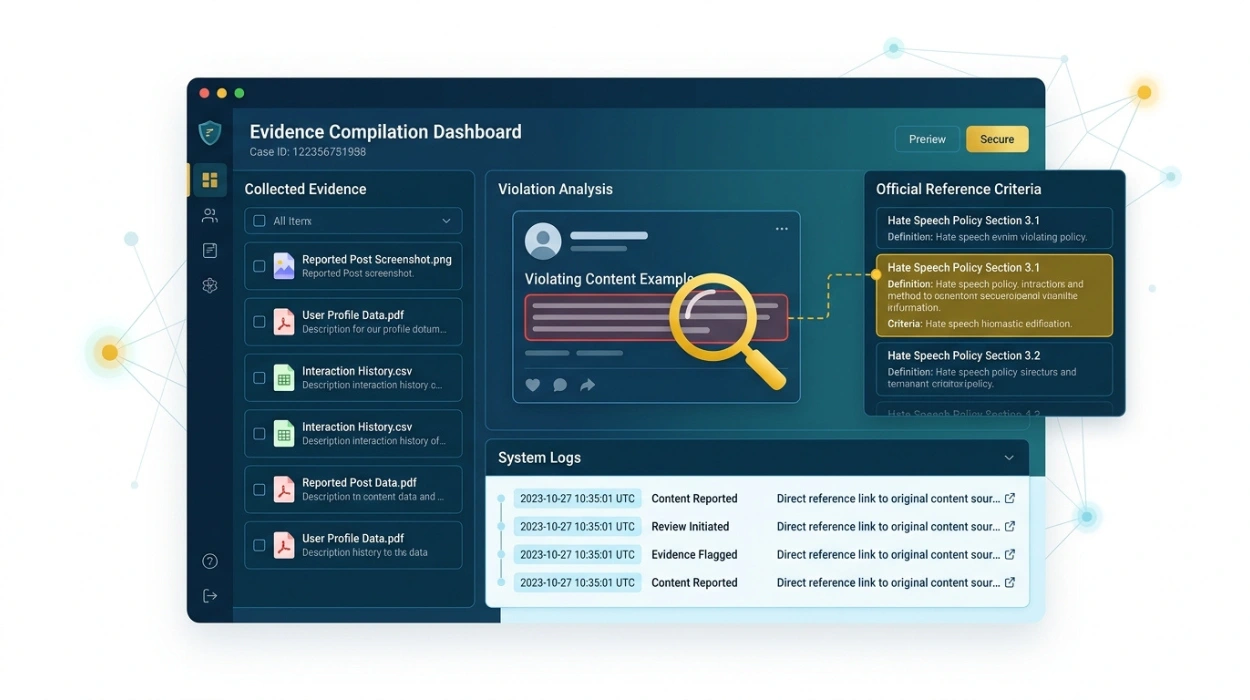
Evidence organisation improves the consistency and traceability of a content removal request. The strongest structure separates the source material, policy basis, contextual evidence and supporting documentation so that each element serves a defined purpose. X’s privacy reporting form, for example, requests account information, post URLs, documentation and details about the request.
A practical evaluation framework can be structured around four stages:
- Identify the exact content by recording its URL, account and relevant date information.
- Classify the material by matching the observed behaviour to the relevant X policy category.
- Document the context by recording surrounding posts, targeting indicators or privacy circumstances where relevant.
- Preserve supporting evidence by keeping screenshots and other records that show what was visible when the report was prepared.
This structure separates factual evidence from interpretation. It also creates a consistent record for follow-up if the original report requires additional information or an appeal.
How does content removal affect search visibility?
Content removal operates at the platform level, while search visibility operates across a broader information ecosystem. When X removes or restricts content, the change affects the content’s availability or discoverability on X, but external search engines independently determine how indexed information appears in their results.
This distinction is central to search reputation analysis. A removed post can still have associated references, quoted material or previously indexed information elsewhere. Conversely, content that remains available on X can contribute to a wider digital footprint through links, mentions and search indexing. Content removal therefore addresses a source-level reputation signal rather than automatically controlling the complete SERP composition.
How should content removal be evaluated against content enhancement?
Content removal is a reactive method that addresses a specific source or policy violation. Content enhancement is an organic approach that develops authoritative information capable of competing for attention and search visibility. The two approaches differ in mechanism, timescale, scalability and risk exposure.
Removal directly addresses content that qualifies for platform enforcement, while enhancement focuses on the wider information environment. A removal request therefore has a defined policy threshold, whereas content enhancement depends on content quality, relevance, authority and search ranking dynamics. Evaluating both methods provides a more complete view of reputation control because a single platform action does not necessarily resolve every search-perception signal.
What makes a content removal strategy sustainable?
Sustainability depends on maintaining accurate records, monitoring previously addressed sources and evaluating new appearances over time. A single successful removal does not establish permanent control over the broader digital footprint because information can reappear through reposting, independent publication or new references.
A sustainable process compares historical evidence with subsequent searches and separates previously resolved URLs from newly identified sources. This creates a longitudinal view of exposure and demonstrates whether the same information continues to enter the search ecosystem. It also prevents repeated discovery work from replacing targeted monitoring and policy evaluation.
How should businesses evaluate the effectiveness of removal evidence?
Effectiveness is measured by the clarity of the policy connection, completeness of the evidence and accuracy of the reported context. A report with an identifiable violation, direct source URL and relevant supporting documentation provides a clearer basis for platform assessment than an unsupported claim. X’s policies demonstrate that enforcement decisions depend on factors including context, severity, targeting and the type of information involved.
The broader reputation outcome requires a separate evaluation of search visibility and entity credibility. Platform enforcement can alter the availability of a source, while search engines independently evaluate indexed content. Measuring both layers avoids treating platform-level action as equivalent to complete SERP control.
Evidence strengthens a content removal request on X when it establishes a clear connection between the reported material, the relevant policy and the surrounding circumstances. Direct URLs, screenshots, contextual records, targeting evidence and privacy documentation each serve a defined role in that assessment.
Removal and suppression also represent distinct reputation-management mechanisms. Removal addresses qualifying content at the source, while reduced visibility changes discoverability without necessarily eliminating the underlying material. Organic content enhancement operates differently by influencing the wider information environment rather than seeking enforcement against a specific source.
For UK users, the evaluation also includes applicable online-safety requirements and X’s dedicated reporting processes. The most reliable analytical framework therefore separates platform enforcement from search-engine behaviour and evaluates both content visibility and broader reputation signals.
What evidence is needed for a content removal request on X?
A strong request includes the exact post URL, a clear explanation of the issue, and evidence showing how the content violates an applicable X policy or legal requirement. Screenshots and relevant supporting records can also clarify the context.
How do I prove that harmful content on X violates a policy?
Identify the specific content and explain which X policy applies to it, using factual evidence rather than general claims. The post URL, screenshots, dates, and relevant context help reviewers assess the report accurately.
Does a screenshot help with an X content removal request?
Yes, screenshots provide a record of what the content displayed at the time of reporting. They are most useful when combined with the original post URL, account details, date, and a concise explanation of the issue.
What makes an X content removal request stronger?
A precise request connects the reported content to a specific policy concern and provides verifiable evidence. Clear URLs, screenshots, relevant dates, and supporting documentation make the submission easier to evaluate.
Can evidence improve the chances of removing harmful content from X?
Relevant evidence helps X assess whether reported content meets the criteria for removal under its applicable policies. A complete submission reduces ambiguity by clearly identifying the content, context, and basis for the request.