Removing harmful content from X requires a structured assessment of the content, the applicable policy grounds, the available evidence, and the correct reporting route. Clear Your Name provides a focused process for reducing harmful social media exposure while strengthening search visibility, reputation signals, and digital trust.
Online reputation is shaped by the information people encounter across social platforms and search engines. A harmful X post can remain visible to an identifiable person, organisation, or public-facing entity and become part of the wider digital footprint. This creates a reputation management issue because social content can influence how an entity is evaluated before direct contact takes place. Effective removal work therefore focuses on content visibility, policy relevance, evidence quality, and risk reduction rather than simply submitting repeated reports. A structured approach creates a clear record of what was reported, why it was reported, and what outcome followed.
Why Does Harmful Content on X Require a Structured Removal Strategy?
A structured removal strategy delivers stronger control because it connects the reported content with a specific basis for review. X processes reports according to its applicable rules and enforcement systems, so a removal request requires more than describing content as harmful. The relevant post, account, context, and policy concern need to be identified accurately. This distinction separates an evidence-led request from a general complaint. It also creates a clearer basis for tracking the result and determining the next appropriate step.
The first stage involves identifying the exact content that creates the reputation risk. This includes locating the original post or profile, recording its URL, documenting the visible information, and preserving relevant context. Screenshots provide an additional record when content changes or becomes unavailable after reporting. Dates and surrounding information also help establish the sequence of events. These records create an auditable evidence base for the removal process.
Understanding how X handles reports is equally important when assessing the correct route. For a broader explanation of the platform’s reporting mechanisms and harmful-content assessment, readers can review our analysis of how X handles harmful content reports in the UK. This context helps distinguish platform-policy issues from problems that require a different legal, privacy, or reputation-management route.
Which Evidence Makes an X Content Removal Request Stronger?
Clear, relevant evidence strengthens a removal request because it allows the reported material to be evaluated against a defined concern. The strongest evidence identifies the exact content rather than referring to an account generally. It also explains the relationship between the content and the person or entity affected. Supporting information must remain factual, specific, and directly relevant. This approach reduces ambiguity during assessment.
A practical evidence set can include:
- Record the exact post URL so the reported material can be located without ambiguity.
- Capture screenshots showing the content, account name, date, and relevant surrounding context.
- Document the specific policy or rule concern that relates to the reported material.
- Preserve supporting records that establish identity, ownership, impersonation, privacy concerns, or other relevant circumstances.
- Track submission dates and responses so each action forms part of a documented case history.
Evidence quality also affects process efficiency. A vague description forces the reviewer to determine what content is being challenged and why it creates a policy concern. A precise submission reduces that interpretive burden by connecting the evidence, content, and reason for reporting. This does not guarantee removal because the final decision remains subject to the platform’s rules and review process. It does, however, create a more coherent and reviewable request.
Dive Deeper With Our Expert Guides:
Get Harmful Content Removed With a Trusted UK Removal Service
Remove Harassing Social Media Posts Quickly With Our UK Specialist Support
How Does Social Media Content Removal Influence Online Reputation?
Social media content removal influences reputation by reducing the availability of material that contributes to negative perception. When harmful content remains publicly accessible, it forms part of an entity’s digital footprint and can be discovered through direct searches, platform searches, or external indexing. Removing eligible content changes the amount of information available for people to encounter. This can improve the overall information environment surrounding a person or organisation. The effect is strongest when the content represents a significant and identifiable reputation risk.
Search engines evaluate and organise publicly available information through complex ranking systems rather than assigning a single reputation score to an individual. A page, post, profile, or article can gain visibility because of relevance, authority, freshness, links, engagement, or other signals. Consequently, content removal and search reputation management are related but distinct activities. Removing a source reduces its availability, while search perception influence also considers what remains visible across the wider digital ecosystem. A reliable strategy therefore assesses both the original content and its secondary visibility.
This distinction is particularly important when harmful X content appears in search results. Removing the source can address the underlying content, while separate search-engine processes determine how indexed information changes over time. The result is not an instant rewriting of search rankings. Instead, the information environment changes as platforms, crawlers, and search indexes process the updated state of the web.
What Does a Professional Social Media Content Removal Process Involve?
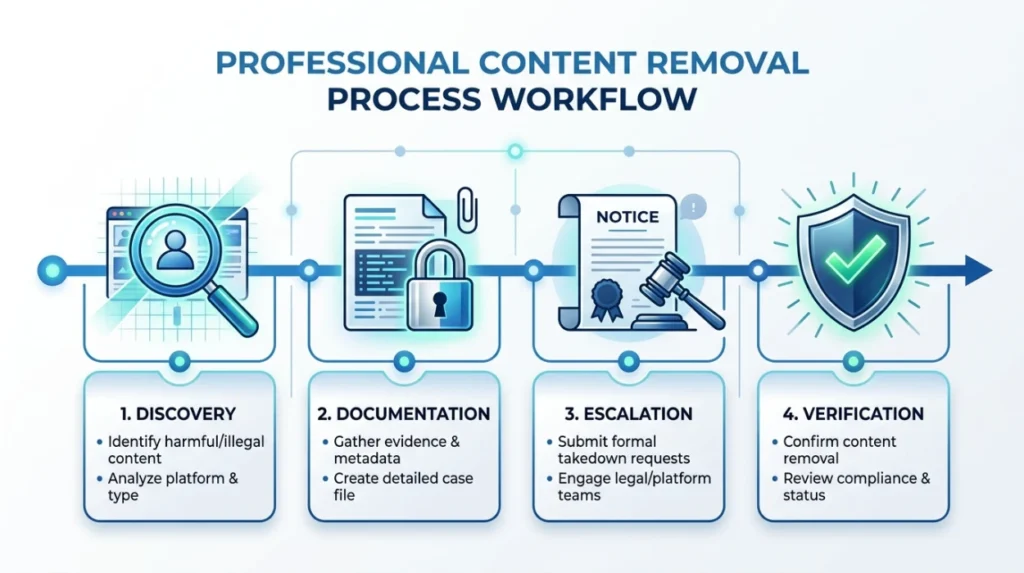
A professional process creates consistency from discovery through resolution. It begins with content identification and evidence collection before determining the appropriate reporting basis. Each URL is then assessed individually rather than treating an entire account as one removal target. This distinction improves case accuracy because different posts can involve different policy considerations. The process concludes with outcome tracking and further assessment where an unresolved issue remains.
A clear removal workflow typically follows these stages:
- Identify harmful posts and profiles by recording the exact URLs and relevant account information.
- Assess the content against applicable platform policies and the circumstances surrounding publication.
- Document evidence through screenshots, dates, contextual information, and supporting records.
- Submit the report through the appropriate reporting mechanism using precise and relevant information.
- Monitor the response and record the platform’s outcome for each reported URL.
- Review unresolved cases separately so further action remains targeted rather than repetitive.
Process clarity reduces operational risk. Without organised records, repeated reports can become difficult to distinguish from earlier submissions, and important evidence can become fragmented. A documented workflow creates a clear history of actions and outcomes. It also allows future searches to identify whether previously reported URLs remain accessible or whether new material has appeared. This makes reputation monitoring an ongoing control process rather than a single reporting event.
Is Content Removal More Effective Than Content Suppression?
Content removal and content suppression address reputation exposure through different mechanisms. Removal focuses on eliminating eligible material from the original platform, while suppression focuses on reducing the prominence of unwanted information by strengthening the visibility of other relevant content. Removal directly addresses the source when platform rules support that outcome. Suppression does not necessarily remove the underlying material. The two approaches therefore serve different purposes within a wider SERP control strategy.
Content suppression becomes relevant when a harmful result remains accessible despite an unsuccessful removal request or when the material does not meet a platform’s removal criteria. The objective is then to strengthen legitimate, relevant information that provides a more accurate representation of the entity. This can involve improving authoritative profiles, publishing useful content, strengthening relevant pages, and developing a consistent digital footprint. Search ranking influence depends on the quality and relevance of those assets rather than on artificial manipulation. The approach therefore requires sustained content and authority development.
A robust reputation strategy evaluates removal before relying on suppression. Removing eligible harmful material addresses the source of exposure, while suppression provides a complementary mechanism for managing the remaining search environment. Treating both methods as interchangeable creates inaccurate expectations. Each operates through a different mechanism and carries a different timeline, level of control, and risk profile.
How Can Clear Your Name Reduce the Risk of Repeated Harmful Content Exposure?
Clear Your Name applies a structured process that separates content discovery, evidence assessment, reporting, and outcome monitoring. This separation creates clearer accountability at each stage and reduces the risk of submitting incomplete or poorly targeted requests. The process also supports a consistent record of URLs and reported material. That record becomes valuable when monitoring whether the same content remains available or new material appears. The objective is sustained visibility control rather than a one-time submission.
Risk reduction depends on maintaining accurate information throughout the case. Each reported URL needs to remain connected to its evidence, reporting basis, submission date, and outcome. This makes it easier to identify unresolved exposure and prevents previously addressed material from being treated as newly discovered content. It also provides a basis for measuring changes in the digital footprint over time. Such monitoring strengthens process reliability because decisions are based on documented information.
The service is particularly relevant when harmful social content affects an individual’s or organisation’s wider search perception. A coordinated process can assess the relationship between social-platform visibility, indexed content, and broader reputation signals. This does not mean every negative result qualifies for removal. Instead, each source is evaluated according to its actual characteristics and the applicable removal mechanism.
How Quickly Can Harmful Content From X Be Removed?
The speed of removal depends on the content, reporting route, evidence, platform review process, and outcome of the assessment. There is no universal removal timeframe that applies to every X report. A complete submission can reduce avoidable delays caused by missing URLs, unclear explanations, or insufficient supporting information. However, the final platform decision remains outside the control of a third-party reputation service.
Speed must therefore be evaluated alongside accuracy. Submitting repeated or poorly supported reports simply to increase volume does not create a reliable removal strategy. A stronger process prioritises correct identification, relevant evidence, and the appropriate reporting mechanism. This approach reduces wasted effort and creates a clearer audit trail.
For decision-makers, the important measure is not simply the number of reports submitted. The more meaningful indicators include the number of relevant URLs identified, the number of valid requests submitted, response outcomes, unresolved exposure, and changes in search visibility. These measures connect operational activity with measurable reputation outcomes.
Is Professional Social Media Content Removal Worth the Long-Term Cost?
Professional removal work provides value when the reputation risk created by persistent harmful content exceeds the cost of structured monitoring and intervention. The assessment needs to consider the visibility of the content, its relevance to the affected entity, its potential search exposure, and the effort required to manage the case accurately. A single visible result can continue generating exposure if it remains accessible and discoverable. Long-term monitoring therefore forms part of the value calculation.
The cost-benefit assessment also changes when the problem involves multiple URLs or repeated publication. Manual discovery, evidence collection, reporting, and follow-up consume time and create an administrative burden. A structured service centralises those activities and maintains a consistent record. This improves operational efficiency while reducing the risk of overlooking relevant sources. The value comes from process control as much as from individual reporting actions.
Sustainability requires more than removing one piece of content. Search environments change continuously, new URLs can appear, old content can return, and previously unknown sources can become visible. A sustainable reputation process therefore combines removal assessment with monitoring and search perception analysis. This provides a stronger foundation for maintaining digital trust over time.
How Should Businesses Measure the Outcome of Content Removal?
The outcome should be measured through visibility, resolution, and exposure indicators rather than through report volume alone. A successful process identifies whether the targeted content remains accessible, whether it continues appearing in relevant searches, and whether new harmful sources have emerged. These measurements provide a practical view of reputation exposure. They also distinguish completed cases from unresolved cases requiring further evaluation.
Useful outcome indicators include:
- Measure URL resolution by recording whether each targeted source remains publicly accessible.
- Track search visibility by monitoring whether relevant harmful results continue appearing for important searches.
- Compare baseline and subsequent results to identify changes in the visible information environment.
- Monitor new URLs to distinguish fresh exposure from previously addressed material.
- Review unresolved cases to determine whether a different reporting or reputation-management approach applies.
This measurement framework improves accountability because it connects each intervention with an observable result. It also prevents reputation management from becoming an activity measured solely by the number of submissions made. The real objective is controlled exposure, improved information quality, and reduced risk within the relevant search ecosystem.
Why Is Clear Your Name a Reliable Option for Harmful Content Removal?
Clear Your Name provides a structured approach centred on evidence, content identification, reporting accuracy, and outcome monitoring. The process treats each piece of harmful content as a distinct source requiring assessment rather than assuming that one reporting action resolves an entire reputation issue. This creates stronger process clarity and supports more accurate decision-making. It also allows unresolved content to remain visible within the case history for targeted follow-up. The result is a controlled workflow rather than an unstructured sequence of reports.
Reliability also depends on realistic expectations. No responsible removal process guarantees that every reported item will be deleted because platform decisions depend on applicable rules and evidence. A credible service therefore focuses on identifying legitimate removal opportunities, preparing relevant evidence, documenting submissions, and measuring outcomes. This reduces risk created by exaggerated promises. It also gives clients a clearer understanding of what the process can control and what remains subject to platform decisions.
For organisations seeking a structured route for social-platform reputation exposure, professional social media content removal support provides a focused mechanism for assessing harmful content and managing the associated reporting process. Where removal alone does not resolve search exposure, the wider reputation strategy can evaluate content visibility and entity credibility across relevant search results.
What Makes a Sustainable X Content Removal Strategy Reliable?
A sustainable strategy combines accurate discovery, evidence management, appropriate reporting, outcome tracking, and ongoing monitoring. These components operate together because content removal is not always a single-step process. New posts can appear after an earlier case has been resolved, while previously unknown URLs can become visible through search indexing. Continuous monitoring therefore provides the information required to identify changes in exposure. This creates a repeatable process for maintaining control over the digital footprint.
The strongest approach also separates platform removal from search perception management. Platform-level removal addresses content where the source exists, while search-focused work evaluates how remaining information appears to users. Treating these as separate but connected systems produces clearer expectations and better measurement. It also reduces the risk of relying on one intervention to solve a broader reputation problem.
Clear Your Name applies this process with a focus on evidence quality, reporting precision, and measurable outcomes. The objective remains straightforward: identify legitimate removal opportunities, reduce harmful content exposure, document the result, and monitor the wider search environment. This combination of process clarity and realistic outcome measurement provides a credible foundation for long-term digital reputation control.
If you are assessing the evidence required before submitting a request, the supporting analysis on evidence for X content removal requests provides a useful consideration-stage reference. It explains how URLs, screenshots, context, and policy relevance contribute to a clearer submission.
How Can Harmful X Content Be Managed Reliably?
Harmful content on X requires a structured process that connects discovery, evidence, policy assessment, reporting, and outcome monitoring. Removal addresses the source when applicable platform rules support that action, while search perception management addresses the wider visibility environment. This distinction creates more accurate expectations and reduces operational risk. Measurable tracking then establishes whether targeted content remains accessible and whether new exposure has emerged. The result is a more controlled approach to digital reputation management.
Clear Your Name positions its process around reliability, evidence quality, and process transparency rather than exaggerated removal guarantees. Each case can be assessed according to its content, evidence, reporting basis, and measurable outcome. This provides a credible framework for reducing harmful social-media exposure while strengthening broader digital trust. For UK individuals and organisations managing reputation risk, structured content removal provides a practical route towards greater visibility control and more stable search perception.
How can I remove harmful content from X in the UK?
Harmful content on X can be reported through the platform’s relevant reporting process when it breaches applicable rules or policies. A clear post URL, supporting evidence, and an accurate explanation of the concern help create a well-documented request.
What evidence is needed to report harmful content on X?
Useful evidence includes the exact post URL, screenshots, account details, dates, and relevant context. The evidence should directly support the reason for reporting and identify the specific content being challenged.
Can social media content removal services remove posts from X?
Social media content removal services can assess eligible content, prepare evidence, and manage appropriate reporting processes. Actual removal remains subject to X’s policies, review procedures, and the circumstances of the reported content.
How long does it take to remove harmful content from X?
There is no universal timeframe because processing depends on the reporting route, evidence, content type, and platform review. A complete and accurately documented request helps reduce avoidable delays.
What happens if X does not remove harmful content?
An unsuccessful removal request can be evaluated to determine whether another valid reporting route or reputation-management approach applies. Monitoring search visibility and the wider digital footprint also helps identify ongoing exposure from unresolved content.