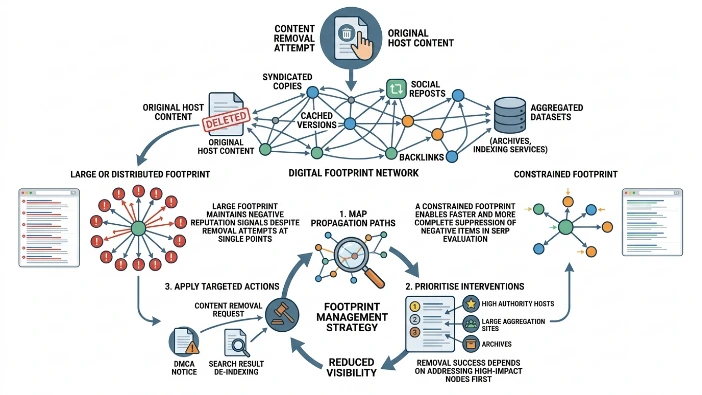

A social media pile-on is managed by assessing the source, limiting further amplification, monitoring search visibility, and selecting an appropriate response strategy. Reputation management strategies differ based on the type of content involved, its distribution, its credibility, and its effect on the wider digital footprint.
Online reputation control methods are evaluated through their ability to influence content exposure, reputation signals, entity credibility, and SERP composition. Effective analysis separates reactive measures, such as addressing harmful content, from organic measures, such as developing authoritative information that changes the balance of visible search results.
What is the most effective way to assess a social media pile-on?
The most effective assessment begins with mapping the content, sources, entities, keywords, and distribution channels involved in the pile-on. A social media pile-on is not a single reputation signal because it consists of connected posts, comments, references, discussions, and potentially secondary publications. Assessing these elements establishes whether the issue remains concentrated on one platform or has entered a broader search ecosystem. The assessment also identifies which content is indexed and which content remains limited to platform-level visibility. This distinction determines whether the problem primarily concerns social perception, search visibility, or both.
Content mapping operates by categorising information according to source, format, sentiment, relevance, authority, and accessibility. Public posts, reviews, articles, forum discussions, videos, and search results represent different content types with different visibility characteristics. A high volume of comments on one platform creates a different risk profile from negative material distributed across independent websites. Mapping therefore measures distribution rather than relying on engagement figures alone. The resulting information structure provides a basis for comparing removal, suppression, enhancement, and monitoring approaches.
How does content removal compare with content enhancement?
Content removal focuses on reducing the availability of specific information, while content enhancement focuses on increasing the visibility and relevance of alternative information. Removal operates at the source level by addressing content that violates platform rules, privacy requirements, legal standards, or other applicable policies. Enhancement operates within the search ecosystem by developing or strengthening information that provides greater relevance and authority for particular queries. These approaches therefore target different mechanisms rather than representing interchangeable reputation management techniques.
The primary strength of removal is direct reduction of the targeted content’s availability when a legitimate removal route exists. Its limitation is scope because removing one publication does not automatically eliminate copies, references, screenshots, discussions, or independently published material. Content enhancement has broader search applications because it changes the competitive composition of SERPs rather than depending entirely on one source decision. Its limitation is that new content requires relevance, quality, authority, and sufficient search visibility to influence the results. A balanced evaluation therefore considers whether the problem is source-specific or ecosystem-wide.
Is reactive reputation management more effective than organic reputation building?
Reactive reputation management is more effective for immediate content-level issues, while organic reputation building is more suitable for sustained changes in search perception. Reactive management operates by responding to an existing event, publication, review, complaint, or harmful reference. Organic reputation building operates by establishing useful, authoritative, and relevant information that strengthens the entity’s broader digital footprint over time. The two approaches therefore address different stages of reputation development.
Reactive approaches offer speed because they focus directly on an identified source or reputation signal. Their limitation is that each action remains connected to a specific piece of content, platform, or incident. Organic approaches provide greater scalability because a coherent body of authoritative information can address multiple related queries and entity associations. Their limitation is the time and content quality required to achieve meaningful search ranking influence. Evaluating effectiveness therefore requires measuring both immediate exposure and longer-term SERP composition.
How does content suppression compare with content enhancement in search results?
Content suppression reduces the prominence or availability of unwanted information, whereas content enhancement increases the visibility of relevant information that provides an alternative search context. Suppression operates through source removal, de-indexing where applicable, platform moderation, or changes in the competitive search environment. Enhancement operates through content quality, topical relevance, internal linking, authority development, and alignment with search intent. These mechanisms influence SERP composition from opposite directions.
Suppression has a direct relationship with the targeted content because the objective concerns its visibility or accessibility. However, suppression does not guarantee that all references to the same subject disappear from search results. Enhancement creates a more distributed approach because multiple relevant pages can establish stronger contextual coverage around an entity. This provides greater resilience when a reputation issue involves numerous independent sources. The comparative weakness is that enhancement depends on search ranking systems and therefore requires sustained relevance and authority rather than a single intervention.
Which approach creates the lowest risk during a reputation crisis?

The lowest-risk approach is determined by the nature, accuracy, legitimacy, and distribution of the information rather than by the strategy name alone. Content assessment provides the foundation because legitimate criticism, factual reporting, misinformation, impersonation, privacy violations, and policy-breaking material require different responses. Treating every negative reference as removable creates unnecessary risk and ignores the distinction between reputation protection and suppression of legitimate information. A structured evaluation therefore begins with source characteristics and content status before selecting an intervention.
Risk exposure also depends on how a response affects the wider information ecosystem. Aggressive responses to legitimate criticism can increase attention, create additional references, or introduce new reputation signals. A measured approach focuses on factual accuracy, platform rules, applicable rights, and the actual search impact of the content. This framework reduces strategic risk because each action is connected to an identifiable mechanism. Risk evaluation therefore considers both the immediate outcome and secondary effects on entity credibility.
How does sentiment distribution affect the choice of reputation strategy?
Sentiment distribution describes how positive, neutral, and negative information is distributed across the content associated with an entity. It provides a broader view than counting negative comments because it measures the composition of the available information environment. A concentrated negative discussion creates a different reputation profile from an environment containing balanced information from independent and authoritative sources. Analysing sentiment distribution therefore helps determine whether the problem involves an isolated spike or a sustained change in public-facing information.
Sentiment analysis operates by identifying recurring language, themes, opinions, and contextual associations within relevant content. It does not establish the factual accuracy of individual statements because sentiment and factual verification represent different analytical dimensions. A strategy based exclusively on sentiment reduction therefore provides an incomplete assessment of reputation. Combining sentiment distribution with source authority, indexing status, search ranking, and query relevance produces a more reliable evaluation. This approach also prevents engagement volume from being treated as a direct measure of entity credibility.
How does search ranking influence the spread of a social media pile-on?
Search ranking influences the spread of a social media pile-on when related content becomes relevant to queries associated with the affected entity. Search engines evaluate content according to systems that consider relevance, quality, authority, user intent, freshness, links, and other signals. Ranking does not simply reward negative or positive sentiment, so a negative page gains visibility because it satisfies particular search requirements rather than because it is negative. The reputation effect emerges when users repeatedly encounter that content for relevant queries.
Search ranking influence also extends beyond the original social platform. A controversy can generate articles, reviews, forum discussions, videos, and other pages that compete for visibility in search results. These additional documents create a wider SERP environment where users encounter different interpretations of the same event. Content enhancement attempts to influence this environment by establishing relevant alternatives, while suppression focuses on reducing the visibility of specific unwanted sources. Comparing the two approaches requires examining which mechanism has greater relevance to the actual search landscape.
Dive Deeper With Our Expert Guides:
How to Report and Remove Non-Consensual Images From Social Media
How to Remove Harmful Posts Made by a Former Partner
How can short-term and long-term reputation strategies be compared?
Short-term reputation strategies prioritise immediate exposure control, while long-term strategies focus on sustained search perception and entity credibility. Short-term measures include content assessment, platform reporting, response management, monitoring, and addressing specific sources. Long-term measures include developing authoritative content, maintaining consistent entity information, strengthening topical relevance, and monitoring search results over time. These approaches operate on different time horizons and therefore require different performance measurements.
Short-term effectiveness is measured through changes in content availability, exposure, search positions, and active discussion. Long-term effectiveness is evaluated through SERP stability, source diversity, content relevance, entity consistency, and the distribution of reputation signals. A strategy that produces immediate visibility changes without creating sustainable search coverage has limited long-term value. Conversely, a long-term content programme does not replace immediate assessment when harmful information is actively spreading. Comparing both time horizons provides a more complete measure of reputation control.
Which reputation management method is most scalable?
Content enhancement is generally more scalable for broad search environments because one coherent content system can address multiple related queries and entity associations. Scalability refers to the ability of a strategy to maintain effectiveness as the number of queries, sources, platforms, or reputation signals increases. Removal-based approaches are less scalable when each item requires separate source-level assessment or platform intervention. Their effectiveness remains closely connected to the policies and decisions of individual content hosts.
Scalable reputation management therefore depends on creating processes rather than isolated actions. A structured system categorises sources, tracks indexing, monitors SERP positions, evaluates sentiment, and identifies recurring semantic associations. Content development then addresses information gaps that affect entity credibility and search perception. This approach creates a repeatable framework for analysing changes across a larger digital footprint. Scalability is consequently measured through operational consistency and coverage rather than content volume alone.
How should reputation management strategies be evaluated for sustainability?
Sustainable reputation management is evaluated through whether its effects remain useful after the immediate crisis has declined. Sustainability depends on the stability of content, the strength of information sources, the diversity of reputation signals, and the ability to monitor changing search conditions. Short-term suppression without broader information development provides limited protection against future references appearing elsewhere. Likewise, publishing large amounts of low-quality content creates weak foundations for long-term entity credibility.
A sustainable strategy maintains alignment between factual information, search intent, content quality, and entity consistency. It monitors how search results change as new documents are indexed and existing pages gain or lose ranking positions. It also distinguishes between legitimate criticism and information that requires a platform, legal, or policy-based response. This prevents reputation management from becoming dependent on one mechanism. Sustainability therefore reflects the resilience of the wider information environment rather than the success of one individual intervention.
How can the right approach be selected for a social media pile-on?
The appropriate approach is selected by evaluating content legitimacy, distribution, search visibility, source authority, sentiment, urgency, and long-term reputation risk. First, the information environment is mapped to determine where the pile-on exists and which sources contribute to its visibility. Next, each content type is evaluated according to its relevance, credibility, accessibility, and potential search impact. The analysis then compares removal, suppression, enhancement, response, and monitoring according to their respective mechanisms. This framework connects each action to a measurable reputation objective.
A practical evaluation framework uses the following sequence:
- Map the content by identifying original posts, secondary references, indexed pages, reviews, and recurring keywords associated with the event.
- Evaluate the sources by comparing authority, credibility, accessibility, publication context, and relevance to the affected entity.
- Measure search visibility by recording which queries expose related content and how those pages contribute to SERP composition.
- Compare interventions by assessing removal, suppression, enhancement, monitoring, and response against risk, scalability, and sustainability.
- Monitor changes by tracking indexing, ranking positions, sentiment distribution, new references, and changes in entity perception.
This sequence separates reputation analysis from reactive decision-making. It also ensures that content removal strategies are evaluated alongside content enhancement rather than treated as the only available mechanism. The resulting approach provides a clearer basis for determining which intervention matches the structure of the reputation problem.
Managing a social media pile-on requires comparison between strategies rather than reliance on one universal reputation management method. Content removal and suppression focus on reducing the availability or visibility of specific information, while content enhancement focuses on strengthening alternative information within the search ecosystem. Reactive approaches prioritise immediate exposure, whereas organic approaches focus on sustained search perception and entity credibility.
The most reliable evaluation considers effectiveness, scalability, risk exposure, and sustainability together. Search visibility, sentiment distribution, source authority, content indexing, and SERP composition provide measurable indicators for comparing strategic options. Crisis Support for a Social Media Pile-On represents the next consideration stage after understanding these strategic differences, while the present analysis remains focused on evaluating the mechanisms that influence reputation outcomes.
How do you manage a social media pile-on before it spreads?
Managing a social media pile-on starts with identifying the original content, tracking related posts, and assessing how quickly the discussion is expanding. Reputation management strategies can then focus on content assessment, appropriate removal routes, monitoring, and strengthening accurate information.
Can social media content removal stop a reputation crisis?
Social Media Content Removal Services can address eligible content when it violates platform policies, privacy rules, or other applicable requirements. Removal reduces the availability of specific content but does not automatically remove copies, references, or independent discussions elsewhere online.
Is content removal better than content suppression for reputation management?
Content removal targets the availability of specific material, while content suppression focuses on reducing the visibility of unwanted information in search results. The appropriate approach depends on the content source, search visibility, legitimacy, and wider digital footprint.
How does a social media pile-on affect Google search results?
A pile-on can affect search visibility when related posts, articles, reviews, or discussions become indexed and relevant to searches about an entity. Search ranking depends on factors such as relevance, content quality, authority, indexing, and search intent rather than negative sentiment alone.
What is the best long-term strategy for managing a social media pile-on?
A sustainable strategy combines monitoring, accurate content development, source evaluation, and appropriate responses to eligible harmful material. This approach addresses both immediate reputation signals and the longer-term SERP composition surrounding the entity.