
Real-time social media monitoring gives businesses early visibility into harmful mentions, emerging reputation threats, and changes in public sentiment. Search visibility control and accurate reputation signals help organisations protect entity credibility and make informed decisions about harmful online content.
Why does real-time social media monitoring matter for reputation management?
Real-time social media monitoring provides an early-warning system for reputation risks developing across public digital channels. Reputation signals influence how an organisation, professional, or brand is perceived when users encounter related information through social platforms and search engines. Monitoring captures new mentions, discussions, reviews, and potentially harmful content close to the point of publication. This creates an evidence base for assessing the source, context, sentiment, and potential search relevance of each mention. Businesses can therefore distinguish an isolated reference from content that forms part of a wider reputation narrative. The importance of monitoring is explained further through real-time social media reputation threats, where early detection forms the first stage of effective risk assessment.
What does a professional social media monitoring service include?
A professional social media monitoring service combines continuous detection with structured analysis of reputation-related content. The process begins by defining relevant names, keywords, phrases, entities, topics, and reputation indicators that require monitoring. New mentions are then categorised according to source, context, sentiment, publication time, relevance, and relationship with the monitored entity. This prevents a monitoring system from treating every mention as an equally significant reputation event. High-priority content receives further assessment based on its visibility, credibility, platform, and potential influence on public perception. A structured service therefore provides information that supports decisions rather than simply producing a continuous stream of notifications.
How does social media monitoring influence search perception?
Social media monitoring influences search perception indirectly by identifying content that forms part of the information environment surrounding an entity. Search engines evaluate indexed content according to relevance, context, authority, freshness, and other ranking signals rather than applying a universal reputation score to individual social posts. Monitoring does not directly control rankings, but it identifies content that enters the wider searchable ecosystem or becomes connected to other indexed information. This distinction is important because social visibility and search visibility operate through different mechanisms. A harmful mention with limited social engagement can still become relevant to a reputation assessment if it is indexed, referenced, or associated with entity-related queries. Monitoring therefore provides the evidence required to evaluate potential search perception changes.
When should businesses consider social media content removal?
Businesses should consider social media content removal when a specific piece of content presents an identifiable basis for action under platform rules, privacy requirements, legal processes, or another applicable mechanism. Monitoring establishes what has been published, while removal assessment determines whether a legitimate route exists for addressing that content. This distinction prevents businesses from treating every negative mention as removable. An assessment considers the platform, content type, evidence, ownership, applicable policies, and the relationship between the content and the affected entity. Where removal is not appropriate or available, alternative reputation-management approaches can address search visibility or the wider digital footprint. This makes content assessment an essential part of a reliable reputation-management process.
Which reputation management approach provides stronger risk reduction?
A combined approach provides stronger risk reduction because monitoring, content assessment, removal, and search visibility management address different parts of the reputation system. Monitoring identifies emerging threats, while content assessment determines their relevance and severity. Removal focuses on eligible content at its source, whereas negative content suppression addresses situations where harmful information remains accessible but becomes prominent within search results. Content enhancement provides another mechanism by strengthening accurate and relevant information within the entity’s wider digital footprint. These approaches are not interchangeable because each operates at a different stage of reputation control. The strongest strategy therefore matches the intervention to the specific reputation signal rather than applying one method to every situation.
How does the monitoring process turn online threats into measurable action?
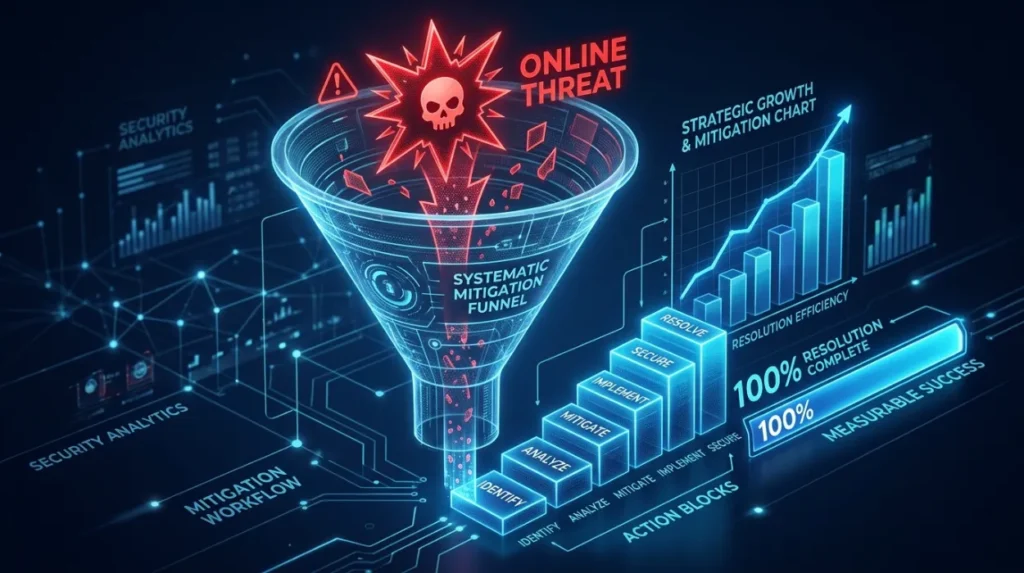
A structured monitoring process converts online threats into measurable action through detection, verification, classification, prioritisation, intervention, and review. Detection identifies new mentions, while verification confirms that the content genuinely relates to the monitored entity. Classification then establishes whether the mention involves negative sentiment, harmful claims, privacy concerns, misleading information, or another relevant risk category. Prioritisation considers factors such as source authority, search visibility, repetition, topical relevance, and potential impact on entity credibility. Intervention is selected according to the characteristics of the content and the applicable platform or search mechanism. Ongoing review then measures content status, visibility changes, sentiment distribution, and new reputation signals.
How does evidence-based monitoring improve reputation decisions?
Evidence-based monitoring improves reputation decisions by replacing assumptions with documented information about content, sources, visibility, and changes over time. Each relevant mention can be assessed using its publication date, platform, source characteristics, entity relationship, sentiment, and search relevance. This information establishes a clear record of why a piece of content received attention and what action was considered. Search visibility can then be measured against defined queries instead of relying on general impressions about online reputation. The same framework supports comparison between the original information environment and its condition after intervention. Reliable decision-making therefore depends on measurable evidence rather than unsupported claims about reputation improvement.
Is content removal enough to protect long-term online reputation?
Content removal alone is not enough to establish long-term reputation protection because an entity’s digital footprint contains information from multiple independent sources. Removing one social media post does not automatically remove reviews, articles, profiles, images, forum references, or other indexed documents associated with the same entity. Long-term reputation management therefore requires continued monitoring of the information environment after an individual content issue has been addressed. Search perception also depends on the composition of indexed results and the relevance and authority of competing information. A sustainable strategy combines content-level intervention with broader search visibility and reputation analysis. This approach reduces dependence on a single removal outcome and provides better visibility into future reputation risks.
Dive Deeper With Our Expert Guides:
Get a Rapid Response Plan for Your Social Media Crisis
Protect Your Company From Employee Social Media Fallout With Us
How quickly can real-time monitoring identify harmful mentions?
Real-time monitoring reduces the delay between content publication and detection by continuously checking defined sources and alert conditions. Detection speed depends on platform accessibility, monitoring coverage, keyword configuration, and the availability of relevant public information. The measurable performance indicator is the interval between content becoming available and its appearance within the monitoring workflow. Faster detection preserves publication context and provides earlier evidence for assessing whether a mention is isolated or developing into a wider narrative. Accuracy remains equally important because excessive irrelevant alerts reduce the practical value of rapid detection. A reliable monitoring system therefore evaluates both response speed and the percentage of alerts that represent genuine reputation signals.
How should businesses evaluate the cost of reputation monitoring?
Businesses should evaluate reputation monitoring costs against the value of earlier detection, clearer risk assessment, and more controlled reputation decisions. The number of alerts alone does not establish service value because irrelevant notifications provide limited decision-making benefit. A meaningful evaluation considers monitoring coverage, detection accuracy, reporting frequency, platform scope, response procedures, and measurement capabilities. Businesses also need to distinguish monitoring costs from intervention costs because identifying harmful content and addressing it are separate activities. Long-term value increases when monitoring creates a consistent evidence base that supports repeated reputation decisions. Cost evaluation therefore works best when linked to measurable operational outcomes rather than treated as a simple monthly expense.
Why is a UK-focused social media monitoring service valuable?
A UK-focused social media monitoring service provides analysis within the search, platform, audience, and regulatory context relevant to UK organisations. Search perception depends partly on the information sources and queries used by the target audience, making geographic relevance important when evaluating digital reputation. UK-focused assessment also supports closer consideration of applicable privacy principles, platform policies, and legal routes when harmful content requires further investigation. However, the appropriate intervention remains dependent on the nature of the content and the platform where it appears. Geographic focus therefore complements rather than replaces technical reputation analysis. For UK organisations, the combination creates a more relevant framework for assessing search visibility, reputation signals, and digital trust.
What makes Clear Your Name a suitable option for reputation monitoring?
Clear Your Name provides a structured reputation-management approach that connects content assessment with broader online reputation considerations. Its service model focuses on identifying harmful content, evaluating applicable removal routes, and considering platform-specific requirements rather than treating every negative mention as automatically removable. This process is relevant to decision-makers because harmful content can originate across different platforms and require different forms of assessment. A credible reputation service also needs clear communication about what is actionable, what depends on third-party platforms, and what requires longer-term search visibility management. Professional social media content removal service is therefore best understood as one component of a broader reputation-risk process rather than an isolated technical action. This distinction supports realistic expectations and clearer evaluation of potential outcomes.
How can businesses combine monitoring with social media content removal?
Businesses can combine monitoring with content removal by using monitoring as the detection layer and removal assessment as the intervention layer. The monitoring stage identifies potentially harmful content and records its source, timing, context, sentiment, and entity relationship. The assessment stage then determines whether the content meets the relevant criteria for a platform report, privacy request, legal route, or another applicable process. Where removal is not available, the information remains useful for assessing search visibility and wider reputation exposure. Continued monitoring then establishes whether related content appears or whether the original narrative expands across additional platforms. This creates a connected process from detection to intervention and subsequent measurement.
How can businesses improve their reputation monitoring setup?
Businesses can improve their reputation monitoring setup by combining precise entity tracking with contextual keywords and clear alert priorities. Exact-name alerts establish the core monitoring layer, while associated terms identify discussions connected with particular reputation risks. Exclusion terms reduce irrelevant matches, while sentiment indicators help prioritise potentially harmful discussions. Businesses can also establish different alert levels for direct mentions, high-risk topics, rapid increases in discussion volume, and references from high-authority sources. The result is a monitoring framework that prioritises meaningful reputation signals rather than treating every mention equally. For organisations building this capability, harmful social media mention alerts provide the practical bridge between reputation analysis and continuous monitoring.
What outcomes can real-time social media monitoring deliver?
Real-time social media monitoring delivers earlier threat detection, stronger visibility into reputation signals, clearer evidence for decision-making, and more consistent measurement of online perception. The service does not guarantee removal of every harmful item or a specific search ranking because platforms and search engines control those external outcomes. Measurable outcomes instead include detection speed, alert accuracy, content-status changes, search visibility trends, sentiment distribution, and changes in the wider digital footprint. These indicators provide a stronger basis for assessing whether reputation risk is being identified and managed consistently. Long-term monitoring also establishes historical data that helps identify recurring themes and changes in entity perception. The emphasis therefore remains on measurable control, evidence quality, and sustainable reputation management.
Why does process clarity matter when choosing a reputation management service?
Process clarity matters because reputation management involves multiple information systems and different intervention mechanisms. A reliable process explains how content is identified, how evidence is assessed, which intervention is applicable, and how outcomes are measured afterwards. It also distinguishes between actions controlled by the service provider and decisions controlled by social platforms or search engines. This transparency reduces the risk of unrealistic expectations around content removal, rankings, or search perception influence. Clear reporting further allows businesses to evaluate progress using defined indicators rather than general claims. For decision-makers, process clarity therefore functions as a core trust signal when comparing reputation management options.
Why choose a structured real-time monitoring approach?
Real-time social media monitoring provides a structured foundation for identifying reputation threats before they become difficult to evaluate within a wider information ecosystem. Monitoring detects signals, content assessment establishes relevance, removal strategies address eligible material, and search-focused methods evaluate visibility and entity perception. Clear Your Name combines reputation-management considerations with content-focused processes to provide a structured route for organisations assessing harmful online information. The reliability of this approach comes from documented evidence, clear processes, realistic outcome measurement, and recognition of third-party platform constraints. Businesses can therefore evaluate reputation management through measurable factors including detection speed, content status, search visibility, sentiment distribution, and long-term digital footprint stability. This evidence-led framework provides a practical basis for protecting entity credibility and maintaining greater control over online reputation.
What is real-time social media monitoring?
Real-time social media monitoring continuously tracks public mentions, keywords, topics, and reputation signals across relevant social platforms. It helps businesses identify emerging harmful content and assess potential effects on online reputation and search visibility.
How can social media monitoring protect a business reputation?
Social media monitoring identifies harmful mentions and changes in sentiment before they develop into broader reputation narratives. Early detection provides evidence for evaluating content, assessing risk, and selecting an appropriate response.
What are social media content removal services?
Social media content removal services assess harmful or policy-violating content and identify applicable platform-based or legal removal routes. The process typically considers the content type, platform rules, evidence, and the relationship between the content and the affected entity.
Can removing social media content improve search visibility?
Removing eligible social media content can reduce the availability of a specific reputation signal, but it does not guarantee a particular search ranking. Search visibility depends on indexed content, relevance, authority, query intent, and other search-engine ranking signals.
How does Clear Your Name handle social media reputation risks?
Clear Your Name uses a structured approach that considers harmful content, platform policies, evidence, and broader reputation-management factors. Its approach distinguishes content removal from search visibility and recognises that final decisions can depend on third-party platforms.