

Personal information removal differs for public figures and private people because search visibility, public interest, and privacy considerations influence how information is evaluated.
Reputation management is the process of understanding and influencing how information about a person or entity is discovered, interpreted, and represented across digital environments.
How Does Personal Information Removal Differ Between Public Figures and Private People?
Personal information removal follows different considerations for public figures and private people because the information ecosystem surrounding each group has different levels of public interest and search visibility. Online reputation refers to the collection of information, opinions, references, profiles and content that shape how an individual is perceived across search engines and digital platforms. For a private person, personal information often has limited public relevance and a stronger connection to individual privacy. For a public figure, information can have a wider public context because professional activities, public statements and historical records receive greater search attention.
Search engines do not simply classify information according to whether a person wants it removed. Content indexing, source authority, relevance and the context surrounding the information influence how pages appear in SERPs. Personal information therefore exists within a broader search ecosystem where privacy considerations interact with accessibility and public interest. The distinction between public and private individuals affects how these factors are interpreted rather than creating an automatic rule for removal.
What Is Personal Information Within a Search Ecosystem?
Personal information refers to data that identifies, describes or provides information about an individual within a digital environment. This includes names, addresses, telephone numbers, email addresses, photographs, employment details, family references and other information connected to an identifiable person. When such information becomes indexed by search engines, it forms part of the individual’s digital footprint. The visibility of that information then contributes to entity perception when users conduct searches associated with the person’s name.
Search visibility determines how easily personal information can be discovered. A piece of information published on a low-authority webpage and rarely indexed has a different practical impact from information appearing prominently across authoritative search results. Search engines evaluate relevance and authority when determining ranking positions, so the same type of personal information can produce different levels of exposure. Reputation analysis therefore examines both the existence of information and its position within the wider search landscape.
Why Does Public Status Affect Personal Data Removal?
Public status affects personal data removal because public figures operate within a higher-information environment where professional activities and public records receive greater attention. A politician, business leader, entertainer or other public-facing individual frequently has an established entity footprint containing interviews, publications, professional profiles and historical references. These sources contribute to how search engines understand the entity. Personal information connected to that entity therefore requires contextual evaluation rather than simple classification as private data.
The distinction does not mean that public figures lose all privacy considerations. Personal data can still involve information unrelated to legitimate public interest, particularly where disclosure creates unnecessary exposure. The relevant assessment focuses on the nature of the information, its source, its relevance and the context in which it is published. This creates a more precise framework for analysing whether information has legitimate relevance to public identity or functions primarily as unnecessary personal exposure.
How Do Search Engines Interpret Personal Information About Private People?
Search engines interpret information about private people through the same fundamental ranking systems used for other indexed content, while the surrounding information ecosystem often contains fewer authoritative references. A private individual’s search results can include social profiles, directory pages, data broker records, archived pages, forum references and user-generated content. These sources contribute to the person’s searchable digital footprint. When personal information is prominently indexed, it becomes easier for users to access and connect separate pieces of information.
Authority and relevance influence the prominence of these pages. A highly authoritative website can achieve stronger visibility than an obscure page even when both contain similar information. Content indexing also determines whether information enters the searchable database in the first place. Understanding these mechanisms explains why personal information removal involves more than locating one page, as visibility depends on the relationship between source, indexation, relevance and ranking.
How Is Personal Information About Public Figures Evaluated Differently?
Personal information about public figures is evaluated within a broader context of public interest, professional identity and existing reputation signals. Public figures often have extensive digital footprints because their activities generate media coverage, professional references, public records and audience discussion. These sources create an established entity profile that search engines use to associate information with the individual. Information connected to public responsibilities therefore receives different contextual treatment from information that exists solely as private personal data.
Public-interest relevance is an important distinction in this evaluation. Information concerning professional conduct, public responsibilities or established public activities has a different relationship to public visibility than a private telephone number or residential address. Reputation management analysis therefore separates information that contributes to legitimate entity understanding from information that exposes an individual without meaningful relevance. This distinction supports more accurate assessment of search visibility and privacy-related concerns.
How Do Reputation Signals Influence Personal Information Visibility?
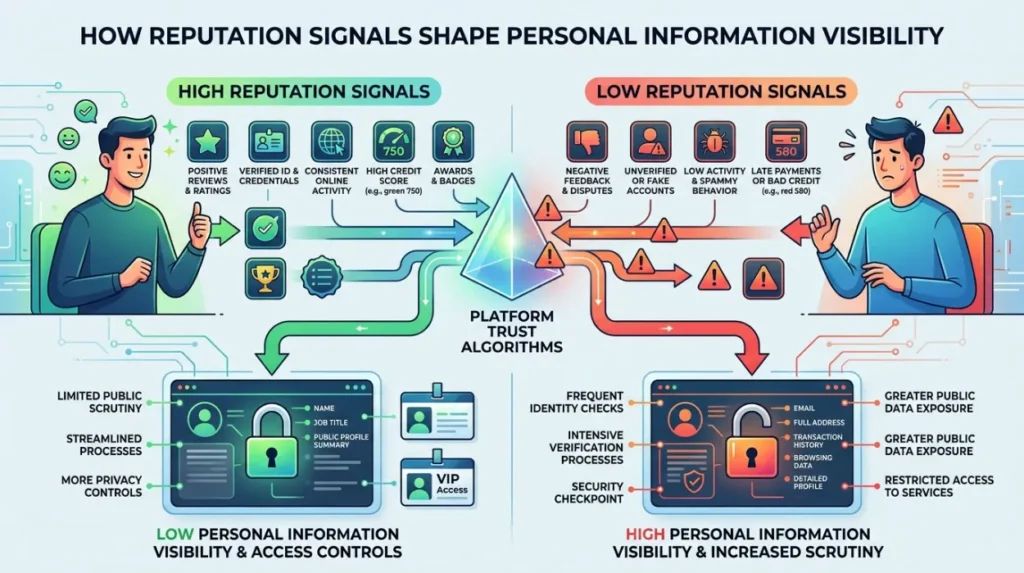
Reputation signals influence personal information visibility by shaping the broader information environment associated with an individual. These signals include authoritative publications, professional profiles, verified information, reviews, references, social accounts and other sources that contribute to entity understanding. Search engines use signals from indexed content to determine relevance and ranking relationships. The resulting SERP composition influences how users interpret the individual before they access individual webpages.
For private people, a small number of highly visible personal-data pages can disproportionately shape search perception because fewer authoritative sources exist to provide contextual information. Public figures generally have a larger entity footprint, creating a more complex search environment with competing sources and reputation signals. This difference affects how information is discovered and interpreted. Personal information removal analysis therefore considers the complete SERP rather than examining a data point independently.
How Do Reviews and Sentiment Affect Personal Information Searches?
Reviews and sentiment influence personal information searches when user-generated content becomes part of the indexed information environment. Reviews can communicate experiences, opinions and evaluations that contribute to reputation signals around an individual or organisation. Search engines assess these pages through relevance, authority and other ranking characteristics rather than treating sentiment as a simple positive or negative score. The resulting visibility affects the context in which users encounter personal information.
Sentiment interpretation also depends on the source and surrounding evidence. A review on an established platform has a different information context from an isolated comment on an obscure webpage. Searchers often compare multiple sources when forming an opinion, making the distribution of information across SERPs significant. Reputation analysis therefore examines how reviews, commentary and personal information interact within the overall entity footprint.
What Role Does Content Authority Play in Personal Information Removal?
Content authority determines how strongly a webpage can influence search visibility and therefore affects the practical significance of personal information appearing on that page. Authoritative websites generally possess stronger domain-level and page-level signals, allowing their content to achieve greater visibility for relevant searches. Information published on such sources can therefore remain prominent even when other pages contain competing information. Analysing authority provides a clearer understanding of why some personal-data references create greater search exposure than others.
Authority also affects the feasibility of changing SERP composition. Search engines evaluate competing pages independently, meaning replacing a prominent result requires relevant and authoritative information rather than simple content volume. This creates an important distinction between content existence and content visibility. Personal information removal analysis therefore evaluates the authority of the source alongside the nature of the information itself.
How Does a Digital Footprint Shape Personal Information Removal?
A digital footprint is the collection of publicly accessible information and digital references associated with an individual or entity. It includes websites, social profiles, directory listings, media coverage, reviews, professional pages and other indexed resources. For private people, the footprint can contain fragmented personal information distributed across unrelated sources. For public figures, the footprint generally contains a larger combination of professional, historical and public-interest information.
The structure of a digital footprint influences entity perception because search engines connect information through names, references, entities and contextual relationships. Removing one page does not necessarily eliminate the wider footprint. Other indexed sources can continue providing the same information or reinforcing the same association. Understanding these relationships is therefore essential when evaluating personal information removal within a search ecosystem.
Dive Deeper With Our Expert Guides:
Which Types of Exposed Personal Information Pose the Greatest Risk
How AI Chatbots May Learn and Repeat Your Personal Information
Why Is Context Important When Assessing Personal Data Removal?
Context determines whether information represents legitimate public knowledge, ordinary professional information or unnecessary personal exposure. The same category of information can have different implications depending on the person, source, purpose and surrounding circumstances. For example, professional information connected to a public role has a different contextual function from residential information unrelated to that role. Search perception is influenced by these distinctions because users interpret information according to the surrounding entity narrative.
Contextual evaluation also reduces inaccurate assumptions about what search engines can remove. Search engines generally do not determine whether information is desirable based solely on an individual’s preference. Removal processes depend on applicable policies, legal frameworks, privacy considerations and the characteristics of the content. A precise assessment therefore begins with identifying what the information represents and why it appears within the searchable ecosystem.
What Should Public Figures Know Before Requesting Personal Data Removal?
Public figures need to understand that personal data removal involves balancing privacy considerations with public interest, relevance and existing search visibility. Their established entity footprint creates additional context because professional activities, public records and media references frequently form part of their searchable identity. Requests therefore require clear identification of the information, its source, its relevance and the reason for seeking reduced exposure. Personal data removal is most effectively understood as a contextual evaluation rather than a universal deletion mechanism.
This distinction is important because public visibility does not automatically make every piece of personal information relevant to public interest. Equally, private status does not automatically guarantee that every indexed reference qualifies for removal. Each item requires assessment according to its characteristics and the environment in which it appears. This framework provides a more accurate understanding of privacy, search visibility and reputation signals.
How Does Personal Information Affect Online Credibility?
Personal information affects online credibility when users encounter data that changes their understanding of an individual’s identity, professional status or reliability. Accurate information can strengthen entity understanding by providing verifiable context, while outdated, misleading or unnecessarily exposed information can create confusion. Search engines contribute to this process by determining which sources appear most prominently for relevant queries. The resulting SERP composition becomes part of the user’s evaluation process.
Online credibility therefore depends on information quality as well as information quantity. A digital footprint containing authoritative, consistent and relevant information creates clearer entity signals. Conversely, fragmented or contradictory information can create ambiguity around identity and reputation. Personal information analysis consequently forms part of a wider assessment of digital trust and search perception.
How Can Personal Information Removal Be Understood as a Reputation Concept?
Personal information removal is best understood as a privacy and search-visibility concept operating within the wider reputation management ecosystem. Reputation management is concerned with how information shapes entity perception, while personal information removal focuses on the exposure of data connected to an identifiable individual. The two concepts overlap when personal information becomes sufficiently visible to influence how users interpret the individual online. This makes search visibility, content indexing and reputation signals relevant to privacy-related analysis.
The distinction between public figures and private people ultimately rests on context, public interest, entity footprint and information relevance. Public figures operate within broader information environments, while private people often have more limited public-facing footprints. Both groups remain subject to search ranking dynamics, source authority and content indexing. Understanding these mechanisms provides a more accurate foundation for analysing personal information visibility without assuming that every reference has the same status or removal pathway.
What Are the Key Differences Between Public and Private Individuals?
The key differences arise from the scale of the digital footprint, the level of public interest and the relationship between personal information and professional identity.
- Evaluate public relevance by determining whether information contributes to understanding a public role or exists independently of legitimate public interest.
- Assess source authority by examining whether the information appears on an authoritative publication, directory, platform or low-authority webpage.
- Analyse search visibility by measuring where the information appears within relevant branded or personal-name SERPs.
- Separate private exposure by distinguishing residential, contact or sensitive information from legitimate professional and public information.
- Examine entity context by assessing how the information connects with the individual’s wider digital footprint and reputation signals.
These distinctions demonstrate why personal information removal cannot be evaluated through a single universal rule. Search visibility depends on content, context, authority and indexing, while privacy considerations depend on the nature and relevance of the information. Public and private individuals therefore occupy different information environments even when the underlying search mechanisms remain similar.
How Does Personal Information Removal Fit Into Search Reputation?
Personal information removal fits into search reputation by addressing how identifiable data contributes to the information landscape surrounding an individual. When personal information becomes highly visible, it can influence entity perception independently of whether the underlying information is accurate. Search reputation analysis examines this visibility alongside authoritative sources, reviews, professional references and other reputation signals. This creates a complete view of how the individual is represented across search ecosystems.
The central concept is controlled information exposure rather than indiscriminate deletion. Understanding content indexing, SERP evaluation, source authority and entity perception helps explain why some information has a stronger reputational effect than other information. For both public figures and private people, the relevant assessment begins with the relationship between information, visibility and context. This framework provides a neutral basis for understanding personal information removal within modern search systems.
Personal information removal differs for public figures and private people because their digital footprints, public-interest contexts and reputation signals operate at different scales. Search engines evaluate indexed information through relevance, authority and contextual relationships, making search visibility an important factor in understanding personal-data exposure. Public figures face more complex entity environments because professional and public information frequently coexists with private data. Private people generally have narrower digital footprints, making individual personal-data pages more prominent within their search results.
The key principle is contextual evaluation. Personal information, content indexing, authority, reviews, reputation signals and SERP composition interact to shape online credibility and entity perception. Understanding these mechanisms provides a clearer foundation for analysing privacy-related information without treating public and private individuals as identical search entities.
How does personal information removal differ for public figures and private people?
Personal information removal involves different contextual considerations because public figures have greater public visibility and more extensive digital footprints. Private people generally have less public-facing information, making privacy and unnecessary personal-data exposure more prominent considerations.
Can public figures request personal information removal from search results?
Yes, public figures can request removal of personal information when it meets applicable privacy, legal or platform requirements. Public status does not automatically prevent removal, but public interest and the relevance of the information are considered.
What personal information can be removed from search engines?
Personal information such as residential addresses, telephone numbers, email addresses and other sensitive identifying data can qualify for removal under applicable policies or legal frameworks. Eligibility depends on the information, its source, public interest and the specific removal mechanism available.
Does being a public figure affect personal data removal requests?
Public-figure status affects how personal data is evaluated because professional activities and public-interest information form part of a broader digital footprint. Information unrelated to legitimate public interest remains distinct from information connected to a person’s public role.
How does personal information affect online reputation?
Highly visible personal information can influence entity perception when users encounter it during name-based searches or online research. Accurate and relevant information can provide useful context, while unnecessary, outdated or misleading information can affect search visibility and online credibility.