

Reviews that share confidential company information violate Indeed’s review guidelines because the platform prohibits non-public information and internal company details in company reviews. Indeed’s UK guidance states that reviews should reflect a reviewer’s own experience rather than disclose confidential or non-public material.
Reputation management is the process of analysing and influencing how information about an organisation, person, or entity is interpreted across digital environments. Online reputation refers to the collection of reputation signals created by reviews, search results, published content, ratings, and other indexed information.
Why does confidential information violate Indeed review policy?
Confidential information violates Indeed’s review policy because company reviews are intended to represent an individual’s workplace experience rather than expose non-public organisational information. Indeed specifically identifies non-public information and internal company details as content that should not appear in company reviews.
A confidential disclosure differs from an ordinary opinion because it introduces information that is not intended for public distribution. Examples include internal operational details, restricted business information, private documentation, or information obtained through a position of trust. The distinction is important for reputation systems because search users interpret publicly available information as part of an organisation’s observable digital footprint.
Indeed’s guidance also states that reviews should be original, truthful, and based on the reviewer’s own experience. It separately identifies personal information, another person’s words, and legal claims as content that should not be included.
What counts as confidential company information in a review?
Confidential company information refers to non-public organisational information that is not intended to be disclosed through a public review. Its defining characteristic is restricted availability rather than simply whether the information appears negative. This distinction separates confidential disclosure from legitimate workplace criticism.
A review describing workplace conditions, management practices, or an employee’s personal experience does not automatically constitute confidential disclosure. Indeed’s guidance specifically allows reviewers to describe their own experience and opinions while directing them to focus on the company’s environment and culture.
The policy boundary becomes relevant when a review moves from personal experience into the disclosure of internal information. At that point, the content changes from experience-based reputation information into potentially restricted organisational information.
How does confidential information affect online reputation?
Confidential information affects online reputation by introducing additional content into the public information environment surrounding an organisation. Once published, a review becomes part of the entity’s digital footprint and can contribute to how search users interpret the organisation.
Online reputation refers to the accumulated public information associated with an identifiable entity across search engines, review platforms, websites, directories, and social environments. Search engines analyse publicly available content through processes such as crawling, indexing, and ranking, while users interpret the resulting information through context, language, authority, and relevance.
A confidential disclosure therefore has two distinct dimensions. The first is the platform-policy dimension, where the content is evaluated against publishing rules. The second is the reputation dimension, where the existence and wording of the content contribute to the broader information environment surrounding the organisation.
How do search engines interpret review content?
Search engines interpret review content as part of the wider body of information associated with an entity. They analyse textual relevance, relationships between entities, page context, content quality, and other signals when determining how information appears in search results.
A review does not operate independently from the rest of the search ecosystem. Its content exists alongside company pages, news coverage, directories, social profiles, websites, and other sources. These sources collectively contribute to the information available for entity perception.
Content indexing is therefore important because indexed review text becomes discoverable through search queries. When users search for an organisation, relevant indexed content can become part of the SERP evaluation environment and influence the information they encounter.
How do reviews contribute to entity perception?
Reviews contribute to entity perception by providing first-hand textual signals about an organisation and its workplace environment. Their influence comes from the information they add to the public representation of an entity rather than from a single review operating as an isolated ranking factor.
Entity perception refers to how a search ecosystem represents and contextualises an identifiable organisation or person. Reviews can provide attributes relating to workplace culture, management, communication, working conditions, and employee experience.
The distinction between opinion and factual disclosure remains important. Indeed instructs reviewers to give their own opinions and not present opinions as facts, while also requiring reviews to be truthful and accurate. This framework creates a clearer separation between legitimate experience-based content and unsupported or restricted claims.
Why is non-public information different from an ordinary negative review?
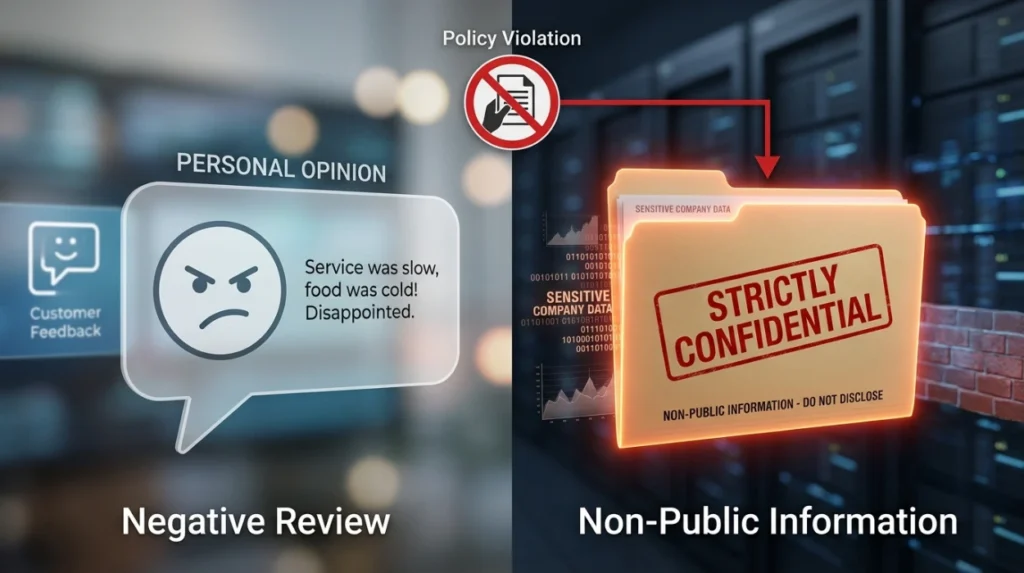
Non-public information differs from an ordinary negative review because negativity describes sentiment, while confidentiality describes information-access status. A negative opinion about workplace culture is fundamentally different from publishing restricted internal information.
Sentiment interpretation evaluates the positive, negative, or neutral characteristics expressed within text. Confidentiality evaluation concerns whether the information itself belongs in a public environment. These are separate semantic dimensions, so a review can be negative without being confidential and can contain confidential information without relying on strongly negative language.
This distinction matters for reputation management because reputation signals must be evaluated according to both meaning and context. Treating every negative review as equivalent to a confidential disclosure produces inaccurate analysis of the underlying content.
How does Indeed evaluate reviews that breach its guidelines?
Indeed states that content violating its guidelines or policies can be removed. Its UK company-review guidance explains that users can report content through the review interface, after which Indeed reviews the reported material against its policies.
The platform’s published process involves selecting the reporting option associated with a review and identifying the relevant reason. Indeed states that it reviews reported content and removes it when it determines that the content violates its guidelines.
This process demonstrates the difference between publication and indexing. A review first exists as platform content, then potentially becomes publicly accessible and indexable. If the platform removes the content, its availability within that source changes, although search visibility across the wider ecosystem follows separate indexing and crawling processes.
How does confidentiality relate to trust and credibility signals?
Confidentiality relates to trust because information quality depends partly on whether the information is appropriate for its publication context. A review platform designed for workplace experiences has a defined information boundary, and content outside that boundary becomes less aligned with the platform’s intended purpose.
Trust signals are not limited to positive statements about an organisation. They also involve consistency, authenticity, relevance, transparency, and the relationship between a claim and its supporting context. A review containing first-hand experience therefore has a different informational function from a review reproducing restricted internal material.
From a search perception perspective, credibility depends on the overall coherence of information surrounding an entity. Search users evaluate what they encounter through multiple sources, while search systems organise information according to relevance and other quality-related signals.
Dive Deeper With Our Expert Guides:
Why Discriminatory Language in Indeed Reviews Can Be Reported
What Indeed’s Community Guidelines Actually Prohibit in Reviews
Can a review contain workplace criticism without violating confidentiality rules?
Yes. Workplace criticism can remain within the intended review context when it expresses the reviewer’s own experience and opinion without disclosing restricted information. Indeed’s UK guidance specifically encourages reviewers to discuss their own experience and opinions and to focus on the company’s environment and culture.
The semantic distinction is between experience and disclosure. Statements describing how an employee experienced management, communication, workload, or workplace culture communicate personal experience. Statements exposing internal documents, restricted operational information, or other non-public material move beyond that experiential function.
This distinction also supports more accurate reputation analysis. Search perception systems benefit from understanding whether a piece of content represents sentiment, experience, factual information, confidential disclosure, or another semantic category.
How does confidential review content influence SERP evaluation?
Confidential review content can become relevant to SERP evaluation when it is publicly accessible and indexed. Search engines process indexed pages as information sources, while users encounter those sources through queries relating to an organisation, workplace, or employer.
SERP evaluation refers to the assessment of search results in relation to a particular query and its underlying information need. Review content can therefore become part of the information landscape surrounding branded or entity-specific searches when the page is discoverable.
However, platform removal and search-engine ranking are separate systems. A platform can remove content according to its own policies, while search engines independently process crawled and indexed information. This distinction is essential when analysing the relationship between review moderation and search visibility.
What role does a digital footprint play in company reputation?
A digital footprint is the collection of publicly accessible information associated with an entity across digital platforms. For organisations, this footprint can include company websites, business profiles, reviews, news articles, directories, social pages, employment platforms, and other indexed sources.
The footprint creates the information environment through which entity perception develops. Each source contributes a particular type of reputation signal, while the combination of sources creates a broader representation of the organisation.
Review platforms therefore form one component of a larger reputation ecosystem. Their content can provide workplace-specific signals, while other sources contribute different forms of authority, context, and factual information.
Why is policy compliance important for reputation signals?
Policy compliance is important because reputation signals operate within defined information environments. Content that violates a platform’s publishing rules can be removed, reducing its continued availability through that source. Indeed explicitly states that content violating its guidelines or policies can be removed.
This creates a direct relationship between content governance and information visibility. A review must first satisfy the platform’s content requirements before it can continue functioning as a public reputation signal on that platform.
For search perception analysis, this means content should be evaluated according to its origin, purpose, policy status, accessibility, and semantic meaning. Reputation analysis becomes more accurate when these dimensions are treated separately rather than combining them into a single measure of sentiment.
How should confidential information in reviews be understood within reputation management?
Confidential information in reviews is best understood as a content-governance issue within the wider reputation ecosystem. The central question is not simply whether the review is positive or negative, but whether its information belongs within the public review environment.
Reputation management analyses how information about an entity is created, published, interpreted, indexed, and retrieved. Within that framework, review-policy compliance represents the governance layer, while search visibility represents the discovery layer and sentiment represents the interpretation layer.
Indeed’s published guidance establishes that company reviews should focus on authentic workplace experiences and should not include non-public information or internal company details. Understanding this distinction helps explain why confidential disclosures represent a different category of reputation content from ordinary workplace criticism. For a deeper understanding of the evidence involved, How to Prove an Indeed Review Leaked Confidential Information explains how confidential disclosures can be identified and assessed within an Indeed review.
Confidential company information is distinct from ordinary workplace criticism because confidentiality concerns the public disclosure of restricted information, while criticism concerns an individual’s experience or opinion. Indeed’s UK company-review guidance prohibits non-public information and internal company details and establishes that reviews should represent the reviewer’s own workplace experience.
From a reputation-management perspective, review content forms one component of an organisation’s digital footprint. Its effect depends on publication, policy compliance, indexing, search visibility, sentiment interpretation, and entity perception. Understanding these separate mechanisms provides a clearer framework for analysing how review content participates in the wider search ecosystem.
Why does Indeed remove reviews containing confidential company information?
Indeed prohibits reviews that disclose non-public information or internal company details. Such content falls outside the platform’s review guidelines because company reviews are intended to describe the reviewer’s own workplace experience.
What counts as confidential information in an Indeed review?
Confidential information includes non-public internal company details, restricted business information, private documents, or information not intended for public disclosure. Sharing this material in an Indeed review can violate the platform’s content policies.
Can Indeed remove a review for revealing internal company details?
Yes, Indeed can remove content that violates its review guidelines, including reviews containing non-public information or internal company details. Reported reviews are assessed against the platform’s applicable policies.
Can an employer report an Indeed review that contains confidential information?
Yes, an employer can report review content that appears to violate Indeed’s guidelines, including the disclosure of confidential company information. The platform then evaluates the reported content under its review policies.
How can confidential information in an Indeed review affect online reputation?
A review containing confidential information can become part of an organisation’s digital footprint if it remains publicly accessible and indexed. This can influence search visibility, reputation signals, and how users perceive the organisation online.