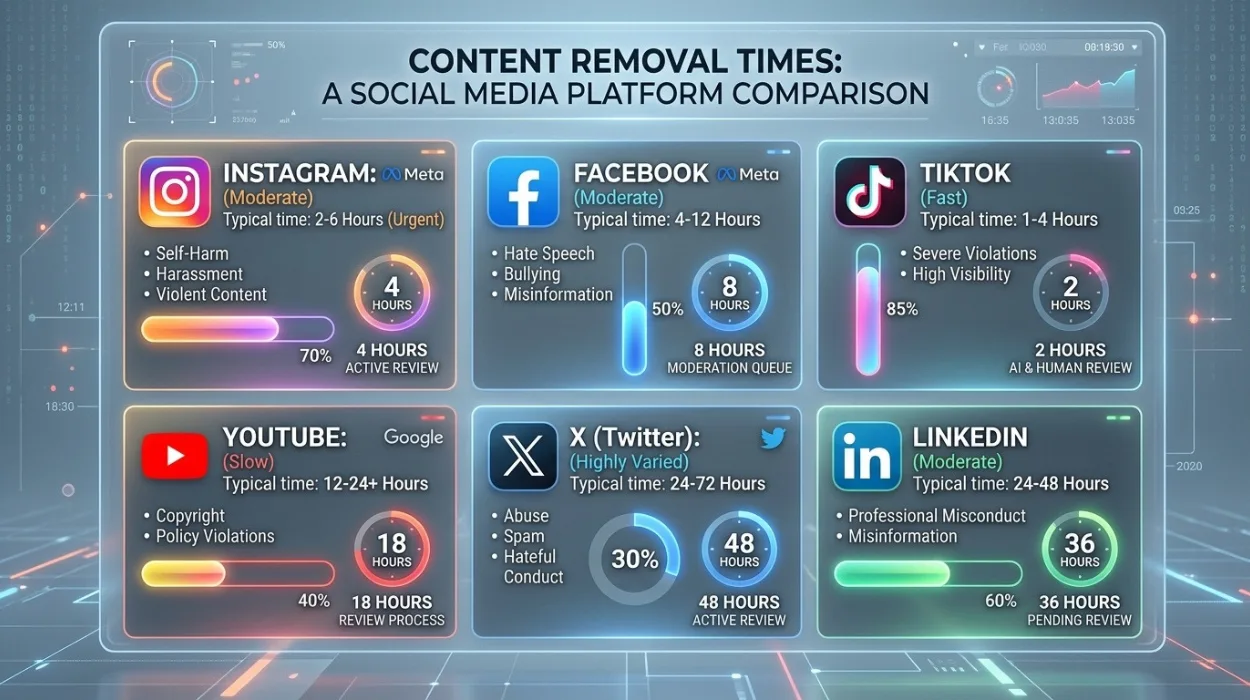
Social media content removal timelines vary by platform, content type, reporting route, evidence quality, and the complexity of the review process. Reputation management strategies differ based on whether the objective involves removing a source, reducing its search visibility, or strengthening alternative reputation signals.
Online reputation control methods are evaluated through their effect on search visibility, trust signals, SERP composition, and entity credibility. Social media removal is a reactive strategy that addresses an existing publication, while content enhancement is an organic strategy that builds additional information around an entity. Comparing these approaches requires an understanding of how platform moderation and search engine ranking operate as separate but connected systems.
How does social media content removal differ between platforms?
Platform-specific moderation systems create different removal timelines because each service applies its own policies, reporting interfaces, evidence requirements, and review procedures. Content removal is the process of requesting that a platform restricts or deletes material that falls within an applicable policy or rights-based category. The process operates at source level, meaning the platform evaluates the publication before any resulting change reaches external search engines.
Some platforms use structured reporting categories that direct submissions towards particular policy teams. Other platforms apply broader reporting pathways in which the context and supporting evidence receive greater attention during assessment. The distinction affects the amount of information required before a request enters substantive review.
Platform architecture also affects the relationship between removal and search visibility. A deleted social media publication can disappear from its original URL while search engines retain an indexed reference until recrawling occurs. Consequently, platform removal time and search-result change time represent separate stages rather than one continuous process.
Which factors have the greatest effect on social media removal times?
The strongest timeline factors are policy category, evidence quality, account status, content complexity, and the platform’s review procedure. A clearly documented policy violation has a more defined assessment pathway than a request requiring interpretation of context, ownership, privacy rights, or disputed statements.
Evidence quality directly affects procedural clarity. Screenshots establish the appearance of content, URLs identify the precise publication, and account information establishes its source. When these elements correspond clearly with a platform policy, the assessment contains a direct connection between the reported material and the requested action.
Content complexity also influences the workload involved in review. A single post has a different structure from a collection containing comments, reposts, images, videos, and multiple account references. Each connected publication creates an additional relationship that requires identification and assessment.
How does a policy violation compare with a rights-based removal request?
Policy-based removal relies on demonstrating that content breaches a platform’s stated rules, while rights-based removal relies on establishing a recognised legal or ownership interest. Policy reporting typically focuses on the nature of the publication, whereas rights-based procedures examine the relationship between the requester and the material.
Privacy-related requests can involve personal information, consent, identification, or exposure of private details. Copyright-related requests focus on ownership and unauthorised use of protected material. Impersonation reports centre on identity representation and the relationship between an account and the person or organisation represented.
The distinction affects evidence requirements and procedural complexity. A policy submission containing direct evidence of a prohibited category has a defined analytical basis. A rights-based request requires documentation that connects the claimant to the relevant right, creating a different review structure.
Does content type change how long social media removal takes?
Content type changes the assessment because text, images, videos, reviews, comments, and account information are governed by different policy considerations. Textual content requires analysis of language and context, while visual content introduces questions involving identification, ownership, consent, and presentation.
Video content creates additional review dimensions because the relevant material can occur within spoken audio, captions, individual frames, descriptions, or accompanying comments. The reviewer therefore evaluates more than the visible post description when determining whether a policy applies.
Reviews and recommendations have another structure because they combine user-generated sentiment with platform-specific reputation features. Their effect extends beyond the publication itself when review scores, recommendations, or associated profile information contribute to an entity’s visible reputation signals.
Is content removal faster than search-result suppression?
Source-level content removal and search-result suppression operate through different systems, so their timelines are not directly interchangeable. Content removal addresses the publication on the originating platform, while search suppression addresses the discoverability of information through a search engine.
A platform can remove a post before a search engine updates its index. During this interval, search users can encounter an outdated result, cached reference, or other representation of information that no longer exists at the original source.
Search-result suppression also uses different mechanisms. Search engines evaluate relevance, authority, freshness, query relationships, and other ranking signals when determining SERP composition. A removal request therefore requires distinction between eliminating the source and changing how the source appears in search.
How does content creation compare with social media content removal?
Content creation is an organic reputation strategy that introduces additional information into an entity’s digital footprint, while removal is a reactive strategy that attempts to eliminate an existing reputation signal. Content creation operates through publication and discovery, whereas removal operates through platform governance and policy enforcement.
Content enhancement can strengthen the informational environment surrounding an entity by creating authoritative pages, professional profiles, informative resources, and other relevant assets. These assets contribute additional documents for search engines to evaluate and users to encounter.
Removal addresses a different problem. When eligible content is removed at source, that particular publication no longer provides the same direct reputation signal. The two approaches therefore have different mechanisms: content suppression vs content enhancement represents source reduction on one side and informational expansion on the other.
Which approach has a stronger short-term effect on search visibility?

Source removal has a direct effect on the availability of the targeted publication, while content enhancement generally operates through the gradual development and ranking of additional pages. The distinction makes removal more closely connected to the specific source being addressed.
Content enhancement requires search engines to discover, index, evaluate, and rank newly published material. Ranking influence develops through the accumulation and interpretation of signals associated with the new content and its source.
Removal also has a limitation within search ecosystems. Eliminating one publication does not eliminate independent articles, reposts, comments, screenshots, cached information, or separate pages discussing the same subject. Short-term source reduction therefore requires evaluation alongside the wider SERP composition.
Which strategy provides greater long-term reputation sustainability?
Long-term sustainability depends on the persistence of the underlying reputation strategy rather than the duration of a single action. Removal provides a source-level intervention, while content enhancement builds an ongoing information structure around an entity.
A removed publication no longer contributes the same direct signal from its original location, but new publications can emerge elsewhere. Continuous content enhancement creates an expanding set of relevant assets that search engines can evaluate over time.
Sustainability therefore relates to information continuity. A stable digital footprint containing accurate, authoritative, and relevant information provides search engines with a broader entity context. Removal and enhancement address different parts of that system and operate on different time horizons.
How does search engine indexing affect the removal timeline?
Search engine indexing introduces a separate stage between source removal and changes in search visibility. Indexing is the process through which a search engine stores and processes information from a web resource for potential retrieval in search results.
When a social media publication is removed, the original platform changes first. Search engines then encounter the changed page during subsequent crawling and update their stored representation. The SERP therefore does not necessarily change at the same moment as the source.
Search visibility also depends on whether the publication was indexed before removal. A non-indexed post has limited direct search exposure, whereas an indexed publication associated with a person’s or organisation’s name has a stronger connection to the visible digital footprint.
How do reputation signals affect the effectiveness of removal?
Reputation signals determine how individual publications contribute to broader entity perception. A reputation signal is a piece of information that influences how an entity is interpreted by search systems or users.
The significance of a social media publication depends on factors including visibility, relevance, source authority, sentiment, indexing status, and relationship to the searched entity. A highly visible publication associated directly with an entity name has a different search impact from content that receives limited exposure.
Sentiment distribution also matters because search results contain a mixture of positive, neutral, and negative information. Removing one negative source changes that distribution only to the extent that the source contributes to the visible SERP. Other indexed sources continue to form part of the entity’s reputation environment.
Dive Deeper With Our Expert Guides:
How to Evaluate a Social Media Reputation Service Before Hiring
How to Document Evidence of a Social Media Harassment Campaign
How should organic and reactive reputation strategies be evaluated?
Organic and reactive strategies require evaluation against different criteria because they address different stages of information exposure.
- Measure source visibility by checking whether the targeted social media content is indexed, ranking, or appearing for branded or personal-name searches.
- Evaluate policy eligibility by matching the publication against the platform’s relevant rules and documenting the evidence supporting the reporting category.
- Assess SERP composition by identifying whether independent pages, reposts, reviews, or news results continue to represent the same reputation signal.
- Compare sustainability by analysing whether the strategy removes an existing source or establishes additional authoritative information that remains available over time.
This framework separates immediate source intervention from longer-term search perception management. It also prevents removal success from being measured solely by whether a platform confirms that content has been deleted.
How does platform complexity affect social media content removal costs?
Platform complexity affects cost because more complex cases require greater analysis of evidence, policy categories, publication relationships, and reporting pathways. A straightforward request involving one identifiable URL has a different procedural structure from a case involving multiple accounts and interconnected publications.
Complexity also increases when the same content appears across platforms. Each platform has its own moderation system, meaning a successful action on one service does not automatically produce equivalent action elsewhere.
The relationship between timeline and cost therefore involves workload rather than elapsed time alone. A transparent assessment of a removal request examines the number of sources, evidence requirements, applicable policies, platform procedures, and search-reputation implications before determining the resources involved. This is why transparent quote for social media content removal relates to case scope rather than simply the number of posts involved.
How can removal effectiveness be measured after content is addressed?
Removal effectiveness is measured by examining both source status and resulting search visibility. Source-level measurement establishes whether the original publication remains accessible, while search-level measurement examines whether indexed references continue to appear.
The first measurement concerns publication availability. The relevant URL, account, media attachment, or post is checked to establish whether the source remains publicly accessible. The second measurement concerns search indexing and SERP composition.
A broader assessment examines whether duplicate or independent content continues to transmit the same reputation signal. This distinction prevents a platform-level outcome from being treated as complete search-reputation resolution when other indexed sources remain visible.
How should social media content removal timelines be compared?
Social media removal timelines are best compared by examining the mechanism behind each platform’s review process rather than assigning one universal timeframe. Platform policy, content category, evidence quality, account status, case complexity, and search indexing all influence the sequence of events.
Removal, suppression, and content enhancement represent distinct reputation management mechanisms. Removal targets an existing source, suppression focuses on discoverability within search results, and enhancement introduces additional information for search engines and users to evaluate.
The most useful comparison therefore considers effectiveness, scalability, risk exposure, and sustainability separately. A source-level intervention addresses a specific publication, while an organic strategy influences the broader information environment. Understanding these differences provides a clearer framework for evaluating social media content removal as part of wider reputation management.
How should social media content removal strategies be understood?
Social media content removal operates through platform-specific moderation systems, while search reputation operates through indexing, ranking, authority, relevance, sentiment, and other reputation signals. These systems interact, but they do not operate as one mechanism.
Reactive removal focuses on an existing source and depends heavily on policy eligibility, evidence, and platform procedures. Organic content enhancement focuses on developing additional information that contributes to SERP composition and entity credibility over a longer period.
Effective evaluation therefore separates source removal from search-result change and distinguishes short-term intervention from long-term reputation development. Comparing these mechanisms through search visibility, trust signals, scalability, risk exposure, and sustainability provides a structured way to understand how social media content removal fits within broader online reputation control.
How long does social media content removal take?
Social media content removal time varies according to the platform, content type, reporting route, evidence provided, and review complexity. A straightforward policy-based request follows a different timeline from a case requiring additional verification or escalation.
How long does it take to remove content from social media platforms?
The timeframe depends on the platform’s moderation process and the category of content being reported. Review queues, evidence requirements, account status, and policy assessments all influence how quickly a platform processes a removal request.
Which factors affect social media content removal time?
Key factors include policy eligibility, evidence quality, content complexity, number of URLs, account ownership, and platform-specific review procedures. Search engine indexing also affects when removed content stops appearing in search results.
Does social media content removal happen immediately after reporting?
Reporting content does not automatically result in immediate removal because platforms first assess whether the publication violates their policies or applicable rights. Additional review or evidence requirements can extend the processing timeline.
How long does it take for removed social media content to disappear from Google?
Google search visibility can persist after a social media platform removes the original content because search engines update their indexes separately. The timing depends on crawling, indexing, and the availability of the original page when Google revisits it.