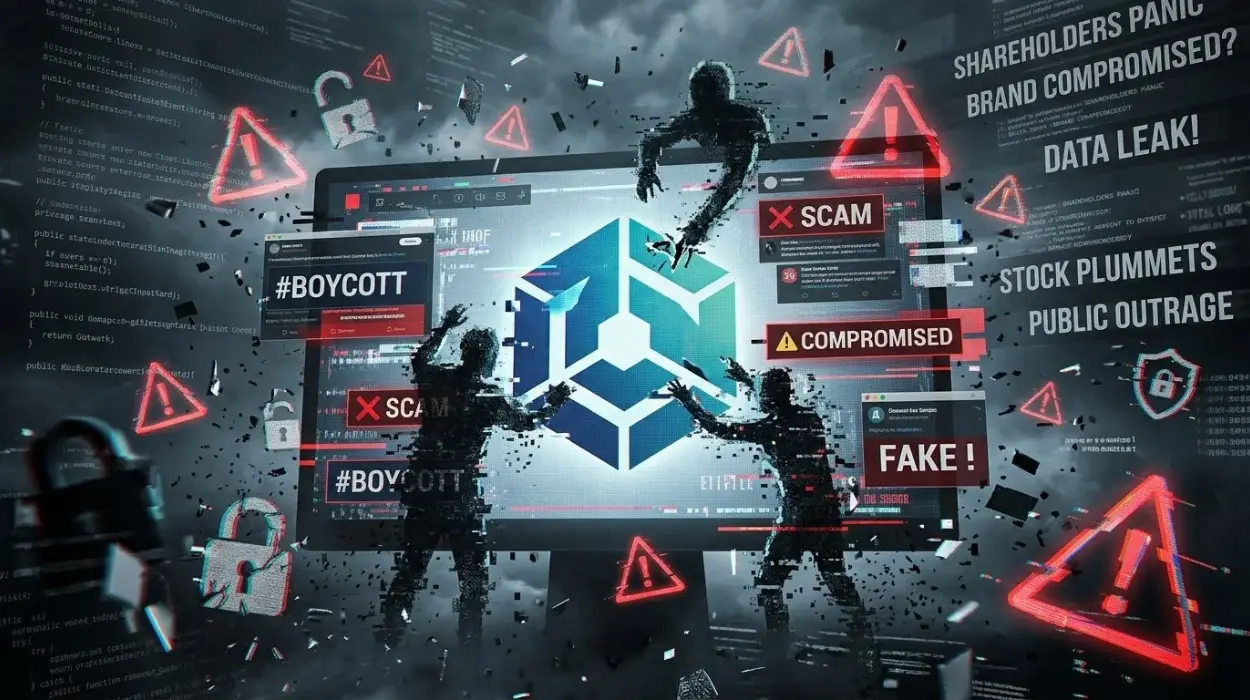
Brand hijacking is the unauthorised use of a company’s name, identity, trademarks or digital assets to mislead audiences, divert attention or exploit established brand recognition. It harms corporate reputation by introducing misleading information into search results, weakening consumer trust and distorting how search engines and audiences interpret a company’s credibility.
Reputation management is the process of understanding and influencing how an organisation is perceived through digital information, public feedback and search visibility. Online reputation refers to the collective perception of a company formed through indexed content, reviews, media coverage, social media activity and other reputation signals across digital platforms.
What Is Brand Hijacking in Digital Environments?
Brand hijacking is the unauthorised exploitation of an established brand identity to attract attention, misrepresent affiliation or gain an advantage from existing brand recognition. Within search ecosystems, it occurs when an external party uses a company’s name, trademark, visual identity or related keywords to create confusion about the origin, ownership or legitimacy of digital content. The activity ranges from misleading social media profiles to impersonation websites, counterfeit product listings and fraudulent advertising. Its defining characteristic is the exploitation of another organisation’s established identity without appropriate authorisation. This makes brand hijacking a reputational issue as well as a question of intellectual property and digital identity.
The digital footprint of a company consists of the information associated with its name across websites, search engines, business directories, review platforms and social networks. Brand hijacking introduces unauthorised information into this footprint, creating competing representations of the same corporate entity. Search engines index accessible content according to technical accessibility, relevance, quality and other ranking signals rather than treating every unauthorised reference as automatically invalid. Consequently, misleading pages can become discoverable alongside legitimate corporate resources. This creates a gap between the organisation’s actual identity and the identity presented to people searching for it.
How Does Brand Hijacking Affect Corporate Reputation?
Brand hijacking damages corporate reputation by weakening confidence in the authenticity, consistency and reliability of information associated with a company. Corporate reputation is the accumulated assessment of an organisation’s conduct, competence, credibility and public standing. Audiences form this assessment through direct experiences, independent reporting, customer reviews and information discovered during online searches. When unauthorised content imitates an established business, users encounter conflicting signals about which sources represent the genuine organisation. These inconsistencies affect entity perception because the company’s name becomes associated with information it does not control or endorse.
Reputational harm develops through the relationship between exposure, interpretation and subsequent behaviour. An impersonation page that appears in a branded search can make a fraudulent offer seem connected to the legitimate company, particularly when its wording and visual presentation resemble official communications. Users who encounter inconsistent information can question the organisation’s security, professionalism or transparency. Negative experiences linked to an impersonator can also produce complaints, reviews or social posts that mention the legitimate company. The resulting information remains part of the wider digital conversation even when the organisation was not responsible for the original activity.
Corporate reputation also depends on the consistency of identity signals across digital channels. An organisation that maintains an official website, verified social profiles and consistent business information presents a clearer identity than one surrounded by conflicting representations. Brand hijacking disrupts that consistency by introducing alternative accounts, domains or product listings. These competing representations increase the difficulty of distinguishing authorised communication from unauthorised activity. Reputation analysis therefore examines not only the existence of misleading content but also its visibility, context and association with the corporate entity.
How Does Brand Hijacking Influence Search Engine Results?
Brand hijacking influences search engine results by introducing competing pages that target the same brand-related queries as legitimate corporate resources. Search engine results pages (SERPs) organise indexed information according to query relevance, content characteristics, authority signals and other ranking systems. A hijacking website that uses a company name in its domain, headings or page content creates a direct association with that search query. This association does not establish legitimacy, but it gives the page an opportunity to appear when users search for the brand. The reputational risk increases when unauthorised content occupies prominent positions or appears beside official corporate pages.
Content indexing is the process through which a search engine analyses and stores information discovered on accessible web pages. Once a misleading page enters the index, it becomes eligible for retrieval in relevant searches, subject to the search engine’s systems and policies. Ranking determines the order in which eligible pages appear for a particular query, while indexing determines whether a page is included in the search engine’s searchable collection. These processes are distinct, meaning that a page can be indexed without ranking prominently. Equally, a legitimate corporate page does not automatically rank first for every query containing the company’s name.
Branded search queries carry particular reputational significance because they often express direct interest in a specific organisation, product or service. Users searching for a company’s official website, customer support details or product information expect results that clearly identify the relevant entity. Unauthorised pages can compete for these searches by reproducing brand terminology or publishing content that appears relevant to the query. The resulting SERP evaluation involves relevance and other ranking considerations, not a universal guarantee that the authentic source will always receive the highest position. This creates a visibility problem when users cannot readily distinguish official information from misleading alternatives.
Why Do Search Engines Associate Unauthorised Content With Legitimate Brands?
Search engines associate content with legitimate brands because their systems identify relationships between words, entities, links and other contextual signals across the web. An entity is a distinct person, organisation, product or concept that information systems recognise through related attributes and references. A company’s name appearing in a webpage title, domain, article or product description provides contextual evidence of a relationship between the page and that company. The relationship itself does not prove that the company owns, approves or publishes the content. Search engines must interpret the available evidence to determine the page’s relevance to a user’s query.
Authority signals also influence how information is evaluated within search ecosystems. Links from relevant websites, established publication histories, structured information and references across credible sources contribute to how a page or entity is understood. However, authority is not equivalent to legal ownership, factual accuracy or corporate authorisation. A misleading page can attract external links, mentions or user engagement without becoming an official company resource. Reputation analysis therefore separates discoverability from legitimacy when evaluating how unauthorised content appears in search results.
Search algorithms use multiple signals rather than a single universal trust score that guarantees the authenticity of every result. Content relevance, page quality, technical accessibility and the surrounding information environment contribute to ranking decisions. A trademark appearing on a page does not, by itself, establish that the page violates intellectual property law or must be removed from search results. Likewise, the absence of an obvious warning does not establish that a website is authorised. Understanding these distinctions explains why brand hijacking is partly a problem of digital identity interpretation rather than simply a ranking error.
How Do Reviews and Sentiment Signals Affect Brand Reputation?

Reviews and sentiment signals influence brand reputation by shaping the information users encounter when evaluating an organisation. Reviews provide public descriptions of customer experiences, while sentiment analysis refers to the computational interpretation of language as positive, negative or neutral. Search platforms and other digital systems present review information in different formats, and their methods of collecting, displaying and interpreting that information vary. When brand hijacking leads to fraudulent transactions or impersonation, dissatisfied users can associate their experiences with the legitimate company’s name. This association can introduce negative sentiment into searches related to the authentic organisation.
The source and context of a review determine how accurately it represents the business being discussed. A review concerning an impersonator does not necessarily describe the conduct, service quality or products of the legitimate company. However, users who cannot identify the distinction can interpret the complaint as evidence about the genuine organisation. The same problem occurs when misleading profiles direct customers to unauthorised contact details or websites. Reputation analysis therefore examines the relationship between the reviewed entity, the stated experience and the platform on which the feedback appears.
Review signals also operate within a wider information environment that includes news articles, social posts, discussion forums and corporate statements. A negative review does not independently establish widespread reputational damage, just as a positive rating does not prove that every corporate interaction is reliable. The significance of a review depends on its authenticity, relevance, visibility and relationship to other evidence. Brand hijacking complicates this assessment by creating uncertainty about the identity responsible for the underlying experience. Distinguishing genuine customer feedback from complaints involving impersonators is essential to interpreting reputation signals accurately.
What Is the Difference Between Brand Hijacking and Trademark Infringement?
Brand hijacking is a broad description of unauthorised activity that exploits a brand’s identity, whereas trademark infringement is a legal concept concerning the unauthorised use of a protected mark under applicable law. The two concepts overlap when a party uses a company’s trademark in a way that meets the relevant legal test for infringement. However, not every incident described as brand hijacking automatically constitutes trademark infringement. The outcome depends on factors such as the rights involved, the nature of the use, the relevant jurisdiction and the likelihood of confusion where that test applies. This distinction separates reputational analysis from the legal determination of intellectual property rights.
Trademark rights generally protect eligible signs used to distinguish goods or services, subject to the scope of the registration and applicable law. Brand hijacking can involve those signs, but it also includes conduct involving impersonation, misleading social profiles, fraudulent advertisements or confusing digital identities that requires separate assessment. A company name, logo or product image can appear in a context that raises reputational concerns without every instance necessarily meeting the legal threshold for infringement. Conversely, unauthorised commercial use of a protected mark can raise legal issues even when the resulting content attracts limited search visibility. Accurate classification depends on the specific conduct and evidence rather than the label assigned to the incident.
The distinction matters because legal rights, platform rules and search ranking systems follow different processes. A platform evaluates reports under its own policies, while a court or other competent authority applies the relevant law when determining legal liability. Search engines also apply indexing and ranking systems that do not function as a substitute for a judicial decision. A company can therefore experience reputational harm before the legal status of a disputed use has been determined. Analysing each process separately produces a clearer understanding of the available evidence and the nature of the risk.
Which Reputation Signals Reveal the Impact of Brand Hijacking?
Reputation signals reveal the impact of brand hijacking by showing how unauthorised content affects discoverability, identity consistency and public interpretation. These signals include branded search results, suspicious domains, unauthorised social accounts, customer complaints, review patterns and references linking misleading content to a corporate entity. No single indicator establishes the full extent of reputational damage. A suspicious domain, for example, demonstrates a potential identity risk but does not independently prove that users have been deceived. Reliable assessment connects individual observations with corroborating evidence and the context in which the content appears.
Search visibility provides one measurable dimension of the problem. Analysts examine whether unauthorised pages appear for the company’s name, branded product queries or searches involving customer support and official contact information. They also distinguish between a page being indexed and that page appearing prominently for relevant searches. Changes in ranking positions, the appearance of new domains and shifts in the composition of branded SERPs help identify developments in the digital footprint. These observations describe discoverability, although they do not independently establish the cause of every ranking change.
Entity consistency provides another important indicator. Analysts compare the company name, domain ownership information where available, verified account details, contact information and product descriptions across official and unauthorised sources. Contradictions between these elements can indicate impersonation or misleading affiliation, particularly when a page directs users to unrelated contact channels. Public complaints and customer reports provide additional evidence about how users interpret those inconsistencies. Combining technical observations with documented user experiences offers a more reliable picture of reputational impact than relying on search rankings alone.
Dive Deeper With Our Expert Guides:
How Stolen Photography and Digital Assets Hurt Creative Business Growth
Can Competitors Legally Use Your Registered Brand Name in Google Ads?
How Does Brand Hijacking Change Public Perception Over Time?
Brand hijacking changes public perception when repeated exposure to misleading information creates associations between a legitimate company and unauthorised activity. Public perception develops through the accumulation of information encountered across different channels rather than through a single search result. A misleading page can establish an initial association, while subsequent mentions, complaints or reposts reinforce the connection. When these references remain accessible, users conducting later searches encounter the same association within the company’s digital footprint. The reputational effect depends on the content’s accuracy, prominence, persistence and relevance to the audience.
Content persistence is particularly important because publication and removal operate on different timelines. A website owner can delete a misleading page while cached references, external links or copies on other platforms continue to exist. Search engines update their indexes as they discover changes, but the timing of those updates varies. As a result, a change to the original source does not guarantee the immediate disappearance of every related search result. This difference between source-level correction and search-level visibility explains why the effects of digital impersonation can outlast the original publication.
Repeated exposure also influences how people interpret credibility. Users compare claims across official websites, independent publications, customer feedback and other accessible sources when deciding which information appears reliable. Conflicting information increases uncertainty when the sources do not clearly distinguish the authentic organisation from an impersonator. At the same time, search visibility alone does not demonstrate that every exposed user believes the misleading claim or changes their behaviour. A balanced reputational assessment separates the presence of harmful information from demonstrated effects on trust, enquiries, purchasing decisions or other business outcomes.
How Can Brand Hijacking Be Understood Within Online Reputation Systems?
Brand hijacking is best understood as a disruption to the relationship between corporate identity, published information and public interpretation. A company’s online reputation develops through the interaction of its own communications, third-party reporting, customer experiences and the content indexed by search engines. Unauthorised use of brand identifiers introduces competing representations into this environment. Search algorithms evaluate the available content according to their ranking systems, while audiences interpret the resulting information through their own expectations and assessments of credibility. These processes interact, but they are not interchangeable: search visibility measures discoverability, whereas reputation concerns the meaning and credibility audiences assign to the information.
A complete conceptual assessment distinguishes four related dimensions: identity, visibility, credibility and impact. Identity concerns whether content accurately represents the organisation; visibility concerns where and how the content appears; credibility concerns whether the information is supported by reliable evidence; and impact concerns its observable effect on audience understanding or behaviour. This framework prevents an indexed reference from being mistaken for proof of wrongdoing or a prominent ranking from being treated as evidence of legitimacy. It also clarifies why trademark status, platform compliance and search performance require separate evaluation. For a deeper understanding of copyright-related content removal, the Step-by-Step Guide to Filing an International DMCA Takedown Request explains the process of addressing potentially infringing material across digital platforms. Each dimension describes a different part of the relationship between digital information and corporate reputation.
In conclusion, brand hijacking harms corporate reputation by creating unauthorised representations that compete with legitimate corporate information across digital channels. Its effects emerge through search visibility, inconsistent entity signals, misleading associations and uncertainty about the credibility of published content. Search engines determine how information is indexed and ranked, but those processes do not independently establish legal ownership or factual legitimacy. Reviews, external references and persistent copies can extend the visibility of misleading associations beyond the original incident. Understanding these mechanisms provides a factual basis for evaluating brand hijacking as a digital identity risk within the wider system of online reputation.
What is brand hijacking?
Brand hijacking is the unauthorised use of a company’s name, trademark, logo or digital identity to mislead audiences or exploit established brand recognition. It can involve impersonation websites, fake social media accounts and misleading advertisements that damage corporate reputation.
How does brand hijacking harm corporate reputation?
Brand hijacking damages corporate reputation by creating confusion about a company’s authenticity, credibility and official communications. Misleading content, fraudulent transactions and negative customer feedback can influence public perception and weaken trust in the legitimate business.
How does brand hijacking affect Google search results?
Brand hijacking can introduce unauthorised websites and misleading pages into search engine results pages (SERPs) for branded queries. These pages compete for search visibility and make it harder for users to identify official company information.
Can trademark infringement be considered brand hijacking?
Trademark infringement can constitute brand hijacking when an unauthorised party exploits a protected mark in a way that meets the applicable legal requirements. However, brand hijacking is a broader term that also covers certain forms of impersonation and misleading digital activity that do not automatically qualify as trademark infringement.
How can businesses protect their online reputation from brand hijacking?
Businesses can monitor branded search results, verify official digital accounts, document impersonation evidence and report content that violates platform policies or applicable intellectual property laws. Services such as Clear Your Name’s copyright and trademark support address relevant content concerns through appropriate reporting and takedown procedures, where applicable.