UDRP domain disputes address eligible conflicts over domain name registration and trademark rights, while trademark search takedowns seek action against specific content or search listings under applicable policies or legal grounds. Reputation management strategies differ based on whether the underlying problem involves domain control, infringing content or misleading information in search results.
Online reputation control methods are evaluated through their effect on search visibility, entity credibility, risk exposure and the accuracy of information presented to users. Choosing between domain dispute procedures and takedown routes requires an understanding of what each mechanism can resolve, what evidence it requires and how its outcome affects the wider digital footprint. The distinction is important because transferring a domain, removing a webpage and de-indexing a search result are different outcomes. Each addresses a separate part of the relationship between online identity and reputation. A suitable evaluation therefore begins with the source of the problem rather than the visibility of its symptoms.
What Is the Difference Between a UDRP Domain Dispute and a Trademark Search Takedown?
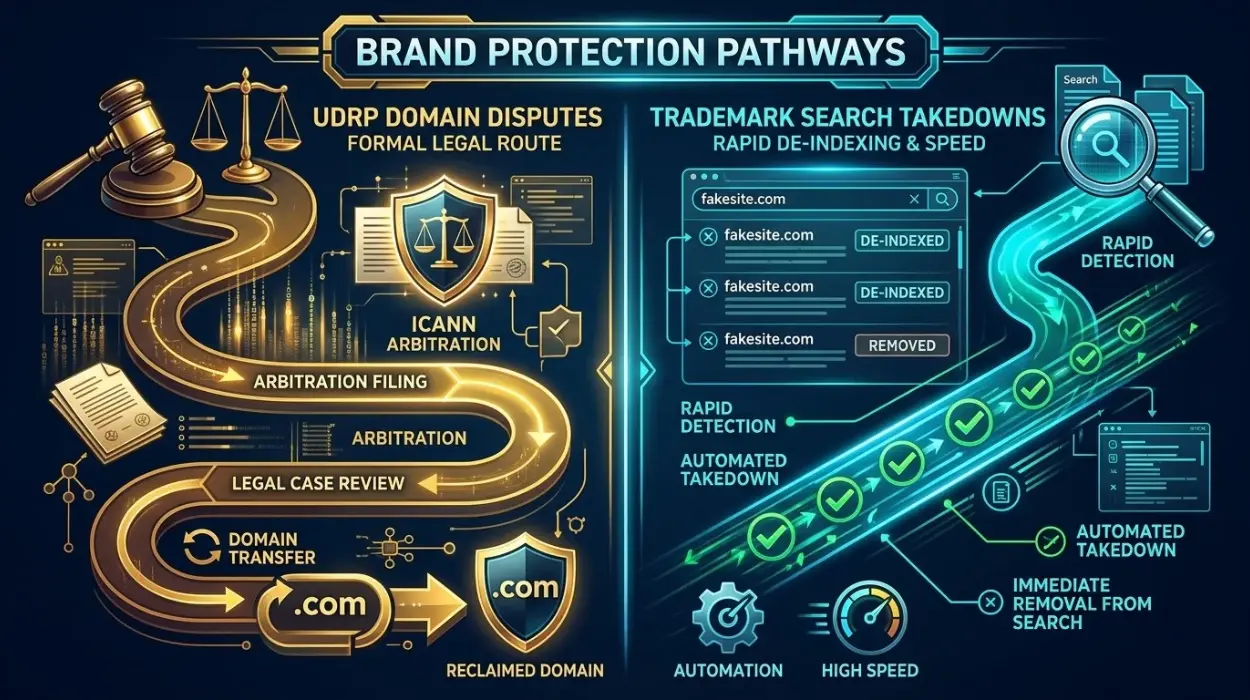
A UDRP domain dispute is an administrative process for resolving certain disputes involving domain names and trademark rights, whereas a trademark search takedown is a request for a platform or search provider to act against specific content or a listing. The Uniform Domain-Name Dispute-Resolution Policy (UDRP) applies to eligible disputes involving domain names covered by the policy, including qualifying generic top-level domains. A complainant generally needs to establish trademark rights, confusing similarity, the registrant’s lack of rights or legitimate interests, and bad-faith registration and use. A successful UDRP complaint can result in transfer or cancellation of the disputed domain. It does not ordinarily award monetary damages or resolve every wider question of trademark infringement.
A trademark takedown follows a different mechanism because it targets material rather than necessarily challenging control of the domain itself. Depending on the circumstances, the request can be submitted to a search engine, hosting provider, website platform, registrar or another relevant intermediary. The applicable requirements vary according to the recipient’s policies, the content involved and the legal basis relied upon. A search engine can remove an eligible result from its index without disabling the website, while a host or platform can take action against content it controls. The term “trademark search takedown” is therefore a broad description of a set of possible routes rather than one universal procedure with identical rules.
The central distinction is the object of the remedy. A UDRP proceeding evaluates whether a domain registration meets the policy’s requirements for transfer or cancellation, while a takedown request evaluates whether specified content or a listing qualifies for removal or restriction. A fake website can involve both issues when its domain unlawfully targets a protected mark and its pages impersonate the legitimate organisation. In that situation, resolving only the search listing leaves the domain question unanswered, while transferring the domain does not automatically remove every associated result from search indexes. The appropriate comparison considers domain control, content availability and search visibility as separate but connected outcomes.
Which Route Is More Effective for Recovering a Hijacked or Lookalike Domain?
A UDRP complaint is more directly aligned with recovering an eligible domain when the evidence establishes all required elements under the policy. Its remedy is specifically directed at the disputed registration, allowing an eligible complainant to seek transfer or cancellation rather than simply reducing the domain’s visibility. The procedure requires documented trademark rights and evidence addressing confusing similarity, legitimate interests and bad faith. A confusingly similar name alone is not sufficient to guarantee a successful result. The assessment must establish the required circumstances under the applicable policy.
A search takedown is more directly aligned with reducing the visibility of a particular webpage when the search provider’s removal criteria are satisfied. This route can be relevant when a fake domain displays copied branding, misleading claims or content that meets the provider’s legal or policy standards for removal. Its principal limitation is that the underlying domain can remain registered and accessible. The operator can also publish the material on another page or domain, creating a continuing monitoring requirement. The immediate search outcome and the resolution of domain ownership are therefore distinct measures of effectiveness.
The strongest evaluation identifies the specific outcome required before selecting a route. If the priority is control of an eligible domain, a UDRP proceeding directly addresses the registration dispute. If the priority is removal of a specific search result or infringing page, the relevant content-reporting mechanism addresses that target more directly. Where both domain misuse and indexed impersonation exist, separate procedures can address different parts of the problem, subject to eligibility and evidence. Effectiveness is measured by whether the remedy resolves the underlying issue, not merely whether one visible result disappears.
How Do Evidence Requirements and Legal Thresholds Compare?
UDRP proceedings use a defined three-part test, making the quality and relevance of the evidence central to the outcome. The complainant needs to show that the disputed domain is identical or confusingly similar to a trademark in which it has rights, that the registrant has no rights or legitimate interests in the domain, and that the domain was registered and is being used in bad faith. Evidence can include trademark records, domain details, website content, misleading affiliation claims and material indicating the registrant’s intent or conduct. The panel evaluates the submitted record under the policy and its applicable rules. A weak connection between the trademark and the disputed registration, or evidence of a legitimate interest, can affect the result.
Takedown procedures do not use one universal evidential threshold because the requirements depend on the recipient and the legal or policy basis of the request. A search provider’s form can require the precise URL, identification of the protected mark, an explanation of the alleged infringement and supporting documentation. A hosting provider or platform can apply a different process, including separate rules for impersonation, intellectual property or fraudulent activity. A complaint that identifies a domain but fails to identify the relevant content can be insufficient for a page-level removal request. Accurate URL identification and a clear explanation of the alleged violation improve the clarity of the submission, but do not guarantee acceptance.
The two routes also differ in the scope of their findings. A UDRP decision addresses the policy criteria for the domain name and does not necessarily determine every claim that could be brought under national trademark law. A takedown decision generally addresses the material or listing within the recipient’s control rather than deciding domain ownership. Neither route automatically proves every allegation about the registrant or website operator. Evidence management therefore needs to distinguish verified ownership information, observed content, inferred intent and the remedy being requested.
How Do Removal Strategies Compare with Content Enhancement for Search Reputation?
Removal strategies seek to eliminate or restrict content that qualifies for action under an applicable law, platform policy or search engine policy, while content enhancement improves the accuracy, relevance and visibility of legitimate information. Removal is a reactive approach because it responds to an existing domain, webpage or listing that creates a specific problem. Content enhancement is an organic approach because it develops authoritative information that helps users and search systems identify the legitimate entity. The methods address different mechanisms and are not substitutes for one another. Removal targets an eligible harmful asset; enhancement improves the wider information environment around the brand.
Search engines use multiple signals to assess relevance and rank pages, including the content available, links and the relationship between a page and a query. Publishing accurate information does not automatically suppress a deceptive website or guarantee a higher ranking for official pages. However, maintaining consistent official details across a website, verified profiles and credible third-party references helps users distinguish legitimate sources. This improves the clarity of entity information and supports a more reliable search results page. Its impact depends on the quality and relevance of the information rather than the volume of pages published.
Content suppression versus content enhancement is best understood as a difference in mechanism and target. Suppression attempts to reduce the discoverability of qualifying material through an applicable removal route, whereas enhancement strengthens legitimate content so it can better serve relevant queries. A removal request can produce a relatively direct change to a specific listing when accepted, but it does not establish lasting control over every source of the same information. Enhancement develops a longer-term foundation for entity credibility, but it does not remove an infringing domain or resolve trademark ownership. A balanced assessment distinguishes immediate remediation from sustained management of the digital footprint.
How Do the Routes Affect Search Visibility, Trust Signals and SERP Composition?
Search visibility measures how readily a webpage or domain appears in search results for relevant queries. A successful UDRP decision changes the control or status of the disputed domain through transfer or cancellation, but the resulting effects on search results depend on what happens to the domain and its content afterwards. A search takedown can directly remove an eligible result from a provider’s index, although the website can remain accessible through other routes. Neither procedure guarantees the removal of every copy, reference or related page across the internet. Search visibility must therefore be assessed at the level of the specific domain, URL and provider involved.
SERP composition refers to the combination and ordering of results displayed for a search query. Branded searches can return official pages, third-party reviews, directory listings, news reports and potentially deceptive domains. A misleading result can affect entity perception if its title, snippet or domain name implies an official relationship. Removing an eligible result can reduce one source of confusion, while establishing consistent official content can improve the information available to searchers. The overall result depends on the query, the pages indexed and the ranking systems operating at the time.
Trust signals are indicators that users and search systems interpret when assessing the relevance, authority or credibility of an online source. They include consistent business information, recognised domain references, relevant links and clear associations between a brand and its official properties. A successful legal or policy-based removal does not automatically strengthen every trust signal connected with the genuine organisation. Likewise, a high ranking or professional website design does not prove that a domain is authorised. Effective evaluation separates technical ranking, visible credibility cues and verified legal rights rather than treating them as interchangeable evidence.
Which Approach Offers Better Speed, Scalability and Long-Term Sustainability?

The speed of a UDRP dispute depends on the applicable procedure, the completeness of the complaint, the respondent’s participation and the case’s complexity. The process follows formal requirements and is designed to address eligible domain disputes, but preparation and adjudication take time. A takedown request can be more direct when the relevant provider offers a clear reporting process and the evidence fits its criteria. However, review times and outcomes vary by provider, content type and legal basis. Neither route offers a universal timeline or guaranteed resolution.
Scalability depends on the number of affected assets and the extent to which the same issue recurs. A UDRP proceeding is focused on a particular domain dispute, so separate registrations can require separate assessments or proceedings. Takedown workflows can handle individual URLs or groups of material according to the recipient’s procedures, but each request still needs to meet the relevant criteria. Monitoring systems help identify repeated patterns, including lookalike registrations, copied page content and newly indexed URLs. Scaling a process therefore requires consistent evidence collection, accurate classification and records of previous outcomes.
Long-term sustainability depends on addressing the source of the risk as well as its visible effects. Domain transfer or cancellation can resolve control of a qualifying disputed domain, but it does not prevent all future registrations that resemble a brand. Search removal can reduce the visibility of specific material, but equivalent content can appear elsewhere. Maintaining a documented portfolio of legitimate domains, monitoring suspicious registrations and publishing consistent official information addresses different parts of the risk. Sustainable reputation management combines outcome measurement with ongoing assessment of new domain activity and changes in search results.
How Should Organisations Evaluate Risk Before Choosing a Route?
Organisations can evaluate risk by classifying the issue according to domain ownership, content misuse and search visibility. This classification prevents a page-level problem from being treated as a domain ownership dispute without supporting evidence. It also prevents an eligible domain dispute from being reduced to a search listing issue. The assessment begins with the exact domain or URL, the relevant trademark rights and the nature of the alleged misuse. The required outcome then determines which procedure is relevant.
A practical evaluation framework includes the following actions:
- Identify the affected asset by recording the complete domain, specific URLs, observed content and date of discovery.
- Verify the rights involved by checking relevant trademark records, legitimate domain ownership and evidence of authorised use.
- Classify the problem by distinguishing disputed domain registration from infringing content, impersonation or search index visibility.
- Match the remedy to the target by assessing UDRP eligibility for domain control or the relevant provider’s criteria for content and search removal.
- Measure the outcome by checking domain status, page accessibility, search index presence and the accuracy of official brand information.
Risk exposure also depends on the potential consequences of the deceptive domain. A domain used to impersonate customer support or collect sensitive information presents a different operational concern from a parked domain displaying a misleading brand reference. The nature of the content, the audience affected and the available evidence help determine the urgency and appropriate reporting route. Where immediate fraud or data-security concerns exist, relevant security, hosting and law-enforcement reporting channels are separate considerations from trademark and search procedures. Reputation assessment is most reliable when it records these distinctions rather than assuming that one removal mechanism addresses every risk.
Dive Deeper With Our Expert Guides:
Evaluating When Fair Use Arguments Fail in Digital Copyright Takedowns
How Search Engine De-Indexing Protects Copyrighted Intellectual Property
When Are Combined Domain Dispute and Takedown Strategies Appropriate?
A combined approach is relevant when a single incident involves both a disputed domain registration and specific pages that mislead users or violate provider policies. A UDRP complaint addresses eligible questions about the domain registration, while a separate takedown request addresses content or search listings within another provider’s control. The evidence can overlap, but each process has its own requirements and intended remedy. A successful result in one process does not guarantee a successful result in the other. Coordinating the two therefore requires separate tracking of eligibility, submissions and outcomes.
The sequence depends on the main objective and the available evidence. Where domain control is the central issue and the UDRP criteria appear applicable, the domain dispute route directly addresses that issue. Where a specific result exposes users to misleading or infringing material, the relevant provider’s reporting route directly addresses the visible content. Urgent security concerns can require parallel action with the relevant hosting provider or security team rather than waiting for a domain dispute outcome. The decision should reflect the risks and procedures involved, not an assumption that one route is universally faster or more effective.
After action has been taken, monitoring verifies whether the intended result occurred. Domain status checks help establish whether a registration was transferred or cancelled, while URL checks and search queries help assess whether content remains accessible or indexed. Official information can then be reviewed for consistency across relevant online properties. These checks distinguish procedural completion from actual changes in search visibility and user-facing information. They also identify residual issues that require a separate response.
In conclusion, UDRP domain disputes and trademark search takedowns address different parts of domain-related reputation risk. UDRP is a defined route for eligible disputes over domain registration, while takedown processes seek action against particular content or search listings under the applicable rules. Their effectiveness depends on the target, evidence, legal basis and remedy available, while their impact on SERP composition and entity credibility requires separate monitoring. Content enhancement supports the long-term clarity of legitimate brand information, but it does not replace domain recovery or eligible removal procedures. Businesses seeking to recover hijacked brand domains and remove fake sites need to match each problem to the relevant mechanism and measure domain control, content availability and search visibility independently.
What is the difference between a UDRP domain dispute and a trademark takedown?
A UDRP domain dispute is an administrative procedure used to seek the transfer or cancellation of an eligible domain that infringes trademark rights under the policy’s criteria. A trademark takedown request targets specific content or search listings through a relevant platform, hosting provider or search engine.
How long does a UDRP domain dispute take?
A UDRP proceeding commonly takes around two months from filing to decision, although the timeline varies with the provider’s procedures and case circumstances. Preparing evidence and meeting filing requirements also affects the overall time needed to pursue domain recovery.
Can a trademark takedown remove a fake website from Google?
A successful request can lead to the removal of an eligible webpage from Google Search, but this does not necessarily take the website offline. Removing the underlying content generally requires action by the website owner, hosting provider or another party with control over the site.
What evidence is needed to file a UDRP domain dispute?
A UDRP complaint generally requires evidence of trademark rights, confusing similarity between the mark and domain, the registrant’s lack of rights or legitimate interests, and bad-faith registration and use. Relevant records include trademark documents, domain details, screenshots and evidence of misleading brand use.
Should a business choose a UDRP dispute or a trademark search takedown?
A UDRP dispute is more appropriate when the objective is to recover or cancel an eligible domain, while a takedown request targets qualifying content or search listings. If a fake domain and its indexed pages create separate problems, both routes may be relevant, subject to their individual requirements.