Reputation management is the process of analysing and influencing how an individual, organisation, or entity is represented across digital environments. Online reputation refers to the collection of search results, published content, reviews, references, and reputation signals that shape perceived credibility.
What is online reputation?
Online reputation is the observable representation of an entity across search engines, websites, social platforms, review systems, directories, and other indexed digital sources. It is formed through the interaction between published information and the systems that retrieve, classify, rank, and display that information. Search engines do not treat reputation as a single measurable attribute; instead, SERP evaluation considers signals associated with relevance, authority, quality, context, and user intent. The resulting search landscape influences how people understand an entity before they interact with it directly.
An online reputation therefore extends beyond individual pieces of content. A review, article, forum discussion, company profile, social post, legal record, or image can become part of an entity’s digital footprint when it is publicly accessible and discoverable. The relationship between these sources creates a broader information environment around a person, organisation, product, or brand. Search visibility determines which parts of that environment receive attention when a relevant query is made. Reputation analysis examines this information structure rather than treating individual search results in isolation.
How is reputation formed in search engines?
Search reputation is formed through the accumulation and interpretation of information associated with an identifiable entity. Search engines crawl publicly accessible pages, process their content, establish relationships between entities and concepts, and determine which pages satisfy particular queries. Content indexing makes information available to retrieval systems, while ranking systems determine its position for specific searches. This process means that reputation signals are connected to both the existence of information and its visibility within search results.
Entity perception develops through repeated associations between an entity and particular topics, attributes, events, organisations, or opinions. A consistent set of authoritative sources creates a different information pattern from disconnected or contradictory references. Search systems analyse relationships between words, entities, links, documents, and user queries to understand topical meaning. Reputation therefore emerges from an information network rather than from one isolated ranking factor.
How do search results influence online reputation?
Search results influence online reputation by controlling which indexed information receives prominent visibility for a query. A search engine results page acts as an information interface where titles, descriptions, URLs, rich results, images, reviews, and other features compete for user attention. The ordering of these results creates an initial information hierarchy around the searched entity. Higher search visibility gives particular sources greater exposure, while lower visibility reduces their immediate prominence without necessarily removing the underlying content.
The effect depends on query context and search intent. A navigational search for an organisation produces a different result environment from an informational search about its activities or a specific event. Search systems evaluate relevance against the wording and implied purpose of each query. Reputation analysis therefore examines query-to-content relationships rather than assuming that one fixed set of results represents an entity across every search.
How does content affect search reputation?
Content affects search reputation through its ability to introduce, reinforce, contextualise, or contradict information associated with an entity. Search engines evaluate documents according to factors such as relevance, content quality, authority, context, and relationships with other information sources. Indexed content that directly matches a query has greater opportunity to appear when the corresponding search intent is satisfied. Its position then contributes to the information environment encountered by users.
Content also creates semantic associations. Repeated references connecting an entity with a particular subject establish patterns that search systems can interpret as part of the entity’s broader context. These associations do not automatically represent factual conclusions because search engines retrieve and rank information rather than independently verifying every claim contained within a document. Understanding this distinction is essential when analysing online credibility and search perception.
How do reviews influence online reputation?
Reviews influence online reputation by providing publicly visible signals about experiences, satisfaction, service quality, and perceived performance. Review platforms structure this information through ratings, written comments, dates, categories, and reviewer activity. Search systems can incorporate review-related information into search features when it satisfies their eligibility and quality requirements. The resulting review signals contribute to how an entity is represented within relevant searches.
Sentiment interpretation provides another layer of analysis. Natural-language systems can identify positive, negative, or neutral expressions within review content, although sentiment classification does not establish whether an individual claim is factually accurate. A cluster of consistent review themes creates a recognisable semantic pattern around an entity. Changes in review content therefore alter the available reputation signals that users and search systems encounter.
How do authority and trust signals affect credibility?
Authority and trust signals help search systems evaluate the relative usefulness and reliability of information sources. Authority relates to the recognised expertise, relevance, reputation, and relationships associated with a source or topic. Trust involves signals that support confidence in the origin, quality, accuracy, and transparency of information. These concepts operate through multiple signals rather than a single universal reputation score.
Source characteristics influence how content participates in the search ecosystem. A specialised publication discussing a subject within its established area of expertise presents a different contextual signal from an unrelated page with little topical connection. Links, citations, authorship information, organisational identity, content quality, and consistency can all contribute to how information is interpreted. Reputation analysis therefore evaluates the source as well as the statement being published.
What is a digital footprint in reputation management?
A digital footprint is the collection of publicly available information and digital traces associated with an entity. It includes indexed webpages, profiles, reviews, articles, images, directories, social references, publications, and other discoverable material. Some elements are created directly by the entity, while others originate from independent publishers, customers, journalists, organisations, or public databases. The combined footprint forms the wider information environment in which online reputation develops.
Digital footprint analysis identifies how these sources connect to search visibility. An entity with a large digital footprint has more information available for search systems to process and users to encounter. However, footprint size alone does not determine reputation quality because source authority, relevance, context, accuracy, and visibility also influence interpretation. Effective analysis therefore maps the structure and prominence of information rather than simply counting references.
How does content indexing affect reputation?

Content indexing affects reputation because indexed information becomes eligible for retrieval through search queries. Crawling discovers accessible content, while indexing involves processing and storing information so that it can participate in search retrieval. A page that is not indexed generally does not appear through ordinary organic search results for its content. Indexing therefore represents an important boundary between published information and search-visible information.
Indexing does not guarantee high ranking. Search systems evaluate indexed pages against query relevance and other ranking considerations before determining their positions on a SERP. Consequently, reputation analysis distinguishes between publication, indexing, ranking, and user exposure. These stages represent different points within the search visibility process.
How do content removal and search visibility differ?
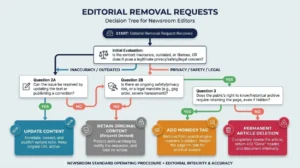
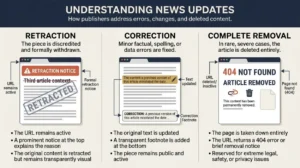
Content removal and search visibility are separate concepts because removing a source and reducing its prominence involve different mechanisms. Content removal refers to eliminating or restricting the underlying material at its original location, while search visibility concerns whether and where information appears within search results. A page can remain online while receiving limited search visibility, and a removed page can disappear from its original location while related references continue to exist elsewhere.
This distinction is important when analysing reputation-related information. Removing one document does not automatically eliminate duplicate publications, quotations, cached references, reviews, screenshots, or independent reporting. Conversely, a page with low search visibility remains part of the wider digital footprint if it remains publicly accessible. Reputation analysis therefore examines both source availability and search exposure.
How do legal and copyright factors relate to online content?
Legal and copyright considerations establish separate frameworks for addressing particular types of online content. Copyright generally concerns rights in protected creative works, while other legal mechanisms address matters such as privacy, defamation, unlawful disclosure, or misuse of personal information. The applicable mechanism depends on the nature of the material, ownership or rights involved, jurisdiction, and circumstances surrounding publication. Reputation analysis must distinguish these legal concepts from general dissatisfaction with search results.
A content removal request therefore requires identification of the underlying issue rather than treating every undesirable result as equivalent. Copyright-related material involves questions about protected works and rights ownership. Other forms of content involve different legal standards and procedures. This distinction explains why online reputation intersects with legal and content governance systems without making reputation itself a legal category.
Dive Deeper With Our Expert Guides:
How to Remove Unauthorized Brand Mentions Online
Legal Digital Cleanup Services for Businesses
Why does entity perception matter in search?
Entity perception matters because search engines organise information around identifiable people, organisations, places, products, and concepts. When multiple documents refer to the same entity, search systems attempt to establish relationships between those references and understand their meaning. The resulting entity representation affects which information is associated with that entity across relevant queries. Search perception is therefore partly determined by the consistency and context of information connected to an entity.
Entity perception is not equivalent to public opinion. It describes how information systems organise and retrieve information about an entity, while public opinion represents human attitudes and judgements. The two interact because users consume search results and other digital information when forming opinions. Maintaining this distinction produces a more accurate analysis of reputation systems.
How can online reputation be analysed objectively?
Online reputation can be analysed by examining the sources, search queries, rankings, content themes, review signals, authority indicators, and entity associations that define the visible information environment. The analysis begins with identifying the entity and relevant search intents. Researchers then evaluate which information is indexed, how prominently it appears, what sources publish it, and which semantic associations recur across results. This creates a structured view of the entity’s search reputation.
A robust assessment separates observable search evidence from interpretation. Search positions are measurable observations, while conclusions about credibility or public perception require contextual analysis. Source ownership, publication date, jurisdiction, authorship, corroboration, and content type also affect interpretation. This approach prevents a single SERP result from being treated as a complete representation of an entity’s reputation.
What are the key principles of online reputation management?
Online reputation management is fundamentally an information-analysis discipline concerned with how digital information is created, indexed, ranked, interpreted, and encountered. The central principles involve understanding the digital footprint, identifying reputation signals, evaluating source authority, analysing search visibility, and distinguishing content publication from content removal. These principles explain why reputation cannot be assessed through one ranking position or one isolated review.
The relationship between legal, technical, editorial, and search systems also matters. Content can exist independently of its search visibility, while search visibility can change without altering the underlying publication. Reviews can influence perception without establishing factual accuracy, and authoritative sources can carry different contextual weight from low-quality references. A complete analysis therefore considers the entire information ecosystem surrounding an entity.
What is the relationship between content removal and reputation management?
Content removal is one component of the wider information environment surrounding online reputation. Reputation management analyses how information affects search visibility and entity perception, while content removal addresses specific material through applicable editorial, platform, legal, privacy, or copyright mechanisms. The two areas overlap when particular content contributes to an entity’s visible digital footprint. They remain conceptually distinct because not every reputation issue involves removable content.
Understanding this relationship prevents reputation analysis from becoming synonymous with deletion. Search ecosystems contain information from independent sources that cannot be treated as one unified database. A change to one source does not automatically alter every related search result or reputation signal. The complete process therefore requires an understanding of indexing, ranking, source relationships, and the applicable rules governing the underlying content.
Online reputation is formed through the interaction of digital content, search visibility, entity relationships, reviews, authority signals, and user interpretation. Search engines organise indexed information according to query relevance and other ranking systems, creating an information hierarchy that shapes what users encounter. Content removal operates separately from ranking because eliminating a source and changing its search visibility involve different mechanisms.
A structured understanding of digital footprints, SERP evaluation, content indexing, review signals, and entity perception provides a clearer framework for analysing online credibility. Reputation systems are not represented by one universal score or one search result. They are information ecosystems in which sources, signals, rankings, and contextual relationships collectively determine the visible representation of an entity.
What is online reputation management?
Online reputation management is the process of analysing how an individual, organisation, or brand is represented across search engines, websites, reviews, social platforms, and other digital sources. It focuses on search visibility, reputation signals, content indexing, and entity perception.
What does content removal mean in reputation management?
Content removal refers to the process of requesting the deletion, restriction, or removal of specific online material from its original source. The applicable process depends on factors such as copyright, privacy, legal rights, platform policies, and the nature of the content.
Can copyright law be used to remove online content?
Copyright law can provide a basis for requesting removal when online material infringes copyright owned or controlled by the claimant. A copyright takedown generally requires identifying the protected work and explaining the alleged infringement under the relevant legal framework.
How does negative content affect online reputation?
Negative content can affect online reputation when it receives prominent search visibility or creates repeated associations with an individual or entity. Reviews, articles, forum posts, and other indexed pages can contribute to reputation signals and influence how users interpret an entity in search results.
What is the difference between content removal and search result removal?
Content removal addresses the underlying material at its original website or platform, while search result removal concerns whether that material appears in a search engine’s results. Removing a search result does not necessarily delete the original content from the internet.