
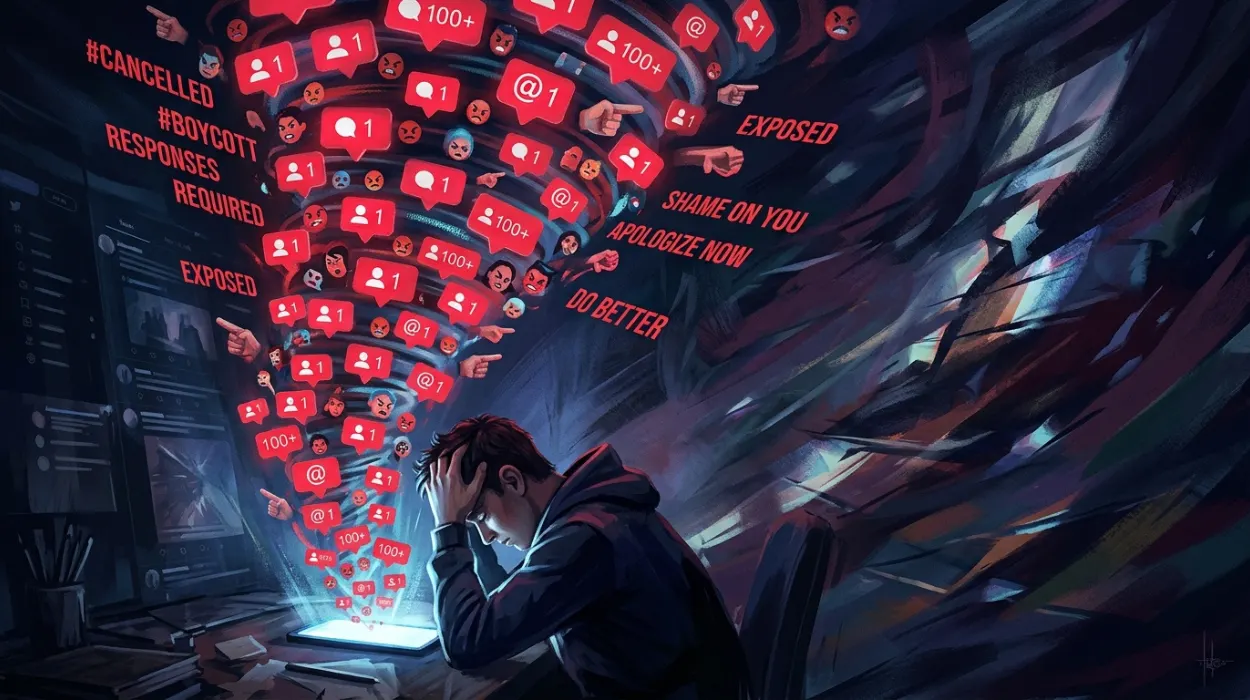
A social media pile-on escalates into a reputation crisis when concentrated negative discussion creates persistent reputation signals across social platforms and search results. Reputation management is the process of understanding, monitoring, and influencing how information about a person, organisation, or entity is interpreted across digital environments.
Online reputation refers to the collection of information, associations, sentiment, and credibility signals connected to an entity across the internet. A pile-on becomes significant when discussion moves beyond temporary social activity and contributes to a wider digital footprint that search systems can discover, index, rank, and associate with the entity.
What is a social media pile-on?
A social media pile-on is a concentrated period of public discussion in which multiple users respond to the same person, organisation, event, or piece of content with criticism or negative commentary. The defining characteristic is the accumulation of related content rather than the existence of one isolated negative post. Each additional response creates another piece of information within the entity’s digital footprint. Public engagement also creates relationships between posts, accounts, keywords, hashtags, and references. This network of connected information gives the discussion greater structural significance within the wider online environment.
The reputation impact depends on how the information becomes connected and discoverable. A single post represents one content object, while a large discussion creates a broader set of reputation signals surrounding the same entity. Search engines evaluate publicly accessible information through systems that analyse relevance, relationships, authority, content quality, and other ranking factors. Social engagement itself does not automatically determine search ranking, but widely referenced content can contribute to the information ecosystem surrounding an entity. The resulting environment affects how users encounter and interpret information during search.
How does a social media pile-on become a reputation crisis?
A social media pile-on becomes a reputation crisis when negative information develops sufficient persistence, visibility, and association to influence the broader perception of an entity. The transition is therefore based on information behaviour rather than simply the number of comments or posts. Repeated references establish stronger associations between the entity and the subject of criticism. External websites, forums, news publications, review platforms, and other indexed sources can extend those associations beyond the original social platform. Once the information enters multiple discoverable environments, reputation management becomes a search ecosystem issue rather than a social media issue alone.
The escalation process involves information propagation and semantic association. Users repeat particular descriptions, phrases, claims, or keywords, creating recurring language around the entity. Search systems process text and relationships across documents to understand what pages represent and which queries they relate to. When independent sources discuss the same entity in similar contexts, those references form part of the wider information environment used for entity understanding. This does not mean that negative claims become factually validated through repetition, but repetition increases the amount of accessible information associated with the entity.
How does negative content affect search visibility?
Negative content affects search visibility by introducing additional indexed documents, references, and associations connected to an entity. Search visibility refers to the extent to which an entity or its associated content appears within search engine results pages for relevant queries. A reputation crisis changes the competitive content environment because new pages and discussions enter the search ecosystem. These pages compete for visibility based on relevance, authority, content quality, links, user intent, and other ranking signals. Consequently, a rapidly developing controversy can alter the composition of results even when the original discussion occurred outside search engines.
Content indexing is the process through which search engines discover, process, and store information for potential retrieval. Social media content is not universally indexed in the same way, and platform accessibility affects what search systems can discover. Public references can nevertheless generate additional web content when discussions are reproduced, reported, quoted, reviewed, or discussed elsewhere. Each indexed reference represents a potential entry point through which users encounter information about the entity. Search visibility therefore depends on the broader set of accessible content rather than one social media post alone.
How do search engines interpret reputation signals?
Search engines interpret reputation-related information through multiple signals that contribute to relevance, authority, quality, and entity understanding. Reputation signals are observable indicators associated with an entity across digital content and references. These signals include textual associations, source authority, contextual relevance, links, reviews, mentions, and the consistency of information across different sources. Search algorithms do not use one universal reputation score that determines whether an entity has a good or bad reputation. Instead, different systems evaluate information according to their own ranking and quality mechanisms.
Entity perception develops from the relationship between an entity and the information connected to it. An entity is a person, organisation, business, product, place, or other identifiable subject represented across digital information. When the same entity appears across multiple documents, search systems use contextual information to distinguish and associate those references. Consistent factual information supports clearer entity understanding, while conflicting or ambiguous references create a more complex information environment. A pile-on introduces additional associations that become part of this environment when they are publicly accessible and relevant to search queries.
How do reviews and sentiment influence online reputation?
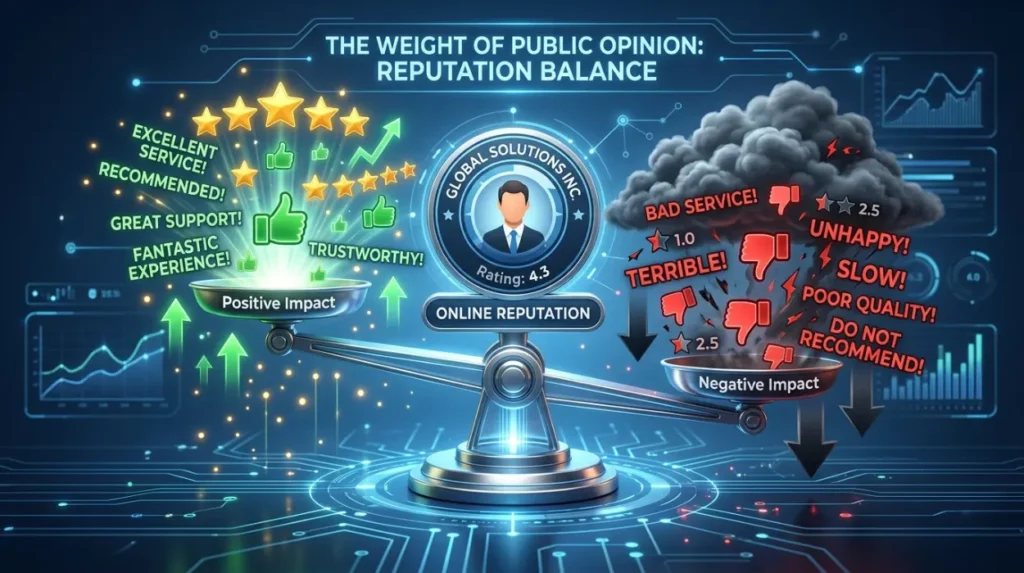
Reviews influence online reputation by providing structured and unstructured signals about an entity, particularly where review content is publicly accessible and relevant to user search behaviour. Review signals include ratings, written feedback, recurring themes, review volume, recency, and the context surrounding individual assessments. Sentiment interpretation involves analysing language to identify positive, negative, or neutral expressions associated with an entity or topic. Search engines and other platforms use their own systems to evaluate review content, so sentiment does not operate as a universal ranking factor. Its significance depends on the platform, query context, content characteristics, and relevance to the information being evaluated.
A pile-on can influence sentiment perception when repeated criticism becomes associated with the entity across multiple discussions. Repetition creates a visible pattern in the available information, particularly when similar descriptions appear across independent sources. However, sentiment volume does not establish factual accuracy, and search systems do not treat every public statement as verified information. Credibility depends on source quality, context, evidence, and the relationship between the claim and the entity. Reputation analysis therefore distinguishes between the existence of negative sentiment and the evidential strength of the information expressing that sentiment.
What role do authority and trust signals play in a reputation crisis?
Authority and trust signals influence how information competes for visibility and how users evaluate its credibility. Authority refers to the recognised expertise, relevance, or prominence associated with a source within a particular subject area. Trust relates to the reliability and credibility attributed to information based on source characteristics, evidence, consistency, and context. These concepts operate differently from social engagement because a highly shared post does not automatically become an authoritative source. Search systems evaluate content through ranking and quality mechanisms that consider numerous factors beyond engagement.
The source environment therefore matters when analysing a reputation crisis. A negative statement from an unidentified account represents a different information type from a detailed publication containing documented evidence and identifiable sourcing. Both can contribute to online discussion, but their credibility characteristics differ. Authority signals also operate at the source and content level rather than functioning as a simple reputation score for the entity being discussed. Understanding this distinction prevents social activity from being treated as equivalent to verified information.
Dive Deeper With Our Expert Guides:
What UK Law Says About Non-Consensual Intimate Image Sharing
Why Ex-Partners Sometimes Post Harmful Content on Social Media
How does content ranking intensify a reputation crisis?
Content ranking intensifies a reputation crisis when highly relevant negative pages gain visibility for queries associated with the affected entity. Ranking determines the order in which eligible content appears for a particular search query. Relevance connects the content to the user’s query, while other ranking systems evaluate characteristics such as quality, authority, freshness, links, and user intent. A negative page that satisfies a specific search intent can therefore receive visibility without the search engine making a judgement about the entity’s overall character. The result is a search environment where individual documents compete according to query-specific ranking mechanisms.
Query expansion also affects how users encounter reputation-related information. Users frequently search an entity alongside terms describing an event, criticism, complaint, review, or controversy. These combinations create additional query contexts in which related content becomes relevant. If multiple indexed documents address the same subject, different queries can expose different parts of the information environment. Reputation analysis therefore examines not only the entity’s name but also the semantic relationships surrounding it.
Why does a digital footprint matter during a reputation crisis?
A digital footprint is the collection of publicly available digital traces associated with an entity across websites, platforms, search results, publications, reviews, profiles, and other online environments. It matters during a reputation crisis because information rarely remains confined to its original publication context. Content can be referenced, reproduced, linked, discussed, archived, or incorporated into later publications. These interactions expand the number of locations where users can encounter information connected to the entity. The digital footprint consequently provides a broader representation of the information environment than any single social platform.
A reputation crisis also demonstrates why content availability and search visibility represent different concepts. Removing or restricting content on one platform changes the availability of that particular item within that platform. It does not automatically remove references, duplicate publications, independent discussions, or indexed pages elsewhere. Search visibility therefore requires evaluation across the wider digital footprint. This distinction is central to understanding how reputation systems operate beyond the boundaries of individual platforms.
How can a social media pile-on be analysed as a search ecosystem?
A social media pile-on can be analysed as a search ecosystem by examining the relationships between content, entities, queries, sources, sentiment, authority, and indexing. First, analysts identify the entity and the information directly associated with the discussion. Next, they evaluate where those references appear, whether the content is accessible to search engines, and which queries expose it. They then examine source characteristics, contextual relevance, repetition, and the relationship between social discussion and indexed web content. This approach separates social activity from measurable search visibility.
A structured reputation analysis also distinguishes information layers rather than treating every mention as equivalent. Social posts represent one layer, while reviews, editorial content, websites, forums, directories, and search results represent additional layers. Each layer has different publication controls, indexing characteristics, ranking mechanisms, and credibility signals. Comparing these layers reveals whether a pile-on remains concentrated on a social platform or has developed into a broader search reputation issue. The analysis therefore focuses on information relationships rather than emotional intensity or raw engagement volume.
What determines whether a reputation crisis persists in search results?
A reputation crisis persists in search results when relevant content remains accessible, indexed, competitive, and associated with queries connected to the entity. Persistence is therefore a function of the search ecosystem rather than simply the duration of social discussion. Content that remains available can continue participating in ranking systems after the original social activity declines. New references can also reinforce existing associations by introducing additional documents into the information environment. The resulting SERP evaluation reflects the current competitive state of relevant indexed content.
Changes in search visibility occur as content is published, updated, de-indexed, replaced, or outranked. Search results are dynamic because ranking systems continuously process available information and changing query contexts. A reputation crisis can therefore become less visible without the original content disappearing, particularly when other relevant information gains stronger search positions. Conversely, continued publication of related negative material maintains additional competition for reputation-related queries. Understanding persistence requires monitoring the relationship between content availability, indexing, ranking, and entity associations.
A social media pile-on becomes a reputation crisis when concentrated discussion develops into a wider and persistent information environment surrounding an entity. Online reputation is shaped by the interaction between digital footprint, content indexing, search visibility, sentiment, authority, trust, and entity perception. Social engagement alone does not define search reputation because search systems evaluate information through distinct ranking and retrieval mechanisms.
The critical distinction is between social activity and search ecosystem effects. A discussion can remain confined to a platform, or it can generate references that become discoverable across a wider digital footprint. How to Manage a Social Media Pile-On Before It Spreads addresses the management dimension that follows from this distinction, while the present analysis focuses on how escalation occurs within reputation and search systems.
What is a social media pile-on?
A social media pile-on is a concentrated wave of public discussion, criticism, or negative commentary directed towards a person, organisation, or entity. When related content spreads across platforms and becomes indexed elsewhere, it can contribute to a wider online reputation issue.
How does a social media pile-on affect online reputation?
A social media pile-on can create repeated negative reputation signals associated with an entity, particularly when posts, reviews, articles, or discussions appear across multiple online sources. Increased content visibility can influence how users perceive the entity when researching it through search engines.
Can a social media pile-on affect Google search results?
A social media pile-on can affect the broader search environment when related content becomes publicly accessible, indexed, and relevant to searches about the entity. Search visibility depends on factors such as relevance, authority, content quality, indexing, and ranking dynamics rather than social engagement alone.
How can negative social media content become part of a digital footprint?
Negative social media content becomes part of a digital footprint when information about an entity remains publicly accessible or is referenced, reproduced, discussed, or linked elsewhere online. These references can create additional content and reputation signals associated with the entity.
How does reputation management address a social media pile-on?
Reputation management analyses the content, sources, search visibility, sentiment, and entity associations created by a social media pile-on. For Clear Your Name, Social Media Content Removal Services relate to addressing eligible content, while broader reputation analysis examines how information appears across the wider search ecosystem.